TL;DR:
- Pool surface fading is mainly caused by chemical imbalances, not just age or sun exposure.
- Proper water chemistry maintenance and early intervention can extend pool surface lifespan up to 15-20 years.
- Resurfacing becomes necessary when surface integrity shows signs of chalking, pitting, or delamination.
Your pool looked stunning when it was first filled, but now it’s dull, patchy, and oddly white in places despite your regular cleaning routine. You’re not alone in that frustration. Across Orlando and Jacksonville, homeowners scrub, shock, and treat their pools, yet the fading keeps coming back. Here’s the thing most people don’t realize: fading is almost never about age or sunlight alone. The real culprits are chemistry and maintenance habits, and once you understand them, you gain real control over how long your pool surface stays vibrant and intact.
Table of Contents
- The science behind pool fading: What really happens
- Types of fading: Identifying scale, chalking, and etching
- The role of maintenance and environment in fading
- When pool fading means it’s time to resurface
- Our take: What most homeowners overlook about pool fading
- Restore beauty and value: Trusted resurfacing solutions in Florida
- Frequently asked questions
Key Takeaways
| Point | Details |
|---|---|
| Chemistry is key | Unbalanced water is the top reason pools fade, not just age or sunlight. |
| Different fading types | Chalking, scale, and etching each need separate solutions—and some can’t be reversed without resurfacing. |
| Proactive care pays off | Routine maintenance and chemistry checks can delay or prevent fading and costly resurfacing. |
| Know when to resurface | Cosmetic fading alone may not mean resurfacing but deep chalking or rough spots usually do. |
The science behind pool fading: What really happens
Fading feels like a slow, mysterious process, but it follows a predictable chemical pattern. Understanding those patterns gives you the power to interrupt them before serious damage sets in.
The biggest driver of fading is not the Florida sun beating down on your pool. It’s water chemistry. When your pool water falls out of balance, it becomes either corrosive or oversaturated, and either state attacks the surface. Improper water chemistry accelerates fading: high chlorine or oxidizers degrade surfaces, low pH causes etching and brittleness, and high pH and calcium lead to scaling or chalking. That’s a lot of variables working against your finish at the same time.
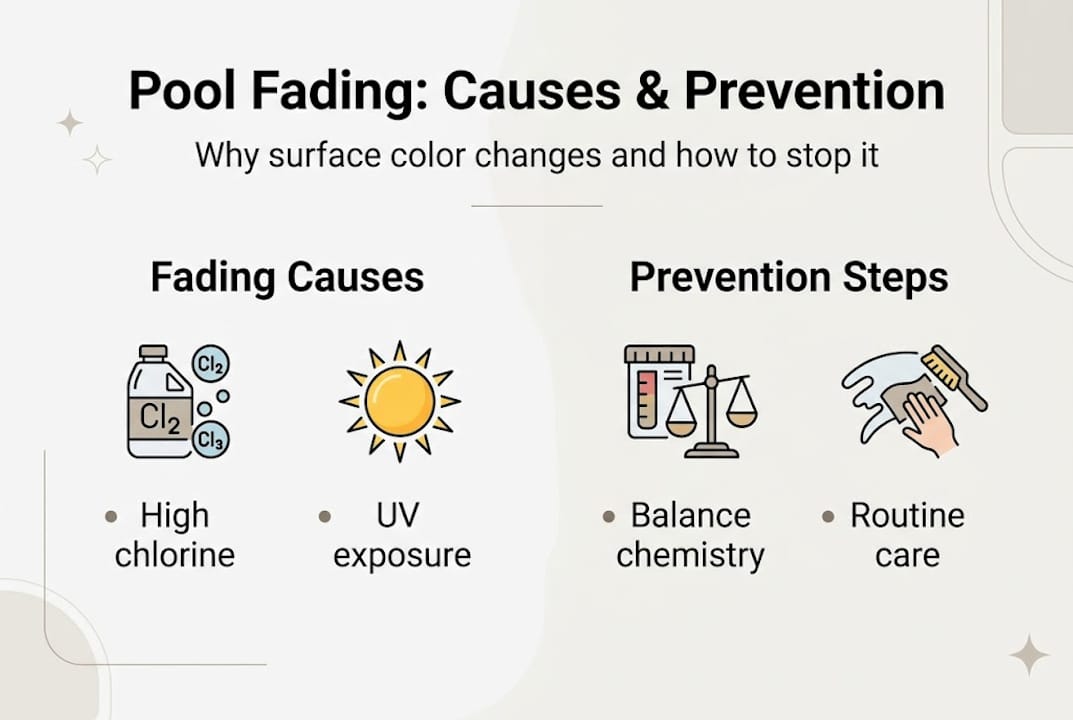
Here’s how each factor plays out in practice. High chlorine concentrations, particularly when you shock the pool frequently or use unstabilized chlorine, produce aggressive oxidizers that physically break down the binder materials in plaster and fiberglass gel coats. The result is a surface that literally loses its top layer over time. Low pH water, anything below 7.2, becomes acidic enough to etch calcium-based surfaces like plaster and marcite, creating a dull, rough, pitted look. High pH water above 7.8, combined with elevated calcium hardness, deposits mineral films that appear as a white or gray haze.
Florida’s climate stacks these risks even higher. The intense UV exposure accelerates chlorine burn-off, which prompts many homeowners to add more chlorine than necessary. Heavy summer rainstorms dilute water and destabilize pH almost overnight. Heat speeds up all chemical reactions, meaning a chemistry imbalance that might take weeks to cause damage in a northern state can visibly affect a Florida pool surface within days.
The following table gives you a quick reference for the most common pool issues, their chemical causes, and what you’ll see on the surface.
| Pool issue | Chemical cause | Visible symptom |
|---|---|---|
| Etching | Low pH (below 7.2) | Rough, pitted, dull surface |
| Scaling | High pH or high calcium | White or gray mineral crust |
| Chalking | Degraded gel coat or plaster | Powdery white smear on fingers |
| Surface bleaching | Excess chlorine or oxidizers | Uneven color loss, streaking |
| Staining | Metals in water (iron, copper) | Brown, green, or black spots |
Key insight: Florida pool owners often chase visible symptoms, adding chemicals to fix the look without testing what’s actually out of balance. That reactive approach usually makes fading worse, not better.
Understanding why upgrade pool surfaces matters starts here. A degraded surface becomes increasingly porous, which means chemicals penetrate more deeply and the damage compounds faster over time. You can also learn more about why pools get rough and how surface texture changes are often early signs of chemical wear.
Types of fading: Identifying scale, chalking, and etching
Understanding the science is step one. Now let’s see how it shows up in the real world, because chalking, scaling, and etching look frustratingly similar but need completely different responses.
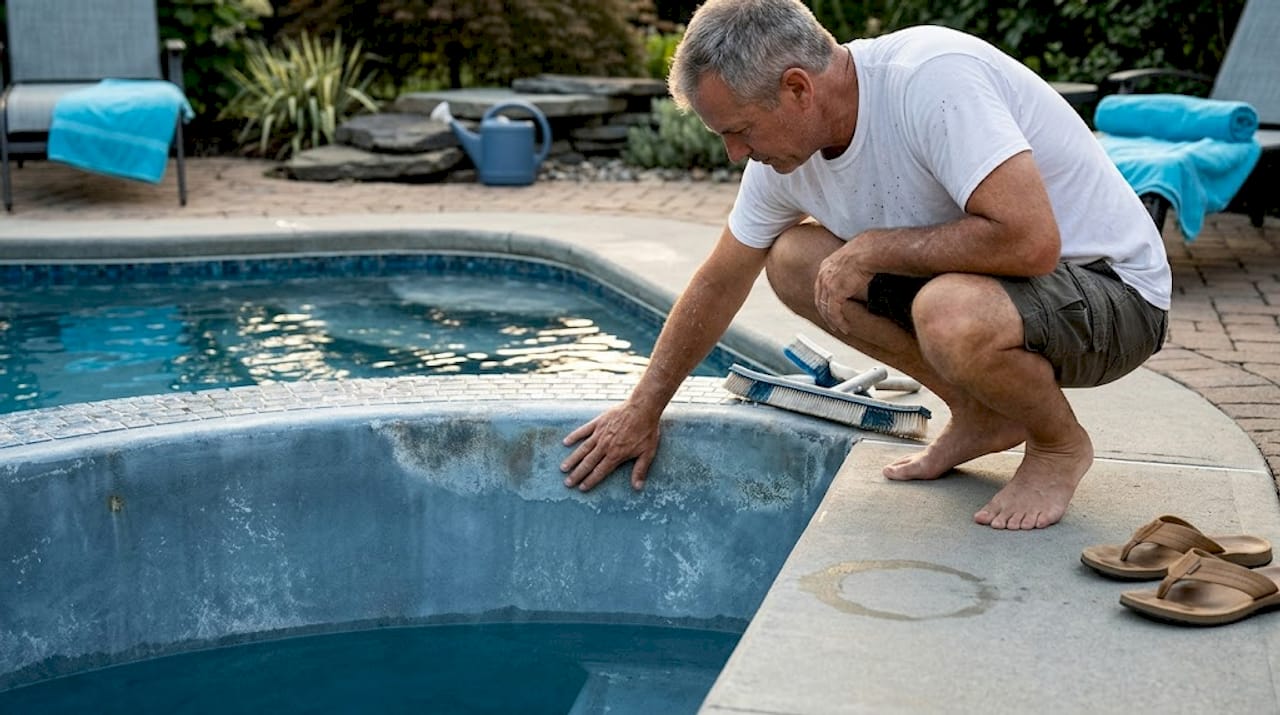
Misdiagnosing the type of fading is one of the most common and expensive mistakes pool owners make. Someone buys an acid wash to treat what they think is scale, only to discover it’s chalking from a degraded gel coat. The acid wash removes healthy material while leaving the actual problem untouched.
Here’s what to look for with each type:
Chalking:
- White powder rubs off when you run your finger along the surface
- Appears evenly across large areas, not in patches
- Does not dissolve or soften with brushing
- Common in older fiberglass pools and aging plaster
Scaling:
- Hard, crusty deposits, often white or tan
- Typically concentrated near the waterline or around jets
- Feels gritty or rough to the touch
- Can sometimes be scraped off in flakes
Etching:
- Surface looks dull, almost matte where it used to be glossy
- Rough texture when you run your hand along the wall
- Invisible under water but obvious when the pool is partially drained
- More common in plaster pools with persistently low pH
Chalking in fiberglass is irreversible without resurfacing, while scale can often be removed with acid or chelating agents. Some homeowners attribute all white haze to scale, but the two conditions are chemically distinct and require different treatment paths. Getting the diagnosis wrong wastes money and delays real solutions.
The following comparison table makes it easier to spot what you’re dealing with.
| Fading type | Key symptom | Reversible? | Best fix |
|---|---|---|---|
| Chalking | Powdery residue on touch | No (in fiberglass) | Resurfacing |
| Scaling | Hard crusty deposits | Often yes | Acid wash or chelants |
| Etching | Rough, dull texture | Partial | Chemistry correction, then resurface |
| UV bleaching | Color loss in streaks | No | Resurfacing with UV-resistant finish |
Worth noting: Many homeowners spend hundreds of dollars on cleaning treatments for chalking before accepting that the surface itself has failed. A proper assessment upfront saves that wasted expense.
Understanding why pool finish peels is closely linked to these fading types. Peeling and chalking often occur together in older pools because the same chemical stress that degrades the surface binder also causes delamination.
The role of maintenance and environment in fading
Now that you can recognize what’s happening to your pool’s surface, let’s see what part ongoing care and climate play, because your daily and weekly habits make a bigger difference than most homeowners expect.
Florida is genuinely one of the most demanding environments for pool surfaces in the country. Between April and September, Orlando and Jacksonville pools endure extreme UV levels, water temperatures that regularly hit 90°F, and weekly rain events that can swing pH by a full point or more. Each of those factors accelerates the chemical reactions that fade surfaces. Water chemistry imbalances cause faster surface breakdown in warm climates because heat speeds up the rate of chemical reactions at the surface level.
The good news is that routine maintenance is the one factor you can control most directly. Here’s a practical numbered routine built around Florida conditions.
- Test water chemistry twice per week during summer. pH should stay between 7.4 and 7.6. Chlorine should stay between 1 and 3 ppm. Test after every significant rain event, not just on a fixed schedule.
- Check total alkalinity weekly. Keep it between 80 and 120 ppm to buffer against pH swings caused by rain or heavy bather load.
- Monitor calcium hardness monthly. Ideal range is 200 to 400 ppm. Too low causes etching. Too high causes scaling.
- Brush pool walls and floor twice per week. This removes early mineral deposits before they harden into scale, and it distributes sanitizer evenly across the surface.
- Inspect the waterline tile each month. Mineral deposits concentrate here first, giving you early warning before fading spreads across the floor and walls.
- Drain and refill partially every 12 to 18 months. Total dissolved solids (TDS) build up over time and reduce the effectiveness of all chemicals. A partial drain resets the balance.
- Have a professional assess your water chemistry seasonally. Companies offering professional pool care can catch imbalances that standard test strips miss, especially for metals and cyanuric acid levels.
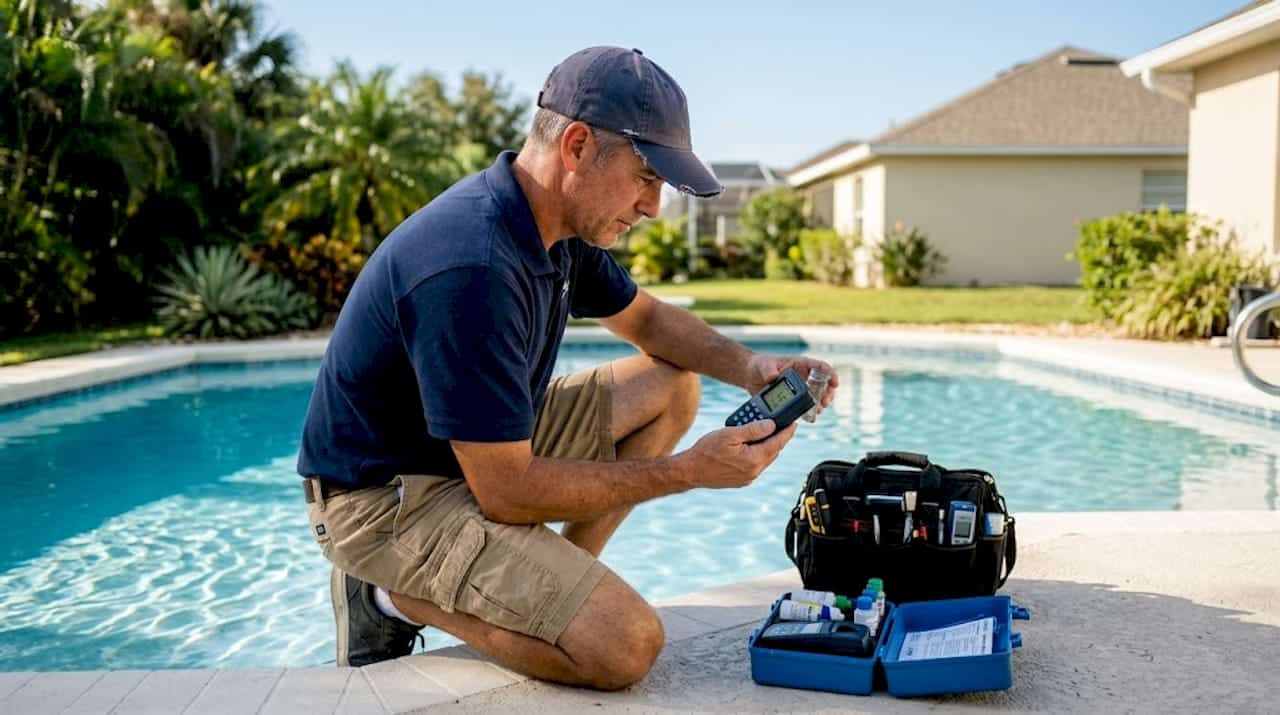
Pro Tip: A digital photometer, a device that reads water chemistry electronically rather than relying on color comparison strips, costs about $50 and gives you lab-quality readings at home. It’s one of the most cost-effective tools a Florida pool owner can own. Catching a pH drift of 0.3 points early costs nothing to fix. Letting it go for six months can cost thousands in resurfacing.
You can find more detail on pool maintenance tips for Florida and how to maintain pool surface to build a routine that matches your specific surface type and pool size.
When pool fading means it’s time to resurface
Maintenance slows fading, but sometimes restoration is the only real solution. Knowing when you’ve crossed that line saves you from wasting money on cleaners that can’t fix what’s already broken.
Not every faded pool needs resurfacing. Surface discoloration from organic material, algae staining, or mineral buildup can often be resolved with an acid wash or enzyme treatment. The key is knowing when fading is cosmetic versus structural.
Here are the signs that fading has crossed the line into resurfacing territory:
- Chalking that persists after cleaning. If white powder returns within days of brushing and treating, the surface material itself has degraded.
- Rough texture across large areas. Isolated rough patches might be scale. Widespread roughness signals surface deterioration.
- Visible pitting or crazing. Small cracks in a web-like pattern (called crazing) mean the finish has lost structural integrity.
- Hollow sounds when tapping. A hollow tap on plaster or marcite indicates delamination, where the finish is separating from the shell underneath.
- Staining that acid washing won’t remove. Deep staining embedded in a degraded surface won’t lift because the chemical has penetrated below the finish layer.
- Surface that cuts feet or skin. A surface rough enough to cause abrasions is a safety issue, not just an aesthetic one.
Chalking in fiberglass is irreversible without resurfacing, and the same principle applies broadly. Once the surface material itself has failed rather than just accumulated deposits, cleaning addresses the symptom but not the cause.
Pro Tip: Don’t wait until fading becomes a full structural failure. A pool surface that’s treated in early deterioration often needs standard resurfacing. One that’s been ignored for years may require extensive repair to the underlying shell before a new finish can even be applied, adding significantly to the cost and timeline.
If you do move forward with resurfacing, preparing properly matters. Learn how to prep pool for resurfacing before the project starts, and review pool maintenance after resurfacing so your new finish gets the best possible start.
Our take: What most homeowners overlook about pool fading
Here’s a pattern we’ve seen repeatedly across more than 100,000 pools resurfaced since 1988. Homeowners treat fading like a cosmetic issue until it becomes a structural one. They equate it with aging, assume it’s inevitable, and delay action until the surface is genuinely failing.
The real trap isn’t ignorance. It’s the belief that fading is simply something pools do over time. That mindset leads to reactive spending instead of smart prevention. A pool that receives consistent chemistry management and early intervention can hold a quality finish for 15 to 20 years. One that’s treated reactively might need resurfacing in 7 to 10 years.
Florida’s environment is genuinely demanding, and the homeowners whose pools hold up best are the ones who maintain pool finish proactively rather than waiting for a problem to become visible. Investing in a durable finish like Pebble Tec® and pairing it with consistent water chemistry is not just aesthetics. It’s protection for one of your home’s most valuable assets.
Restore beauty and value: Trusted resurfacing solutions in Florida
If your pool shows serious fading, here’s how we can help restore and protect it.
At Classic Marcite, we’ve worked with Orlando and Jacksonville homeowners since 1988, and we know exactly how Florida’s climate tests pool surfaces. Whether you need a full resurface, a targeted repair, or guidance on which finish will last longest in your specific conditions, we have the experience and materials to deliver lasting results.

We’re the largest Pebble Tec® applicator in Central Florida, and we offer free assessments so you know exactly what your pool needs before spending a dollar. Start with the pool resurfacing basics to understand your options, explore our Jacksonville pool renovation services if you’re in Northeast Florida, or check out Winter Park pool resurfacing if you’re in the greater Orlando area. Contact us today for your free estimate.
Frequently asked questions
Is all pool fading caused by chlorine?
No. While high chlorine can cause fading, imbalanced pH and calcium levels are equally responsible, with low pH causing etching and high calcium causing scaling and chalking.
Can pool fading be reversed without resurfacing?
Some fading from scale deposits can be removed with acid treatments or chelating agents, but chalking in fiberglass typically cannot be reversed without replacing the surface finish entirely.
How can I tell if my pool needs resurfacing or just cleaning?
If fading is accompanied by rough texture, visible pitting, or a chalk residue that returns after cleaning, the surface has likely degraded beyond what any cleaning treatment can fix.
Why do Florida pools fade faster than other regions?
Florida’s intense UV exposure, high water temperatures, and frequent rain events all accelerate chemical breakdown at the pool surface, making water chemistry harder to stabilize and surface degradation faster than in cooler, drier climates.