
TL;DR:
- Successful hotel pools in 2025 focus on versatility, guest experience, and measurable ROI.
- Design trends include lagoon pools, multi-level layouts, rooftop infinity pools, and interactive features.
- Proper planning, compliance, and aligning with guest profiles are crucial for maximizing pool investment benefits.
Florida’s hotel and resort market is one of the most competitive in the country, and your pool is no longer a simple amenity. Guests in 2025 expect immersive, multi-functional experiences that justify premium rates and generate social media buzz. Properties that invest strategically in pool design are seeing measurable gains in occupancy, average daily rate (ADR), and ancillary revenue. This article breaks down the design trends reshaping Florida’s hospitality pool landscape, with practical criteria, side-by-side comparisons, and a decision framework you can apply to your property right now.
Table of Contents
- Key criteria for 2025 hotel pool design success
- The biggest design trends: From lagoon luxury to rooftop infinity
- Comparing pool design options: Functionality, cost, and guest impact
- Making the right choice for your property
- Our perspective: Why Florida’s best hotels look beyond the trend
- Ready to upgrade? Expert pool solutions for Florida hotels
- Frequently asked questions
Key Takeaways
| Point | Details |
|---|---|
| Multi-functional pools boost ROI | Designs with swim-up bars, cabanas, and event spaces drive higher occupancy and revenue. |
| Florida’s trends blend luxury and fun | Tropical lagoons, rooftop infinity pools, and adaptive features wow guests and fit unique markets. |
| Sustainability cuts long-term costs | Eco-focused upgrades increase upfront cost but reduce maintenance and operating expenses over time. |
| Timing and compliance matter | Investing during off-season and following ADA/local regulations ensures optimal results and guest safety. |
| Tailor design to your audience | Choose trends that align with your brand and target guest—for lasting impact and property value. |
Key criteria for 2025 hotel pool design success
Not every trend deserves your capital. Before committing to a redesign, hotel owners need a clear filter for evaluating what actually moves the needle. The right pool design in 2025 balances guest experience, regulatory compliance, operational efficiency, and measurable return on investment.
Here are the core criteria to apply when assessing any pool design trend:
- Functionality and versatility: Can the space serve multiple revenue streams? Swim-up bars, shaded cabanas, event-ready decks, and private pool areas all expand earning potential beyond room nights.
- Year-round usability: Florida’s climate is an asset, but enclosures, heated pools, and covered deck areas extend the revenue season and protect against weather disruption.
- Guest experience alignment: Does the design match what your target guest actually wants? Families, couples, and business travelers all have different expectations.
- Regulatory compliance: Every pool must meet ADA accessibility standards, local health codes, and Florida-specific safety regulations. Non-compliance creates liability and can shut down operations.
- ROI clarity: Can you project the return? Multi-functional pool spaces with swim-up bars, cabanas, event areas, and year-round enclosures directly boost occupancy, RevPAR, and ancillary sales.
A practical look at Florida hotel pool financials confirms that pools generate significant ancillary revenue when designed with multiple monetization points in mind. The data shows that properties treating the pool as a passive amenity leave real money on the table.
Compliance deserves its own paragraph. ADA requirements, barrier fencing, certified lifeguard areas, and chemical handling standards are not optional. Ignoring them mid-renovation adds cost and delays. Build compliance into your design brief from day one, not as an afterthought.
For a broader view of what Florida pool trends for 2025 look like across property types, the picture is consistent: versatility and guest experience drive the strongest returns.
Pro Tip: Before finalizing any pool design, run it past your insurance carrier. Some features, like cliff jumps or zero-depth splash zones, may affect your coverage terms and premiums. Knowing this early prevents costly redesigns.
The biggest design trends: From lagoon luxury to rooftop infinity
With your criteria established, here is where the market is actually moving. Florida resorts are not all chasing the same look, but several design directions are dominating new builds and major renovations heading into 2025 and beyond.
Tropical lagoon pools remain the gold standard for Florida family resorts. Freeform shapes, lush landscaping, rock formations, and zero-entry beach entries create an escapist atmosphere that photographs beautifully and keeps families on property longer. Fontainebleau Miami Beach’s pool deck expansion is a headline example, blending tropical lagoon aesthetics with multi-level layouts and fire and water features to redefine family-friendly luxury in South Florida.
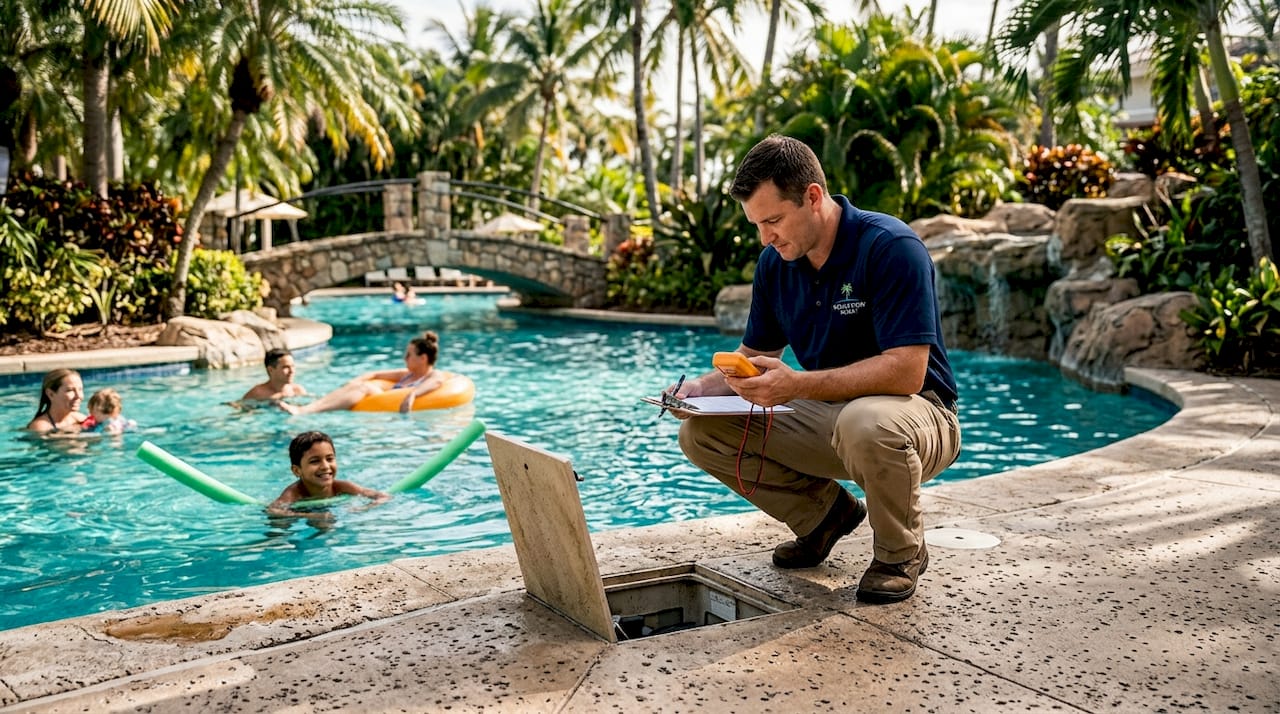
Multi-level pool designs add drama and function simultaneously. Upper tiers with infinity edges create aspirational photo opportunities. Lower levels can be zoned for lap swimming, children’s areas, or quiet adult retreats. This separation of use keeps diverse guest segments happy without conflict.
Rooftop infinity pools are gaining ground in urban Florida markets like Miami and Tampa. For boutique and lifestyle hotels, the rooftop pool is a brand statement. It commands premium pricing for pool-view rooms and creates an exclusive amenity that full-service resorts with ground-level pools simply cannot replicate.
Swim-up bars and poolside cabanas continue to outperform as revenue generators. These features turn passive pool time into active spending. Properly positioned, a swim-up bar can generate thousands in daily food and beverage revenue during peak season.
Fire and water features add sensory drama that elevates perceived property value. Guests associate these elements with luxury, even when the base pool design is relatively modest.
The broader hotel sector design trends show a clear split between wellness-focused and family-fun-oriented properties. Wellness resorts are investing in lap pools, cold plunge areas, and spa integration. Family resorts are doubling down on interactive water features, slides, and shallow play zones. Understanding which lane your property occupies matters enormously.
For residential design inspiration that translates well to smaller boutique properties, residential pool trend ideas offer a useful reference point for material choices and color palettes.
“The properties that win are those that design for their specific guest, not for the trend brochure. A rooftop infinity pool is irrelevant to a family beach resort, and a splash pad adds zero value to an adults-only wellness retreat.”
Pro Tip: Prioritize designs with natural shade integration. Florida’s sun intensity directly affects how long guests stay poolside. More shade structures mean longer dwell time, which means higher food and beverage spend per guest.
Comparing pool design options: Functionality, cost, and guest impact
Choosing the right pool style requires weighing investment against return across several dimensions. Here is a side-by-side comparison of the four most relevant pool types for Florida hotel properties.
| Pool type | Upfront cost | Maintenance level | Guest appeal | Best fit |
|---|---|---|---|---|
| Tropical lagoon | High | High | Families, leisure travelers | Full-service family resorts |
| Infinity edge | Very high | Medium | Couples, luxury travelers | Boutique, luxury, urban hotels |
| Multi-level design | High | Medium | Mixed demographics | Large resorts, family properties |
| Traditional rectangle | Low to medium | Low | Budget-conscious, fitness guests | Midscale, extended stay hotels |
Cost context matters here. Sustainability premiums can raise upfront renovation costs by 10 to 20 percent, but properties that incorporate energy-efficient pumps, LED lighting, and solar heating consistently reduce operating expenses over a three to five year horizon.
Tropical lagoon pools carry the highest long-term maintenance load. Freeform shapes require more surface area to resurface, more complex plumbing routing, and more intensive landscaping upkeep. But their guest appeal in the Florida family resort segment is unmatched, and the RevPAR premium they support tends to justify the cost.
Infinity edge pools have a different cost profile. The structural engineering requirements drive up installation costs significantly. Ongoing maintenance is more manageable, but the vanishing edge mechanism requires precise calibration and periodic servicing. The payoff is a signature amenity that defines the property’s brand image.
Multi-level designs offer the best versatility for large properties. They allow zoning by guest segment without the drama of a full lagoon build, and their modular nature makes phased renovation more feasible.
For hotels moving forward with any of these options, understanding the pool renovation workflow and available energy-saving pool upgrades helps owners plan realistic timelines and budgets before breaking ground.
Making the right choice for your property
Knowing the options is one thing. Choosing the right one for your specific property requires a structured approach. Here is a practical decision framework for Florida hotel owners.
- Define your guest profile. Who stays at your property most often? Families, couples, corporate travelers, and wellness guests all have different pool priorities. Start here before you look at a single design rendering.
- Identify your market segment. A midscale hotel in Orlando has different competitive pressures than a luxury boutique in Miami Beach. Your pool needs to match your positioning, not exceed it to the point of financial strain.
- Map your renovation timing. Florida’s off-season, typically late summer through early fall in many markets, is the optimal window for major pool work. Q2 2025 data shows an ADR of $196 and RevPAR of $135 for upper-midscale Florida hotels, meaning peak season downtime is genuinely costly.
- Audit compliance requirements. ADA, local health codes, and safety regulations must be confirmed before design finalization. These are non-negotiable and vary by municipality.
- Set a realistic budget with contingency. Commercial pool renovations routinely run over initial estimates. Budget a 15 percent contingency for surprises, especially in older properties with aging infrastructure beneath the deck.
- Calculate the value add. Project the revenue impact of each design element. A swim-up bar is not just aesthetic. It is a revenue center with a calculable return. Treat it as such.
For hotels working within tighter budgets, pool renovation cost-saving strategies offer practical ways to maximize impact without overspending. And for operators navigating the regulatory side, reviewing pool compliance requirements for rentals provides useful baseline context.
Pro Tip: If your budget does not support a full redesign, prioritize resurfacing and finishing upgrades first. A fresh Pebble Tec® surface in a trending color can transform guest perception of an older pool at a fraction of the cost of structural renovation.
Our perspective: Why Florida’s best hotels look beyond the trend
After working with hundreds of commercial pool projects across Orlando, Jacksonville, and beyond, we have seen a clear pattern. The hotels that generate the strongest long-term returns from pool investment are not the ones that chased the most popular trend in a given year. They are the ones that aligned every design decision with their specific guest, their brand, and their operational reality.
Trends are useful as a signal of what guests are responding to. But a rooftop infinity pool that your maintenance team cannot properly service, or a tropical lagoon that your budget cannot sustain, is not an asset. It is a liability.
The contrarian truth in commercial pool design is this: the most impressive-looking pool is rarely the most profitable one. The most profitable pool is the one that fits seamlessly into your property’s ecosystem, reduces friction for your operations team, and gives your specific guest exactly what they came for.
If you are asking why renovating your pool matters for property value, the answer is never just aesthetics. It is always alignment between investment and outcome.
Ready to upgrade? Expert pool solutions for Florida hotels
If you are ready to bring any of these 2025 trends to life at your property, the execution partner you choose matters as much as the design itself.

Classic Marcite has resurfaced more than 100,000 pools since 1988, working with hotels, resorts, and theme parks across Florida. We specialize in commercial pool finishes that hold up to high-traffic environments while delivering the visual impact your guests expect. Whether you need a full pool remodeling service or a targeted finish upgrade using Pebble Tec® and premium materials, we match the solution to your property’s specific goals. Our team also handles modern interior pool finishes for indoor and enclosed pool environments. Contact us for a free estimate and a practical renovation roadmap tailored to your property.
Frequently asked questions
What pool features are most popular in Florida hotels for 2025?
Tropical lagoon layouts, multi-level designs, swim-up bars, and energy-efficient upgrades lead Florida hotel pools in 2025, with fire and water features growing in demand among luxury properties.
How does sustainability impact costs for hotel pool renovations?
Sustainability upgrades can add 10 to 20 percent to upfront renovation costs but consistently reduce long-term operating expenses through energy and water savings.
When is the best time to renovate a hotel pool in Florida?
Renovate during the off-season to minimize disruption to paying guests. Florida hotel data confirms that peak-season downtime carries a real revenue cost that off-season scheduling avoids.
What regulations must Florida hotel pools meet?
Florida hotel pools must meet ADA accessibility standards, state health and safety codes, and local municipality requirements. These should be confirmed with your contractor and local authority before any renovation begins.
Recommended
- Enhance Your Florida Home With 2025’s Top Pool Trends
- Top Commercial Pool Trends Shaping Florida In 2025
- Renovating Resort Pools Explained: Enhancing Value And Safety
- 7 Essential Pool Remodeling Ideas For Florida Properties
- Electric Pool Heater Installation in San Antonio: Boosting Pool Comfort
- Pool Renovation The Villages FL
