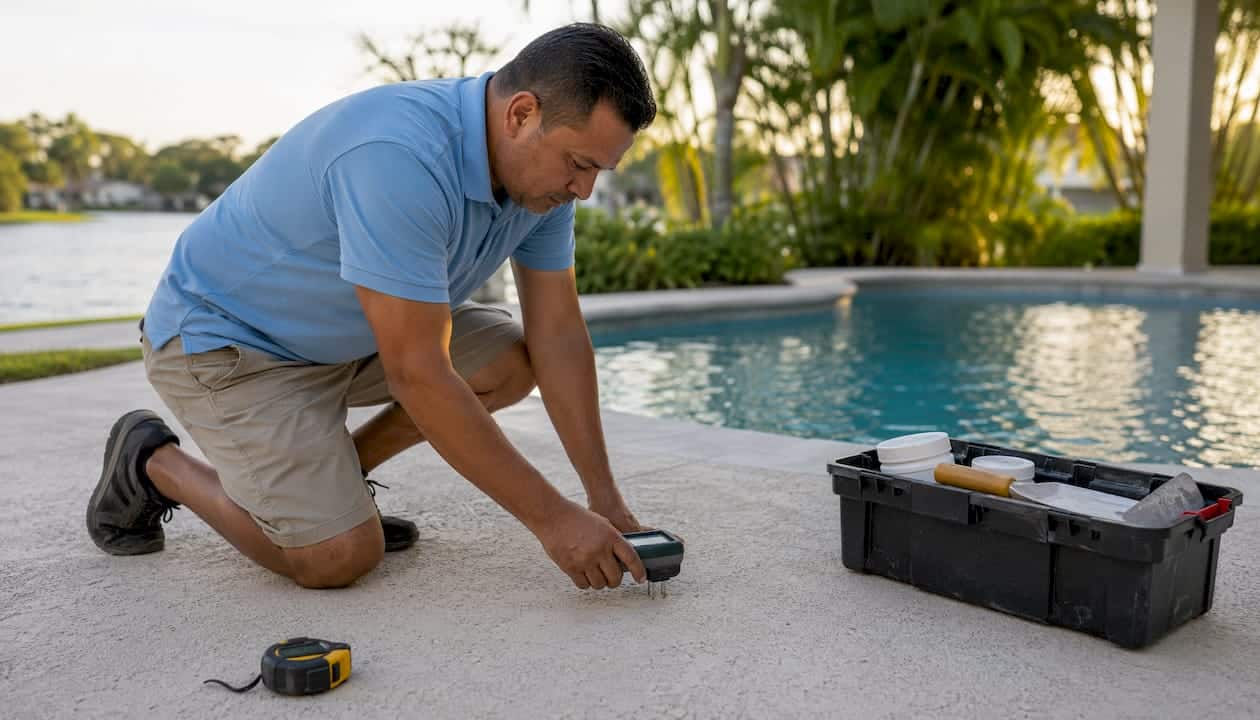
Pool deck restoration follows one fixed sequence: documented condition assessment, structural repairs where needed, mechanical surface preparation, and then a climate-appropriate resurfacing system. Skip any step and the finish fails early. Florida’s combination of UV intensity, humidity, salt air, and pool-chemical exposure makes that order non-negotiable. A professional written inspection is the right first move, whether you see a single crack or widespread spalling.
- Assessment first. A written report documents existing damage, determines whether permits are required, and protects you at resale.
- Structural repairs before cosmetics. Applying any overlay over active cracks or moisture issues often leads to premature overlay failure.
- Surface prep is the deciding factor. Industry professionals consistently identify mechanical profiling as the single biggest driver of long-term performance.
- Choose for Florida, not just aesthetics. UV breakdown, thermal movement, and chlorine exposure eliminate finishes that perform fine in other climates.
Ballpark costs for Florida pool deck resurfacing vary widely depending on finish type, substrate condition, and drainage corrections. Pricing examples include mid-sized decks with basic acrylic overlays costing a few thousand dollars, while premium finishes can reach substantially higher amounts on similar-sized decks.
Table of Contents
- How do you know if your pool deck needs restoration?
- What resurfacing materials work best for Florida pool decks?
- What happens during a professional pool deck restoration?
- What does pool deck restoration cost in Florida?
- What should you ask a contractor before signing anything?
- How do you maintain a restored pool deck?
- Common mistakes that shorten a deck’s lifespan
- Why Classicmarcite has the experience to get this right
- Safety precautions and protective gear during restoration work
- Environmental considerations and disposal of old materials
- Key Takeaways
- Why assessment and surface prep are the two things that actually matter
- Classicmarcite serves Florida homeowners and property managers directly
- Further reading and authoritative references
How do you know if your pool deck needs restoration?
Start with a slow walk around the deck, barefoot if possible. You will feel problems your eyes miss.
| Sign | What It Suggests | Repair or Resurface? |
|---|---|---|
| Hairline cracks, isolated | Surface shrinkage or minor settling | Spot repair if under 10–15% of area |
| Wide or active cracks (>1/4 in.) | Structural movement or ASR | Structural repair required first |
| Spalling or pitting | UV/freeze-thaw degradation | Resurface when widespread |
| Peeling or blistering coating | Moisture under existing overlay | Strip, dry, and resurface |
| Pooling water | Drainage failure or settlement | Drainage correction before resurfacing |
| Loose or sunken pavers | Sub-base erosion | Re-base and reset or replace |
| Delamination (hollow sound underfoot) | Bond failure between layers | Full removal of failed layer |
Contractors use a threshold of affected area to decide between repair and full resurfacing: smaller affected areas often warrant targeted repairs, while more extensive damage typically leads to recommending full resurfacing. Documented inspection matters beyond the repair decision. Permits, resale disclosures, and manufacturer warranty eligibility all depend on a written record of existing conditions before work begins.
Pro Tip: Tap the deck surface with a metal rod or coin. A hollow sound indicates delamination. Mark those areas with chalk before a contractor visits — it speeds the assessment and shows you have done your homework.
Visible signs of pool surface damage like staining or rough texture often appear before structural problems do. Catching them early keeps repair costs lower.
What resurfacing materials work best for Florida pool decks?
Florida’s climate drives UV breakdown, moisture-driven adhesion loss, salt-induced rebar corrosion, and thermal movement faster than most other U.S. markets. Material selection has to account for all four.
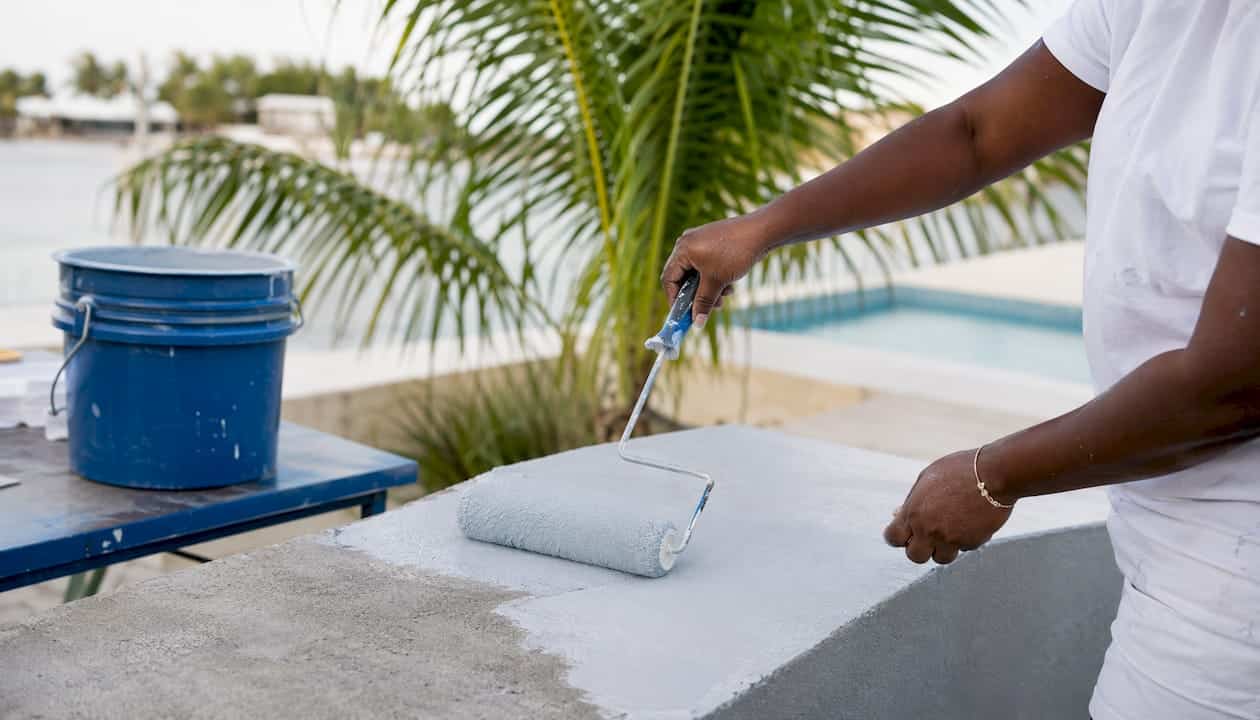
Acrylic / “cool deck” coatings are the most common entry-level option. They reduce surface heat, improve slip resistance, and cost less upfront. The tradeoff: UV degradation means recoating every 7–12 years in Florida conditions. They work only on structurally sound slabs.
Cementitious and polymer overlays (thin-bond systems) add texture and color to an existing slab. They bond well when the substrate is properly profiled, but they are not a fix for structural problems. Expect 10–15 years with good maintenance.
Stamped or stained concrete offers a custom look at moderate cost. Staining alone does not add thickness or structural value, so it suits decks with good bones and surface-only wear.
Exposed-aggregate and pebble finishes, including Pebble Tec®, are the premium tier. The aggregate surface is naturally slip-resistant, handles pool-chemical exposure well, and resists UV fading better than coatings. Pebble Tec® carries manufacturer warranty documentation and requires a certified applicator. Classicmarcite is the largest Pebble Tec® applicator in Central Florida.
Pavers and natural stone (travertine, porcelain) are the most durable long-term option. Travertine stays noticeably cooler underfoot than concrete and has a natural slip-resistant texture. Pavers require a stable sub-base; if the existing slab has settlement issues, this is actually an advantage because individual units can be reset.
- Systems requiring a structurally sound slab: acrylic coatings, thin-bond overlays, stained concrete
- Systems that can accommodate minor sub-base corrections: paver replacement, natural stone installation
- Systems requiring certified applicator status: Pebble Tec® and similar exposed-aggregate products
For a deeper look at how these options compare, resurfacing types and decision criteria are covered in detail on the Classicmarcite site.
What happens during a professional pool deck restoration?
The five-to-six-phase workflow is consistent across reputable contractors, though Florida’s humidity and afternoon rain patterns affect scheduling at every stage.
| Phase | What Happens | Typical Duration |
|---|---|---|
| Documented assessment | Condition mapping, moisture testing, drainage check | 1–2 hours |
| Permitting check | Confirm local municipality requirements | 1–10 business days |
| Demolition / spot repair | Remove failed layers, crack injection, joint work | 1–2 days |
| Surface profiling | Shot blast, diamond grind, or pressure wash | 1 day |
| Overlay / coating application | Material applied per manufacturer spec | 1–2 days |
| Cure and final inspection | Ambient humidity and temperature govern cure time | — |
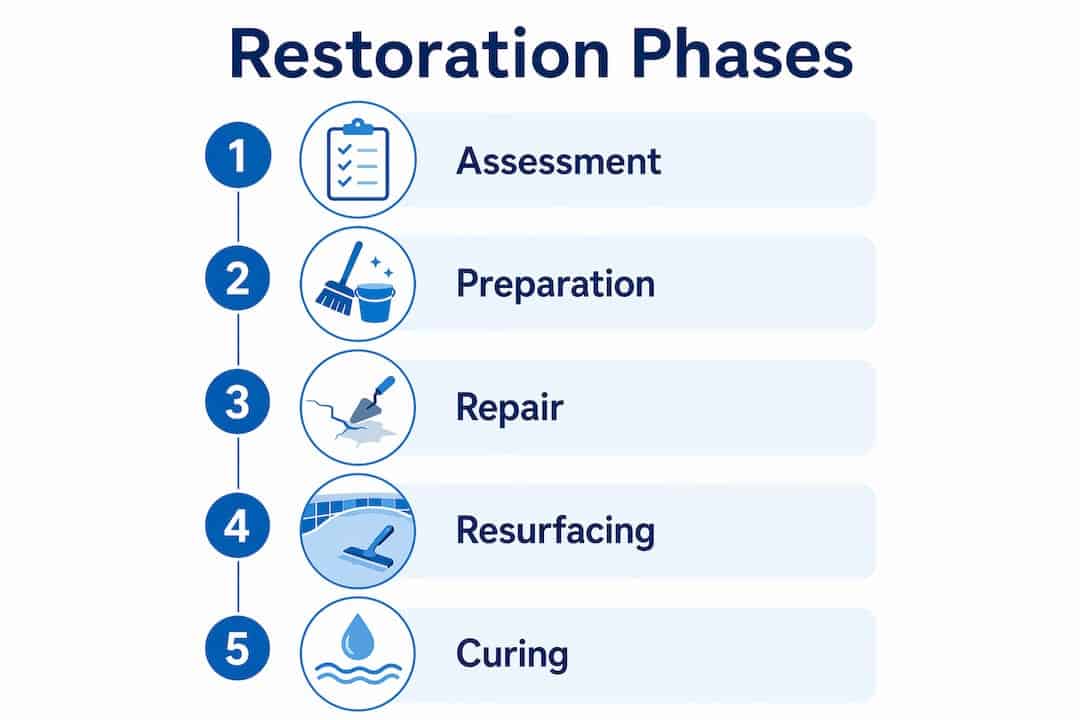
Florida’s heat accelerates surface drying but high humidity slows full cure. Reputable contractors schedule application in morning windows and avoid application when rain is forecast within the cure window. Expansion joints must be re-established after any overlay work; skipping them causes cracking within one or two thermal cycles.
Pro Tip: Ask your contractor for a written cure schedule tied to the specific product and ambient conditions. If they cannot provide one, that is a red flag.
The pool deck repair process and the resurfacing steps each have their own technical requirements. A contractor who conflates the two is likely underestimating scope.
What does pool deck restoration cost in Florida?
Costs vary widely by finish, substrate condition, and site-specific factors. Typical market pricing differs by finish type, with lower-cost options available at entry levels and higher-cost ones for premium materials and installations. Additional expenses for substrate repairs, drainage corrections, and permits can add substantially to the base resurfacing cost. Coastal properties with salt-air exposure tend to need more frequent maintenance cycles regardless of finish type.
What should you ask a contractor before signing anything?
A site-specific assessment is the baseline expectation. Any contractor who quotes a price over the phone without visiting the site is not doing the job correctly.
| Contract Item | Why It Matters |
|---|---|
| Itemized scope with substrate repairs listed separately | Prevents scope creep and hidden charges |
| Moisture and adhesion testing documentation | Required for warranty eligibility on most systems |
| Manufacturer applicator status (e.g., Pebble Tec®) | Unlocks manufacturer warranty; proves product training |
| Written cure schedule tied to ambient conditions | Protects against premature use and coating failure |
| Warranty language with explicit exclusions | Vague warranties are unenforceable |
| Permit confirmation in writing | Missing permits can affect resale and title |
| Insurance and indemnity certificates | Protects you if a worker is injured on your property |
Red flags: a one-size-fits-all proposal with no site visit, pressure to skip surface prep to save time, vague warranty terms, or no written timeline. Whether to DIY or hire a professional contractor is a real question for smaller deck repairs, but for full resurfacing in Florida, the substrate complexity and warranty requirements make professional installation the practical choice.
How do you maintain a restored pool deck?
Maintenance is what separates a 10-year finish from a 20-year one.
- Rinse after heavy pool use. Chlorine and salt overspray left to dry accelerates coating breakdown.
- Neutralize chemical spills promptly. pH extremes damage both coatings and natural stone sealers.
- Inspect annually. Look for early cracking, sealer wear, and joint separation before they become structural.
- Reseal on schedule. Natural stone needs sealing every 1–3 years; acrylic coatings need recoating every 7–12 years in Florida.
- Re-sand paver joints as needed. Eroded joints invite sub-base moisture and ant activity.
- Address minor cracks immediately. A $50 crack repair prevents a $5,000 resurfacing job.
For a full post-resurfacing maintenance calendar, Classicmarcite covers the specific care steps by material type. Sealing details are also covered in the pool deck sealing guide.
Common mistakes that shorten a deck’s lifespan
Most premature failures trace back to a small set of repeatable errors.
| Mistake | Consequence | Professional Safeguard |
|---|---|---|
| Skipping structural inspection | Overlay fails within 1–2 seasons | Written condition assessment before any work |
| Overlaying active cracks or moisture | Blistering, delamination, bond failure | Moisture testing; crack injection before overlay |
| Using non-UV-rated coatings | Rapid fading and chalking | Specify UV-stable products in writing |
| Omitting expansion joints | Cracking at thermal stress points | Re-establish joints per manufacturer spec |
| Ignoring drainage corrections | Standing water, algae, sub-base erosion | Slope verification and drain clearing before resurfacing |
Pro Tip: Request the product data sheet for any coating or overlay your contractor proposes. It lists the required surface preparation, moisture limits, and expansion joint spacing. If the contractor’s plan does not match the data sheet, ask why in writing.
Surface preparation is the single biggest determinant of overlay longevity. Contractors who rush or skip mechanical profiling are the primary source of early failures. More on renovation mistakes to avoid is available from Classicmarcite.
Why Classicmarcite has the experience to get this right
Classicmarcite has been resurfacing pools in Florida since 1988, with over 100,000 pools completed across residential, commercial, and international projects. As the largest Pebble Tec® applicator in Central Florida, the company brings manufacturer-certified installation, documented inspection protocols, and a project gallery that lets you see comparable Florida work before you commit.
Before signing with any contractor, ask for these materials: an itemized inspection report, before-and-after project photos from similar Florida jobs, customer references, and the manufacturer warranty documentation for the specific product being applied. Classicmarcite provides project galleries and customer reviews directly on its site.
Safety precautions and protective gear during restoration work
Deck restoration involves chemical strippers, grinding dust, and wet coatings, all of which carry real exposure risks.
Workers and any homeowners present during work should wear NIOSH-approved respirators when grinding or shot-blasting (silica dust is a serious inhalation hazard), chemical-resistant gloves when handling acid washes or solvents, and safety glasses rated for chemical splash. Non-slip footwear matters on wet or freshly coated surfaces. Keep children and pets off the work area until the cure schedule is complete, not just until the surface looks dry.
Contractors should post wet-surface warnings and secure the perimeter during application and cure phases. Confirm that your contractor carries workers’ compensation insurance; if a worker is injured on your property without it, liability can fall to you.
Environmental considerations and disposal of old materials
Grinding and shot-blasting generate concrete dust and coating debris that require proper containment. Responsible contractors use vacuum-equipped grinders and collect waste rather than allowing it to wash into pool water or storm drains.
Old acrylic coatings and solvent-based sealers are classified as hazardous waste in most Florida counties and cannot go into standard dumpsters. Ask your contractor for a disposal plan in writing before work begins. Water used in pressure washing that contains chemical residue should be directed to a sanitary drain, not a storm drain or lawn area. For natural stone or paver removal, most material is inert and can go to a concrete recycling facility rather than a landfill.
Key Takeaways
A Florida pool deck restoration that lasts starts with a documented inspection and ends with a written maintenance schedule — surface preparation is the step that determines whether everything in between holds.
| Point | Details |
|---|---|
| Inspection is step one | A written condition assessment determines scope, permits, and warranty eligibility before any work starts. |
| Surface prep drives longevity | Mechanical profiling (grinding, shot blasting) is the single biggest factor in how long any finish lasts. |
| Match the finish to Florida conditions | UV stability, slip resistance, and chemical resistance should guide material selection, not aesthetics alone. |
| Require a written contract | Itemized scope, cure schedule, warranty language, and permit confirmation protect you at every stage. |
| Classicmarcite for Central Florida | As the largest Pebble Tec® applicator in Central Florida since 1988, Classicmarcite offers documented inspections and manufacturer-backed warranties. |
Why assessment and surface prep are the two things that actually matter
Most deck failures are not material failures. They are preparation failures. The finish that peeled after two Florida summers did not fail because it was the wrong product; it failed because the substrate had active moisture, the surface was not properly profiled, or the expansion joints were skipped to save a day of labor. Every shortcut in the prep phase shows up in the finish phase, usually within one or two thermal cycles.
Florida compounds every one of those risks. The UV load here is among the highest in the continental U.S. Humidity slows cure times and creates adhesion windows that close faster than contractors from other markets expect. Salt air at coastal properties attacks rebar and accelerates coating breakdown from below. A documented assessment that maps all of those site-specific conditions is not a formality. It is the only way to write a scope that actually matches the problem.
Classicmarcite serves Florida homeowners and property managers directly
Classic Marcite has completed over 100,000 pools across Florida since 1988, and the work starts the same way every time: a documented on-site inspection, an itemized written estimate, and a scope that reflects what the substrate actually needs, not a generic package. As the largest Pebble Tec® applicator in Central Florida, Classicmarcite can deliver manufacturer-backed warranties on premium finishes that most local contractors cannot offer.
Service areas include Orlando, Dr. Phillips, Winter Park, The Villages, and Jacksonville. When you request an estimate, ask specifically for the written inspection report, the cure schedule tied to ambient conditions, and the warranty documentation for the finish being proposed. Request photos of comparable Florida projects before signing anything.
Request a free estimate for pool resurfacing in Orlando and get a written scope you can compare against any other bid.
Further reading and authoritative references
| Source | What It Covers |
|---|---|
| Pool Deck Materials That Stay Cool on Hot Florida Days | Comparative guide to cool-deck materials, coatings, and maintenance for Florida climates |
| Questions to Ask Before Hiring a Pool Contractor | Pre-hire checklist covering licensing, scope, warranty, and contract terms |
| Pool Deck Repair vs Resurfacing in Florida | Decision framework for repair vs. full resurfacing based on Florida failure modes |
| Pool Deck Resurfacing in Florida: Methods & Materials | Technical overview of resurfacing systems and substrate decision boundaries |
| Pool Deck Repair and Resurfacing on the Gulf Coast | Workflow phases and cure-time guidance for Florida conditions |
Bring a printed version of the inspection checklist and the contract must-haves table to any contractor meeting. A contractor who objects to written documentation of scope, testing, or warranty terms is telling you something important.