TL;DR:
- Water chemistry, especially the LSI, primarily determines the durability of a pool finish during curing and beyond. Maintaining proper calcium hardness, pH, alkalinity, and analyzing fill water beforehand prevent irreversible etching or scaling. Daily brushing and extended filter running during the 28-day cure are essential to protect the finish and ensure longevity.
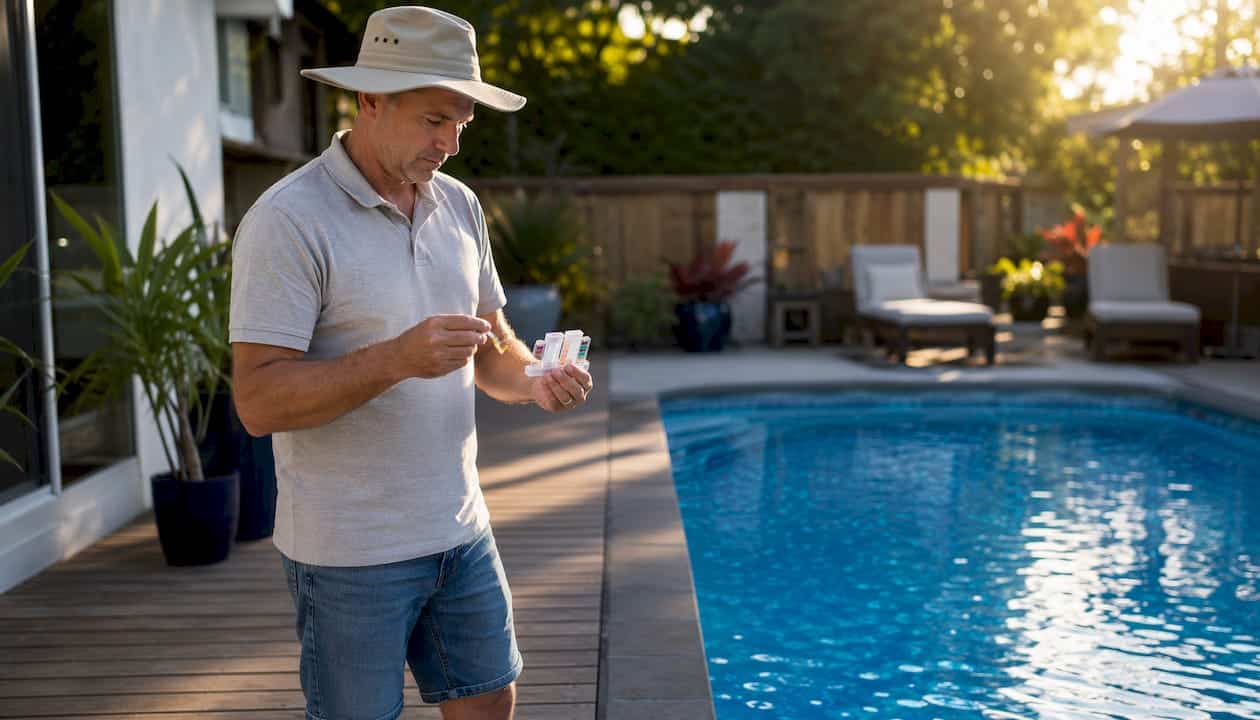
Water chemistry, not just workmanship, largely decides whether a new pool finish lasts or fails. Balanced water during fill and throughout the first 28 days protects a resurfaced finish and prevents irreversible etching or scaling. Three actions matter most right now: test your fill water before it enters the pool, set startup chemistry per NPC/ANSI guidance, and enforce daily brushing plus extended filter run for the full 28-day cure window.
The numeric targets you need from day one:
- Langelier Saturation Index (LSI): 0.0 to +0.3 (below −0.3 is corrosive; above +0.5 produces scaling)
- Calcium hardness: 200–400 ppm
- pH: 7.2–7.8
- Total alkalinity: 80–120 ppm
These targets apply whether your pool has a classic marcite plaster finish, a quartz blend, or a Pebble Tec® aggregate surface. The material changes the sensitivity, not the principle.
Table of Contents
- How does water chemistry affect a resurfaced pool finish?
- What signs tell you the surface is causing water problems?
- What should you do in the first 28 days after resurfacing?
- How do you balance pool chemistry to protect a new finish?
- Does your finish type change how you manage water chemistry?
- What does long-term maintenance look like for a resurfaced pool?
- What does the science behind the LSI actually tell you?
- Key Takeaways
- A resurfacing pro’s perspective on chemistry and finish longevity
- Professional resurfacing and water-protection planning from Classicmarcite
- Authoritative sources and industry references
How does water chemistry affect a resurfaced pool finish?
New cementitious finishes, including marcite (pool plaster) and quartz blends, chemically hydrate after installation. During that process, the cement releases calcium hydroxide, a soluble compound that migrates toward the water surface. What happens next depends entirely on your water chemistry.
When the water is undersaturated, meaning the LSI sits below −0.3, it acts as a solvent. It pulls calcium hydroxide out of the fresh plaster faster than the finish can stabilize, leaving a roughened, porous surface. That process is called etching, and according to CL Industries, etching causes permanent structural alteration that no acid wash or sanding can reverse.
Oversaturated water does the opposite. With an LSI above +0.5, dissolved minerals precipitate onto the surface as white calcium carbonate scale. Scale is removable, but repeated cycles of scale formation and removal wear down the finish over time.
The pool is not just a vessel for water — it is a chemical system. Fresh plaster is a reactive surface, and the water you fill it with either supports the curing process or attacks it. Calcium and alkalinity are the buffers that neutralize that aggressive potential. Get them right before the hose goes in.
Fill water composition matters before a single chemical is added. Soft or low-calcium water, including water from reverse-osmosis systems, immediately leaches calcium from fresh plaster. High-TDS municipal water or well water with elevated metals introduces a different risk: metal staining and uneven chemical absorption. The fill-water test is not optional. It is the first step in protecting a finish that cost thousands of dollars.
The system works like this: new finish interacts with fill water, fill water interacts with sanitizer and additives, and all of it passes through filtration. Each link in that chain either stabilizes or destabilizes the others.
What signs tell you the surface is causing water problems?
Surface-driven water problems have recognizable signatures. Knowing which symptom points to which cause saves time and prevents the wrong treatment from making things worse.
Common problems and their chemistry fingerprints:
- Plaster dust / surface dusting: Fine white powder in the water during the first two weeks. Caused by low calcium hardness or an LSI that has drifted too negative. Normal in small amounts; excessive dusting signals aggressive water.
- White scale deposits: Crusty white buildup on walls and fittings. LSI is too high, typically above +0.5. More visible on dark finishes.
- Mottling or color fade: Blotchy discoloration on the finish surface. Often linked to elevated cyanuric acid (CYA) or salt levels that skew alkalinity readings and LSI calculations.
- Metal staining: Brown, green, or rust-colored spots. Metals in the fill water or corroding equipment react with oxidizers. Requires a spot test with a sequestering agent to confirm.
- Persistent cloudiness: Water that won’t clear despite correct sanitizer levels. Usually points to high TDS, a filter running too few hours, or both.
Quick diagnostic checklist:
- Run a scratch test on a discolored area. If the surface feels rough or chalky, etching is likely.
- Tap suspected nodules with a fingernail. Hard, white bumps that don’t scrape off are calcium carbonate scale.
- Apply a sequestering agent to a small stained area. If the stain lightens within 24 hours, metals are the cause.
- Pull a full water panel from a certified pool lab and calculate your LSI using current pH, temperature, calcium hardness, and alkalinity values.
DIY treatments work for early-stage problems: brushing, a chelating or sequestering agent for mineral stains, and filter maintenance for cloudiness. Call a professional when you see widespread etching across the floor or walls, hard nodules covering more than a small area, or any sign of bond failure or delamination. Those conditions require assessment before any chemical treatment.
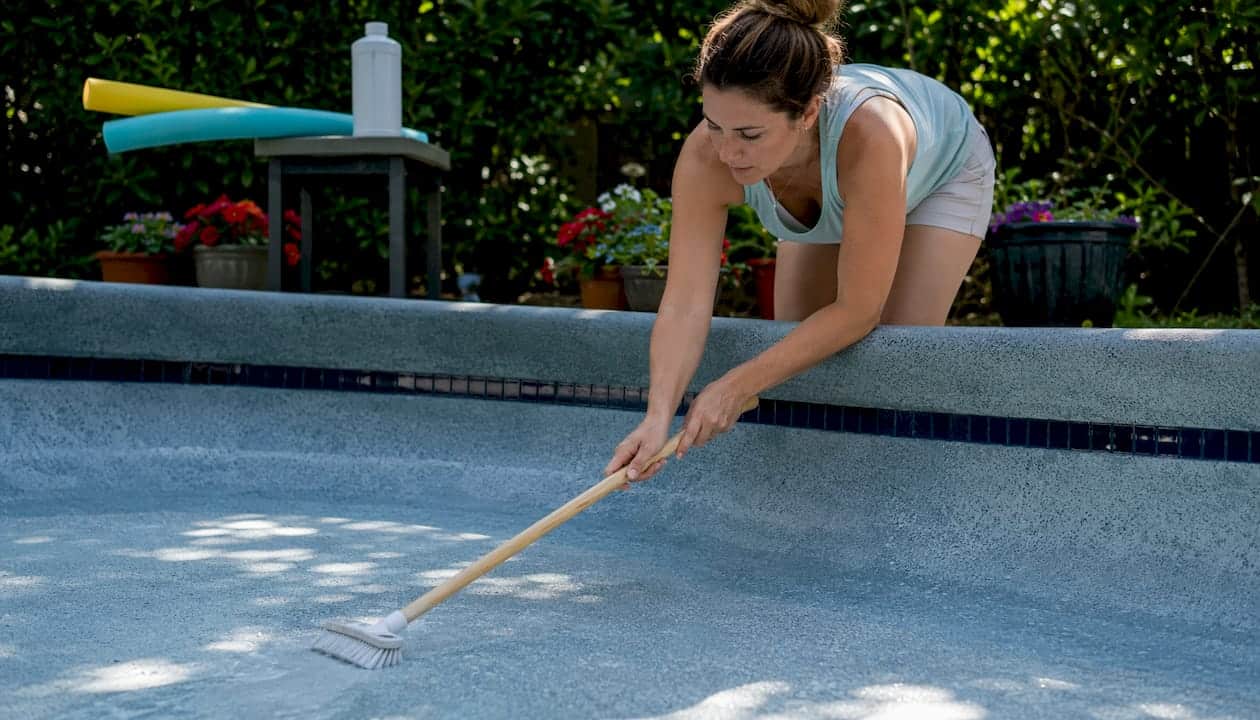
Pro Tip: Daily brushing during the first 28 days removes calcium hydroxide plaster dust before it can settle and form localized scale. Use a nylon brush on plaster and a stainless-steel brush on pebble finishes, and brush the entire surface, not just the visible problem spots.
What should you do in the first 28 days after resurfacing?
The first 28 days are critical. New cementitious finishes continue hydrating after the pool is filled, and startup water chemistry is part of the construction process, not an afterthought. Here is the phase-by-phase protocol.
| Phase | Days | Fill & Chemistry | Brushing | Filter Run | Sanitizer |
|---|---|---|---|---|---|
| Initial fill | 0–7 | Test fill water first; adjust calcium hardness to 200–400 ppm and pH to 7.2–7.8 before adding chemicals; target LSI 0.0 to +0.3 | Twice daily, full surface | 24 hours/day | Add chlorine slowly after pH is stable; target 1–3 ppm; no shocking |
| Active cure | 8–— | Test daily; make small incremental adjustments only; check TA and calcium | Once daily | —–24 hours/day | Maintain 1–3 ppm; no granular shock directly on wet finish |
| Stabilization | —–28 | Test every 2–3 days; adjust CYA for outdoor pools; verify LSI | Once daily minimum | 12–— hours/day | Normal chlorination resumes; avoid large single-dose additions |
What not to do during this window:
- Do not shock the pool with a heavy chlorine dose in the first week. High oxidizer levels combined with an unstable pH spike the LSI in the wrong direction.
- Do not apply granular acid directly to a wet finish. Broadcast it into the deep end with the pump running.
- Do not let the LSI drift below −0.3 or above +0.5 at any point during cure.
- Do not cut filter run time to save electricity. Filtration removes the calcium hydroxide dust that brushing dislodges.
The contractor’s job ends at handoff, but the finish’s fate is decided in the weeks that follow. Owners who treat the startup period as routine maintenance — rather than as the final phase of installation — are the ones who call us back years later with a finish that still looks new.
For post-resurfacing maintenance steps that go beyond the 28-day window, Classicmarcite has a detailed guide covering ongoing care. Before the pool is even filled, reviewing how to prep a pool for resurfacing clarifies what the contractor should complete before the owner takes over.
How do you balance pool chemistry to protect a new finish?
The LSI is the single most useful number in post-resurfacing water management. It combines pH, temperature, calcium hardness, total alkalinity, and TDS into one index that tells you whether your water is aggressive, balanced, or scaling. The NPC ideal range is 0.0 to +0.3 for pool finishes.
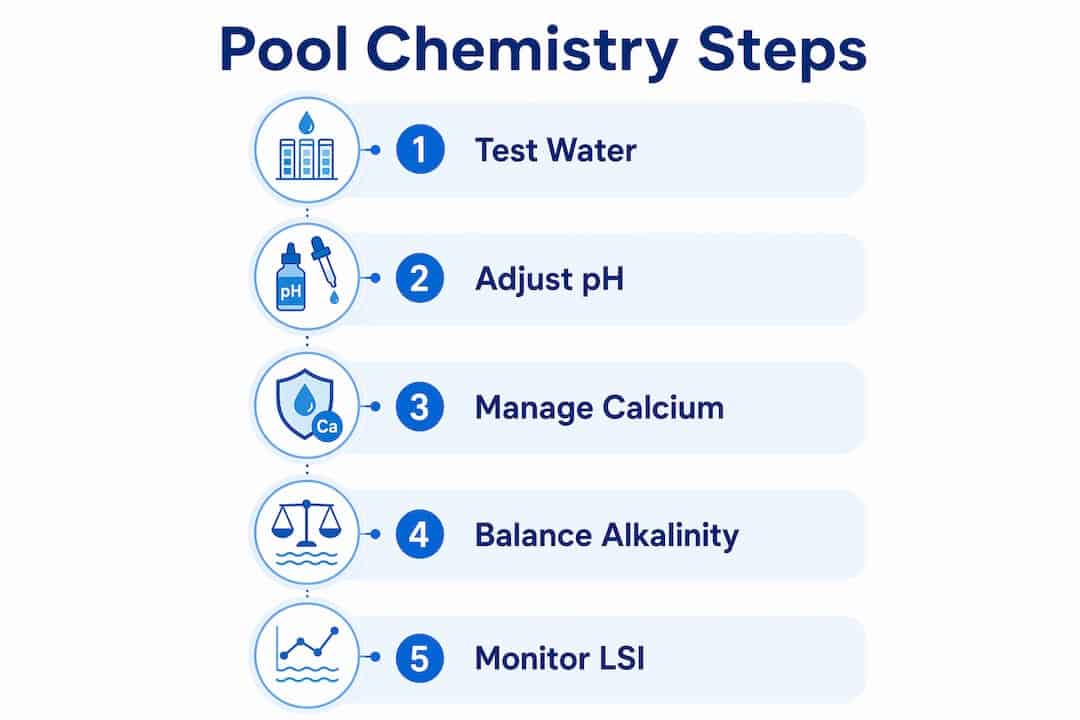
A simple LSI example: Suppose your water reads pH 7.4, temperature 80°F, calcium hardness 250 ppm, and total alkalinity 100 ppm. Using a standard LSI calculator or the PoolMath app, those inputs yield an LSI of approximately +0.1, which sits comfortably in the ideal range. Drop the calcium hardness to 100 ppm and the LSI falls to roughly −0.3, the edge of the corrosive zone. That single variable, calcium hardness, is often the first thing to check when a new finish shows early dusting.
Weekly chemistry routine:
- Test pH and free chlorine every 2–3 days using a reliable test kit (Taylor K-2006 or equivalent).
- Test total alkalinity and calcium hardness weekly for the first month, then monthly once stable.
- Calculate or check LSI whenever you adjust calcium, alkalinity, or pH.
- Check CYA monthly for outdoor pools. Elevated CYA skews alkalinity readings and throws off LSI calculations; account for it in your math.
- Add a sequestering agent monthly if your fill water contains iron, copper, or manganese.
- Make all adjustments in small increments. A rapid pH swing of more than 0.5 units in a single treatment stresses a new finish and risks localized etching or precipitation.
For a deeper look at how alkalinity buffers pH and feeds into the LSI, the pool alkalinity guide from Classicmarcite covers the mechanics clearly. TDS above roughly 1,500 ppm is a signal to consider partial dilution, since high TDS reduces the effectiveness of chemical adjustments and can contribute to finish problems over time.
Does your finish type change how you manage water chemistry?
Yes, and the differences are meaningful. According to Pool Pro Magazine, Many finish breakdowns trace to water chemistry rather than installation errors, but the chemistry thresholds that matter most shift depending on the material.
Marcite and standard plaster have the highest reactive cement content of the common finish types. More cement means more calcium hydroxide produced during hydration and a longer window of vulnerability. Aggressive water during the first 28 days does the most damage to plaster finishes, and the effects are permanent. Brushing frequency matters more here than with any other material.
Pebble and Pebble Tec® aggregate finishes embed natural stone or glass aggregate in a cement matrix. The aggregate itself is chemically inert, which makes these finishes more forgiving of moderate LSI swings. That said, the cement binder between the pebbles is still vulnerable to aggressive water, and scaling patterns on pebble surfaces tend to concentrate in the grout lines and low-flow areas. Pebble Tec® surfaces benefit from the same LSI targets but typically tolerate a slightly wider calcium hardness range.
Dark, smooth finishes show calcium scale far faster than light or textured pebble surfaces. White scale on a dark blue or black finish is visible within days of an LSI excursion above +0.5. Pebble surfaces may hide light scale in the texture, but the structural leaching underneath is still happening.
Quartz blend finishes have a denser surface than straight plaster, which slows the rate of calcium exchange with the water. They are generally more resistant to mild LSI swings, but they are not immune. High-hardness water still scales quartz surfaces, and the denser matrix makes acid washing riskier because it can alter the surface texture unevenly.
Pro Tip: Post-cure densifiers, applied by the contractor after the initial 28-day hydration period, chemically fill the surface pores of plaster and quartz finishes. This reduces the surface area in contact with pool water and measurably lowers LSI-related risk over the life of the finish. Ask your contractor whether they include this step.
For finish-specific longevity data on Pebble Tec® lifespan, Classicmarcite’s resource covers what owners can realistically expect from each material with proper chemistry maintenance.
What does long-term maintenance look like for a resurfaced pool?
Protecting a resurfaced finish over years comes down to consistent testing, equipment discipline, and knowing when to call in professional help.
Monthly checklist:
- Test pH, free chlorine, and total alkalinity every week.
- Test calcium hardness and CYA monthly.
- Monitor TDS quarterly; plan a partial drain when it exceeds 1,500 ppm.
- Inspect filter media monthly; backwash or clean per manufacturer schedule.
- Check pump run time against your pool’s turnover rate target (one full turnover every 6–8 hours is the standard for residential pools).
Equipment to watch:
- Heaters and heat exchangers accumulate calcium scale faster than any other component when hardness runs high. Inspect annually if you heat the pool regularly.
- Salt chlorine generators require accurate TDS and salt readings to function correctly; high TDS can cause the cell to misread and overdose.
- For commercial pools, inspection checklists that cover equipment and water quality standards help facility managers stay ahead of compliance requirements.
Seasonal and annual actions:
- Partial drain and refill when TDS climbs above 1,500 ppm or when metals accumulate despite sequestering treatment. The pool drain and refill guide from Classicmarcite walks through the process safely.
- Schedule a professional inspection every 2–3 years to assess finish condition, check for early etching or nodule formation, and evaluate equipment.
- Persistent etching across the floor, widespread nodules, or visible delamination are signs the finish has reached the end of its serviceable life. At that point, resurfacing is the correct path, not another round of chemical treatment.
What does the science behind the LSI actually tell you?
The Langelier Saturation Index was developed to predict whether water will dissolve or deposit calcium carbonate. For pool finishes, it functions as a stability index: a positive value means the water is slightly saturated and will tend to deposit a thin protective layer of calcium carbonate on the surface. A negative value means the water is undersaturated and will dissolve calcium from the finish to reach equilibrium.
The National Plasterers Council refines the acceptable range specifically for pool finishes. Their published guidance sets the ideal at 0.0 to +0.3, with values below −0.3 classified as corrosive and values above +0.5 as scaling. ANSI/APSP-11 startup protocols call for controlled fill, measured chemical additions, and monitoring during initial cure, recognizing that startup chemistry is a construction step, not routine maintenance.
| Parameter | NPC Ideal Range | Corrosive Threshold | Scaling Threshold |
|---|---|---|---|
| LSI | 0.0 to +0.3 | Below −0.3 | Above +0.5 |
| pH | 7.2–7.8 | Below 7.2 | Above 7.8 |
| Calcium hardness | 200–400 ppm | Below 200 ppm | Above 400 ppm |
| Total alkalinity | 80–120 ppm | Below 80 ppm | Above 120 ppm |
The LSI is not a single-variable test. It is a composite of five interacting parameters. Fixing only pH while ignoring calcium hardness gives you a false sense of security. All five inputs must be in range simultaneously for the index to stay stable.
CYA complicates the calculation for outdoor pools. At concentrations above 50 ppm, CYA ties up a portion of the carbonate alkalinity, which means the effective alkalinity driving the LSI is lower than the total alkalinity reading on your test strip. Use a CYA-adjusted alkalinity value in your LSI math, or use a calculator that accounts for it automatically.
Key Takeaways
Water chemistry controls resurfacing outcomes from the moment fill water enters the pool through the entire life of the finish: maintain LSI 0.0 to +0.3, calcium hardness 200–400 ppm, and pH 7.2–7.8, and enforce daily brushing for the first 28 days.
| Point | Details |
|---|---|
| Test fill water first | Check calcium hardness and metals before filling; soft or low-calcium water immediately leaches calcium from fresh plaster. |
| Hold LSI 0.0 to +0.3 | Below −0.3 causes irreversible etching; above +0.5 produces scale. Both damage the finish. |
| 28-day startup is construction | Daily brushing and 24-hour filtration during the first week are required steps, not optional maintenance. |
| Finish type changes sensitivity | Marcite is most vulnerable; Pebble Tec® aggregate is more forgiving but still requires correct LSI. |
| Classicmarcite provides startup support | Classicmarcite includes material selection, startup chemistry guidance, and post-resurfacing handoff as part of its professional resurfacing service. |
A resurfacing pro’s perspective on chemistry and finish longevity
The most common mistake pool owners make after resurfacing is treating the startup period like normal pool maintenance. It is not. The finish is still curing, still producing calcium hydroxide, and still vulnerable to whatever the water does to it. Owners who test their fill water, hit the LSI target from day one, and brush daily for four weeks almost never call back with chemistry-related finish problems. The ones who skip those steps often do.
At Classicmarcite, we have resurfaced over 100,000 pools across Orlando, Jacksonville, and beyond since 1988. The pattern is consistent: finishes that fail early almost always have a chemistry story behind them, not a workmanship story. That is why we include startup chemistry guidance as part of every resurfacing handoff, not as an add-on. If your pool was recently resurfaced and you want a post-resurfacing inspection or a startup chemistry checklist, reach out to Classicmarcite directly.
Professional resurfacing and water-protection planning from Classicmarcite
Resurfacing a pool is a significant investment, and the finish’s longevity depends on what happens in the weeks after the crew leaves. Classic Marcite offers professional pool resurfacing in Orlando using marcite plaster, Pebble Tec®, and quartz blend finishes, with startup chemistry support included in the handoff process. That means you get material selection guidance, a post-fill chemistry checklist, and a contractor who understands how the finish you chose responds to your local water supply.
Florida’s water varies significantly by region, and a contractor who accounts for local hardness and TDS levels during the startup phase reduces finish failures before they start. Whether you manage a residential pool or a commercial facility, Classicmarcite’s team has the experience to match the right finish to your water conditions and walk you through the first 28 days correctly. Request a free estimate at classicmarcite.com and ask about startup chemistry support when you call.
Authoritative sources and industry references
These are the primary documents and organizations behind the numeric targets and protocols in this article. Each one is worth bookmarking if you manage a pool or work in the industry.
- National Plasterers Council (NPC) — Water Chemistry: The NPC’s core chemistry guidance page. Covers pH, alkalinity, calcium hardness, and TDS targets with finish-specific context. This is the primary source for the 200–400 ppm calcium hardness and 80–120 ppm alkalinity ranges.
- NPC — Pool Finishes & Chemical Etching Deterioration: Explains the mechanisms of etching and scaling, the LSI range (0.0 to +0.3 ideal), and the effects of CYA and salt on finish chemistry.
- NPC 2023 Pool Start-up Card: A two-sided printable reference covering the 28-day startup protocol, brushing schedule, and chemical introduction sequence. Designed for contractor handoff packets.
- NPC White Paper — Avoiding Soft Water and Low Calcium Hardness: Technical paper on the risks of filling with soft or RO water. Includes guidance on pre-conditioning fill water for hardness.
- CL Industries — Water Balance, Scaling, & Etching: Practical breakdown of etching versus scaling, remediation options (sanding, acid washing, chelation), and why etching is irreversible.
- Pool Pro Magazine — The Life (and Death) of a Pool Finish: Industry trade piece covering finish failure causes, including the finding that approximately 60% of finish breakdowns trace to water chemistry.
- Pool Repair Authority — Pool Surface Repair and Resurfacing: Overview of ANSI/APSP startup protocols and contractor responsibilities during the cure period.
- NPC Member Directory: Use this to locate NPC-certified plasterers and contractors in your area who follow the startup and chemistry protocols described in this article.