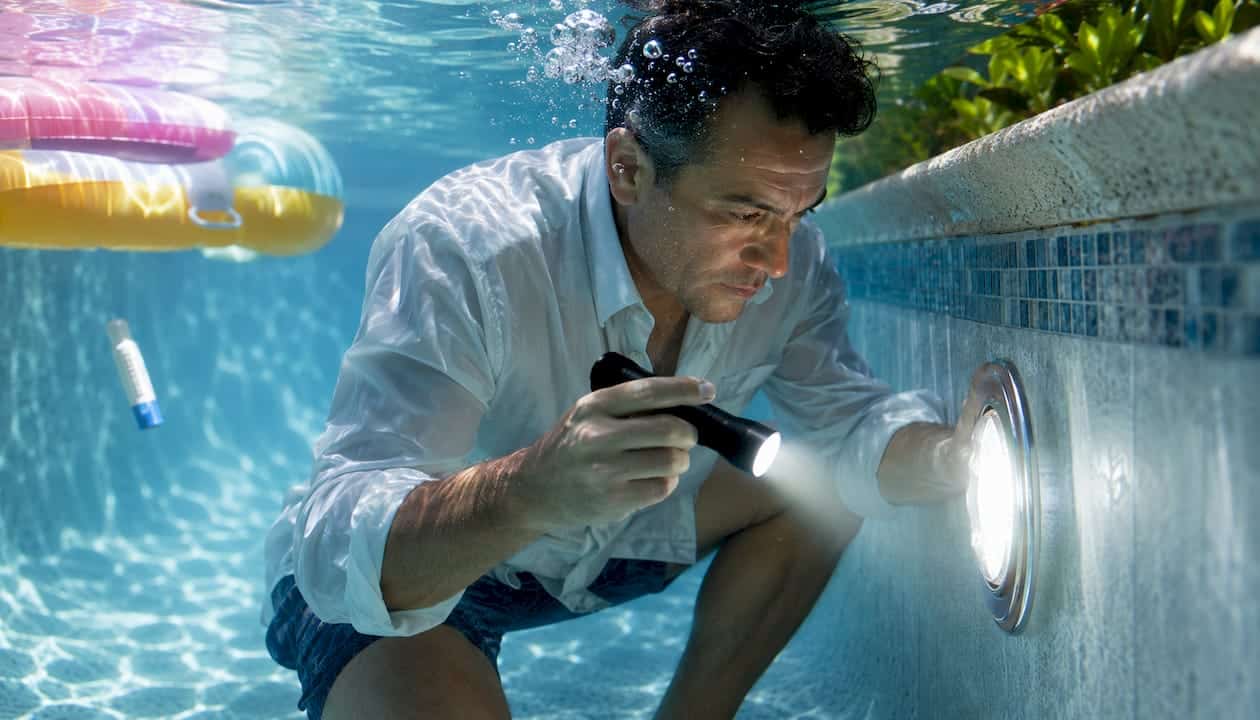
TL;DR:
- Upgrading pool lighting during a renovation saves costs, simplifies installation, and ensures code compliance. full fixture replacements or retrofit bulbs depend on niche condition, bonding, and automation compatibility. A licensed contractor handles permits, testing, and warranty coverage for lasting safety and performance.
For most Florida pools, the right move is a hardwired, pool-rated LED fixture or full fixture replacement, coordinated with your next renovation and installed by a licensed contractor whenever the work touches niche housings, conduit, or bonding. LED fixtures use significantly less energy than incandescent equivalents, have long lifespans, and cost far less to add during a resurfacing project than as a standalone job later.
Three reasons to act during a renovation: labor is already on-site, the shell is accessible, and there is no separate drain-and-fill cycle. Commercial property managers have an additional obligation: Florida Department of Health Rule 64E-9 sets minimum illumination levels for public and hotel pools, and a simple bulb swap rarely satisfies those engineered requirements.
Table of Contents
- 1. Should you DIY or hire a pro for a pool lighting upgrade?
- 2. Why scheduling lighting upgrades during a pool renovation saves money
- 3. What are your best pool lighting options?
- 4. How do you know if a quick retrofit will work or if you need full replacement?
- 5. What does a professional lighting upgrade actually include?
- 6. What do Florida commercial pools need to comply with?
- 7. What affects the cost and timeline of a lighting upgrade?
- 8. Questions to ask before hiring a pool lighting contractor
- 9. How do you avoid “control chaos” and future-proof your lighting?
- Key Takeaways
- What Florida pool renovators actually see on the job
- Classicmarcite handles pool lighting upgrades across Florida
- Sources and further reading
1. Should you DIY or hire a pro for a pool lighting upgrade?
The answer depends on what the job actually touches.
A screw-in LED retrofit is a reasonable DIY task when:
- The existing niche housing is clean, dry, and corrosion-free
- The cord is the correct length and undamaged
- You are staying within the same voltage class (12V to 12V, or 120V to 120V)
- The gasket only needs replacement, not the housing
Hire a licensed contractor when:
- The niche shows visible corrosion or water intrusion
- Bonding conductors are corroded or continuity is broken
- You are changing voltage class (120V to 12V or vice versa)
- New conduit runs or junction-box work are required
- A permit is likely required by your local building department
NEC Article 680 governs bonding, GFCI protection, and wet-niche versus dry-niche classifications. Florida enforces this through local building departments and DBPR contractor licensing. Getting the bonding wrong is not a minor code issue; it creates an electric shock drowning risk.
Pro Tip: Before buying any retrofit parts, pull the existing fixture onto the deck and inspect the housing, cord, and niche. A five-minute inspection prevents a wasted parts order and a second service call.
Professional pool service carries real advantages beyond code compliance. Contractors carry liability insurance, pull permits, and provide written warranties that protect you if something fails after the job closes.
2. Why scheduling lighting upgrades during a pool renovation saves money
Adding lighting during a renovation is significantly more cost-effective because the shell is already accessible, electricians are already on-site, and there is no separate drain-and-fill cycle to pay for.
- No deck cutting: conduit runs happen while the deck is open
- No diver or separate drain: the pool is already empty for resurfacing
- Niche housings can be cut and installed cleanly into fresh shell material
- Electrical and plumbing trades are coordinated in a single mobilization
A standalone retrofit that requires draining, deck cutting, and a separate electrical visit can cost significantly more than the same scope bundled into a resurfacing project. The incremental cost of adding a fixture during renovation is mostly materials, not labor.
Pro Tip: Decide on fixture placement before the resurfacing coat goes on. Niches cut after a new Pebble Tec® or marcite finish require extra care to avoid cracking the fresh surface. Plan lighting in the design phase, not as an afterthought.
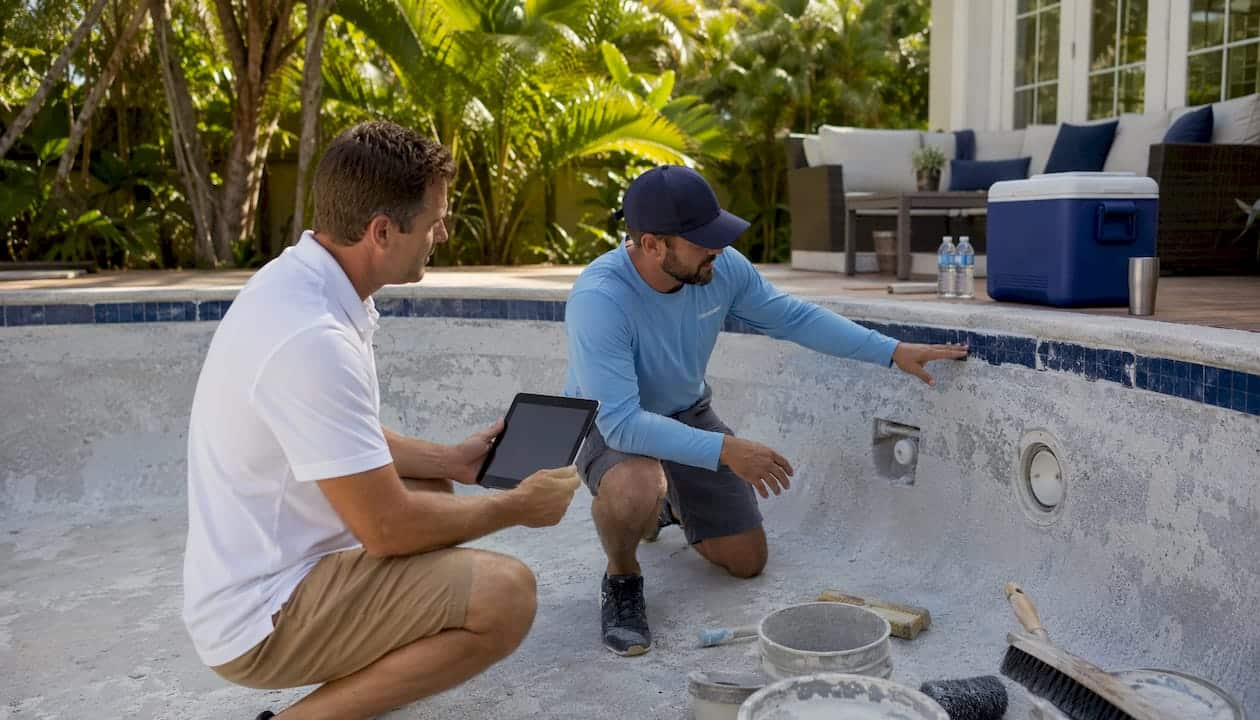
Pairing lighting with pool resurfacing and renovation also lets you coordinate fixture color temperature and beam angle with the new interior finish, so the final result looks intentional rather than patched together.
3. What are your best pool lighting options?
| Type | Best Use | Pros | Cons |
|---|---|---|---|
| Full fixture replacement | Corroded or incompatible niche housings | Most reliable, future-proof, fresh cord | Higher labor, may require conduit work |
| Screw-in LED retrofit bulb | Serviceable niche, same voltage class | Fast, low cost, minimal disruption | Limited by niche depth and gasket condition |
| Color-changing RGB/RGBW | Pools with automation systems | Dramatic visual effect, app control | Must match automation platform to avoid control issues |
| Fiber optic | Accent lighting, near electrical panels | No electricity in water | Lower lumen output, not suitable for full-pool illumination |
| LED strip lights | Above-ground pools, tanning ledges, water features | Great for accents and perimeter | Not rated for full submersion in most configurations |
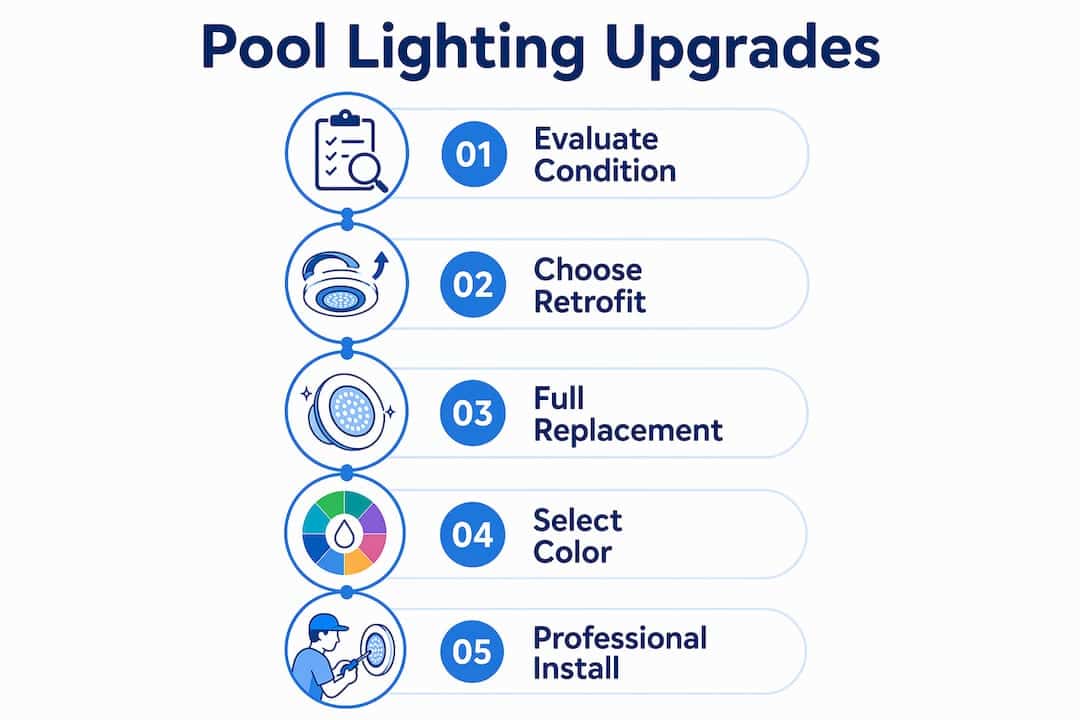
Full fixture replacement is the right call when niche housings are corroded, cracked, or dimensionally incompatible with modern LED units. The labor is higher, but you get a new cord, a verified seal, and a fixture that will not fail in six months.
Screw-in LED retrofit bulbs cost $40–$150 per unit and install quickly when the housing is compatible. The catch: many older niche housings lack the clearance or structural integrity for a reliable retrofit.
Color-changing RGB/RGBW fixtures deliver the most visual impact. Experts recommend choosing your automation platform first and then matching fixtures to it, avoiding adapters, limited color sync, and warranty fragmentation.
4. How do you know if a quick retrofit will work or if you need full replacement?
A retrofit is only a low-cost fix when the niche, cord, gasket, and bonding are all in good condition. Any one of these failing pushes the job into licensed-contractor territory.
Run through this checklist before ordering parts:
- Visible rust, pitting, or white mineral deposits on the niche housing
- Cracked or cloudy lens
- Cord shorter than the service loop requires (common in older Florida pools)
- Water or condensation inside the niche
- Voltage mismatch between the existing transformer and the new fixture
- Transformer that flickers or fails to hold output under load
- Color control that behaves erratically or loses sync
Corroded housings and broken bonding wires are the most common causes of retrofit failure, not the lamp itself. Professionals test bonding continuity before approving any bulb swap.
5. What does a professional lighting upgrade actually include?
Knowing the scope helps you get accurate, comparable quotes. Here is what a complete professional upgrade covers:
- Site inspection: Niche dimensions, conduit condition, transformer sizing, junction box condition, bonding continuity check, and automation compatibility review.
- Permit application: Licensed contractor pulls the required electrical permit with the local building department; GFCI protection is verified.
- Transformer selection: Sized to total fixture wattage with at least 20% headroom to prevent flicker or premature failure.
- Fixture and conduit work: Cutting or installing niches if needed, pulling new cords through conduit, sealing, and gasket replacement.
- Testing and inspection: Submersion test, GFCI trip-time verification, bonding continuity confirmation, and final building inspection sign-off.
| Scope | Typical Timeline |
|---|---|
| Simple LED retrofit (same niche, same voltage) | Hours to 1 day |
| Full fixture replacement during renovation | 1–3 days plus drain/fill and inspection |
| Adding new circuits or conduit runs | Several days, permit-dependent |
Require these deliverables in every quote: itemized scope with fixture model numbers, labor hours, permit and inspection fees, warranty terms for both fixtures and workmanship, and a project timeline with milestones.
Pro Tip: Require written bonding continuity verification and a GFCI test result before you sign off on project close. Any contractor unwilling to provide these in writing is a contractor worth replacing.
6. What do Florida commercial pools need to comply with?
Commercial pools in Florida face requirements beyond the residential NEC standard. Florida Department of Health Rule 64E-9 sets minimum illumination levels for public and hotel pools, and inspectors verify photometric coverage, not just fixture presence.
- Minimum illumination: 0.5 foot-candles at all points on the pool bottom is the standard floor threshold under Rule 64E-9
- Engineered verification: Commercial upgrades typically require documented photometric test results, not just a visual check
- NEC Article 680 compliance: Wet-niche versus dry-niche classifications, bonding conductor requirements, and GFCI protections are all enforced via local building departments
- Licensed contractor required: Permits must be pulled by a licensed contractor; inspectors close the job only after documented test results are submitted
Commercial property managers should budget for engineered photometric verification when upgrading lighting. A simple bulb swap almost never satisfies these requirements. For more on managing commercial pool upgrades in Florida, commercial pool upgrade planning covers the full scope of what inspectors look for.
7. What affects the cost and timeline of a lighting upgrade?
Major cost drivers:
- Fixture type: retrofit bulbs ($40–$150 per unit in parts) versus full fixture replacements ($250–$900 per unit plus labor)
- Number of fixtures and conduit run lengths
- Whether the pool needs to be drained separately
- Transformer replacement and sizing
- Permit and inspection fees (vary by county in Florida)
- Automation integration and control hardware
Fiber optic and specialty systems typically run higher than standard LED fixture replacements. Energy savings from LED upgrades offset operating costs over time, particularly for commercial pools running lights several hours nightly.
Timeline follows scope: a simple retrofit wraps in a day; full fixture replacement during a renovation takes 1–3 days plus drain/fill and inspection scheduling; adding new circuits can stretch to several days depending on permit turnaround in your county.
8. Questions to ask before hiring a pool lighting contractor
Ask every contractor these questions:
- What is your exact license type? (Florida DBPR issues both Electrical Contractor and Swimming Pool/Spa Contractor licenses; confirm which applies to the scope.)
- Do you carry general liability and workers’ compensation insurance?
- Who pulls the permit, and is the permit fee included in the quote?
- What does your workmanship warranty cover, and for how long?
- Will you provide written bonding continuity verification and a GFCI test result?
Require these documents before signing:
- Written scope with fixture model numbers and quantities
- Itemized labor and materials breakdown
- Wiring diagrams if circuits are being added or changed
- Permit and inspection fee line items
- Warranty terms for both labor and fixtures
- Project timeline with milestones
Trust signals worth checking: a portfolio of completed lighting projects, a written warranty on workmanship, a free on-site inspection before quoting, and an itemized bid that includes permit fees. You can review completed residential projects to understand what finished work should look like.
Pro Tip: Get at least two itemized quotes. A quote that bundles everything into a single line item makes it impossible to compare bids or identify what you are actually paying for.
9. How do you avoid “control chaos” and future-proof your lighting?
LED fixtures use significantly less energy than incandescent equivalents and can have very long operational lifespans. That translates to fewer maintenance visits and lower electricity bills, especially for commercial pools running lights nightly.
The bigger long-term risk is control fragmentation. Mixing lighting brands with existing automation platforms often requires complex adapters, reduces color-sync capability, and can void manufacturer warranty coverage. The cleaner path: choose your automation platform first, then select LED fixtures verified to work with it.
Specs to require for a future-proof installation:
- UL 676 or ETL pool-rated fixture listing
- Transformer sized with at least 20% headroom above total fixture wattage
- Control protocol supported natively by your automation system (Hayward, Jandy, Pentair, or equivalent)
- Conduit sized to allow future cord pulls without deck cutting
For outdoor lighting that integrates with your broader backyard setup, LED outdoor lighting principles apply equally to pool perimeter and deck fixtures.
Pro Tip: Run conduit slightly oversized during renovation. The marginal cost at installation is minimal; pulling a new cord through undersized conduit years later is not.
Key Takeaways
Upgrading pool lighting during a renovation is the most cost-effective path for Florida homeowners and commercial property managers, and any work touching conduit, bonding, or permits requires a licensed contractor.
| Point | Details |
|---|---|
| Retrofit vs. replacement | Base the decision on niche condition and bonding continuity, not just fixture age. |
| Bundle with renovation | Lighting added during resurfacing avoids a separate drain cycle and uses on-site labor. |
| Commercial compliance | Florida Rule 64E-9 requires engineered photometric verification; a bulb swap rarely qualifies. |
| LED energy savings | LED fixtures use significantly less energy than incandescent equivalents and have long lifespans. |
| Classicmarcite | Provides lighting integration during resurfacing and standalone fixture replacement with permit handling and written warranty in Orlando and Jacksonville. |
What Florida pool renovators actually see on the job
Most lighting problems in Florida pools come down to three things: corroded niche housings from years of chemical exposure, cord lengths that are too short to bring the fixture onto the deck for service, and automation systems that were expanded piecemeal until nobody can control all the lights from one place.
The fix for all three is the same: address lighting during the resurfacing scope, not after. When the shell is open and the trades are already coordinated, niche housings can be replaced cleanly, cord lengths can be corrected, and a unified automation platform can be specified from the start. Doing it afterward means a second mobilization, a second drain, and a second permit in many cases.
What a proper walkthrough covers: niche dimensions and housing condition, bonding continuity, transformer sizing, conduit capacity, and automation compatibility. Those five checks determine whether you are looking at a retrofit or a full fixture replacement, and they prevent the scenario where a homeowner buys parts, installs them, and calls back two weeks later because the new fixture leaks or the color sync does not work.
Classicmarcite handles pool lighting upgrades across Florida
Classic Marcite has resurfaced more than 100,000 pools in Orlando, Jacksonville, and across Florida since 1988. Lighting integration is a standard part of the renovation scope: licensed electricians handle niche work, conduit, bonding verification, and permit pulls, and every project closes with an itemized warranty covering both fixtures and workmanship.
For homeowners planning a resurfacing project, adding lighting during the same mobilization is the most cost-effective path. For commercial property managers, Classicmarcite coordinates the engineered photometric documentation Rule 64E-9 requires. Every quote includes an on-site inspection, niche and bonding verification, permit fees as a line item, and a written timeline.
Request a free estimate for pool resurfacing in Orlando or contact Classicmarcite directly to schedule a walkthrough and get an itemized quote for your lighting upgrade.
Sources and further reading
Regulatory references:
- NEC Article 680 and Florida pool lighting code requirements
- Florida Department of Health Rule 64E-9 commercial pool standards
- Sarasota pool lighting upgrade permitting and inspection framework
How-to and product resources:
- LED retrofit vs. full fixture replacement guide
- LED pool lighting cost, options, and energy savings
- Transformer sizing and retrofit compatibility
- Pool lighting automation and control integration in Florida
- Bonding continuity and retrofit failure causes
- LED outdoor lighting benefits for homeowners
Classicmarcite resources:
- Pool lighting and renovation planning
- Pool resurfacing in Orlando
- Commercial pool upgrade ideas for Florida owners
- Energy-efficient pool upgrades