TL;DR:
- Most homeowners overlook that proper installation and ongoing maintenance are crucial for quartz pool finish longevity.
- Choosing the right contractor and adhering to water chemistry protocols can significantly extend the finish’s lifespan beyond material quality alone.
Most pool owners in Orlando and Jacksonville spend months choosing the right finish color, assuming that decision alone determines how long their pool will look great. That assumption costs people thousands of dollars every year. Quartz pool finish is one of the most popular choices on the market right now, and for good reason. It’s hard, it sparkles, and it holds color beautifully in Florida’s intense sunlight. But whether your quartz finish lasts 5 years or 15 comes down to factors most homeowners never hear about until something goes wrong.
Table of Contents
- What is a quartz pool finish?
- Quartz vs. other pool finishes: how does it compare?
- What really impacts quartz pool finish lifespan?
- Caring for a quartz pool finish: essential tips
- Why focusing only on finish type is a rookie mistake
- Ready for a quartz pool upgrade? Get expert results
- Frequently asked questions
Key Takeaways
| Point | Details |
|---|---|
| Quartz finish blends strength and beauty | This pool surface combines plaster and quartz for vibrant color and greater resilience than standard plaster. |
| Success depends on more than material | Lasting results rely on proper installation, curing, and attentive water chemistry—not just finish choice. |
| Early care is critical | Brushing and chemistry management during the first weeks prevent early wear and discoloration. |
| Routine maintenance protects investment | Consistent cleaning and testing help maintain quartz’s durability and stunning appearance over the years. |
What is a quartz pool finish?
Quartz pool finish is a surface coating made by blending white cement plaster with natural quartz crystal aggregates. That combination creates a surface that’s denser and harder than standard plaster alone. The quartz crystals are what give the finish its signature sparkle and visual depth, and because quartz is a naturally hard mineral, the finish resists scratching and staining better than basic white plaster.
Here’s what sets quartz apart from older plaster finishes:
- Hardness: Quartz is significantly harder than calcium carbonate plaster, so it resists etching from slightly acidic water.
- Color consistency: Pigments blend more evenly into quartz mixes, giving you richer, more stable color over time.
- Stain resistance: The denser surface is less porous, so algae and mineral stains have a harder time penetrating.
- Visual appeal: The crystal structure reflects light in a way that makes the water look vivid and bright.
You can learn more about how pool surface materials compare by reading about what is pool plaster and the role it plays in overall pool health.
One important thing to understand is that the material is only part of the equation. Proper installation, curing, and chemistry are crucial to avoid early deterioration or discoloration. A perfectly formulated quartz mix can still fail within two or three years if it was applied incorrectly or if start-up water chemistry was off. That reality changes how you should think about choosing a finish entirely.
Quartz vs. other pool finishes: how does it compare?
Now that you know what quartz finish is, see how it stacks up against the most common alternatives.
The three finishes most Orlando and Jacksonville homeowners consider are standard plaster, quartz aggregate, and pebble aggregate finishes. Each has a different feel, price point, and maintenance profile.
| Feature | Standard plaster | Quartz aggregate | Pebble aggregate |
|---|---|---|---|
| Surface feel | Smooth, slightly rough over time | Smooth to slightly textured | Rougher, natural texture |
| Average lifespan | 5 to 10 years | 10 to 15 years | 15 to 20+ years |
| Stain resistance | Low to moderate | Moderate to high | High |
| Color options | Limited | Wide range | Very wide range |
| Cost range | Lowest | Mid range | Highest |
| Maintenance demand | High | Moderate | Moderate to low |
What this table doesn’t show is the role workmanship plays in every single row. Workmanship and consistent chemistry management influence durability as much as finish type does. A pebble finish applied by an inexperienced crew with poor start-up procedures won’t outlast a well-applied quartz finish with proper care.
For Florida homeowners, a few specific factors tilt the comparison:
- UV exposure: Florida’s sun is relentless. Quartz holds color far longer than standard plaster under direct sunlight.
- Heat and evaporation: Concentrated pool water chemistry is a real issue in warm climates. Quartz tolerates moderate pH swings better than plain plaster.
- Humidity and algae pressure: Florida’s humidity creates year-round algae risk. The denser quartz surface offers less opportunity for algae to root compared to pitted or worn plaster.
When you’re weighing options, it helps to explore best resurfacing materials for Florida conditions, and to understand the difference between replastering vs resurfacing before committing to a specific approach.
What really impacts quartz pool finish lifespan?
Comparing finishes is useful, but what determines if your quartz finish actually lasts? Here are the factors that matter most.
The single biggest variable isn’t the brand of quartz you choose. It’s the process your contractor follows from day one.
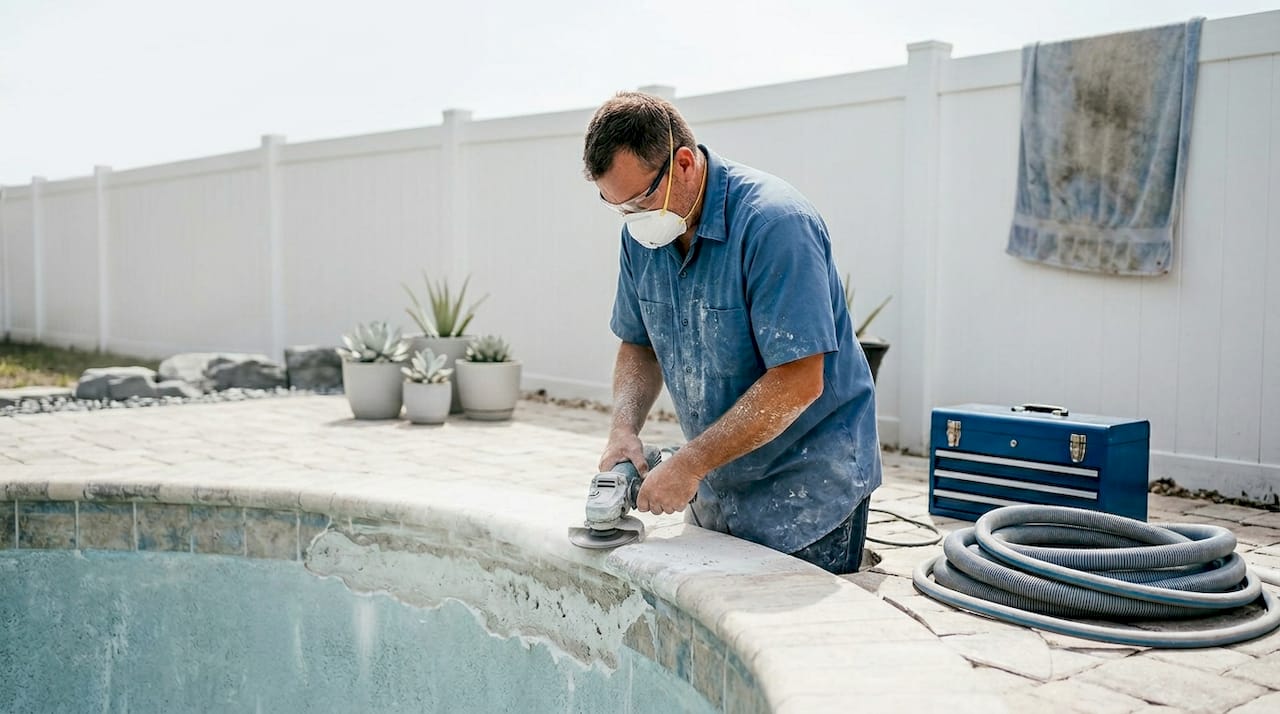
Step 1: Surface preparation
Old plaster must be fully removed or properly abraded. Any contamination, bonding agent failure, or surface moisture during application creates weak spots that will crack or delaminate within years, sometimes months.
Step 2: Mixing and application
The water-to-cement ratio must be controlled tightly. Over-watering the mix weakens the finish structurally. Troweling technique matters too. Overtroweling, meaning working the surface too aggressively, brings excess water and cement paste to the top, creating a soft layer that wears quickly.
Step 3: Curing and exposure
After application, how quickly the finish cures and when the pool is filled both affect the outcome. Rushing the fill or filling too slowly can cause uneven hydration. Improper application, curing, and water chemistry can cause early deterioration and discoloration. This is a well-documented problem in warm climates where ambient temperature speeds up drying.
Step 4: Start-up water chemistry
This is where a lot of homeowners get blindsided. The first 28 days after fill are the most critical period in your finish’s entire life.
“The first month of water chemistry management does more to determine finish lifespan than any single product decision you make.”
Here’s what the start-up phase requires:
- Fill the pool with a garden hose running continuously into the deep end to avoid tide marks.
- Begin running the pump immediately.
- Brush the entire pool surface once or twice daily for the first 14 days. This removes plaster dust and prevents spotting.
- Test water chemistry daily for the first week, then every other day through week four.
- Keep pH between 7.4 and 7.6 during start-up. Lower pH is aggressive and etches the fresh surface.
- Keep calcium hardness above 200 ppm to prevent the water from drawing calcium out of the finish itself.
Pro Tip: Ask your contractor exactly what their start-up procedure is before you sign anything. A contractor who can’t give you a detailed, written start-up plan is a contractor who will blame the finish manufacturer when something goes wrong.
Workmanship and chemistry often outweigh finish type in real-world durability results. Understanding why finishes peel can help you recognize warning signs early. And if you want to see how quality shows up in practice, reviewing examples of pool finishes from actual Florida homes gives you a concrete visual reference.
When choosing your pool finish, make sure the conversation includes installer credentials, not just material options.
Caring for a quartz pool finish: essential tips
Knowing the real-world factors is one part. Here’s how you can protect your investment with proven care steps.
Once your pool is filled and the start-up phase begins, your job as the homeowner shifts to consistent maintenance. The good news is that quartz finishes are forgiving compared to standard plaster, but they still need regular attention, especially in Florida.
Weekly care routine:
- Test and adjust pH, alkalinity, and calcium hardness every 5 to 7 days.
- Brush the walls and floor weekly. Even after start-up, brushing keeps mineral deposits from settling into the surface.
- Check and clean the filter to maintain good water flow. Poor circulation leads to localized chemistry imbalances.
- Skim and vacuum debris before organic matter has a chance to stain the finish.
First-month priorities:
Repeated brushing and careful monitoring of water chemistry are critical in the first days and weeks after installation. This isn’t a suggestion. Skipping brushing during start-up almost guarantees you’ll see gray or white blotching within months.
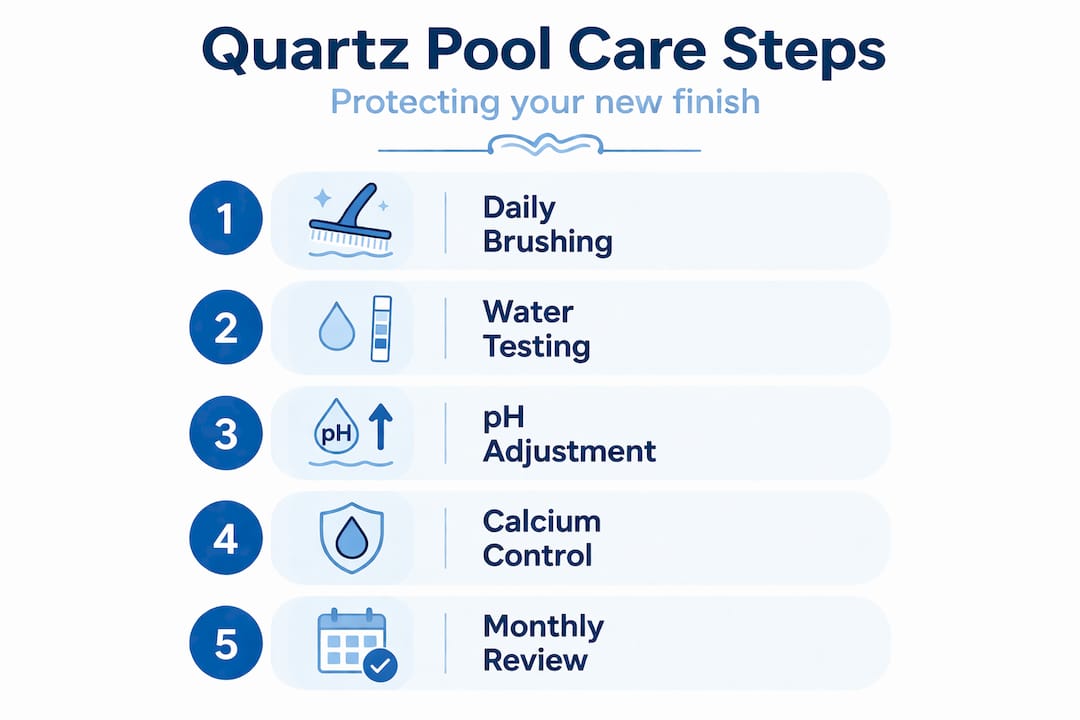
| Care task | First 30 days | Ongoing monthly |
|---|---|---|
| Brushing frequency | Once to twice daily | Once weekly |
| Water chemistry testing | Daily for week 1 to 2 | Weekly |
| pH target | 7.4 to 7.6 | 7.4 to 7.8 |
| Calcium hardness | 200 to 250 ppm | 200 to 400 ppm |
| Alkalinity | 80 to 120 ppm | 80 to 120 ppm |
| Filter operation | Continuous | 8 to 12 hours daily |
Seasonal considerations for Florida:
Summer heat accelerates evaporation, concentrating minerals and raising calcium hardness. Test more frequently during June through September. Fall and winter rains in Florida can dilute pool chemistry fast. After heavy rain events, always test before swimming.
Pro Tip: Keep a simple log of your weekly test results. Patterns in chemistry shifts alert you to problems, like rising calcium or persistent pH drift, long before they cause visible damage.
Spotting problems early:
- White or gray spots: Often mineral scaling from high calcium. Address chemistry before it worsens.
- Rough texture: Can signal etching from low pH. Rebalance water and consult a pro.
- Staining near returns or lights: Usually a circulation or equipment issue, not a finish failure.
- Small cracks: Normal if hairline and shallow. Deep or widening cracks need professional evaluation.
For a full breakdown of what to do after your pool is resurfaced, the guide on post-resurfacing maintenance covers each phase clearly. And for ongoing care beyond the first year, maintaining your pool surface is a practical long-term reference.
Why focusing only on finish type is a rookie mistake
Here’s something the pool industry doesn’t advertise loudly: material choice is the easiest part of the entire resurfacing process. It’s the part contractors show you in showrooms, the part that photographs well, and the part that fills sales brochures. What doesn’t get equal airtime is the fact that finish type alone does not guarantee durability. Real-world outcomes depend heavily on workmanship and ongoing maintenance.
We’ve seen it play out over nearly four decades and more than 100,000 pools. A homeowner upgrades to a premium quartz finish, pays top dollar, and then discovers scaling and discoloration within 18 months. Almost every time, the cause isn’t the material. It’s a rushed application, improper troweling, a contractor who filled the pool too fast, or a homeowner who skipped the first month of brushing because they didn’t know it mattered.
The uncomfortable truth is that a $3,000 standard plaster job done by a skilled, methodical crew with a rigorous start-up protocol will frequently outlast a $6,000 quartz job done by an inexperienced team in a hurry to move to the next project.
What does this mean for you practically? Vet your installer harder than you vet the material. Ask how long they’ve been applying this specific finish. Ask them to walk you through their troweling and curing process step by step. Ask for a written start-up care plan. If they can’t answer clearly, keep looking.
Following real maintenance advice from experienced professionals rather than generic product marketing is how you protect your investment. The homeowners who get 15 years out of their quartz finish aren’t the ones who picked the most expensive product. They’re the ones who hired the right crew and stayed on top of their water chemistry every single week.
Ready for a quartz pool upgrade? Get expert results
If this article has shifted how you think about quartz pool finish, you’re already ahead of most homeowners who start the resurfacing process. The next step is pairing that knowledge with professionals who back it up with real process discipline.

Classic Marcite has resurfaced more than 100,000 pools since 1988, and we’re the largest Pebble Tec® applicator in Central Florida. Whether you’re starting with the Florida resurfacing basics or ready to book a free estimate for your home, we bring the same standards to every job. If you’re in the Jacksonville area, explore our dedicated Jacksonville pool renovation services. Want to see your interior finish options in full? Our guide to Florida indoor pool finishes walks through every choice available for your space.
Frequently asked questions
What is a quartz pool finish made of?
Quartz pool finishes combine plaster and quartz crystals in a blended aggregate mix that delivers added durability, color stability, and stronger stain resistance than plain plaster.
How long does a quartz pool finish last?
With skilled installation and proper water chemistry, quartz pool finishes typically last 10 to 15 years. Proper prep, curing, and chemistry management are the key variables that determine where your finish lands in that range.
What routine care does a quartz pool finish need?
Initially, daily brushing and balanced water chemistry are the top priorities during the first 30 days. Long term, weekly brushing and chemistry testing keep the surface clean, stain-free, and structurally sound.
Can you repair damaged quartz pool finish?
Small localized areas can often be patched by an experienced professional, but widespread discoloration, scaling, or structural cracking typically means the pool needs full resurfacing to restore appearance and performance.