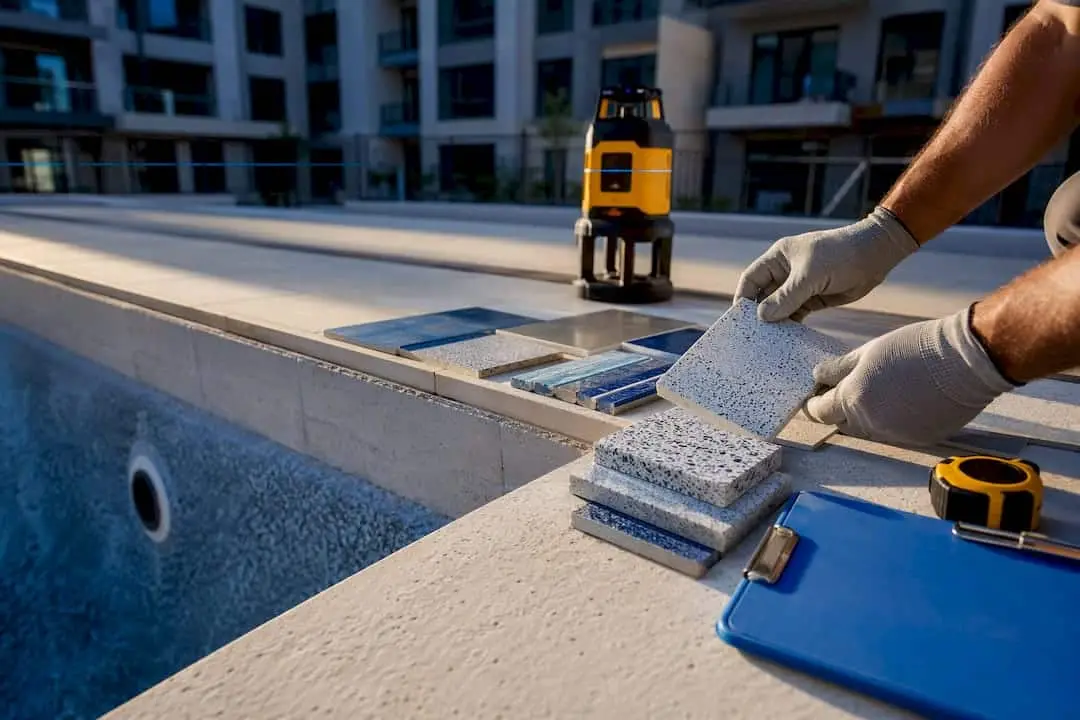
Apartment pool renovation planning starts with one non-negotiable step: commission a documented condition assessment before anyone talks budget. That assessment, covering shell integrity, hydraulics, and code compliance, becomes the scope. Boards that skip straight to bids end up approving guesswork, not a project. From there, the priority order is safety and compliance, then phasing to protect the amenity, then budget transparency so owners see exactly what they’re funding.
TL;DR:
- Conduct a detailed condition assessment covering shell, finish, tile, deck, mechanical, plumbing, electrical, and safety systems to establish an accurate scope before bidding.
- Decide between resurfacing, refreshing, or full renovation based on the assessment findings, with durations ranging from 3 to 18 weeks, depending on scope complexity.
- Schedule project timelines during off-season windows, setting clear reopening dates, phasing strategies, and early procurement of permits and materials to minimize disruptions.
- Ensure compliance with federal anti-entrapment laws, ADA standards, and local health codes throughout the project, with early coordination to avoid delays.
- Build a comprehensive, phased budget based on needs versus wants, including hidden condition risks, with contingency allowances of 10-20 percent for full renovations.
Table of Contents
- What Should a Pool Condition Assessment Cover?
- Resurface, Refresh, or Full Renovation: How Boards Should Decide
- How Should Boards Schedule and Phase a Pool Renovation?
- What Codes and Safety Rules Affect Renovation Scope?
- How Do You Build a Defensible Pool Renovation Budget?
- How Should Boards Run a Pool Renovation RFP?
- Which Equipment Upgrades Are Worth Bundling Into a Renovation?
- Why Classic Marcite Fits HOA and Apartment Renovation Projects
- Board Checklist: From Assessment to Reopening
- What Contractors Wish Boards Understood About Renovation Risk
- Get a Scoped Walkthrough From Classic Marcite
- Sources
What Should a Pool Condition Assessment Cover?
A condition assessment is the document that turns “the pool looks tired” into a scope a contractor can price accurately. Commercial contractors routinely say the biggest source of renovation disputes is a scope built on a walkthrough impression instead of documented deficiencies, which is why pricing should come from the assessment, not a visual estimate.
The inspection needs to cover the full system, not just the finish:
- Shell integrity: cracks, hollow spots, structural movement
- Finish condition: etching, staining, delamination, roughness
- Tile and coping: loose grout, spalling, cracked coping stones
- Deck slope and drainage: ponding, cracking, trip hazards
- Mechanical room: pump age, filtration capacity, wiring condition
- Plumbing and electrical: corrosion, bonding, GFCI compliance
- Access points, fencing, gates, and required signage
Diagnostics worth commissioning include leak detection, core samples on questionable substrate, flow and turnover testing, and an equipment load review, backed by annotated photos and as-built verification. The deliverable the board actually needs is a prioritized deficiency list, with each item written as a problem statement tied to an operational consequence, plus rough phasing suggestions and a contingency allowance.
Pro Tip: Ask the assessor for measurable hydraulic numbers, not adjectives. “Circulation seems weak” is not.
Resurface, Refresh, or Full Renovation: How Boards Should Decide
Not every pool needs a full renovation, but every board needs a clear rule for deciding which scope fits. Match the decision to what the condition assessment actually found, not to what’s easiest to approve.
- Resurface only: The shell is sound and the deficiency list is limited to finish wear, staining, or surface roughness. Fastest and cheapest path, but it carries risk if hidden substrate issues surface once the old finish comes off.
- Refresh (tile, coping, equipment): Multiple visible subsystems are aging in parallel. Since the pool is already drained for finish work, bundling tile and equipment replacement is usually the efficient move.
- Full renovation: The assessment turns up structural cracking, hydraulic failures, or code gaps. Costlier and longer, but it avoids draining and remobilizing crews twice within a few years.
Duration is the clearest signal of which category a project actually falls into. Surface refinishing alone typically runs 3 to 5 weeks, partial renovations run 6 to 10 weeks, and full renovations run 10 to 18 weeks. Commercial pricing is quoted per property after a walkthrough, since bather load and phasing complexity change the numbers enough that generic price lists aren’t useful. For finish-level detail on what resurfacing actually replaces, see this breakdown of key renovation components.
How Should Boards Schedule and Phase a Pool Renovation?
Work backward from opening day, not forward from the vote. Off-season windows, roughly fall through early spring in most climates, fill up fast, and boards that start scoping a season ahead get smoother projects with less resident friction.
- Set the reopening target and count backward through cure time, procurement, and permitting.
- Choose a phasing model: full closure for speed, partial-area sequencing if the pool can be split, or staged deck-then-shell work to keep some access open.
- Line up lead times early: permitting review, specialty finish material orders, and equipment procurement often move slower than the construction itself.
- Build in a contingency buffer, typically two to four weeks, for weather, inspection delays, or discovered conditions.
- Time resident notices to land alongside procurement milestones, not after the crew has already arrived.
Pro Tip: Send the first resident notice the day the board approves scope, not the week before demolition. Complaints spike hardest when people feel ambushed, not when they’re simply inconvenienced.
What Codes and Safety Rules Affect Renovation Scope?
Commercial pool work touches three regulatory layers that change scope more often than boards expect: federal anti-entrapment law, accessibility standards, and state or local health codes. Missing any one of them mid-project stalls the schedule.
- VGB Act compliance: Anti-entrapment requirements can force drain and circulation changes whenever plumbing is disturbed, triggering rework and re-inspection if overlooked upfront.
- ADA 2010 Standards: Pool entry and exit points may require accessible means, like a fixed lift or sloped entry, that change deck and shell design.
- Health department plan review: Most jurisdictions require plan review before construction and hold points during it; find your local requirements early, since renovation projects often need concurrent building and health reviews.
- Closeout documentation: Insist on inspection signoffs and compliance records in the final contract deliverables, not verbal assurances.
How Do You Build a Defensible Pool Renovation Budget?
A budget survives board scrutiny when it separates what the pool needs from what the board wants, and shows its math. The riskiest line items are the ones nobody can see until demolition starts: substrate deterioration under an old finish, concealed rebar corrosion, and grading problems that only reveal themselves once decking comes up.
- List cost drivers explicitly: substrate repair, corrosion remediation, re-grading for drainage, code-triggered upgrades.
- Separate “needs” (safety, code, structural) from “wants” (design upgrades, water features) so the board can trim without cutting anything essential.
- Present pricing in phases tied to consequences, since documenting the operational impact of each item makes it far easier to defend a line item to skeptical owners.
- Build in contingency, generally 10 to 20% for full renovations given the hidden-condition risk.
Funding usually comes from reserves, a special assessment, financing, or some blend of the three. Whichever route the board picks, the pool should be tied to the reserve study’s lifecycle planning rather than treated as an emergency expense, since deferred capital work almost always costs more later than it would have cost on schedule.
How Should Boards Run a Pool Renovation RFP?
A tight RFP is the single best defense against change orders. Every proposal should be priced from the same documented condition assessment, not from a contractor’s own site visit, so bids are actually comparable.
- Require documented scope: each deficiency item, tied to its operational consequence, with fixed milestones and clear permit responsibility.
- Ask for commissioning and training deliverables, plus warranty terms and proof of insurance, in writing before any contract is signed.
- Verify commercial qualifications: license status, HOA or apartment project references, and evidence of systems-based renovation experience rather than surface-only jobs.
- Establish governance: one project manager as single point of contact, a defined change-control process, and documentation requirements for board acceptance at closeout.
The workflow a contractor follows tells you almost as much about reliability as their price does.
Which Equipment Upgrades Are Worth Bundling Into a Renovation?
Draining the pool for resurfacing is the cheapest moment to upgrade equipment you’ll be running for the next decade. The highest-value additions are variable-speed pumps, upgraded filtration, chemical automation, leak detection, and a modern controller.
- Variable-speed pumps and better filtration typically cut energy use and improve turnover consistency compared to older single-speed systems.
- Chemical automation reduces the staffing burden of manual dosing and keeps water chemistry more stable between checks.
- Leak detection systems catch small losses before they become shell damage.
Pro Tip: Write commissioning and operator training into the contract itself. Equipment that’s never properly tuned rarely delivers the efficiency gains it was bought for.
Why Classic Marcite Fits HOA and Apartment Renovation Projects
Classic Marcite has resurfaced more than 100,000 pools since 1988, with deep specialization in Pebble Tec® finishes, and that volume includes a substantial share of commercial and HOA work, not just backyard pools. That history matters for boards because commercial resurfacing runs on different logistics than residential jobs: phased scheduling, warranty documentation, and formal handoff packages that satisfy board recordkeeping.
A scoped walkthrough with Classic Marcite typically produces:
- A documented condition assessment with annotated photos
- A prioritized deficiency list tied to operational impact
- A board-ready scope and cost breakdown, phased where useful
Readers weighing finish options can review why Pebble Tec holds up under heavy commercial bather loads before requesting an estimate.
Board Checklist: From Assessment to Reopening
Three phases carry every renovation from a board vote to a reopened pool.
- Immediate: commission the condition assessment, cross-check it against the reserve study, and set a firm approval deadline for the board.
- Procurement: draft the RFP, shortlist qualified contractors, and confirm which permitting authority and inspections apply.
- Execution: lock in phasing, contingency windows, commissioning, operator training, and the resident notice schedule.
| Phase | Key Action | Owner |
|---|---|---|
| Immediate | Commission condition assessment | Board / property manager |
| Immediate | Align findings with reserve study | Board |
| Procurement | Issue RFP, verify permits | Property manager |
| Execution | Confirm phasing and contingency | Contractor + PM |
| Execution | Commissioning and training | Contractor |
For readers planning a bigger amenity redesign alongside the renovation, this apartment pool design planning guide covers layout considerations worth folding into scope discussions early.
What Contractors Wish Boards Understood About Renovation Risk
Most renovation surprises aren’t really surprises. Hidden corrosion under old tile and permit delays from incomplete plan submissions show up on nearly every project that skipped a thorough condition assessment. Boards that document each decision, and why it was made, build a paper trail that makes the next reserve cycle easier to plan.
The contrast is stark in practice: one HOA that phased its renovation around a documented deficiency list reopened on schedule with no assessment surprises. A neighboring property that approved scope from a verbal walkthrough discovered substrate rot mid-demolition and lost six weeks to a change order fight.
— Results
Get a Scoped Walkthrough From Classic Marcite
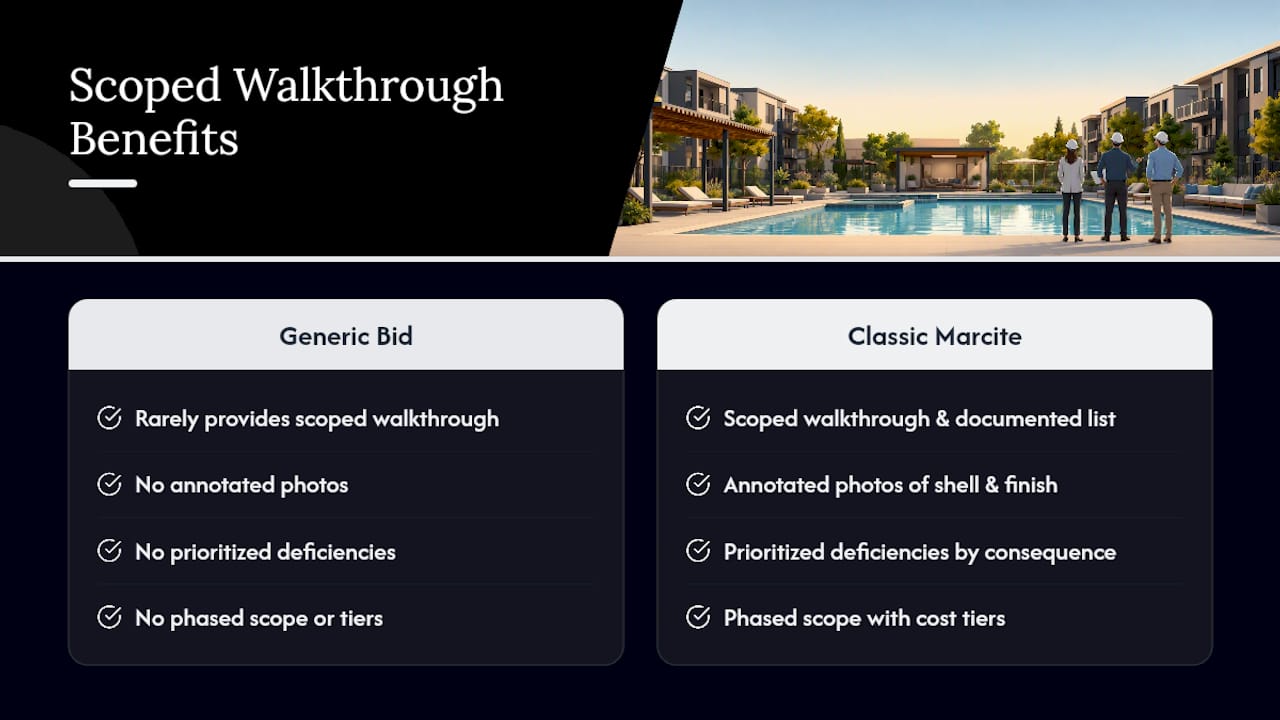
Classic Marcite gives boards something a generic bid process rarely does: a scoped walkthrough that produces the same documented deficiency list and board-ready cost breakdown this guide recommends, backed by decades of commercial resurfacing experience across Central Florida.
That walkthrough typically includes annotated photos of shell and finish conditions, a prioritized list of deficiencies ranked by operational consequence, and a phased scope with cost tiers separating essential repairs from optional upgrades like Pebble Tec® finish colors or water feature additions. Commercial resurfacing, tile and coping repair, phasing coordination, and equipment upgrade guidance all fall under one point of contact, which cuts down on the handoff friction that causes change orders elsewhere.
If your board is preparing a renovation vote, request a scoped walkthrough and estimate and bring documented numbers to the next meeting instead of a verbal quote.
Sources
For code and safety questions specifically, keep these on hand: VGB Act drain-safety requirements for anti-entrapment compliance, the ADA 2010 Standards for accessible entry design, your state health department’s pool plan-review page for local hold points, and industry cost benchmarks for scoping budget conversations with owners.
- What commercial pool contractors wish owners knew about renovating
- Commercial pool renovation cost: what facility managers should expect
- Commercial pool renovation services: Scope, code requirements, and providers
