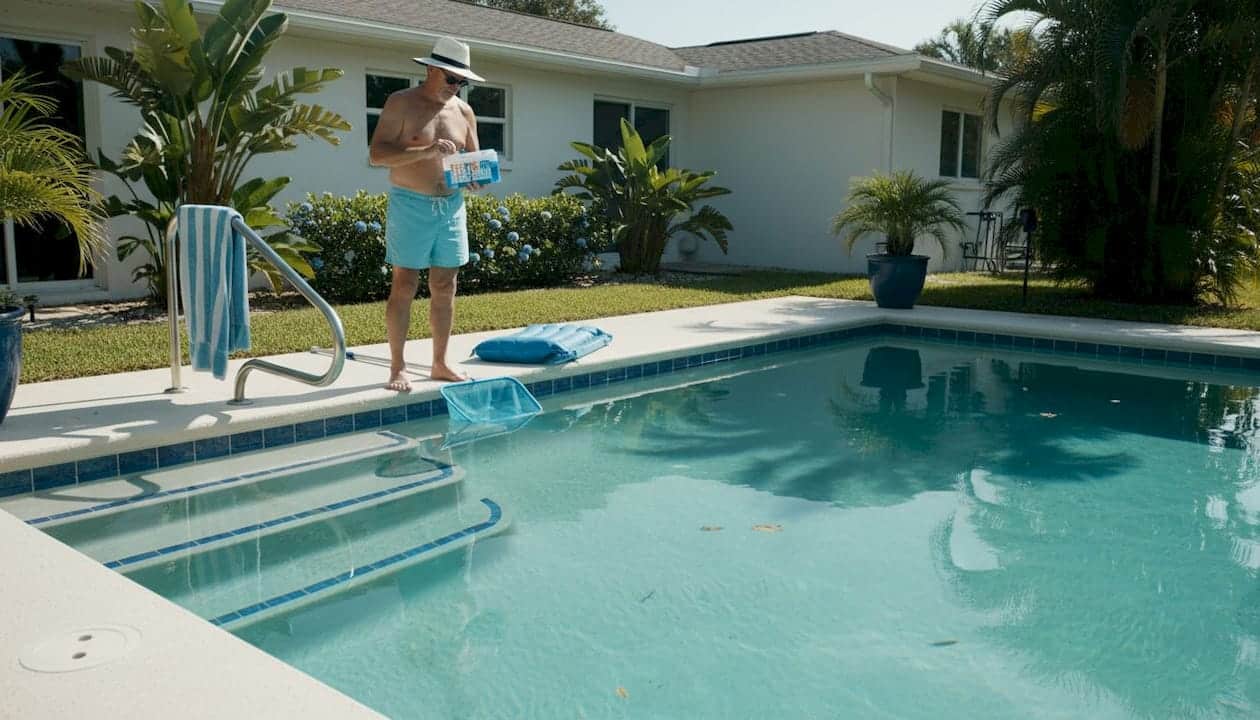
TL;DR:
- Pool discoloration in Florida results from metals, algae, organic debris, and climate-related factors.
- Regular testing, balancing chemicals, brushing, and covering the pool help prevent stains.
- Professional resurfacing may be needed for persistent or deeply penetrating stains.
You keep up with your pool. You test the water, run the pump, and skim out the leaves. Then one morning you look outside and notice a brownish tint creeping along the pool wall, or a green haze settling in a corner. It feels unfair, but here’s the truth: pool discoloration happens to attentive owners all the time, especially in Orlando and Jacksonville, where heat, storms, and heavy rain create conditions that work against even the best maintenance routines. This guide will walk you through exactly why it happens, how to catch it early, and what you can do to stop it before it becomes a bigger problem.
Table of Contents
- Understanding pool discoloration: What it is and why it matters
- The main causes of pool discoloration in Florida
- How to spot early signs of pool discoloration
- Best practices for preventing and treating pool discoloration
- What most pool owners get wrong about discoloration
- Restore and protect your Florida pool’s beauty
- Frequently asked questions
Key Takeaways
| Point | Details |
|---|---|
| Pool stains are common | Discoloration happens even with good care, especially in Florida’s climate. |
| Environmental factors play a big role | Orlando and Jacksonville’s storms and heat boost the risk of pool stains. |
| Routine is crucial | Balanced chemicals, frequent testing, and debris removal prevent most stains. |
| Act early | Spotting and fixing early signs of discoloration saves money and keeps your pool looking great. |
| Professional help solves tough stains | If DIY methods fail, professional resurfacing or repair ensures long-lasting results. |
Understanding pool discoloration: What it is and why it matters
Pool discoloration is any visible change to the color or clarity of your pool water or its surface finish that falls outside what’s considered normal. It shows up in several forms: broad staining across the plaster or tile, uneven shading along the walls, or cloudy water that won’t clear with standard treatment.
The colors themselves are clues:
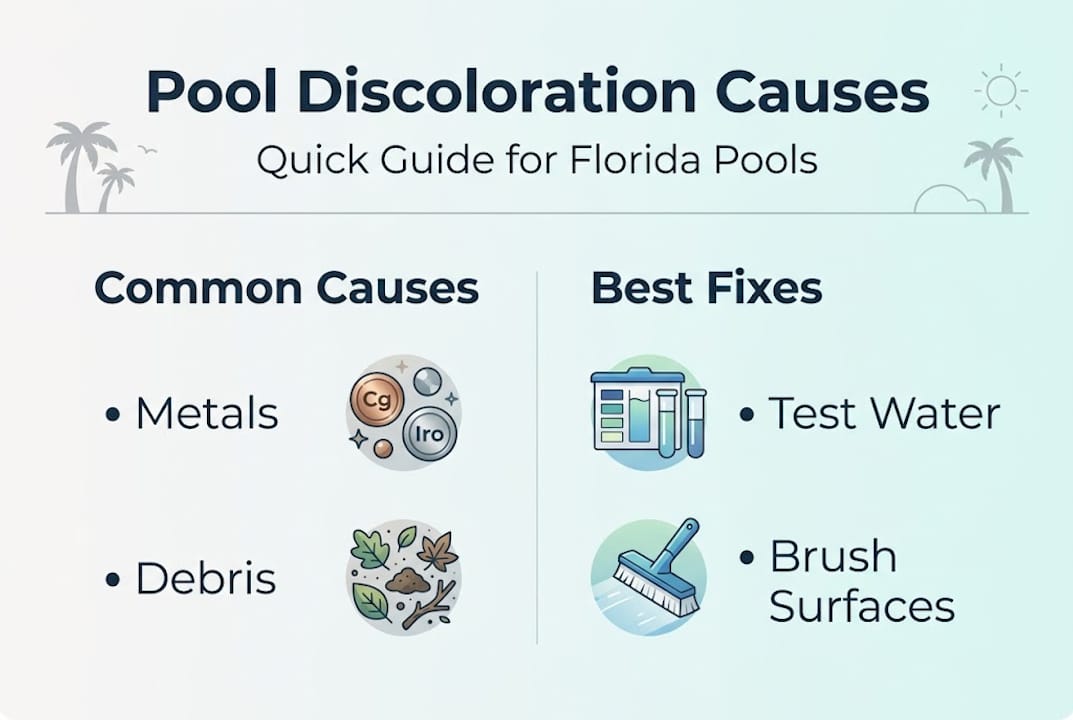
- Green water or staining usually signals algae growth or copper contamination from corroded equipment
- Brown or rust-colored stains point to iron, either from your fill water or degraded metal parts
- Yellow or mustard tones often indicate algae variants or sulfur compounds
- Blue or teal staining typically results from copper deposits, often linked to low pH eating through copper pipes or heater elements
- Black spots can mean a severe algae strain or manganese deposits settling on the surface
Beyond how it looks, discoloration carries real consequences. Algae-driven discoloration creates surfaces that are slippery and unsafe to walk on. Metal stains often signal that corrosive chemistry is actively damaging your plaster or Pebble Tec finish underneath. Cloudy water reduces visibility, which is a safety issue for swimmers, especially children.
Florida’s climate adds a layer of difficulty that pool owners in other states simply don’t face. High summer temperatures accelerate chemical consumption, intense UV breaks down chlorine faster, and heavy rainstorms dump organic debris and dilute your carefully balanced water in a matter of hours.
Staying on top of pool surface maintenance is not optional in this environment. Proper care according to Swim University’s guidance on pool stains means weekly testing and balancing, consistent skimming, brushing, and vacuuming, running the pump 8 to 12 hours per day, using sequestrants for metals, and covering the pool to block debris. In Florida’s summers, chlorine should be maintained between 3 and 5 parts per million (ppm), which is higher than the standard 1 to 3 ppm recommended in milder climates.
The main causes of pool discoloration in Florida
Florida pools face a distinct combination of stressors. Understanding the root causes helps you target the right fix instead of guessing.
1. Metals in the water
Iron and copper are the two biggest offenders. Iron usually enters through fill water, especially in neighborhoods with older infrastructure or well water supplies. When iron oxidizes, it turns brown or orange, staining the pool walls much like rust stains on concrete. Copper most often comes from corroded equipment, particularly heaters with copper heat exchangers. When pH drops below 7.2, the water becomes aggressive and begins dissolving copper, depositing it on surfaces as blue-green stains.
2. Imbalanced pool chemistry
Low chlorine creates the perfect environment for algae to take hold. High chlorine, on the other hand, can bleach and fade colored finishes. pH that’s too low makes water corrosive; pH that’s too high causes calcium to precipitate and form cloudy white scaling. Alkalinity that’s out of range destabilizes pH and makes it nearly impossible to hold steady levels. All of these imbalances can produce visible discoloration quickly.
3. Organic debris
Leaves, pollen, and grass clippings don’t just float on the surface. They sink, decompose, and release tannins and other organic compounds that stain plaster and grout. Orlando and Jacksonville see heavy pollen loads in spring and a consistent debris fall year-round. After a tropical storm, a pool can fill with debris overnight.
4. Environmental factors specific to Florida
Heavy rainfall dilutes chlorine and throws off pH and alkalinity levels in a matter of hours. According to testing data for summer pools, Florida heat and storms demand chlorine levels of 3 to 5 ppm in summer, with testing done twice per week and shocking done weekly. High evaporation rates also concentrate minerals and metals in the water, raising the risk of scaling and staining.
5. Filtration and circulation problems
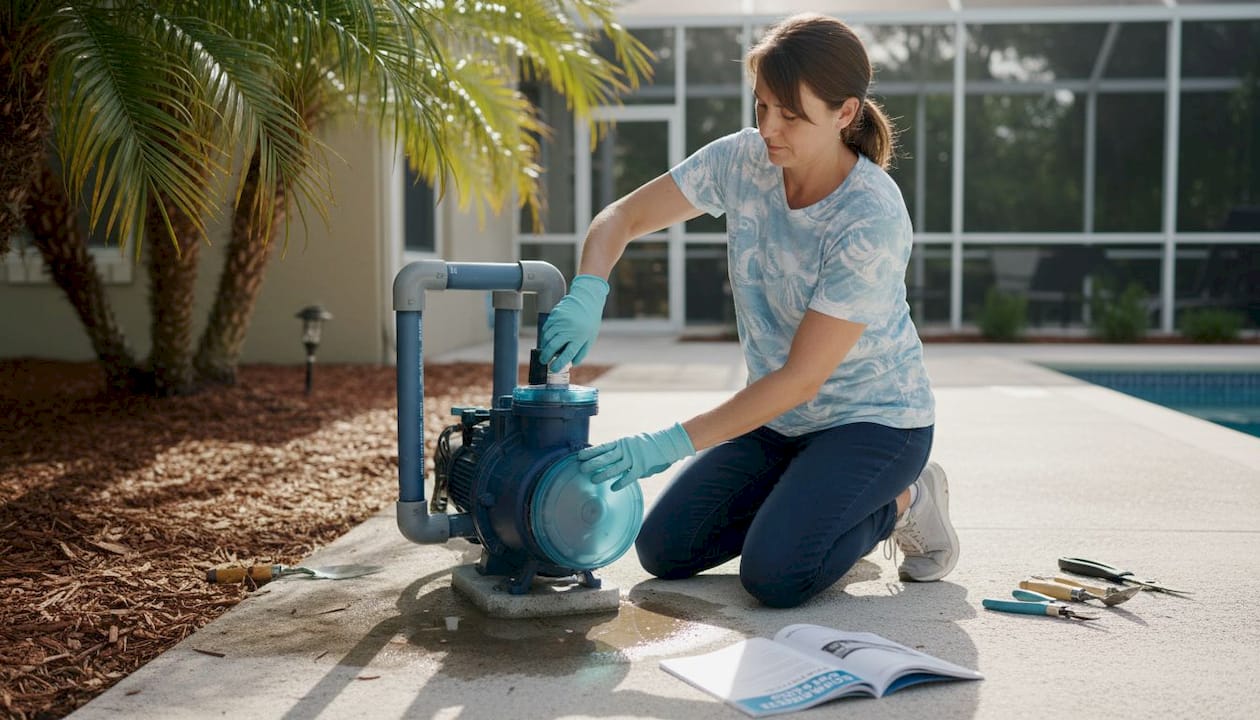
A pump that runs too few hours per day leaves water stagnant in zones where algae and debris settle. Clogged filters fail to remove fine particles, which then coat the surface over time. Dead spots in circulation, often behind ladders or in corners, are where staining starts.
For seasonal-specific guidance, Florida pool prep tips cover how to ready your system before summer hits hard, and if you want to protect your surface while keeping sanitizer use efficient, strategies to reduce chlorine use without losing effectiveness are worth reviewing.
How to spot early signs of pool discoloration
Discoloration rarely appears all at once. It usually starts subtle, which is exactly why many owners miss it until a minor issue becomes a significant stain that requires professional attention. Early detection is your best defense.
Warning signs to watch for:
- A slight fading or dullness of the pool’s finish color, especially in areas that get the most sun
- Thin streaks or spots forming near fittings, steps, or return jets
- A faint film or sheen on the water surface that doesn’t break up after skimming
- A greenish tinge in corners or along the waterline even when chlorine tests in range
- Rough patches forming on the surface where scaling or biological growth is beginning to bond
A structured inspection routine makes a real difference. Walk the perimeter of your pool twice a week, not just to skim, but to actually look at the walls and floor. Pair that visual check with your chemical testing. Testing frequency matters: twice-per-week testing in summer gives you the data you need to catch imbalances before they cause visible damage.
| Sign | Likely cause | Urgency |
|---|---|---|
| Brown streaks on walls | Iron in water | Medium, treat within days |
| Green tint in corners | Algae growth | High, treat immediately |
| Blue stain near jets | Copper deposits | Medium, check equipment |
| Cloudy water | pH or alkalinity off | High, rebalance now |
| White scaling on tile | High calcium hardness | Medium, descale soon |
Pro Tip: Use the white sock test to check for metals before staining appears. Fill a white sock with pool filter media and let it sit in the water for 24 hours. If it comes out stained brown, orange, or teal, you have metals in the water that need to be treated with a sequestrant before they show up on your pool surface.
For a thorough approach to surface care, cleaning pool surfaces with the right tools and techniques goes a long way. Combining physical cleaning with solid chemistry keeps discoloration from gaining a foothold, and the pool maintenance tips tailored to Florida’s specific conditions will help you build a routine that actually holds up through a Florida summer.
Best practices for preventing and treating pool discoloration
Prevention works better than treatment every time. By the time a stain is visible on a plaster or Pebble Tec surface, it has usually been forming for days or weeks. Here’s how to stay ahead of it.
Weekly prevention routine:
- Test water chemistry at least twice per week during summer months. Target chlorine at 3 to 5 ppm, pH between 7.4 and 7.6, total alkalinity between 80 and 120 ppm, and calcium hardness between 200 and 400 ppm.
- Brush walls, steps, and the floor to prevent organic material from bonding with the surface.
- Vacuum thoroughly, paying extra attention to corners and areas behind equipment.
- Run the pump long enough to turn over the full pool volume, typically 8 to 12 hours per day as recommended by Swim University’s pool care guidelines.
- Skim the surface after every storm to remove debris before it sinks and decomposes.
- Use a sequestrant regularly if your fill water tests positive for metals, especially iron or copper.
- Cover the pool when it will be unused for more than a day, particularly during Florida’s storm season.
| Practice | Standard pool owner | Florida pool owner |
|---|---|---|
| Water testing | Once a week | Two times per week in summer |
| Chlorine target | 1 to 3 ppm | 3 to 5 ppm in summer |
| Pump runtime | 6 to 8 hours | 8 to 12 hours |
| Shocking schedule | Monthly | Weekly in summer |
| Sequestrant use | As needed | Regular preventive use |
| Debris removal | After visible build up | After every storm |
When discoloration does appear, the approach depends on the cause. Organic stains, like those from leaves or pollen, often respond to shocking (super-chlorinating) the water and brushing aggressively. Metal stains require a sequestrant to bind the metals and a targeted stain remover formulated for the specific metal type. Algae stains need an algaecide combined with thorough brushing and a shock treatment, followed by adjusting circulation to eliminate dead spots.
Pro Tip: Never use a generic stain remover without identifying the stain type first. A product formulated for organic stains applied to a copper stain can make it worse by chemically fixing the stain into the surface. A simple vitamin C test (ascorbic acid) rubbed directly on the stain will cause metal stains to fade immediately, confirming the cause.
For pools that have recently been resurfaced, following specific maintenance after resurfacing steps is critical. New surfaces are more chemically reactive, and failing to balance the water correctly in the first few weeks can result in early staining or etching. The goal is always to extend pool lifespan through consistent care rather than reactive fixes.
What most pool owners get wrong about discoloration
Here’s an opinion that some might push back on: perfect pool maintenance does not guarantee a discoloration-free pool in Florida. Accepting that truth is actually more useful than chasing an impossible standard.
We’ve seen it across thousands of pools in the Orlando and Jacksonville area since 1988. An owner follows every protocol correctly, and after one severe summer storm, their pool shows a brown film along the floor within 48 hours. The storm dumped enough organic matter and rainwater to overwhelm even a perfectly maintained system. That’s not failure. That’s Florida.
The mistake most owners make is waiting for something to look wrong before acting. By the time discoloration is obvious enough to notice on a casual glance, the problem is usually two to three weeks old. The stain has bonded with the surface. Simple brushing won’t fix it. The chemistry has been off long enough to stress the finish.
What actually works is treating pool care as a monitoring system, not just a cleaning schedule. The goal is data, not just clean-looking water. Your twice-weekly test results should tell you what’s about to happen before it happens. A pH drop that starts trending toward 7.0 over three readings in a row tells you that something is changing, whether it’s heavy usage, dilution from rain, or a chemical feed issue. Acting on that trend before the water hits 7.0 prevents the corrosion that causes staining.
The other mistake is underestimating the age of the surface. Older plaster and finishes are more porous, and stains penetrate faster and deeper. Reviewing common pool repair examples shows that many of the most severe discoloration cases in Florida involve surfaces that are 10 or more years old and have been maintained adequately, but not optimally. The surface itself has reached the end of its practical resistance to staining. In those cases, cleaning only accomplishes so much. Resurfacing is the reset that restores real protection.
Knowing when you’ve crossed from a maintenance problem to a structural surface problem is the most useful skill a Florida pool owner can have.
Restore and protect your Florida pool’s beauty
When routine cleaning and chemical balancing aren’t enough to clear persistent discoloration, it’s time to bring in expert eyes. At Classic Marcite, we’ve worked on over 100,000 pools across Orlando, Jacksonville, and beyond since 1988, and we know what Florida’s climate does to pool surfaces over time.

Our team specializes in pool resurfacing solutions using high-quality materials like Pebble Tec® that resist staining and stand up to Florida’s year-round heat and storms far longer than standard plaster. When discoloration goes deeper than the surface or keeps coming back despite your best efforts, a professional assessment can identify what’s actually causing it, whether that’s a failing finish, hidden plumbing issues, or structural damage. Our pool repair service covers everything from tile and deck repairs to full interior restoration. If your pool’s finish is working against you, we can give you a fresh start that holds up.
Frequently asked questions
What causes brown stains in a pool?
Brown stains are most often caused by iron or organic debris reacting with pool chemicals, a problem that gets worse after Florida storms when both metals and organic matter enter the water in large amounts. Using a sequestrant for metals and covering the pool after storms significantly reduces this risk.
Can incorrect chlorine levels cause pool discoloration?
Yes. Low chlorine allows algae to grow and produce green or black staining, while high chlorine can bleach and fade finished surfaces. Florida’s heat means summer chlorine levels should stay between 3 and 5 ppm to stay ahead of both problems.
How often should I test my pool water in Florida summers?
Test your pool water twice per week during summer months, and plan to shock the pool at least once per week. Florida’s heat accelerates chemical consumption faster than testing once a week can catch.
How do I know if a stain requires resurfacing or cleaning?
If a stain persists after correct chemical treatment, brushing, and multiple shock treatments, the stain has likely penetrated the surface material itself, and resurfacing is the most effective solution. Older pools are particularly prone to this because porous plaster absorbs stains more deeply over time.
What’s the best routine to prevent pool stains in Florida?
Testing and balancing water twice per week, brushing and vacuuming weekly, running the pump 8 to 12 hours per day, using sequestrants if metals are present, and removing debris promptly after storms gives Florida pool owners the strongest practical defense against staining year-round.