TL;DR:
- Pool resurfacing material longevity varies widely, with tile lasting up to 50 years and vinyl liners around 5 to 12 years. Proper water chemistry management and skilled installation are crucial to achieving maximum lifespan and durability. Choosing the right finish depends on climate, usage, and maintenance, with premium options offering the best long-term value.
Pool resurfacing material durability ratings measure how long a finish resists wear, chemical damage, and physical stress before requiring replacement. The industry term for this evaluation is “surface longevity rating,” and it covers five primary materials: traditional plaster, quartz aggregate, premium pebble, ceramic tile, and vinyl liners. Lifespan ranges vary widely by material, from as few as 5 years for vinyl liners to 50 years for tile. Choosing the wrong finish costs homeowners thousands in premature resurfaces. This guide ranks each material, explains what drives longevity, and helps you match the right surface to your pool, budget, and climate.
1. Pool resurfacing material durability ratings: the full ranking
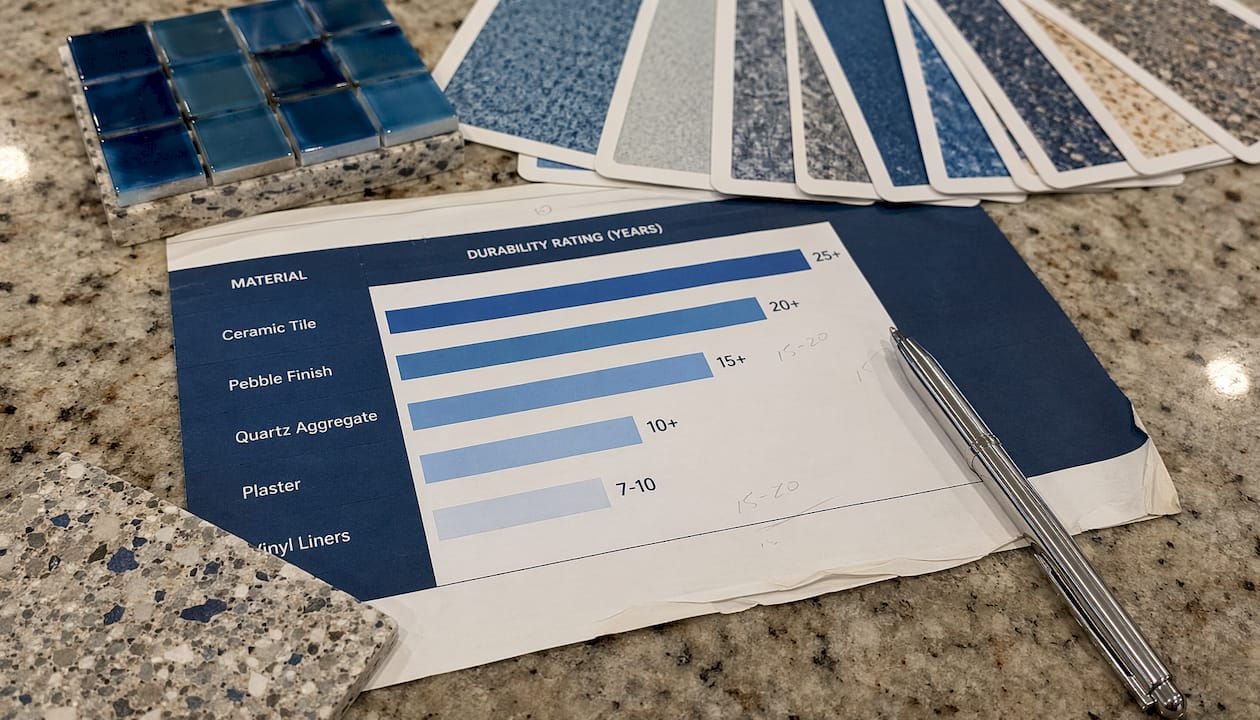
The five major pool finishes span a wide durability spectrum. Understanding where each material sits helps you make a renovation decision you will not regret in year eight.
Ceramic and glass tile: 25–50 years
Tile is the most durable pool surface available. Fired ceramic and glass tiles resist chemical etching, UV fading, and physical abrasion better than any cement-based finish. The tradeoff is cost. Tile requires skilled installation and grout maintenance, but its 25–50 year lifespan makes it the lowest-cost option per year of service life for pools that stay in one family for decades.
Key durability traits:
- Virtually immune to chemical etching
- No fading from UV exposure
- Grout lines require periodic resealing
- Highest upfront cost of any finish
Premium pebble finish: 15–25+ years
Premium pebble finishes, including products like Pebble Tec®, rank second in durability. Natural pebble aggregate is the hardest material used in pool surfaces, shifting wear burden from the cement matrix to durable stone. That shift is why pebble finishes outlast plaster by a factor of two or more. Classicmarcite is the largest Pebble Tec® applicator in Central Florida and has applied this finish to over 100,000 pools since 1988.
Key durability traits:
- Superior resistance to chemical etching
- Textured surface hides minor staining
- Excellent fade resistance in high-UV climates
- Requires professional startup protocol after installation
Pro Tip: Ask your applicator for the batch number on your pebble finish materials. Authentic, factory-verified batches perform to rated specifications. Unverified materials may not.
Quartz aggregate finish: 12–20 years
Quartz finishes sit between plaster and pebble in both cost and durability. Quartz crystals are harder than marble dust, the base of traditional plaster, so they resist etching and wear more effectively. Quartz and mini-pebble finishes typically offer the lowest cost per year of service life among mid-range options. They also hold color better than plaster in sunny climates. Learn more about quartz finish benefits before ruling it out on price alone.
Key durability traits:
- Better stain resistance than plaster
- Smoother underfoot than pebble
- Good performance in high-chlorine environments
- Mid-range upfront cost
Traditional plaster: 7–12 years
Plaster is the most common pool finish in the United States and the least durable of the cement-based options. Its base material, white marble dust, is softer than quartz or natural pebble, making it more vulnerable to etching from unbalanced water. Plaster delivers the lowest upfront cost but often requires two resurfaces over a 20-year ownership period. That frequency erases its initial price advantage quickly.
Key durability traits:
- Lowest upfront cost
- Smooth, classic appearance
- Most sensitive to water chemistry imbalance
- Prone to staining and etching after year five
Vinyl liners: 5–12 years
Vinyl liners are not a cement-based finish. They are a manufactured sheet installed inside the pool shell. Their 5–12 year lifespan reflects vulnerability to punctures, UV degradation, and chemical damage. Liners suit above-ground pools and some in-ground applications where concrete resurfacing is not feasible. For long-term durability, cement-based or tile finishes outperform vinyl in every measurable category.
2. How water chemistry affects pool surface longevity
Water chemistry is the single most controllable factor in pool finish lifespan. A finish rated for 20 years can fail in 8 years under chronically unbalanced water.
The key measurement is the Langelier Saturation Index, or LSI. The LSI is a calculated score that tells you whether your pool water is corrosive, balanced, or scale-forming. Maintaining LSI between 0.0 and 0.3 prevents aggressive water from dissolving the cement matrix that binds your finish together. Water below 0.0 on the LSI scale actively eats the surface from the inside out.
Chemistry habits that protect your finish:
- Test pH, alkalinity, and calcium hardness weekly
- Keep pH between 7.4 and 7.6 at all times
- Maintain calcium hardness above 200 ppm for cement-based finishes
- Use a professional startup protocol during the first 30 days after resurfacing
The first 30 days after installation are the most critical period for any cement-based finish. Improper chemical management during curing reduces surface hardness permanently. A finish that cures incorrectly will underperform its rated lifespan for its entire service life. No amount of maintenance later corrects a bad cure.
Pro Tip: Hire a pool professional to manage your water chemistry for the first 30 days after resurfacing. That single investment protects years of finish life.
Balanced water chemistry, proper installation, and weekly testing collectively push a finish toward the top of its rated lifespan range. Neglect any one factor and the finish drops toward the bottom.
3. Why installation quality determines real-world durability
The material you choose sets the ceiling for durability. The installer determines whether you reach it. Applicator skill in hydration, mixing, and aggregate exposure is as important as material quality for the final durability outcome.
Poor installation causes problems that no amount of maintenance can fix. A water-to-cement ratio that is too high weakens the finish matrix. Aggregate exposed too early or too late creates an uneven surface that traps debris and accelerates staining. Rushed curing skips the chemical adjustments that harden the surface properly.
Common installation mistakes and their effects:
- Excess water in the mix: weakens bond strength, shortens lifespan by years
- Inconsistent aggregate exposure: uneven texture, early staining
- Skipping startup chemicals: permanent surface softness
- Using unverified materials: unpredictable performance, voided warranties
Choosing a factory-trained applicator with verifiable credentials is not a luxury. It is the single decision that most determines whether your finish reaches its rated lifespan. A premium pebble finish installed poorly will underperform a plaster finish installed correctly.
Pro Tip: Request proof of factory training and a written warranty before signing any resurfacing contract. Legitimate applicators provide both without hesitation.
4. Lifecycle costs: durability ratings versus total ownership expense
Upfront cost is the wrong metric for evaluating pool resurfacing options. Total cost over 20 years tells the real story.
| Material | Typical lifespan | Resurfaces over 20 years | Relative cost per year of service |
|---|---|---|---|
| Ceramic tile | 25–50 years | 0 | Lowest |
| Premium pebble | 15–25+ years | 0–1 | Low |
| Quartz aggregate | 12–20 years | 1 | Low to moderate |
| Traditional plaster | 7–12 years | 2 | Moderate to high |
| Vinyl liner | 5–12 years | 2–3 | Highest |
Plaster carries the lowest upfront price but typically requires two resurfaces over 20 years. Each resurface adds labor, materials, and downtime. Premium pebble costs more at the start but requires zero to one resurfaces over the same period. That difference often makes pebble the more economical choice over a full ownership horizon.
Quartz and mini-pebble finishes offer the best balance of upfront cost and service life for homeowners who want durability without the premium pebble price point. Regional climate also affects these numbers. Pools in freeze-thaw climates face physical damage from water trapped in porous cement, which accelerates surface failure even with premium materials. Florida pools avoid freeze-thaw stress but face intense UV exposure year-round, making fade-resistant finishes like pebble and quartz the practical choice. Review the cost factors for pool resurfacing before finalizing your material decision.
5. Choosing the right finish for your home and region
The best pool surface for your neighbor may be the wrong one for you. Four factors should drive your decision: climate, usage intensity, ownership horizon, and maintenance commitment.
UV exposure and regional climate directly influence fading and surface degradation. Pebble and quartz finishes exhibit superior fade resistance in high-UV environments like Florida. Plaster fades and stains faster under the same conditions.
Situational recommendations by homeowner profile:
- Long-term owner, high-use pool: Premium pebble or tile. The durability and low resurface frequency justify the upfront cost.
- Budget-conscious owner, moderate use: Quartz aggregate. It delivers meaningful durability gains over plaster at a manageable price.
- Short-term owner or rental property: Traditional plaster. Lower upfront cost makes sense when you will not own the pool long enough to benefit from premium longevity.
- Commercial or resort property: Tile or premium pebble. High traffic demands the highest durability ratings available.
- Comfort-sensitive household: Quartz over pebble. Quartz is smoother underfoot, which matters for families with young children.
Matching your material to your actual situation, rather than choosing the most expensive option by default, produces the best outcome. Explore pool resurfacing options for Florida to see how these materials perform in the specific conditions of the region.
Key takeaways
Tile and premium pebble finishes deliver the longest service life and lowest cost per year, making them the strongest choices for homeowners who plan to own their pool for 15 or more years.
| Point | Details |
|---|---|
| Tile lasts longest | Ceramic and glass tile rates 25–50 years, the highest durability of any pool finish. |
| Pebble outperforms plaster | Premium pebble lasts 15–25+ years versus 7–12 for plaster, cutting resurface frequency in half. |
| Water chemistry is critical | Maintaining LSI between 0.0 and 0.3 prevents chemical damage that shortens finish life. |
| Installation determines outcomes | Applicator skill in mixing, curing, and aggregate exposure is as important as material quality. |
| Lifecycle cost beats upfront price | Plaster’s low initial cost often becomes the most expensive choice over a 20-year period. |
What I have learned after years of watching pools age
Most homeowners walk into a resurfacing decision focused entirely on the material. They compare pebble versus plaster, read a few reviews, and pick based on price or appearance. That approach misses the two factors that actually determine whether a finish reaches its rated lifespan: who installs it and how the water is managed afterward.
The uncomfortable truth is that a premium pebble finish installed by an undertrained crew will fail faster than a standard plaster job done by a skilled, experienced team. I have seen it happen. The material sets the potential. The applicator and the chemistry determine the result.
The other misconception I encounter constantly is that durability is fixed at installation. It is not. A homeowner who tests their water weekly, keeps the LSI in range, and follows a proper startup protocol after resurfacing will get years more service from any finish than a homeowner who ignores chemistry. The finish does not know what it cost. It responds to how it is treated.
My honest recommendation: spend as much time vetting your applicator as you spend choosing your material. Ask for factory training credentials. Ask for references from pools resurfaced five or more years ago. A contractor confident in their work will answer both questions without hesitation.
— Results
Classicmarcite’s approach to lasting pool surfaces
Classicmarcite has resurfaced over 100,000 pools across Florida since 1988, applying premium finishes to residential pools, commercial properties, resorts, and theme parks. As the largest Pebble Tec® applicator in Central Florida, Classicmarcite brings factory-trained craftsmanship and verified materials to every project.

Whether you are weighing pebble against quartz or planning a full pool renovation, Classic Marcite offers free estimates and personalized guidance on which finish delivers the best durability for your specific pool, usage, and budget. Homeowners in Central Florida can request a pool resurfacing assessment to get expert input before committing to a material. For a full overview of durable finish options, visit Classicmarcite’s resurfacing services page.
FAQ
How long does pool resurfacing last?
Lifespan depends on the material: plaster lasts 7–12 years, quartz 12–20 years, premium pebble 15–25+ years, and tile 25–50 years. Water chemistry management and installation quality determine whether a finish reaches the top or bottom of its rated range.
Which pool surface lasts the longest?
Ceramic and glass tile rates the highest durability of any pool finish, with a lifespan of 25–50 years. Premium pebble finishes rank second at 15–25+ years and offer better value for most residential pools.
Does water chemistry really affect pool finish durability?
Yes. Maintaining the Langelier Saturation Index between 0.0 and 0.3 prevents corrosive water from dissolving the cement matrix. Chronically unbalanced water can cut a finish’s rated lifespan in half regardless of material quality.
What is the most cost-effective pool resurfacing material over 20 years?
Premium pebble and quartz finishes typically deliver the lowest cost per year of service life. Plaster’s low upfront price is offset by the need for two or more resurfaces over a 20-year period.
How does installation quality affect pool surface longevity?
Poor installation, including incorrect water-to-cement ratios and skipped startup protocols, permanently reduces surface hardness. A finish installed incorrectly will underperform its rated lifespan for its entire service life, regardless of material quality.
