Most HOA communities should budget a broad range for a full pool renovation, with resurfacing-only projects typically being significantly less costly. Before you approve a number, order an onsite condition assessment and cross-check your reserve study’s pool line item. Build in a 10% to 20% contingency on top of whatever figure you land on.
TL;DR:
- A full pool renovation usually exceeds $80,000 across all scope categories, though resurfacing alone stays under $30,000.
- Budgeting should include a 10% to 20% contingency and account for regional cost variations in labor, materials, and permits.
- Reserve funds typically cover capital expenses like resurfacing and equipment, while operational expenses include routine repairs and chemicals.
- Proper site assessments and detailed proposals are essential to avoid costly change orders and ensure accurate contractor bids.
- Funding options include reserves, loans, phased payments, and assessments, with conservative collection assumptions reducing financial surprises.
Table of Contents
- What Drives HOA Pool Renovation Costs?
- Worked Example: A Sample HOA Pool Renovation Budget
- How Should an HOA Fund a Pool Renovation?
- Scoping the Project: What’s Required vs. What’s Optional
- How to Get Comparable Contractor Quotes for a Pool Renovation
- Timing, Permits, and Contingency Planning
- What Financial Metrics Should Boards Check Before Approving?
- How Professional Renovators Approach HOA Pool Projects
- A Board’s Priorities for Getting the Budget Right
- How Classic Marcite Helps HOAs Plan a Pool Renovation That Stays on Budget
- Where Boards Can Verify These Numbers
- Sources
What Drives HOA Pool Renovation Costs?
Every HOA pool renovation budget is really a sum of separate decisions, not one line item. Boards that understand what each piece costs catch inflated bids before they reach a vote.
Interior resurfacing is usually the anchor cost. Plaster refinishing runs cheaper than aggregate finishes like Pebble Tec, and a full resurfacing project typically lands in the $8,000 to $26,000 range for a standard community pool, according to industry budgeting research. Larger pools, custom colors, and shell repairs underneath the old surface push that number toward the top.
Coping and deck work often gets underestimated. Concrete coping replacement generally costs within a moderate per linear foot range depending on material, while deck resurfacing or full replacement can add a substantial amount for a mid-sized community deck. If the substrate underneath has cracked or settled, expect a change order here.
Equipment upgrades cover pumps, filters, heaters, and automation systems. A variable-speed pump conversion costs more upfront than a standard replacement but cuts electricity draw substantially over its service life. The EPA’s water-efficiency guidance points to filtration and pump upgrades as the equipment category most likely to pay for itself through lower operating bills.
Plumbing and electrical work is where budgets go sideways fastest, because you often can’t see the problem until the deck comes up. Older communities built before modern bonding and grounding codes may need electrical upgrades just to pass inspection, not because the board asked for them.
ADA and compliance features (entry ramps, lift installation, updated signage) are frequently required by local code once a permit application triggers a compliance review, even if the board only intended to resurface.
Design, permits, and mobilization round out the budget. Permit fees vary by municipality but rarely exceed a few thousand dollars; mobilization and site setup for a commercial contractor typically run 3% to 5% of total project cost.
Here’s how the major categories typically break down for a standard community pool:
- Interior resurfacing: $8,000–$26,000
- Coping replacement: $6,000–$18,000
- Deck resurfacing/replacement: $15,000–$40,000
- Equipment upgrades (pump, filter, heater): $5,000–$20,000
- Plumbing/electrical repairs: $3,000–$15,000
- ADA/compliance upgrades: $2,000–$12,000
- Design, permits, mobilization: $2,000–$8,000
Statistic Callout: A full pool renovation combining shell, deck, coping, and equipment commonly exceeds $80,000 once every category above is in scope, even though resurfacing alone stays well under $30,000.
One classification detail matters for HOA accounting: resurfacing and equipment replacement are typically capital expenses funded through reserves, while routine repairs and chemical treatment are operating expenses. Mixing the two on your budget worksheet makes it harder to justify a special assessment later, since reserve-eligible costs and operating shortfalls need separate lines when you present numbers to owners.
Hidden costs tend to surface once demolition starts. Cracked shell substrate, corroded rebar, and undersized electrical panels rarely show up in a walkthrough bid. That’s exactly why a proper condition assessment before finalizing a budget matters more than getting three quotes fast.
Worked Example: A Sample HOA Pool Renovation Budget
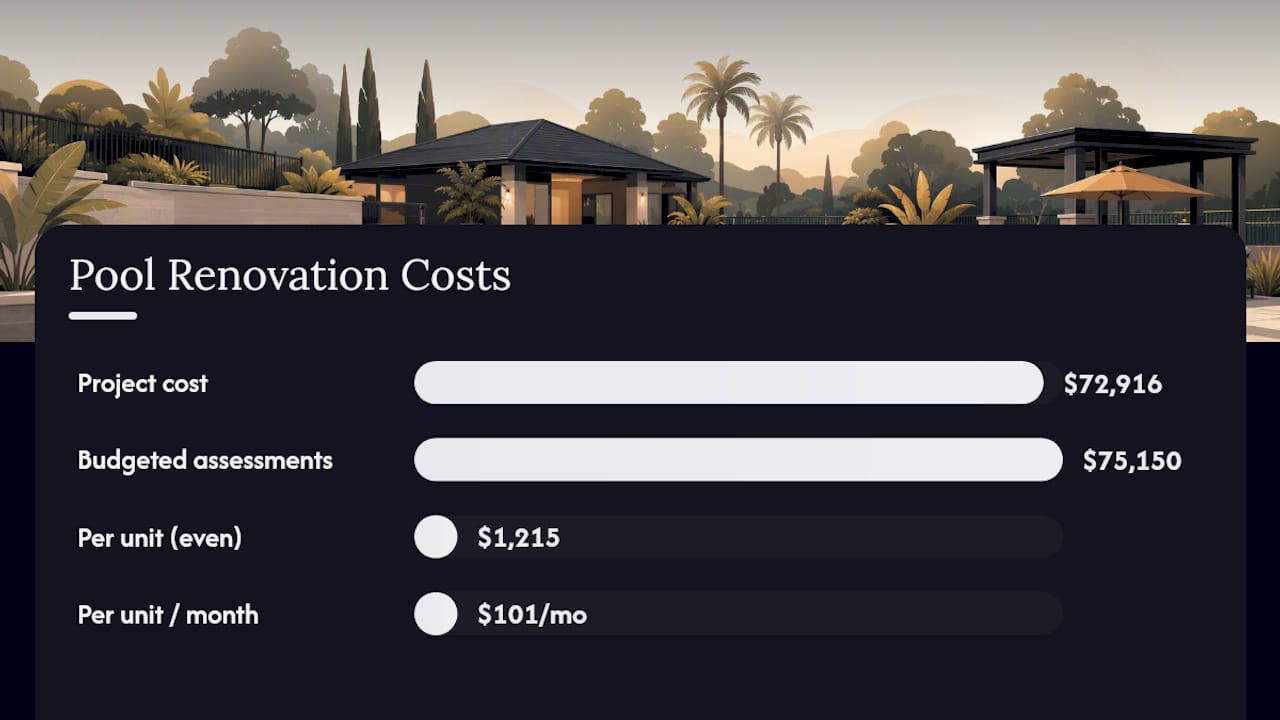
Numbers are easier to defend at a board meeting than percentages. Here’s a sample budget for a mid-sized community pool (roughly 20 by 40 feet, standard deck) that a 60-unit HOA might use as a starting worksheet.
For a 60-unit HOA covering this project entirely through a special assessment, the math looks like this:
- $72,916 ÷ 60 units = $1,215 per unit if split evenly
- Assuming a 97% collection rate (a conservative, industry-standard assumption), the board should budget for roughly $75,150 in total assessments to net the full $72,916
- Spread over 12 months, that’s about $101 per unit per month, or a one-time payment if the association’s governing documents allow it
Adjust every unit price against your own local bids before presenting this to owners. Regional labor costs, pool size, and finish choice can move any single line by 20% or more, and the 7 key components of a renovation worth budgeting separately are worth reviewing before you finalize your own worksheet.
How Should an HOA Fund a Pool Renovation?
Reserve funds and operating funds serve different purposes, and confusing them is one of the fastest ways to trigger a legal or compliance headache. Reserve funds exist specifically for capital replacement, meaning a full resurfacing or equipment replacement qualifies. Operating funds cover day-to-day costs like chemicals and routine repairs, and dipping into them for a major renovation usually requires board disclosure and sometimes a member vote, depending on your governing documents.
Here’s how most associations sequence a renovation funding decision:
- Check reserve fund adequacy first. If your reserve study shows the pool renovation line item is fully or near-fully funded, you may not need outside financing at all.
- Determine if a special assessment is required. Most governing documents set a threshold (often based on a percentage of the annual budget) above which a special assessment needs membership approval, not just board approval.
- Evaluate association loan options. Many financial institutions offer HOA-specific loans that spread the cost over 5 to 15 years, which softens the immediate impact on individual owners but adds ongoing debt service to future operating budgets.
- Consider phasing the project. Splitting resurfacing from deck and equipment work across two fiscal years reduces the size of any single assessment, though phasing across seasons can raise total cost if mobilization fees repeat for each phase.
- Build in a conservative collection assumption. Budget for 97% to 99% collection in a healthy community, dropping to 94% to 96% if your association has a track record of delinquencies.
Pro Tip: Never present a special assessment as a single, sudden number if you can avoid it. Boards that phase in dues increases over 3 to 5 years ahead of a known reserve shortfall face far less pushback than boards that surprise owners with a one-time bill.
Scoping the Project: What’s Required vs. What’s Optional
Not every item on a contractor’s proposal deserves equal priority. Boards need a framework for separating “must fix now” from “nice to have eventually,” and that starts with two distinct documents. A Facility Condition Assessment inspects the physical pool, shell, deck, and equipment to define exactly what’s failing. A reserve study is a financial planning document that projects when components need replacement and how much the association should be saving. You need both, since one tells you what’s broken and the other tells you whether you can afford to fix it.
Once you have both documents, triage the findings:
- Life-safety and code compliance (electrical grounding, entrapment hazards, ADA access) always rank first, regardless of cost.
- Structural integrity (shell cracks, deck heaving, coping separation) ranks second, since deferring these tends to raise repair costs later.
- Equipment efficiency (pumps, filtration, heaters) ranks third; these upgrades often pay for themselves through lower utility bills.
- Aesthetic upgrades (finish color, tile accents, water features) rank last and are the easiest scope to defer or phase into a later budget cycle.
A simple scoring approach works well: rate each item on cost-to-defer, owner benefit, and whether funding is already secured. Items that score high on all three move to the top of your renovation scope, while low scorers become “phase two.”
How to Get Comparable Contractor Quotes for a Pool Renovation
Three bids that all say “resurface and repair” aren’t actually comparable if one contractor includes deck work and another doesn’t. A well-built RFP forces apples-to-apples pricing.
Your RFP should specify:
- Detailed scope of work, broken down by the same line items in your worked budget, not a vague summary.
- Inclusions and exclusions, so you know exactly what allowance covers tile, coping, and equipment before the contract is signed.
- Payment schedule, tied to completion milestones rather than a lump sum upfront.
- Warranty terms, in writing, covering both materials and labor.
- Insurance and licensing proof, confirmed directly with the carrier or state board, not just taken from the bid packet.
- Permit responsibility, spelled out clearly, since unclear permit ownership is a common source of project delays.
When comparing bids, watch for contractors who bury a low headline number under vague allowances or exclude demolition costs entirely. Ask every bidder the same questions: how many HOA or commercial pool projects have they completed, can they provide references from similar-sized associations, and will they share a sample contract before you sign anything.
Pro Tip: A scoped condition assessment turns a vague verbal quote into a testable bid package, which is the single most effective way to reduce change orders once construction starts. Reviewing how experienced contractors structure their workflow before you write the RFP helps you spot which vendors are cutting corners on the proposal stage.
Timing, Permits, and Contingency Planning
Permits are often the hidden clock on your project. Most municipalities require permits for structural work, electrical upgrades, and ADA modifications, and review timelines can run anywhere from two to eight weeks depending on your jurisdiction and how busy the local building department is. Start the permit conversation before you finalize a construction calendar, not after.
Seasonality affects both price and logistics:
- Off-season scheduling (typically late fall through winter in most U.S. climates) often gets you better contractor pricing and faster crew availability, since demand drops when pools aren’t in daily use.
- Cold-weather protection for exposed plumbing and curing surfaces can add cost in northern climates, offsetting some of the off-season savings.
- Peak-season work costs more and takes longer to schedule, since contractors are juggling more concurrent jobs.
Phasing helps manage both cashflow and homeowner disruption. Closing the pool for four to six weeks during shoulder season, rather than during summer, keeps residents happier and often costs less. Some associations split resurfacing from deck work entirely, reopening the pool between phases so amenity access isn’t lost for an entire season.
What Financial Metrics Should Boards Check Before Approving?
Your reserve study’s percent-funded ratio tells you how prepared your association actually is.
Key figures to pull before your board meeting:
- Percent funded: current reserve balance divided by the ideal (fully funded) balance for all components, including the pool.
- Fully Funded Balance (FFB): the theoretical amount your reserves would hold if every component were funded exactly according to its age and remaining life.
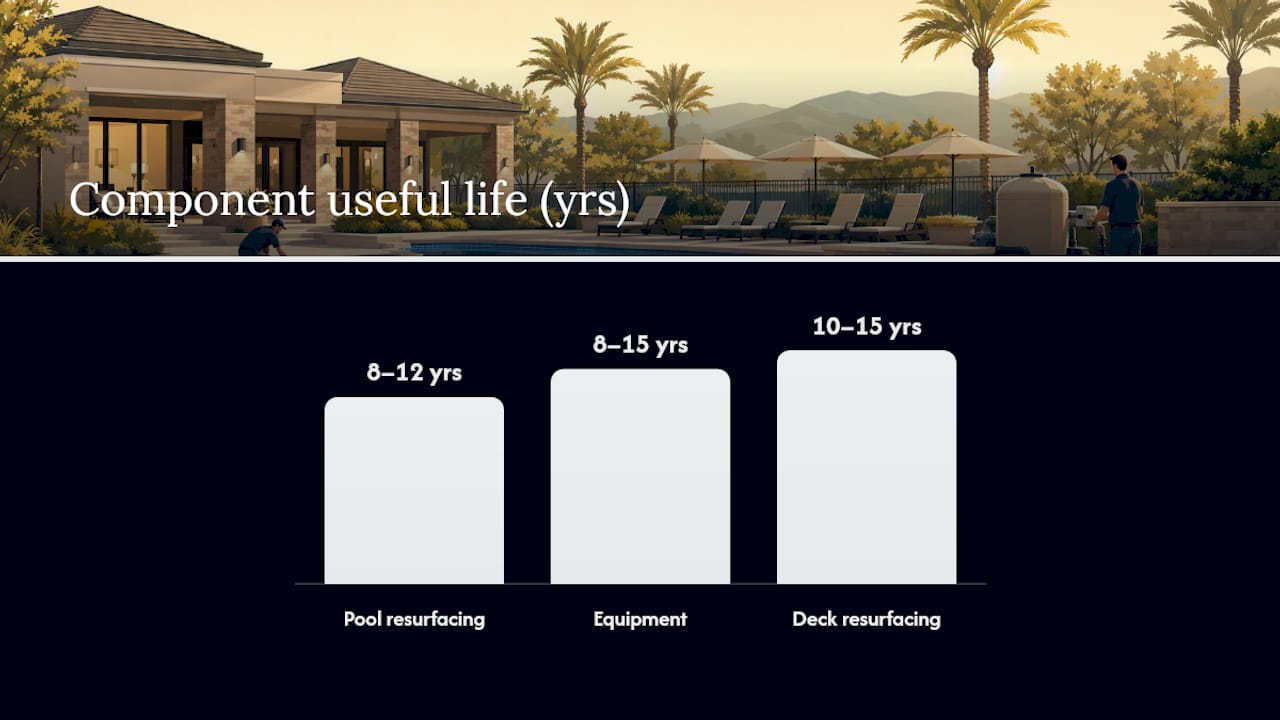
- Component useful life: reserve studies typically assume 8 to 12 years for pool resurfacing, 8 to 15 years for equipment, and 10 to 15 years for deck resurfacing.
Statistic Callout: Best practice calls for a full onsite reserve study update every three years, with annual financial reviews in between, so your percent-funded number doesn’t drift far from reality between site visits.
A renovation resets the clock on useful life, which means your reserve study needs updating immediately after the project closes, not at the next scheduled cycle. New finishes, new equipment, and new deck surfaces all carry fresh replacement-cost assumptions that your old study won’t reflect.
When presenting funding options to owners, show the numbers three ways: a lump-sum special assessment, a financed option with monthly debt service, and a phased approach spread across two budget years. Owners respond better to concrete monthly figures than abstract percentages.
How Professional Renovators Approach HOA Pool Projects
A well-run renovation follows a predictable sequence: condition assessment, scope definition, design, permitting, construction, startup, and warranty handoff. Boards should require a few specific deliverables from any contractor before signing:
- A detailed written scope tied to line items, not vague descriptions.
- A realistic schedule with milestone dates, not just a total duration estimate.
- Written warranty terms covering both materials and workmanship.
- A maintenance handover packet explaining new equipment operation to your pool service provider.
Most change orders trace back to unclear scope or skipped inspections before demolition. A contractor with deep commercial and HOA experience knows to flag potential shell or plumbing issues during the assessment phase, before they become a mid-project surprise. The company has extensive experience with commercial and community association pool projects in Central Florida.
A Board’s Priorities for Getting the Budget Right
The biggest mistake boards make isn’t underestimating cost. It’s skipping the assessment step to save a few weeks, then discovering the real scope mid-construction when change orders are expensive to negotiate. Order the condition assessment first, size your contingency honestly, and use the renovation as a chance to lower long-term operating costs through equipment upgrades, not just refresh the finish. Communicate funding plans to owners early, and always budget collections conservatively. A board that does these four things rarely gets surprised by its own pool project.
— Results
How Classic Marcite Helps HOAs Plan a Pool Renovation That Stays on Budget
Some boards prefer a single contractor to manage the entire process instead of coordinating separate vendors for resurfacing, deck work, and equipment upgrades. Experienced companies in Central Florida often emphasize clear scope and predictable timelines on community association projects, which can be more important than any single finish choice.
Engaging a qualified contractor typically starts with a site assessment that documents shell condition, deck status, and equipment life expectancy before any pricing gets finalized, the same groundwork a board needs before presenting numbers to owners. From there, you get a written scope, a realistic schedule, and warranty terms in place before construction begins. If your community pool is due for resurfacing, remodeling, or equipment upgrades, request a project assessment for your Orlando-area HOA and get a scoped estimate your board can bring straight to the next meeting.
Where Boards Can Verify These Numbers
For deeper reference, the CDC Model Aquatic Health Code covers public pool safety standards relevant to permitting. Boards refining deck material choices can also review general decking project guidance from Cactus Decking. For budget-building basics, see Classic Marcite’s guide on how to budget a pool renovation for maximum value.