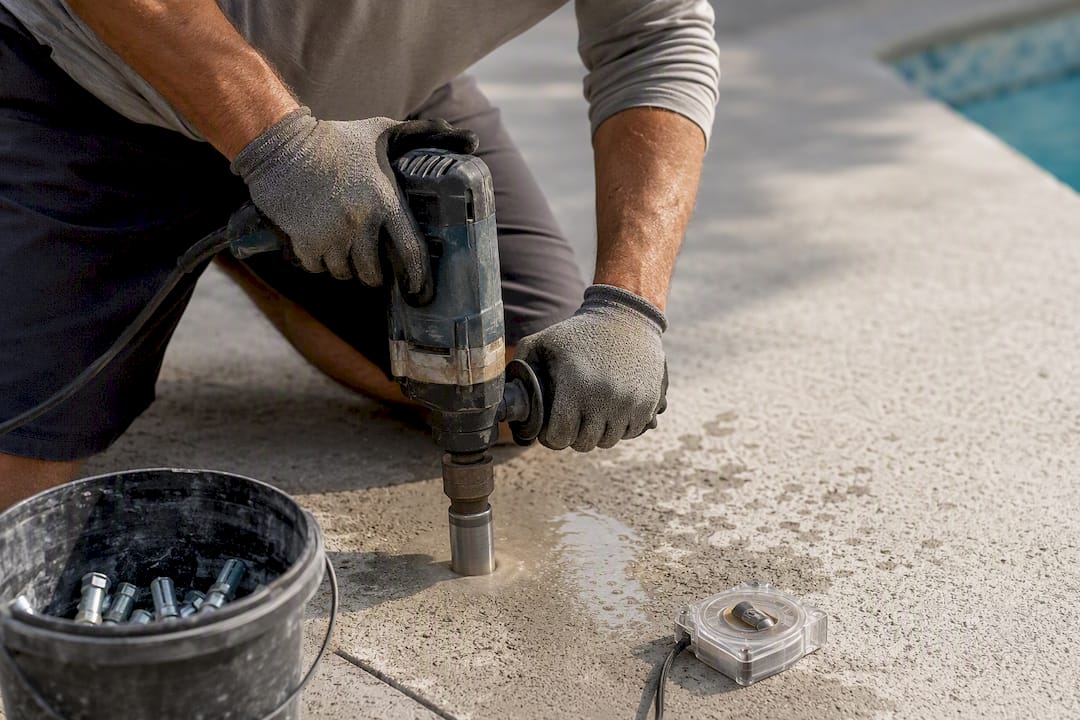
Most homeowners and property managers should hire a licensed installer for pool handrail installation, and the reason comes down to two things a weekend project usually can’t guarantee: a properly embedded anchor and a correctly bonded electrical grid. Get either wrong and you’ve got a rail that pulls loose under weight or a shock hazard hiding under your deck.
- Deck integrity and anchoring: core-drilled anchors need the right embedment depth and epoxy rated for wet, corrosive environments, and a shallow or improperly placed anchor fails quietly until someone leans on it.
- Electrical bonding: fixed metal handrails near the water usually fall under NEC equipotential bonding rules, and getting this wrong can create a real shock risk.
Before you decide, do three things: identify your deck material (concrete, pavers, wood, fiberglass, or vinyl), call your local building department to ask about permit requirements, and get two or three quotes from installers who can also speak to bonding and code compliance.
Key Takeaways
Safe pool handrail installation depends on matching the anchor method to your deck material and confirming NEC bonding requirements before any concrete gets poured or patched.
| Point | Details |
|---|---|
| Hire for anchoring and bonding | DIY works for removable rails; core-drilled anchors and NEC bonding call for a licensed pro. |
| Confirm ADA obligations early | Public and commercial pools face specific ADA entry rules that private residential pools generally don’t. |
| Budget for bonding as a line item | Electrical bonding work often means a separate electrician cost on top of the rail and anchor. |
| Schedule bonding inspection before deck pour | The bonding grid becomes inaccessible once concrete is poured, so timing the inspection matters. |
| Classic Marcite coordinates the full job | Classic Marcite quotes anchoring work directly and coordinates electricians for bonding on residential and commercial pools. |
Codes and standards worth checking before you hire
- ADA 2010 Standards for accessible pool entries
- NEC Article 680 bonding requirements
- NFPA guidance on pool electrical safety
This article is general information, not a substitute for advice from a qualified lawyer. Consult a qualified legal professional about your own circumstances before acting on anything here.
Table of Contents
- How Professionals Handle Pool Handrail Installation
- Which Handrail Type and Material Fit Your Pool?
- What Does Pool Handrail Installation Cost and How Long Does It Take?
- What Permits, ADA Rules, and Electrical Codes Apply?
- Can You Add a Handrail to an Existing Pool?
- How Do You Choose a Qualified Handrail Installer?
- How Classic Marcite Handles Pool Handrail Installation and Renovation
- Sources
How Professionals Handle Pool Handrail Installation
A qualified installer follows a fairly predictable sequence, and knowing it helps you judge whether a quote is thorough or rushed.
- Site assessment. The installer checks deck material and thickness, existing step configuration, and confirms whether a permit is needed. They also locate buried utilities and plumbing before touching a drill, since pool decks routinely hide plumbing runs close to the surface, a point worth confirming with your installer if you’re unsure what’s under your deck.
- Layout and marking. Centerlines get measured against the pool’s stairs or entry point so the rail sits at a usable, code-appropriate height and spacing.
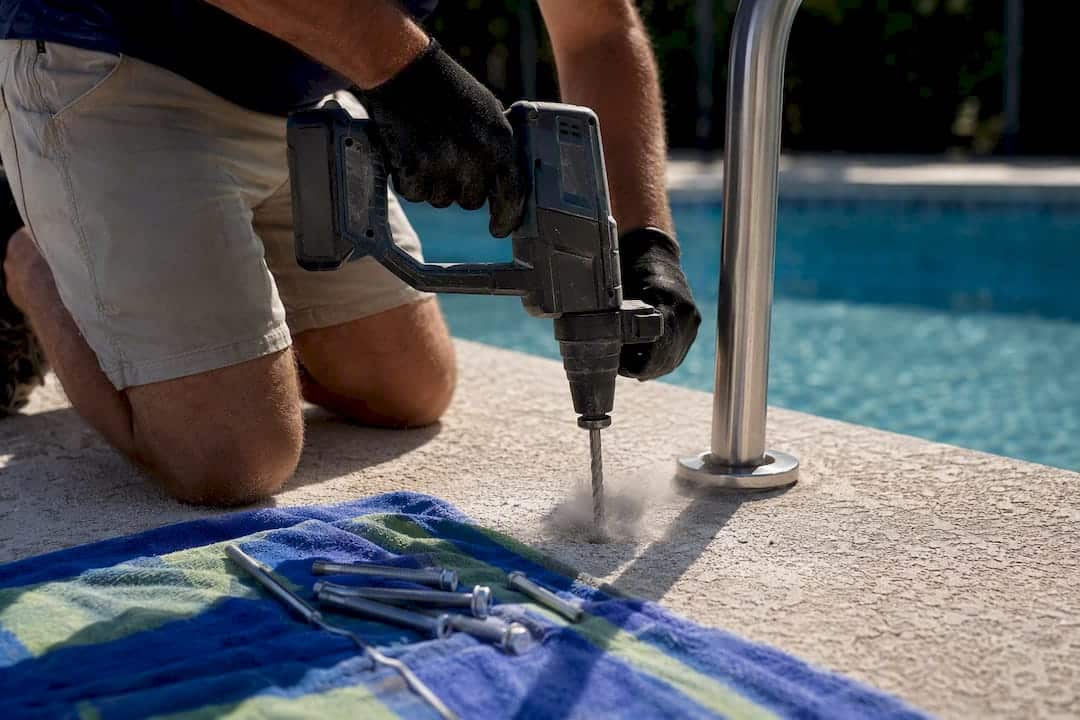
- Coring or anchor placement. On concrete, this means core-drilling and setting epoxy anchors rated for submerged, chlorinated conditions. On wood decking, installers often use through-bolt or surface-mounted flange systems instead.
- Mounting and alignment. The rail goes in, gets torqued to spec, and checked for wobble or misalignment before any deck patching happens.
- Bonding and inspection. If the rail is fixed and within the distance NEC 680.26 defines as requiring equipotential bonding, an electrician ties it into the grid, and the local AHJ signs off if a permit was pulled.
A straightforward on-deck job might take two to three hours from assessment to final check; a core-drilled installation with bonding work can stretch to a half day, plus curing time if the deck gets patched.
Pro Tip: If your deck is being poured or repoured at the same time as the handrail work, schedule the bonding inspection before the concrete goes down. Once the deck is poured, the grid is buried and unreachable if an inspector flags a problem.
Which Handrail Type and Material Fit Your Pool?
Rail choice depends on your pool’s use case as much as its looks.
- Stainless-steel wet-contact rails resist corrosion best, especially in coastal Florida air, and hold up longest against chlorine and salt exposure.
- Powder-coated steel costs less upfront but the coating can chip and expose the base metal to rust over time.
- ADA-focused sloped-entry and transfer rails serve pools where accessible entry is required or simply wanted for aging-in-place households.
- Removable or portable rails work well for rental properties or seasonal use, since they don’t require permanent anchoring.
- Fixed rails cost more to install but last longer and are what most commercial and code-driven residential projects need.
For anyone renting out a property or storing a rail seasonally, removable systems save the anchoring hassle. For everyone else, fixed stainless steel is usually the better long-term investment.
What Does Pool Handrail Installation Cost and How Long Does It Take?
Simple on-deck installations on existing anchor points often run in the low hundreds of dollars. Core-drilled concrete anchor jobs with new hardware typically cost more once labor and materials are factored in, and adding electrical bonding work pushes the price higher still.
- Deck type matters most: coring concrete costs more than mounting to an existing wood deck bracket.
- ADA or lift requirements add both material and labor cost.
- Bonding and electrical work usually means bringing in a licensed electrician, which adds a separate line item.
- Permit fees and access issues (locked gates, tight side yards, second-story decks) can extend both cost and timeline.
Most straightforward jobs move from quote to finished installation within a week or two: a same-day site visit for the estimate, a scheduling window, then an installation day measured in hours rather than days. Deck patching, if needed, adds curing time before the rail sees full use. The 2010 ADA Standards specify exact clear-width requirements for accessible entries, which is one reason ADA-driven jobs often take longer to quote accurately.
What Permits, ADA Rules, and Electrical Codes Apply?
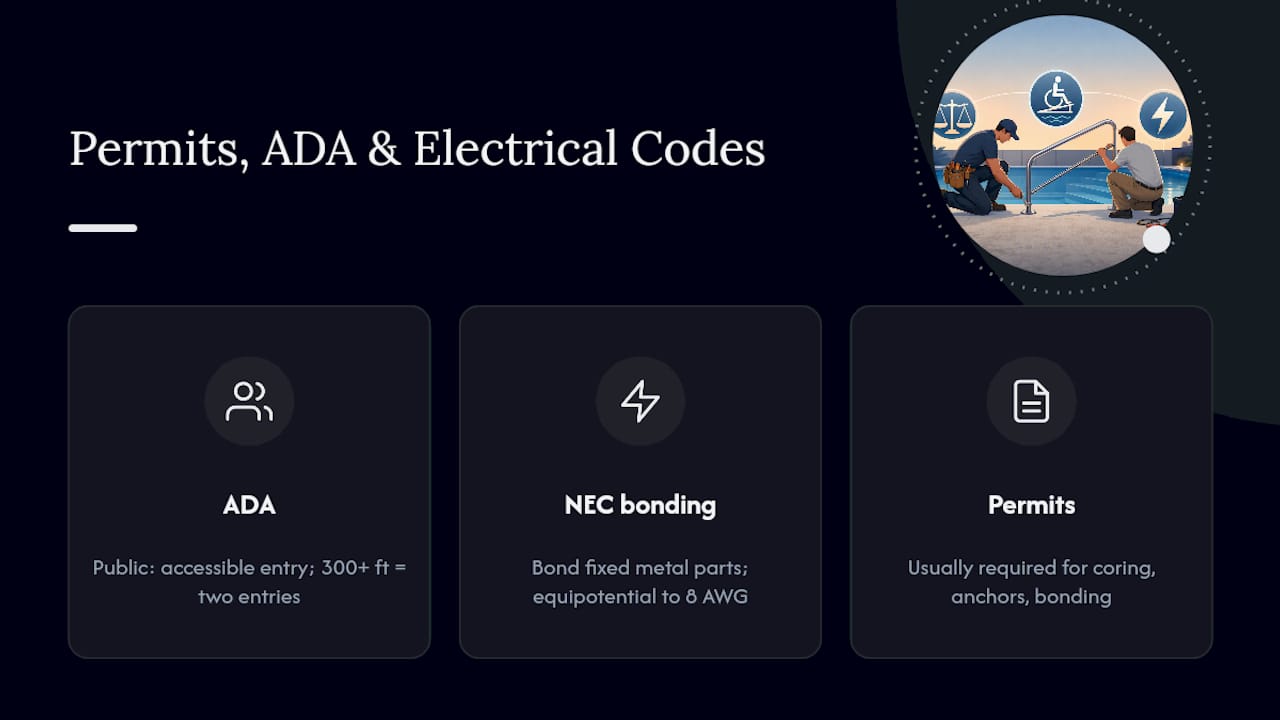
ADA accessibility rules apply differently depending on whether your pool is private or open to the public. The 2010 ADA Standards require newly built or altered public and commercial pools to provide accessible entry: large pools (300 or more linear feet of wall) need two accessible entry points, with at least one being a fixed lift or sloped entry, while smaller pools need at least one. Private residential pools generally fall outside these requirements, though many owners install sloped entries or transfer rails anyway for aging family members.
The electrical side is less optional. NEC Article 680 requires bonding of fixed metal parts, including handrails and ladders, that sit within a defined distance of the pool. The rule exists because water and metal at different electrical potentials create step and touch hazards for swimmers.
Equipotential bonding ties conductive pool parts, including handrails, ladders, and the perimeter surface, to a solid 8 AWG copper conductor so the whole area sits at the same electrical potential, which is what keeps a swimmer from becoming the path between two different voltages.
Local building departments generally require a permit when work involves deck coring, new fixed anchors, or electrical bonding, though rules vary by city and county. Confirm with your local AHJ before scheduling any work; installers who handle permits routinely will know exactly what your jurisdiction expects.
Can You Add a Handrail to an Existing Pool?
Yes, retrofitting is common and usually straightforward. Installers typically use one of a few proven methods:
- Core-drilling with epoxy anchors for concrete decks, the most durable retrofit option.
- Surface-mounted flange systems for wood decking, avoiding the need to drill into structural members.
- Retrofit kits built specifically for vinyl-liner or fiberglass pools, where the shell isn’t conductive.
The real obstacles show up underground: thin deck slabs without enough embedment depth, hidden utility lines, cracked concrete, or a fiberglass shell with no existing bonding path. Fiberglass and vinyl pools need a corrosion-resistant conductive surface bonded to the grid, since the shell itself won’t carry a bond. When the deck needs reinforcement or a full re-pour to support new anchors, that’s no longer a handrail job. It’s a remodeling project, and that’s the point to stop considering DIY.
How Do You Choose a Qualified Handrail Installer?
Ask these questions before signing anything:
- Have you installed rails on this specific deck material before?
- How do you anchor into concrete, and what anchor system do you use?
- Do you handle equipotential bonding yourselves, or coordinate with a licensed electrician?
- Will you pull the permit, and what’s your warranty on the anchor and hardware?
Require proof of a contractor license where your state mandates one, general liability insurance, and worker’s compensation coverage. Ask for references from jobs completed in the last year, ideally on a similar deck type to yours.
Watch for red flags: a contractor asking for full payment upfront in cash, reluctance to mention permits or bonding at all, or no written warranty. A practical guide to metal railing installation from outside the pool industry covers similar anchor and drilling fundamentals if you want a second technical reference point.
Pro Tip: Ask specifically whether the quote includes the electrician’s bonding work or treats it as a separate contractor. Quotes that bundle both usually move faster and avoid scheduling gaps between the two trades.
A practical note on safety-first decisions
Code compliance isn’t paperwork for its own sake. It’s the difference between a rail that holds and a grid that protects swimmers from shock. DIY is reasonable for a removable rail on an existing anchor point; anything involving coring, new anchors, or bonding belongs to a licensed pro.
How Classic Marcite Handles Pool Handrail Installation and Renovation
Classic Marcite is the option for homeowners and property managers who want a single contractor who understands both the deck work and the code requirements around it, not a rail installer who leaves the concrete and bonding questions to someone else.
The company assesses your deck material and pool type on-site, quotes the core-drilling and anchoring work directly, and coordinates with licensed electricians when equipotential bonding is required. Classic Marcite has resurfaced and renovated pools since 1988 across both residential backyards and commercial properties, including commercial pool projects where ADA-driven accessibility upgrades are part of the scope. If your handrail project turns into a bigger conversation about deck condition or surface wear, that’s a natural next step Classic Marcite already handles under one roof. Warranty coverage and aftercare come standard, and the team can point you toward your local AHJ if you’re unsure about permit requirements. Request a free estimate for pool resurfacing in Orlando to get a site assessment scheduled and find out whether your handrail project needs anything beyond a straightforward mount.
Sources
- Ada
- Understanding equipotential bonding requirements for swimming pools, fountains, and similar installations | EC&M
- Code compliant electrical installation the key to swimmer safety and a secure electrical system in pools | NFPA
- Equipotential bonding: pools, spas, and wet areas per NEC 2023 – ExpertCE