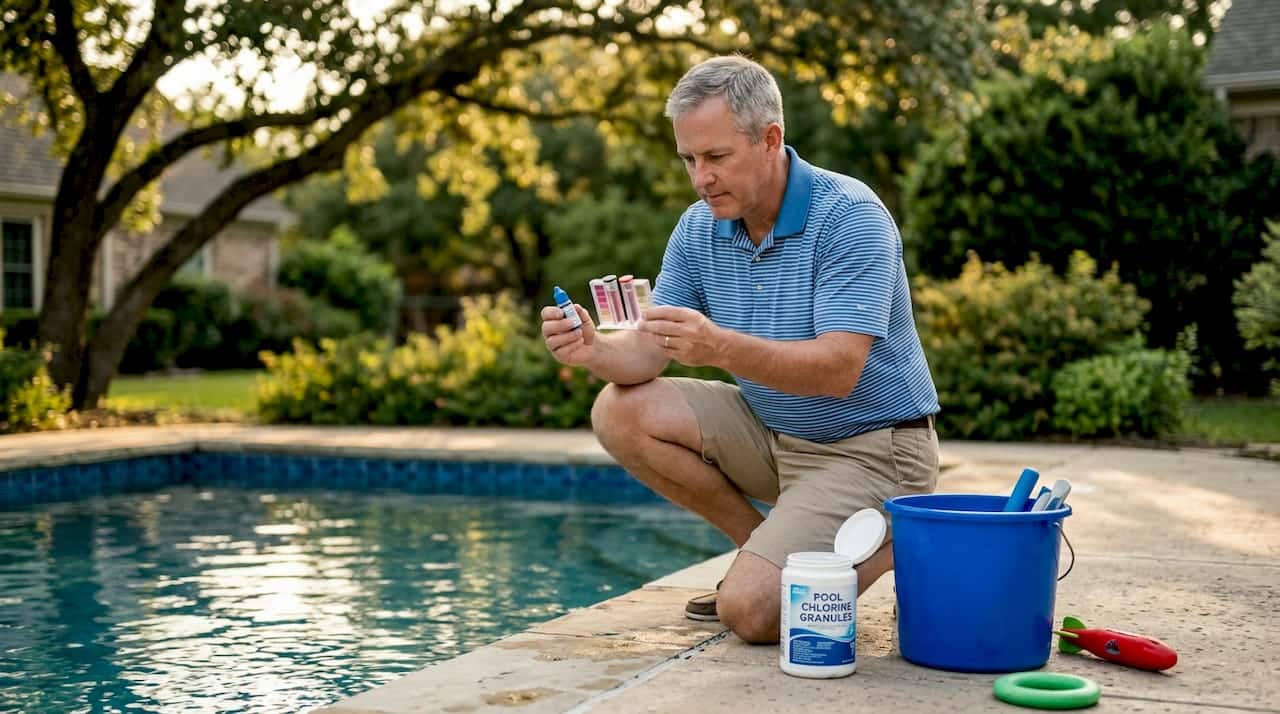
TL;DR:
- Pool scoring has two meanings: in cue sports, it tracks game points, while in maintenance, it assesses water chemical balance through the Langelier Saturation Index (LSI). Proper LSI scoring, with a target range of -0.3 to +0.3, protects pool surfaces from corrosion and scaling, preventing damage like etching and staining. Regular testing and adjustments based on the LSI help preserve pool finishes and avoid costly resurfacing projects.
If you’ve searched “what is pool scoring” expecting a single clear answer, you’ve probably landed on pages about cue sports point systems instead of anything useful for your backyard. That confusion is understandable because the phrase genuinely means two very different things. For homeowners and property managers, the version that matters is rooted in water chemistry. Specifically, it refers to a chemical scoring method that tells you whether your pool water is safe for its surface finish. Get it wrong, and your plaster pays the price.
Key takeaways
| Point | Details |
|---|---|
| “Pool scoring” has two meanings | In cue sports it tracks game points; in maintenance it refers to chemical water balance measurement. |
| LSI is the core scoring tool | The Langelier Saturation Index measures pH, alkalinity, calcium, and temperature to score water balance. |
| Target range is narrow | An LSI score between -0.3 and +0.3 protects pool surfaces from both corrosion and scaling. |
| Surface damage follows bad scores | Plaster etching, staining, and scaling are direct consequences of chronic LSI imbalance. |
| Testing frequency matters | Check your LSI score at least monthly, and weekly during high-use seasons in Florida’s heat. |
What is pool scoring in cue sports
Before focusing on what actually affects your pool surface, it helps to understand why this phrase causes so much confusion. “Pool scoring” has a well-established meaning in billiards and league play, and if you’re not familiar with that world, stumbling into it while researching pool maintenance can send you down the wrong path completely.
In cue sports, pool scoring in league play refers to complex point-tracking systems used in organized competition. Different leagues use different methods, so there’s no single universal standard. Here are the most common approaches:
- 17-point 8-ball system. The winner earns 10 points plus 1 additional point for each ball still on the table belonging to the opponent. The loser receives 1 point per ball they legally pocketed, up to 7. Every match sums to exactly 17 total points, which gives the system its name.
- USA Pool League 9-ball/10-ball scoring. The rack winner receives 14 points. The losing player earns 1 point for each ball they legally pocketed during the rack. Dead balls award no points and match totals are adjusted for handicaps.
- 1-point per rack system. Simpler recreational formats where each game won counts as a single point toward the match total, common in casual bar leagues.
- Handicap-adjusted totals. Many leagues layer a handicap system on top of raw point totals to level competition between players of different skill levels.
Pool game scoring methods in cue sports are entirely domain-specific. They have no connection to water chemistry, pool surfaces, or anything related to your physical pool structure. Understanding scoring in billiards is genuinely useful if you play in leagues. For a homeowner trying to protect a plaster finish, though, these systems are a detour. The scoring that matters to your pool’s longevity lives in a lab test, not a scorecard.
Pool scoring in maintenance: the Langelier Saturation Index
Here is where pool scoring becomes directly relevant to your investment. In the context of pool surface care, “pool scoring” refers to the Langelier Saturation Index, or LSI. This is a calculated numerical score that tells you the overall chemical balance of your pool water relative to its potential to either dissolve or deposit calcium carbonate on your pool’s interior surfaces.
The LSI scores water balance using five key inputs:
- pH — the acidity or alkalinity of the water
- Water temperature — warmer water changes how minerals behave
- Calcium hardness — the concentration of dissolved calcium
- Total alkalinity — the water’s resistance to pH swings
- Total dissolved solids (TDS) — the cumulative concentration of all dissolved materials
Each of these values is plugged into a formula that produces a single score. That score tells you exactly how your water is behaving chemically. The ideal LSI range is -0.3 to +0.3 for residential pools. Water scoring within this range is considered balanced, meaning it neither aggressively attacks your pool surface nor deposits unwanted mineral buildup on it.
| LSI Score Range | Water Condition | Surface Impact |
|---|---|---|
| Below -0.3 | Corrosive | Dissolves plaster, etches surfaces, attacks grout |
| -0.3 to +0.3 | Balanced | Protects surface finish, no scaling or corrosion |
| Above +0.3 | Scale-forming | Deposits calcium, clouds water, clogs equipment |
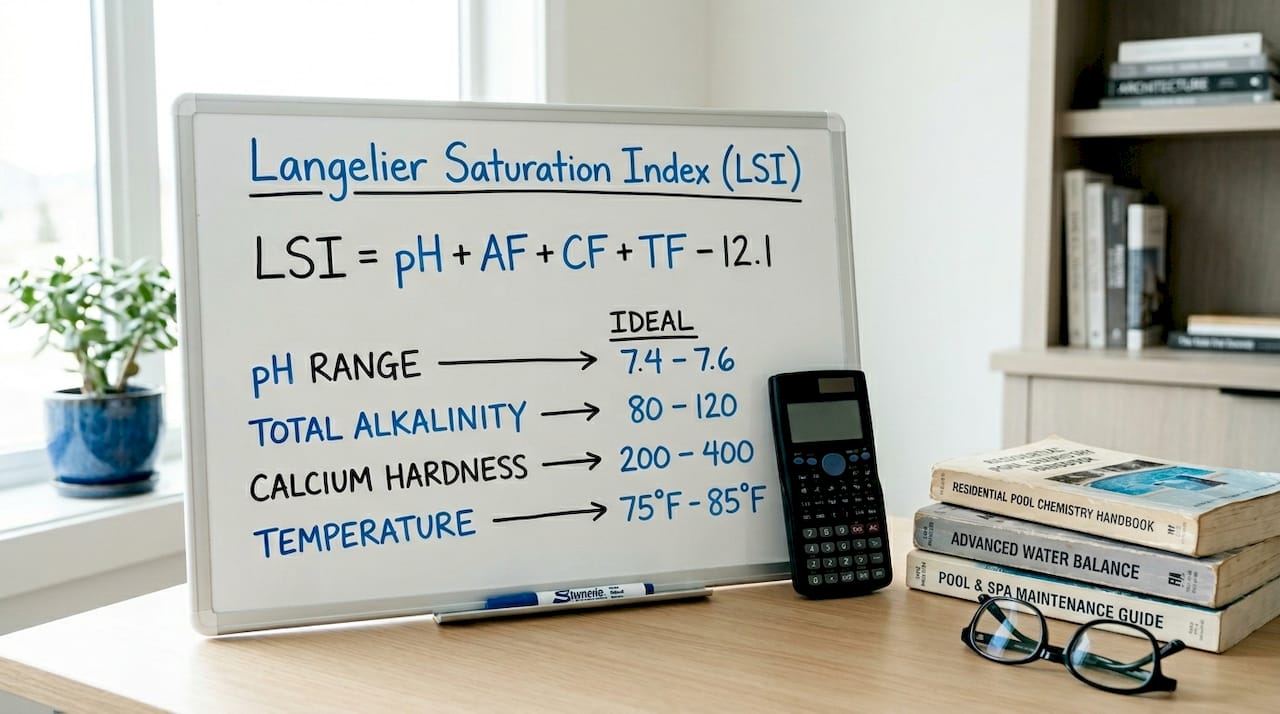
Pro Tip: You can calculate your LSI score manually, but free online calculators make it much faster. Input your five test values and get your score instantly. Many pool stores will calculate it for you at no charge if you bring a water sample.
The LSI concept was developed by Dr. Willard Langelier in the 1930s to assess water’s effect on metal pipes. The pool industry adopted it because the same chemistry that corrodes pipes also destroys plaster and other interior finishes over time.
How scoring results connect to surface damage
Knowing your LSI score is only half the equation. The other half is understanding what that number is actually telling you about the condition and future of your pool surface.
When your pool scores below -0.3, the water is chemically “hungry.” It wants to dissolve minerals, and your pool’s plaster or aggregate finish is the nearest source. This is how etching begins. You might first notice a rough texture on the walls, white or gray patches on formerly smooth surfaces, or a general cloudiness that does not clear with normal chemical treatment. Surface damage like etching and staining correlates directly with chronic water imbalance, and it worsens faster in Florida’s heat because warm water accelerates chemical reactions.
On the other side, water scoring above +0.3 is scale-forming. Calcium deposits cling to tile lines, heater elements, and the pool floor. Over time, this creates a rough, white crust that is difficult to remove without mechanical methods. Heavy scaling also traps algae, making your maintenance routine harder and more expensive.
The practical signs that your pool scoring has been off for a while include:
- Rough or sandpaper-like surface texture where plaster has been etched
- White crusty deposits along the waterline or on steps
- Persistent staining that does not respond to standard shock treatment
- Tile grout deterioration where calcium or acid has worked into the joints
- Cloudy water that recurs despite proper sanitizer levels
Routine chemical scoring helps you catch these problems at the early stage, when a chemistry adjustment fixes everything. Wait too long, and you are looking at a resurfacing project. Maintaining chemistry parameters protects pool plaster longevity and keeps your finish looking clean for years longer than neglected pools.
Pro Tip: After any major rainfall event, test your LSI score within 24 hours. Heavy rain in Florida dilutes calcium and alkalinity rapidly, which can push an otherwise balanced pool into corrosive territory overnight.
Scoring vs. other water quality metrics
Homeowners commonly track pH alone and assume that’s enough. It is not. pH tells you one piece of the story, but it does not account for temperature, calcium concentration, or alkalinity. Each of those variables can dramatically shift how your water behaves against your pool surface even when pH looks perfect.
The table below shows how individual metrics compare to LSI scoring as a diagnostic tool for surface care:
| Metric | What it measures | Surface protection ability |
|---|---|---|
| pH alone | Acidity/alkalinity | Partial; misses scale and corrosion risk |
| Alkalinity alone | pH stability | Partial; does not reflect calcium behavior |
| Calcium hardness alone | Mineral concentration | Partial; misses temperature and pH interaction |
| LSI score | All five factors combined | Full picture; identifies actual surface risk |
The LSI’s strength is that it functions as a holistic water balance score rather than a collection of isolated numbers. A pool with a “normal” pH of 7.4 but very low calcium hardness and high temperature can still score a -0.5 LSI, which means the surface is being attacked even though one metric looks fine. Testing individual parameters gives you fragments. Scoring gives you the whole picture.
Water quality tips for a safe, clear pool always include multiple parameters for this reason. The LSI is how those parameters talk to each other.
Practical steps for implementing pool surface scoring
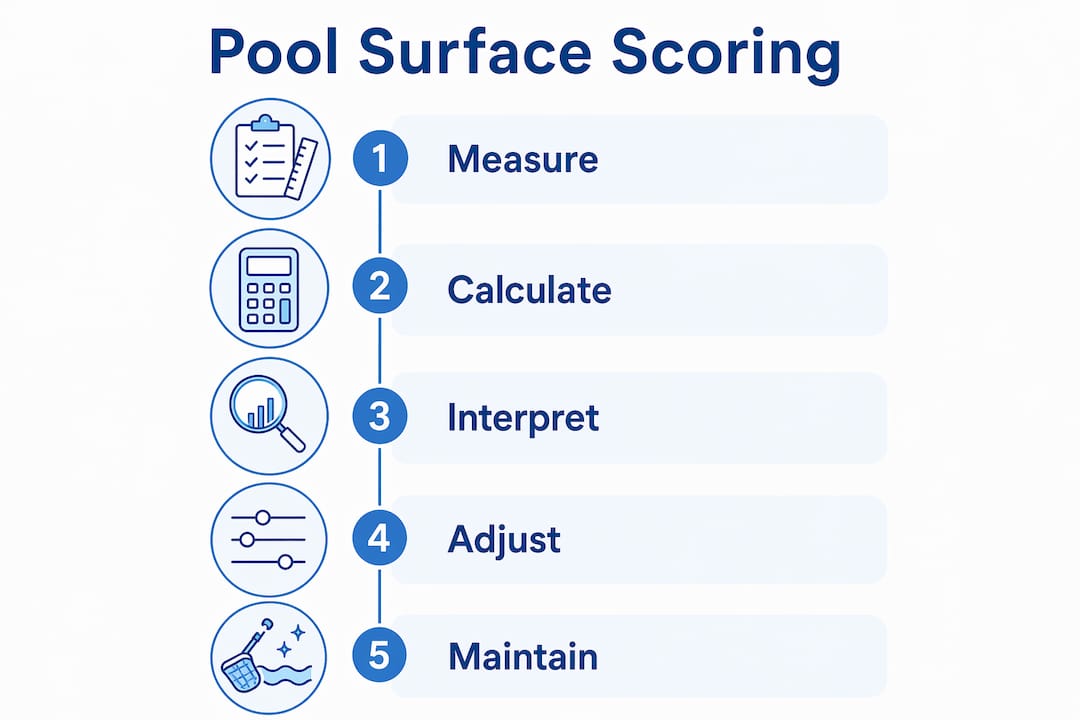
Understanding the theory is useful. Applying it consistently is what actually protects your pool. Here is a straightforward process to integrate pool scoring into your regular maintenance routine:
- Test your five parameters. Use a professional-grade test kit or take a water sample to your local pool supply store. You need pH, total alkalinity, calcium hardness, water temperature, and TDS. Basic test strips will not give you accurate enough readings for reliable LSI calculation.
- Calculate your LSI score. Plug your values into an online LSI calculator or use the formula manually. Note the result and compare it to the -0.3 to +0.3 target range.
- Identify which variable is pulling the score out of range. Low scores usually come from low calcium hardness or low alkalinity. High scores often reflect high pH or high calcium in warm water. Correct the primary cause first rather than adjusting everything at once.
- Make incremental adjustments. Add calcium chloride to raise calcium hardness, sodium bicarbonate to raise alkalinity, or muriatic acid to lower pH. Always add chemicals gradually and retest after 24 hours before adding more.
- Establish a testing schedule. Test weekly during summer in Florida, where heat and heavy pool use push chemistry out of balance quickly. Monthly testing is a minimum for the cooler months. Monitoring scoring metrics after resurfacing is especially critical during the first 30 days when fresh plaster is most vulnerable.
- Know when to call a professional. If your score is consistently difficult to stabilize, or if you are already seeing surface damage, a professional assessment will save you money compared to letting the problem compound.
Avoiding the common pitfall of chasing one number at a time rather than tracking the full LSI score will save you significant time and frustration. Maintaining surface chemistry is a system, not a single fix.
My perspective on pool scoring and why most owners miss it
I’ve worked in and around pool renovation long enough to know that the majority of pool owners who come to us for resurfacing never had to. Their surfaces failed years earlier than they should have, almost always because no one explained what water chemistry was doing to their finish over time.
The phrase “pool scoring” is genuinely underused in the homeowner world. Most people hear about pH and chlorine. Few hear about LSI. Yet in my experience, chronic LSI imbalance is the single biggest driver of premature plaster failure that I see. A pool scorring consistently at -0.5 over two or three seasons is not a chemistry problem anymore. It becomes a structural surface problem.
What I always tell property managers is this: the cost of testing your LSI monthly is near zero. The cost of resurfacing a pool that could have been preserved is significant. That math is not complicated, but only a small percentage of pool owners act on it consistently. Those who do rarely need to resurface on an emergency timeline.
Professional help is not always necessary for chemistry management, but getting a professional assessment once a year, especially going into Florida’s summer, is money very well spent. Know your score. Fix it early. Your surface will thank you a decade from now.
— Classicmarcite
Protect your pool surface with professional resurfacing
Once you understand how water chemistry affects your pool’s surface, the next step is making sure that surface is in good enough condition to be worth protecting.

At Classic Marcite, we’ve resurfaced more than 100,000 pools across Florida since 1988, and we’ve seen exactly what years of LSI imbalance does to plaster and aggregate finishes. If your surface shows etching, staining, or scaling that chemistry corrections can no longer fix, professional pool resurfacing is the right next step. We also offer full renovation services throughout Central Florida, including locations like pool renovation in Maitland and surrounding areas. Contact us for a free estimate and let us assess what your surface actually needs.
FAQ
What is pool scoring in maintenance terms?
In pool maintenance, pool scoring refers to the Langelier Saturation Index (LSI), a calculated score that measures whether your water is chemically balanced, corrosive, or scale-forming. The ideal range is -0.3 to +0.3.
How does pool scoring work in cue sports?
In cue sports, pool scoring tracks points or racks during league matches using systems like the 17-point 8-ball format or the USA Pool League 9-ball method, where rack winners earn 14 points and losers receive points per ball legally pocketed.
What happens if my pool’s LSI score is too low?
A score below -0.3 means your water is corrosive. It will slowly dissolve your pool’s plaster finish, causing etching, rough texture, and surface staining that worsens over time without correction.
How often should I calculate my pool’s LSI score?
Test weekly during high-use summer months and at minimum monthly during cooler periods. Retest within 24 hours after heavy rainfall, since dilution can shift your score significantly.
Can poor pool scoring lead to resurfacing?
Yes. Chronic imbalance in your water chemistry score accelerates surface deterioration. Scaling, etching, and staining caused by sustained LSI imbalance often make resurfacing necessary years ahead of a well-maintained pool’s natural timeline.