TL;DR:
- Pool mastic is a flexible, waterproof sealant that fills the expansion joint between a pool’s coping and deck. It prevents water infiltration, accommodates structural movement, and requires proper application and regular inspection to maintain pool integrity. Neglecting or improperly installing mastic can lead to erosion, settling, and costly repairs, especially in variable ground conditions like Florida.
Pool mastic is defined as a flexible, waterproof sealant installed in the expansion joint between a pool’s coping and surrounding deck. Unlike standard household caulk, pool mastic is engineered to stretch and compress as the pool shell and deck shift independently due to temperature swings, soil movement, and moisture changes. Without it, water finds its way beneath the deck, eroding the base and threatening the pool’s structural integrity. If you own a pool in Florida or anywhere with seasonal ground movement, understanding pool mastic is not optional. It is the thin line between a watertight pool and an expensive repair bill.
What is pool mastic and why is it used around pools?
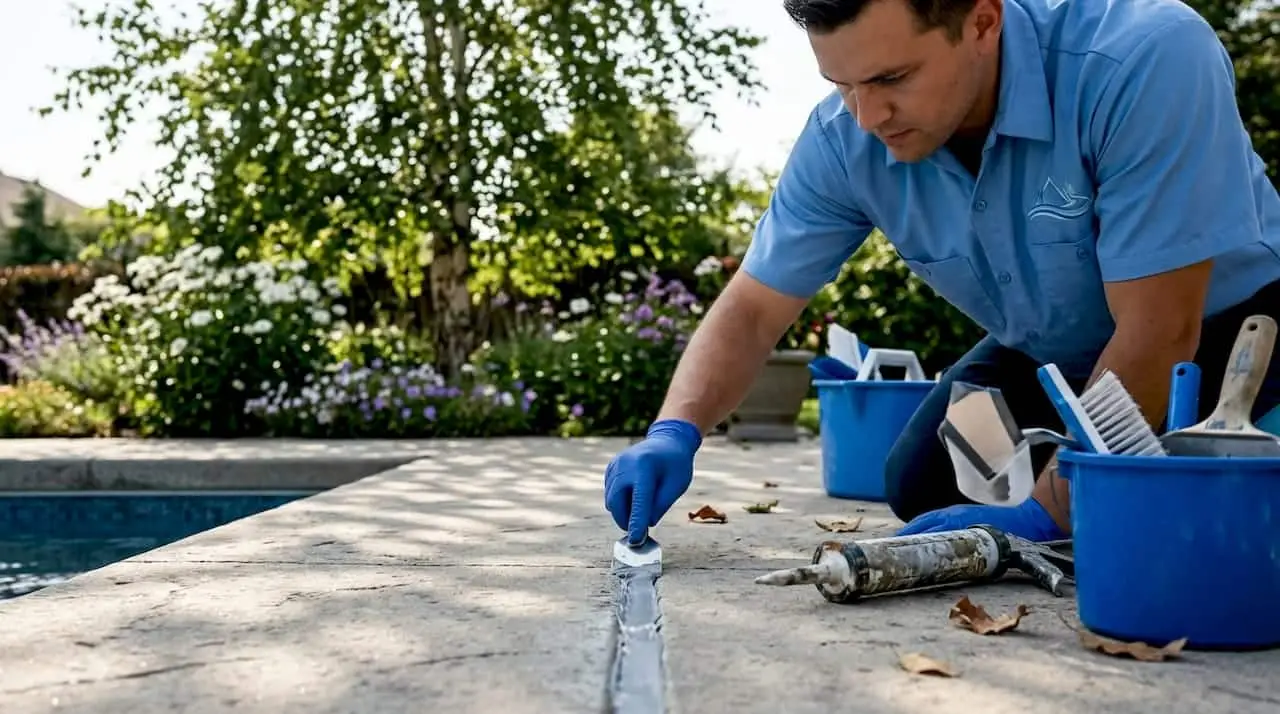
Pool mastic fills the expansion joint between coping and deck, the deliberate gap left during construction to allow the pool shell and the surrounding concrete deck to move without cracking each other. That gap is not a flaw. It is a design feature, and pool mastic is what keeps it functional.
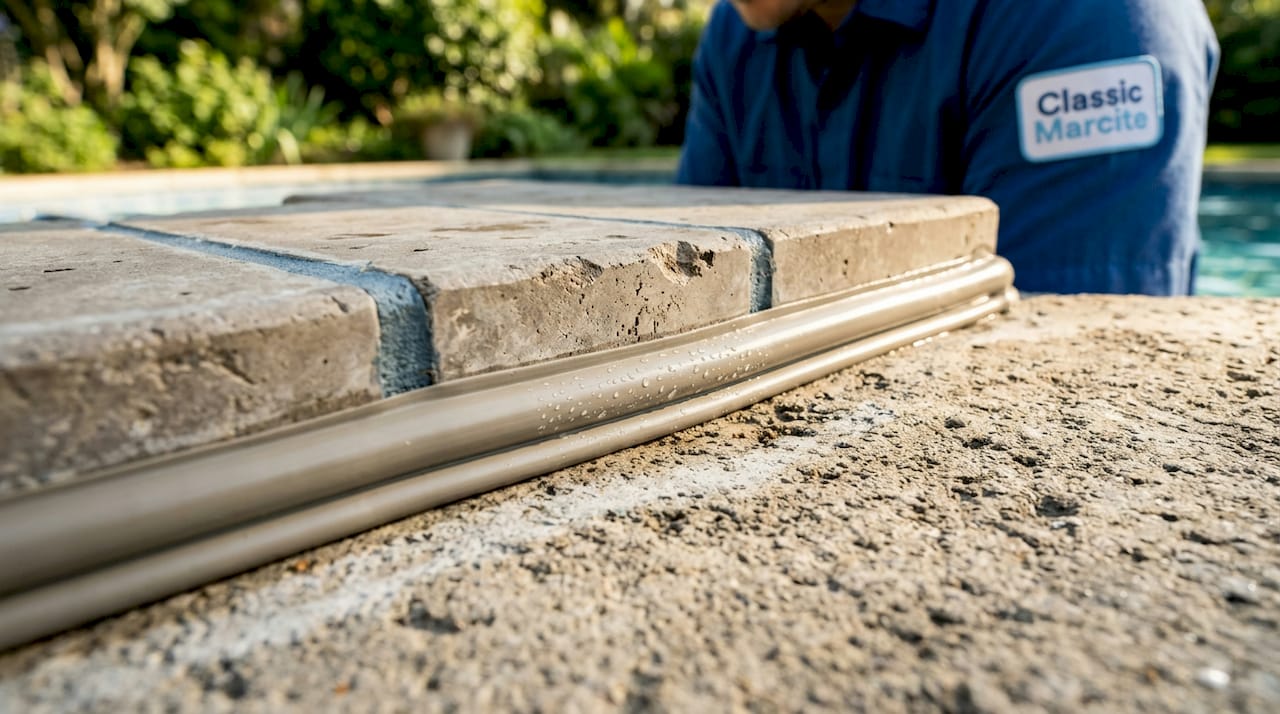
The pool shell and the deck are two separate structures. They sit on different substrates, respond differently to heat, and shift at different rates when the ground beneath them expands or contracts. Temperature, moisture, and soil changes all drive this independent movement. A rigid filler would crack within one season. Pool mastic stays flexible, absorbing that movement without breaking the seal.
When pool mastic fails, the consequences stack up fast:
- Water seeps under the deck, saturating the base material and causing erosion
- Soil beneath the coping washes away, leading to settling and uneven surfaces
- Debris and organic matter pack into the open joint, accelerating deterioration
- Weeds take root in the gap, widening it and forcing the joint apart
- Water intrusion risks erosion and costly pool foundation damage over time
Pro Tip: Never use standard bathroom or kitchen caulk in a pool expansion joint. Generic caulks are not formulated for continuous UV exposure, pool chemicals, or the degree of joint movement a pool deck experiences. They will crack and fail within months.
The purpose of pool mastic goes beyond waterproofing. It also keeps the joint clean, prevents pest intrusion, and maintains the finished appearance of the pool perimeter. For Florida homeowners especially, where ground movement from sandy soils and heavy rain is constant, a properly sealed expansion joint is the first defense against premature deck and coping damage.

What are the different types of pool mastic?
Choosing the right product matters as much as the installation itself. Pool mastic types differ in chemistry, application environment, and performance under specific conditions. The three categories most relevant to residential pools are neutral MS polymer mastics, hydrophilic swell caulks, and self-leveling joint sealants.
| Type | Best application | Key strength | Limitation |
|---|---|---|---|
| Neutral MS polymer mastic | Wet or dry surfaces, underwater | Underwater curing, UV and chemical resistance | Higher cost per unit |
| Hydrophilic swell caulk | Construction joints with water contact | Expands 200–350% on water contact for compression seal | Not suited for wide expansion joints |
| Self-leveling joint sealant | Horizontal deck joints under foot traffic | Pours into joint for continuous seal | Requires clean, dry joint prep |
Neutral MS polymer mastics, such as the GEB POOL MASTIC PISCINE product, cure even when applied on wet surfaces or underwater. This makes them practical for repairs that cannot wait for a pool to be fully drained and dried. They also resist pool water chemicals and UV exposure, which is the combination that destroys lesser products within a year or two.
Hydrophilic swell caulks from manufacturers like SealBoss work on a different principle. They absorb water and physically expand to create a compression seal inside the joint. This expansion is significant. Products in this category can swell to more than three times their original volume on water contact. That makes them effective for construction joints where water is already present, though they are not the right choice for wide expansion joints that need flexible elongation rather than compression.
Self-leveling sealants, like the Deck-O-Seal HS-1 SL, are poured or gun-applied into horizontal joints and cure to a flexible, traffic-resistant seal. They work well for pool deck perimeter joints where the gap is relatively uniform and the surface is horizontal. The self-leveling nature means the product finds its own level in the joint without tooling, which reduces application errors.
Regular household caulk belongs in none of these categories. It lacks the flexibility required for expansion joints and degrades rapidly under pool chemical exposure and Florida sun. Using it is a short-term fix that creates a longer-term problem.
How to apply pool mastic for a lasting seal
Proper pool mastic installation starts well before the product ever leaves the tube. Preparation determines whether the sealant bonds correctly and lasts for years or peels away within a season.
- Remove all old mastic completely. Use a utility knife, oscillating tool, or joint saw to cut out the existing sealant. Leaving old material in place prevents the new mastic from bonding to the joint walls.
- Clean the joint thoroughly. Brush out debris, dirt, and dust. For MS polymer or self-leveling products, the joint should be as clean and dry as possible unless the product is specifically rated for wet application.
- Install a foam backer rod. Press a closed-cell foam backer rod into the joint to control the depth of the sealant. The mastic should fill the top portion of the joint, not the entire depth. A depth-to-width ratio of 1:2 is the standard target.
- Apply the mastic. For gun-applied products, cut the nozzle to match the joint width and apply in a single continuous pass. For self-leveling products, pour slowly and allow the material to settle before adding more.
- Tool the surface if required. Some products need to be smoothed with a wet finger or tool to ensure full contact with both joint walls. Self-leveling sealants generally do not require tooling.
- Allow full cure time before refilling the pool. Cure times vary by product and temperature. Follow the manufacturer’s specification. Rushing this step compromises the bond.
Pro Tip: In Florida’s heat, apply pool mastic in the early morning when surface temperatures are lower. High surface temperatures accelerate skinning and can prevent the sealant from bonding fully to the joint walls before it sets.
Maintenance after installation is straightforward. Inspect the joint at least once per year, ideally before and after summer. Look for any separation from the joint walls, surface cracking, or areas where the mastic has hardened and lost its flexibility. Catching these early means a simple spot repair rather than a full joint replacement.
How to recognize when pool mastic needs replacing
Regular inspection for cracking and brittleness is the most reliable way to stay ahead of pool mastic failure. Most residential pool mastic lasts between five and ten years depending on product quality, installation accuracy, and exposure conditions. Florida pools, with their intense UV load and frequent rain, tend to sit at the shorter end of that range.
The warning signs are visible if you know what to look for:
- Cracking or splitting along the length of the joint, especially at the edges where mastic meets coping or deck
- Discoloration from algae, mold, or chemical staining, which often signals moisture is already getting behind the sealant
- Brittleness when you press the mastic with a finger. Healthy mastic flexes. Deteriorated mastic resists and may crumble
- Separation from joint walls, visible as a gap between the sealant and the coping or deck surface
- Weed or grass intrusion growing up through the joint, which means the seal has been compromised long enough for organic matter to establish itself
Ignoring these signs does not just mean a leaky joint. Deterioration leads to water intrusion that erodes the substrate beneath the deck, causes settling, and can eventually undermine the coping itself. Repairs at that stage involve far more than a tube of sealant. They require deck lifting, base regrading, and coping reset. The cost difference between a timely mastic replacement and a neglected joint repair is significant.
For Florida homeowners, weather’s impact on pool surfaces accelerates this timeline. Inspect after major storms and at the start of each swim season. Do not wait for visible water pooling near the deck edge to act.
Key takeaways
Pool mastic is the flexible joint sealant that prevents water intrusion, accommodates structural movement, and protects the long-term integrity of any pool’s coping and deck connection.
| Point | Details |
|---|---|
| Pool mastic definition | A flexible, waterproof sealant that fills the expansion joint between pool coping and deck. |
| Why flexibility matters | Pool shell and deck move independently, so only a flexible sealant prevents cracking and seal failure. |
| Choosing the right type | MS polymer, hydrophilic swell caulk, and self-leveling sealants each suit different conditions and joint types. |
| Application prep is critical | Removing old mastic and installing a backer rod before applying new sealant determines how long the repair lasts. |
| Inspect annually | Cracking, brittleness, and weed intrusion are early signs that replacement is overdue and structural risk is rising. |
Why homeowners underestimate pool mastic
Most homeowners notice their pool’s surface finish, tile line, and water color long before they think about the expansion joint. That is understandable. The joint is a narrow strip of material that blends into the deck. But after working with pools across Central Florida for decades, the pattern is consistent: the pools that develop serious structural problems almost always have a history of neglected joint maintenance.
The mistake I see most often is homeowners patching over deteriorated mastic with a fresh bead of caulk without removing the old material. The new product bonds to the old, not to the joint walls. It looks fine for a season and then peels away in sheets. The joint is worse than before because now there is a false sense of security.
The second mistake is product selection. Not every sealant labeled for outdoor use belongs in a pool expansion joint. The chemistry has to be right. Pool water, chlorine, and Florida UV are a harsh combination. A product that performs well on a driveway expansion joint may fail completely in a pool environment within a year.
The right approach is simple: use a pool-specific product, prepare the joint properly, and inspect it every year. Routine attention to pool deck maintenance in Florida costs a fraction of what structural repairs demand. The expansion joint is small, but what it protects is not.
— Classicmarcite
How Classicmarcite helps protect your pool from the ground up
Classicmarcite has resurfaced more than 100,000 pools across Florida since 1988, and the work rarely stops at the water line. Expansion joints, coping, and deck conditions all affect how long a resurfaced pool holds up. When these elements are addressed together, the results last.

If your pool’s coping joint is showing signs of wear, or if you are considering a full pool resurfacing in The Villages or anywhere in Central Florida, Classic Marcite offers free estimates and brings the same precision to joint repairs as it does to full surface renovations. As the largest Pebble Tec® applicator in Central Florida, the team understands how every component of a pool works together. Reach out for a free estimate and get a professional assessment of your pool’s full condition.
FAQ
What is pool mastic made of?
Pool mastic is typically made from MS polymer, polyurethane, or polysulfide compounds formulated to remain flexible and waterproof under UV exposure and pool chemical contact. Standard silicone or acrylic caulks are not suitable substitutes.
How long does pool mastic last?
Pool mastic generally lasts between five and ten years, depending on product quality, installation method, and environmental exposure. Florida pools tend to require replacement closer to the five-year mark due to intense UV and frequent rain cycles.
Can I apply pool mastic myself?
Yes, pool mastic installation is a manageable DIY task if you remove all old material, install a foam backer rod, and use a pool-specific sealant product. Skipping the prep steps is the most common cause of early failure.
What happens if pool mastic is not replaced?
Deteriorated pool mastic allows water to seep beneath the deck, eroding the base material and causing settling, coping damage, and potential structural problems that cost significantly more to repair than a timely mastic replacement.
Is pool mastic the same as pool caulk?
Pool mastic and pool caulk refer to the same product in most residential contexts. Both describe the flexible sealant used in pool expansion joints. The term “mastic” is more common in professional pool construction, while “caulk” is the more familiar term for homeowners.
