TL;DR:
- A failed health inspection can lead to immediate pool closure, causing revenue loss and legal liabilities for property managers.
- Maintaining compliance requires daily water testing, proper documentation, timely drain cover replacements, and thorough self-inspections aligned with local regulations.
A failed health inspection can shut your pool down in a single afternoon. For commercial property owners and managers, that means revenue loss, guest complaints, and potential legal exposure. This commercial pool compliance guide covers what you actually need to know: the federal and state regulations that apply to your facility, the documentation that keeps inspectors satisfied, the daily operational habits that prevent violations, and how to approach inspections with confidence rather than guesswork. Whether you manage a hotel pool in Florida, a community center in Arizona, or a resort facility anywhere in between, the framework here applies.
Table of Contents
- Key takeaways
- Your commercial pool compliance guide to regulations
- What you need before your first inspection
- Day-to-day operational compliance
- Passing the pool safety inspection process
- What I’ve learned about compliance after years in the pool industry
- How Classicmarcite helps commercial pools stay compliant
- FAQ
Key takeaways
| Point | Details |
|---|---|
| Know your regulatory layers | Federal law, state codes, and local ordinances all apply simultaneously and often overlap. |
| Certify your operators | Most states require a licensed Certified Pool Operator before you can legally open a public pool. |
| Test and log water chemistry daily | Twice daily chemical testing and on-site logs are required to pass inspection and avoid closure. |
| Track drain cover expiration | VGB-compliant drain covers must be replaced every 5 to 10 years. Expired covers trigger immediate shutdown. |
| Conduct your own self-inspection | Reviewing your facility against the local inspector’s checklist before the official visit eliminates most preventable violations. |
Your commercial pool compliance guide to regulations
The regulatory framework governing commercial pools operates on three levels at once. Federal law sets minimum baselines. State codes add specificity. Local jurisdictions handle permits, inspections, and enforcement. Understanding how these layers interact is the foundation of any sound compliance program.
At the federal level, two laws carry the most weight. The Virginia Graeme Baker (VGB) Pool and Spa Safety Act requires all commercial pools to install anti-entrapment drain covers that meet ANSI/ASME standards. Drain covers must be certified and replaced every 5 to 10 years to stay compliant. This isn’t optional and it isn’t a gray area. The Americans with Disabilities Act (ADA) adds accessibility requirements: pools with 300 or more linear feet of pool wall require two accessible means of entry, while smaller pools require one. For existing facilities, ADA compliance follows a “readily achievable” standard, meaning you must make modifications when they are reasonably feasible given cost and operational impact.
OSHA also enters the picture through chemical handling requirements. If your staff manages chlorine, acid, or other pool chemicals on-site, OSHA’s Hazard Communication Standard mandates Safety Data Sheets, proper labeling, and staff training on chemical safety protocols.
State regulations vary considerably, and that variance matters.
- Florida requires public pool technicians to hold certification approved by the Florida Department of Health, including minimum 16 hours of training. Operating permits must align with the Florida Building Code, and site plans with proof of operator certification are required for permit approval.
- Arizona delegates much of its inspection authority to county health departments. Mohave County, for instance, uses detailed inspection triggers for pH and disinfectant levels that can result in immediate closure or mandatory follow-up visits.
- Washington requires that safety equipment, chemical test kits, and anti-entrapment drain status all be verified and documented for inspection, as outlined in Clark County’s self-inspection checklist.
Pro Tip: Download your local health department’s inspection checklist and treat it as your internal operating standard, not just a pre-inspection review tool. The facilities that consistently pass inspections are the ones running against that list every day.
What you need before your first inspection
Getting your facility inspection-ready starts well before an inspector shows up. The preparation phase separates facilities that sail through audits from the ones that scramble to find paperwork.
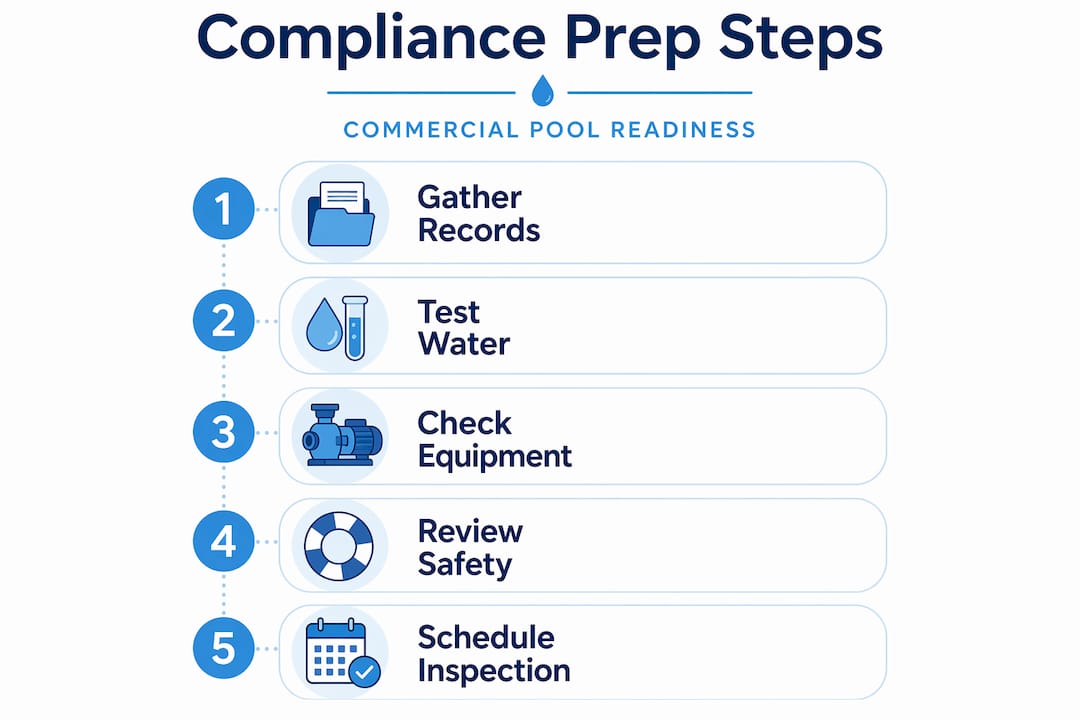
Your operating permit is the first requirement. Permit applications are prerequisites for construction, modification, and operational approval in most jurisdictions. Keep a current copy on site at all times.
Here’s a numbered checklist of what every commercial facility should have in place before any inspection:
- Valid operating permit posted or accessible on-site, current and jurisdiction-specific.
- Certified Pool Operator (CPO) credential for at least one staff member responsible for pool chemistry and maintenance. Many states treat this as a hard requirement, not a recommendation.
- Chemical testing logbooks with entries for every test session, including free chlorine, pH, combined chlorine, and alkalinity. Logs must be on-site, legible, and current.
- Safety equipment inventory: life rings with throwing rope, shepherd’s hooks, first aid kits, and clearly posted emergency phone numbers. Equipment must be unexpired and functional.
- Compliant barrier fencing with self-latching, self-closing gates. Most codes require a minimum 48-inch fence height and gate latches positioned above child reach.
- Signage: depth markers, no diving indicators where applicable, rules signs, and emergency instructions in visible locations.
- VGB-compliant drain covers with current certification documentation. Track installation dates and replacement schedules.
The table below shows the difference between minimum compliance and best practice for the most commonly cited items:
| Requirement | Minimum compliance | Best practice |
|---|---|---|
| Chemical testing | Once daily | Twice daily with written logs |
| Drain cover tracking | Replace when damaged | Asset register with expiration dates |
| Operator certification | One certified staff member | All lead staff certified |
| Safety equipment check | Before opening season | Weekly documented inspections |
| ADA entry assessment | When modifications requested | Annual feasibility review |
ADA accessibility deserves its own attention here. The feasibility analysis isn’t just measuring whether a pool lift fits. It includes measuring pool wall length and conducting a cost-benefit resource review before deciding whether modifications are required. Document that analysis either way.
Day-to-day operational compliance
The most common reason commercial pools fail inspections isn’t ignorance of the rules. It’s the gap between knowing what’s required and executing it consistently. Operational compliance is a daily discipline, not a seasonal event.
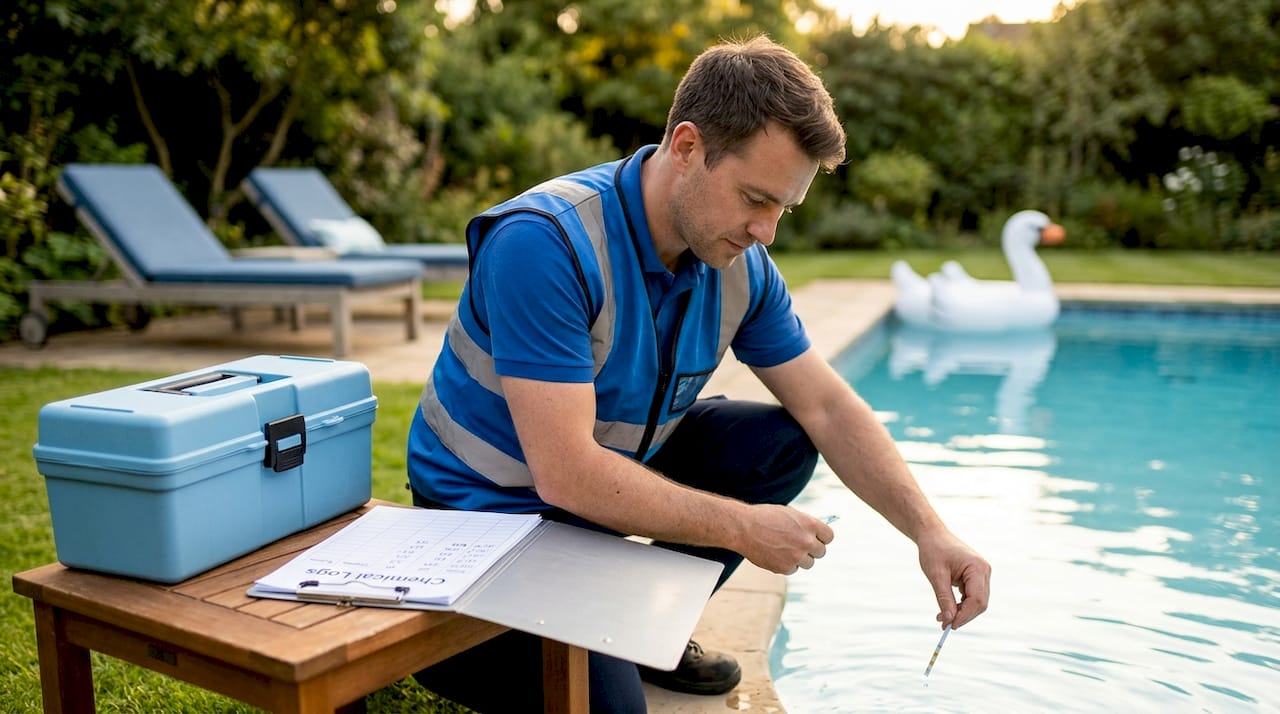
Start every operating day with a chemical test. Twice daily testing of free chlorine, pH, and combined chlorine, with results recorded in a dated log, is the standard that most state agencies and health inspectors expect. Those logs are physical evidence of diligence. If your water chemistry drifts out of range and you have no record showing you caught it and corrected it, you have a compliance problem regardless of what your water looks like on inspection day.
Circulation and filtration systems need daily verification too. Check that pumps are running, turnover rates meet code (typically 6 to 8 hours for a standard commercial pool), and filters are backwashed on schedule.
- Safety equipment readiness: Walk the pool deck before opening each day. Life rings, shepherd’s hooks, and first aid supplies should be in their designated locations and in usable condition.
- Barrier integrity: Check gates and fencing once a week at minimum. A gate latch that stops self-closing is a violation waiting to happen.
- ADA accessibility: Inspect pool lifts and accessible entry points monthly. Battery-operated lifts need charging schedules built into your log.
- Water clarity: Visibility to the main drain from the pool deck is a baseline health code requirement in most states. If you can’t see the drain, the pool closes.
Responding to water chemistry imbalances quickly matters because operational workflows that monitor chemical levels daily directly reduce regulatory risk. Algae growth is almost always a sign of chlorine failure over multiple days, not a single event. Catching the drift early means a correction with chemicals. Missing it means a closure, a remediation, and a re-inspection.
Pro Tip: Schedule any major maintenance or equipment work at least two weeks before a known inspection window. Inspectors will check whether recently addressed items were properly documented, not just fixed.
Passing the pool safety inspection process
The pool safety inspection process follows a predictable pattern once you know what inspectors are actually looking for. Understanding the sequence lets you approach it as a verification exercise rather than a guessing game.
Inspectors typically work through a checklist covering water chemistry readings taken on-site, drain cover certification status, safety equipment presence and condition, barrier compliance, signage, operator credentials, and logbook review. What surprises many property managers is how much weight documentation carries. An inspector who can’t find a current log or a permit copy on-site may treat that the same as a missing piece of equipment.
Here’s a practical pre-inspection workflow:
- Pull your local health department’s inspection checklist one week before any anticipated inspection.
- Walk the entire facility against that checklist yourself, documenting any deficiency and correcting it immediately.
- Verify that all logs are current, legible, and on-site. This includes chemical testing records, equipment maintenance logs, and safety equipment inspection notes.
- Confirm that drain covers are not expired. Missing drain cover certification during an inspection results in immediate pool closure.
- Brief your on-duty staff on what to expect and who to direct the inspector to upon arrival.
When violations do occur, the response timeline matters as much as the correction itself. Most jurisdictions allow a specified window to correct and document the fix. Submit that documentation promptly and keep a copy. Local jurisdictions differ significantly in how they handle follow-up inspections, so contact your health department directly after any violation to understand the specific process for your location.
For Florida-specific guidance on what inspectors examine, the Florida pool inspection standards provide a detailed breakdown that maps closely to what state-licensed inspectors use in the field.
What I’ve learned about compliance after years in the pool industry
I’ve seen the full range of how commercial property managers approach compliance, and the pattern is consistent. Facilities that struggle tend to treat it as an event. Facilities that thrive treat it as a system.
The property managers I’ve worked with who consistently pass inspections aren’t doing anything dramatically different from those who fail. They’re doing the same tasks, just on schedule and with documentation. The log is current because someone fills it out every day, not because inspection is tomorrow.
Where I’ve seen the most painful failures is with drain covers. It’s easy to install a VGB-compliant cover, check the box, and forget about it. But drain covers expire on a 5 to 10 year cycle, and most operators don’t have an asset register tracking installation dates. An inspector who pulls a cover and finds no certification documentation will close the pool on the spot. That’s a $0 problem to prevent and a very expensive one to fix reactively.
ADA compliance also generates more confusion than it should. The “readily achievable” standard is genuinely flexible, but that doesn’t mean you can ignore it. What it means is that you need to conduct and document the feasibility analysis. If you’ve done the analysis and concluded a modification isn’t currently feasible, that documented assessment is your defense. If you’ve never looked at it, you have no defense at all.
My honest take: the single most useful thing any property manager can do is align their daily operational logs with their local inspector’s exact checklist. Not a generic version. The actual document your jurisdiction uses. The gap between what managers think inspectors check and what inspectors actually check is where most violations live.
— Classicmarcite
How Classicmarcite helps commercial pools stay compliant
Pool surfaces that are cracked, stained, or deteriorating aren’t just an aesthetic problem. They create compliance risks around water chemistry, safety, and ADA accessibility that compound over time.

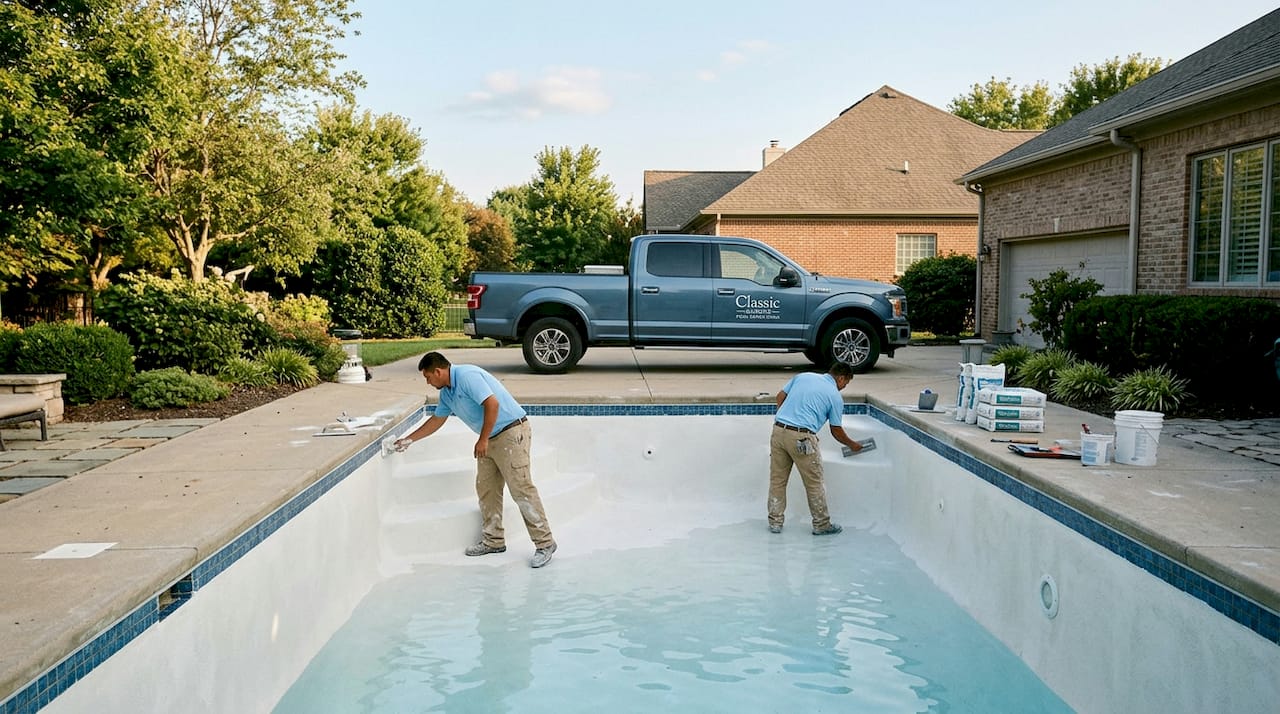
Classic Marcite has resurfaced more than 100,000 pools since 1988, including commercial properties across Florida ranging from hotel pools to resort facilities. The team specializes in commercial pool finish options designed for durability, regulatory readiness, and long-term performance under heavy use. Whether a surface needs a full renovation or targeted repairs to pass an upcoming inspection, Classicmarcite brings the material knowledge and hands-on experience to deliver work that holds up under scrutiny. For facilities in Central Florida, the company is the largest Pebble Tec® applicator in the region. Contact Classicmarcite for a free assessment and see how professional pool resurfacing can move your facility closer to full compliance.
FAQ
What laws apply to commercial pool compliance?
Commercial pools are governed by the VGB Act for drain safety, the ADA for accessibility, OSHA for chemical handling, and state and local codes for operations, permits, and water quality standards.
How often should commercial pool water be tested?
Most state agencies require at minimum once daily testing of free chlorine, pH, and combined chlorine, but twice daily testing with written logs is the operational standard expected during inspections.
What happens if drain covers are expired during an inspection?
Expired or missing drain cover certification results in immediate pool closure. Replacing covers on schedule and tracking certification dates prevents this outcome entirely.
Do all commercial pools need to meet ADA accessibility requirements?
Existing pools must comply with ADA accessibility standards when modifications are readily achievable, meaning reasonably feasible given cost and operational constraints. Document your feasibility analysis regardless of the outcome.
How do you prepare for a commercial pool inspection?
Conduct a self-inspection using your local health department’s exact checklist, verify all logs and permits are current and on-site, check that safety equipment is functional, and confirm drain cover certification status at least one week before the inspection.