TL;DR:
- Maintaining proper pool water quality requires regular testing, consistent circulation, and routine cleaning to prevent imbalances.
- Proper management of chemical levels, filter backwashing, and surface condition ensures clear, healthy water and reduces long-term maintenance issues.
Keeping your pool water clean and balanced takes more than tossing in a chlorine tablet once a week. The right pool water quality tips cover everything from chemical ranges to circulation schedules, and getting any one of these wrong affects the others. Cloudy water, algae outbreaks, and skin irritation are almost always symptoms of an underlying imbalance, not random bad luck. This guide gives you a practical, tested set of strategies to keep your pool safe, clear, and easy to maintain all season long.
Table of Contents
- Key takeaways
- 1. Know the ideal chemical ranges for your pool
- 2. Test your water the right way
- 3. Run your pump for the right amount of time
- 4. Backwash your filter at the right time
- 5. Build a daily and weekly cleaning routine
- 6. Special care for saltwater pools
- 7. Troubleshoot pool water problems by symptom
- My take on proactive pool care over reactive fixes
- How pool resurfacing supports long-term water quality
- FAQ
Key takeaways
| Point | Details |
|---|---|
| Test water frequently | Check chemical levels 2 to 3 times per week to catch imbalances before they become problems. |
| Run your pump long enough | Eight to twelve hours of daily circulation prevents dead zones and distributes chemicals evenly. |
| Clean consistently, not reactively | Daily skimming and weekly brushing stop algae before it starts, saving you time and money. |
| Saltwater pools need active management | pH spikes and salt particulates require daily monitoring, not a set-and-forget approach. |
| Surface condition affects water quality | A rough or deteriorating pool surface holds algae and throws off chemical balance faster. |
1. Know the ideal chemical ranges for your pool
Before anything else, you need a target. Ideal chemical ranges for balanced pool water are: Free Chlorine 1 to 3 ppm, pH 7.2 to 7.6, Total Alkalinity 80 to 120 ppm, Calcium Hardness 200 to 400 ppm, and Cyanuric Acid 30 to 50 ppm.
These numbers are not arbitrary. pH, for example, directly controls how effective your chlorine actually is. At pH 7.8, chlorine loses roughly half its sanitizing power compared to pH 7.2. That means you can have “enough” chlorine in your water and still get algae or a cloudy pool simply because the pH is slightly off.
| Parameter | Ideal Range | What Happens Outside Range |
|---|---|---|
| Free Chlorine | 1–3 ppm | Algae, bacteria, or irritation |
| pH | 7.2–7.6 | Reduced sanitizer effectiveness or scaling |
| Total Alkalinity | 80–120 ppm | pH swings become harder to control |
| Calcium Hardness | 200–400 ppm | Plaster pitting (low) or scaling (high) |
| Cyanuric Acid | 30–50 ppm | Chlorine burns off too fast in sunlight |
Keeping these five parameters in range simultaneously is the core of maintaining pool water. When one drifts, the others tend to follow.
2. Test your water the right way
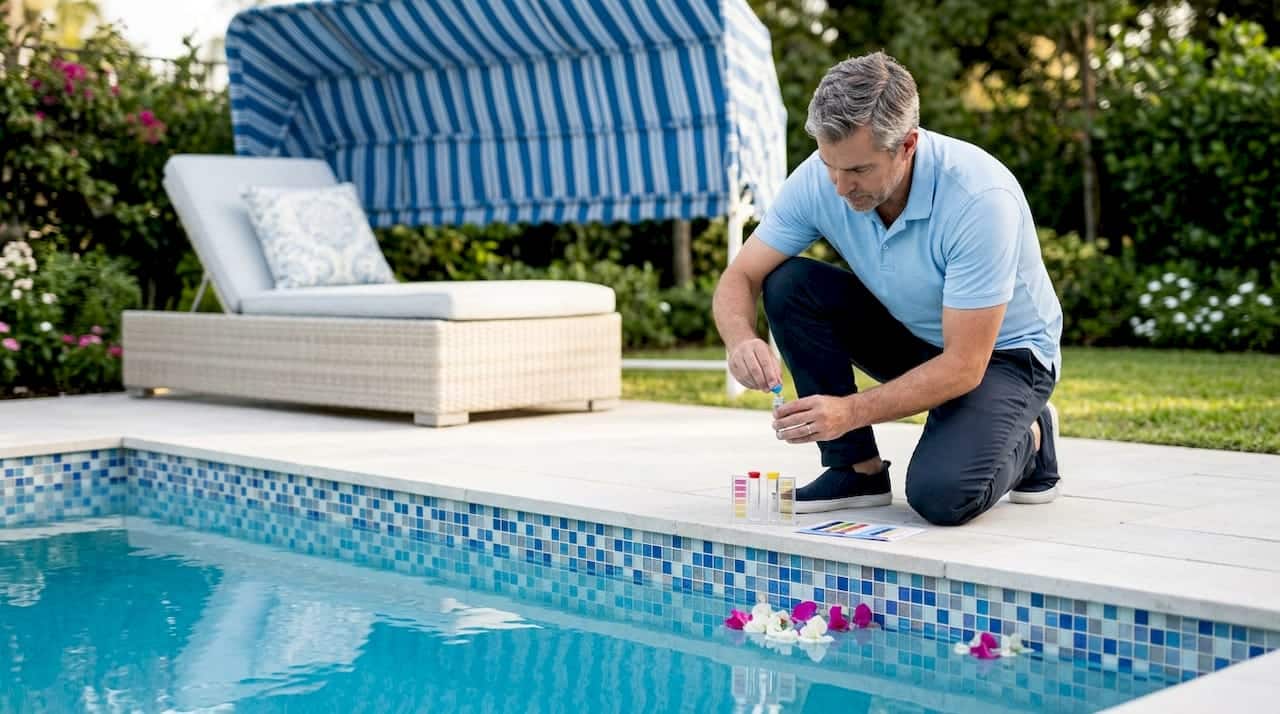
Testing frequency matters, but testing correctly matters just as much. Test 2 to 3 times per week during swim season, and always test after heavy rain or a pool party.
The method you use makes a real difference. Test strips offer ±20 to 30% accuracy at best. For routine quick checks they are fine, but when you need precise adjustments, use a liquid test kit or a digital photometer instead.
Where you collect the sample is equally important. Collect water 18 inches below the surface and away from return jets or skimmers. Surface water and jet-adjacent water give distorted readings that lead you to add chemicals you do not actually need.
Pro Tip: Label a dedicated water sampling bottle and always pull from the same location in your pool. Consistency in sampling removes a major variable from your testing results.
3. Run your pump for the right amount of time
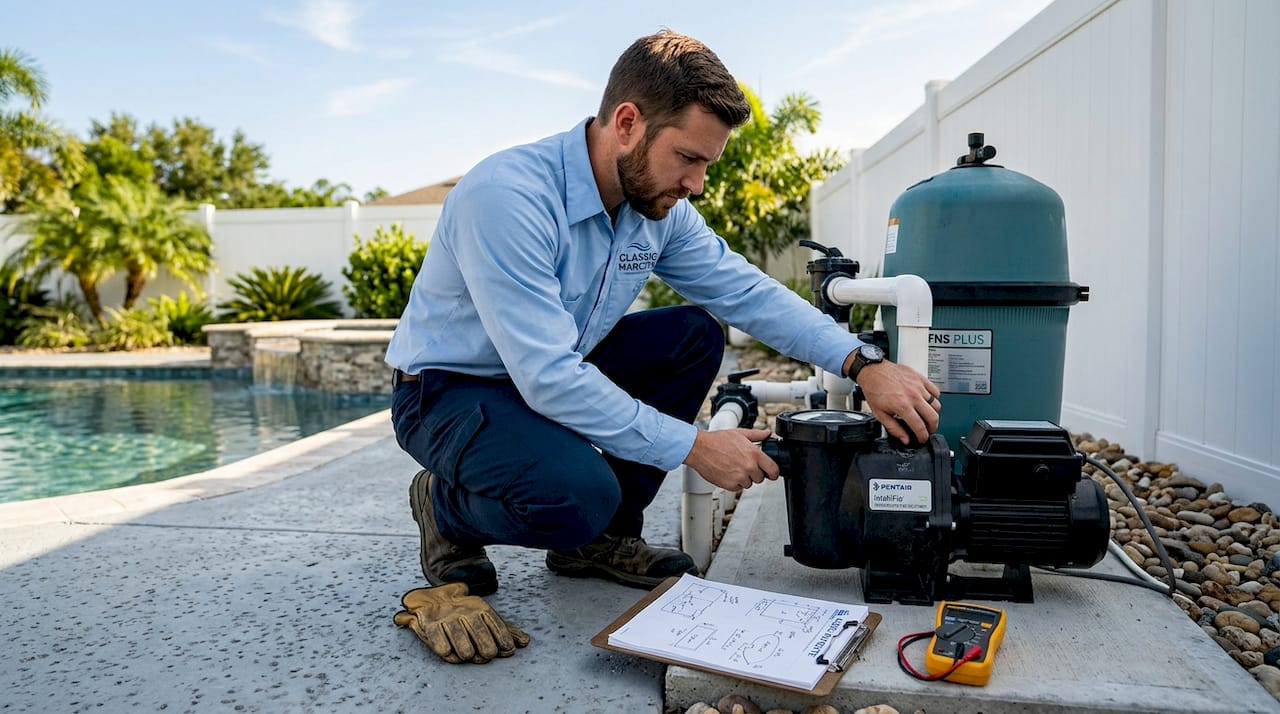
Circulation is the engine of your entire water quality system. Without it, chemicals sit in pockets, dead zones form, and sanitizer never reaches every corner of the pool. Pumps should run 8 to 12 hours daily for adequate turnover.
If you are running a single-speed pump, that runtime adds up on your electricity bill fast. Variable-speed pumps save up to 65% on energy compared to single-speed models, which translates to roughly $450 per year in savings. You can schedule them to run longer at lower speeds overnight, still hitting your turnover goals without paying peak-rate electricity. Learn more about how energy-efficient pump upgrades can lower your operating costs significantly.
Pro Tip: Split your pump runtime: run it during the early morning and again in the evening. This gives you two circulation cycles per day and lets you add chemicals during off-peak hours when the sun is not burning off chlorine.
Cloudy water that clears up overnight and comes back by midday is almost always a circulation problem, not a chemistry problem. Check your return jets to confirm they are angled to create a full circular current.
4. Backwash your filter at the right time
More homeowners over-backwash their filters than under-backwash them. That sounds backwards until you realize that a small amount of debris in a sand or DE filter actually helps it catch finer particles. Backwash only when pressure rises 8 to 10 PSI above the clean baseline reading.
Set a sticky note or a phone reminder with your filter’s baseline pressure the day after a fresh backwash. That number is your reference point. Backwashing on a fixed weekly schedule without checking pressure is an inefficient habit that degrades filtration quality over time.
Clean your skimmer basket and pump basket at least twice a week. A clogged basket restricts flow to the pump, which reduces pressure through the filter and drops your effective turnover rate, all without triggering an obvious warning sign.
5. Build a daily and weekly cleaning routine
Physical cleaning and chemical balance work together. Organic debris, dead leaves, sunscreen residue, and body oils all consume chlorine and feed algae. Removing them before they break down keeps your sanitizer working on bacteria instead of wasting itself on organic material.
Here is a simple schedule that works for most residential pools:
- Daily: Skim the surface (5 to 10 minutes). Check water level. Glance at pump pressure.
- Twice weekly: Test water chemistry. Clean skimmer and pump baskets.
- Weekly: Brush walls, steps, and tiles. Vacuum the floor. Check and adjust all chemical levels.
- Monthly: Inspect equipment for wear. Clean filter media if needed. Check for surface staining.
Daily skimming takes about 5 to 10 minutes and prevents algae from getting a foothold. Weekly brushing and vacuuming take roughly 30 to 45 minutes total. That is under an hour per week to avoid a green pool situation that takes days and significant money to fix.
Pro Tip: Brush before you vacuum, not after. Brushing loosens debris and sends it into the water column where your filter can capture it. Vacuuming first just moves debris around.
For tips on protecting your surface during cleaning, check out how to maintain pool surface for long-lasting results.
6. Special care for saltwater pools
Saltwater pools carry a common misconception: that they are low-maintenance. They are not. Saltwater pools are not maintenance-free. The salt cell generates chlorine through electrolysis, which is convenient, but it also continuously raises pH. Without active monitoring, pH creeps above 7.8 and your sanitizer becomes significantly less effective.
Key practices for saltwater pool owners:
- Monitor pH daily. The electrolysis process pushes pH up faster than traditional chlorine pools.
- Agitate the pool floor daily. Automated cleaners help break up salt particulate deposits before they abrade surfaces.
- Rinse cleaning equipment weekly with high-pressure water to remove salt buildup on brushes, poles, and vacuum heads.
- Optimize pump speed. Running the pump at an adequate speed helps disperse chlorine concentration zones that form near the salt cell return.
- Watch for mineral scaling. White deposits on tiles or fittings signal that pH and calcium hardness need adjustment before damage occurs.
| Concern | Traditional Chlorine Pool | Saltwater Pool |
|---|---|---|
| pH tendency | Stable with proper dosing | Rises continuously from electrolysis |
| Chlorine source | Manual addition | Auto-generated by salt cell |
| Surface abrasion risk | Low | Moderate if salt particulates settle |
| Equipment corrosion risk | Low with balanced water | Higher if pH and salinity drift |
Daily floor agitation and weekly rinsing of cleaning equipment significantly reduce salt scale buildup and extend surface life.
7. Troubleshoot pool water problems by symptom
When something looks wrong with your water, resist the urge to dump in chemicals right away. Consistent small adjustments outperform large chemical dumps every time. Overcorrecting chemistry causes a new set of problems before the first ones clear up.
“The biggest mistake I see pool owners make is adding chemicals based on how the water looks rather than what the test kit actually says.”
Here is how to read common symptoms and respond:
- Cloudy or dull water: Test chemistry first. The most likely causes are low sanitizer, high pH, dirty filter, or inadequate circulation. Cloudy water is the first visible sign of an underlying imbalance. Do not add clarifier until you know the root cause.
- Green water: Algae bloom. Shock the pool, then brush every surface, then run the pump continuously until the water clears. Retest and balance chemistry before adding algaecide.
- White scale on tiles: Calcium hardness or pH too high. Lower pH first, then address hardness.
- Eye or skin irritation: Usually a pH problem, not excess chlorine. Test pH before adding anything.
- Persistent foam: Usually caused by body products or an algaecide reaction. Shock and run the pump.
When you shock, do it at dusk or after dark. Sunlight destroys unstabilized chlorine quickly, and shocking at night gives the chemicals a full cycle to work before UV exposure. Keep the pump running for at least 8 hours after shocking.
Pro Tip: Keep a simple log of your test results and any chemicals you add. After two or three months, patterns appear. You will know when your pool tends to lose pH, when alkalinity drifts, and which weeks typically require extra chlorine.
My take on proactive pool care over reactive fixes
I’ve seen hundreds of pool owners come to us after a season of neglect, and the story is almost always the same. They skipped testing for a few weeks, added a big dose of chemicals when the water started looking off, and repeated that cycle until something broke or the surface started showing stains.
What I’ve learned over years of working with pools is that the reactive approach costs more in every way. More chemicals, more equipment wear, and more surface damage that eventually requires professional intervention. The homeowners who spend 10 minutes three times a week on their pool almost never face a crisis.
The interplay between circulation, filtration, chemistry, and cleaning is tighter than most people realize. Pool maintenance is a coordinated system where every element affects the others. Neglect one, and the others compensate until they can’t. Fixing chemistry without addressing filtration is like patching one leak while another opens.
My advice is to build the smallest possible routine and stick to it. Two chemical tests, a basket check, and a quick skim. That is your foundation. Everything else builds on top.
— Classicmarcite
How pool resurfacing supports long-term water quality
The condition of your pool’s interior surface has a direct impact on how easy or hard it is to maintain water quality. A rough, pitted, or deteriorating surface holds algae in microscopic crevices, throws off your calcium hardness balance, and makes vacuuming less effective. No amount of chemical adjustment fully compensates for a compromised surface.

Classic Marcite has resurfaced over 100,000 pools across Central Florida since 1988, using materials like Pebble Tec® that create a durable, smoother interior finish. A properly resurfaced pool is easier to clean, holds chemical balance longer, and simply performs better as a complete system. If your water quality problems keep recurring despite consistent maintenance, the surface itself may be the issue worth investigating.
Explore pool resurfacing in Florida to understand how surface quality ties directly to water chemistry and long-term maintenance ease. For homeowners in Central Florida, Classicmarcite offers expert resurfacing in Winter Park and surrounding communities. Request a free estimate to find out what your pool’s surface is actually telling you.
FAQ
What are the most important pool water quality tips?
Test your water 2 to 3 times per week, maintain free chlorine between 1 and 3 ppm, keep pH between 7.2 and 7.6, and run your pump 8 to 12 hours daily. These four practices address the majority of common water quality problems.
How often should I test my pool water?
Test pool water 2 to 3 times per week during swim season, and always after heavy rain or high bather loads. Use a liquid test kit or digital tester for precise readings rather than relying solely on test strips.
Why does my pool water keep going cloudy?
Cloudy water typically signals low sanitizer, high pH, a dirty filter, or insufficient pump runtime. Test chemistry first before adding any clarifier, and check your filter pressure to rule out a filtration issue.
Are saltwater pools easier to maintain than chlorine pools?
No. Saltwater pools generate their own chlorine automatically, but they require daily pH monitoring because electrolysis continuously raises pH. Salt particulates can also damage surfaces if not managed through regular cleaning and circulation.
When should I shock my pool?
Shock your pool after heavy use, following a rainstorm, when chlorine drops below 1 ppm, or at the first sign of algae. Always shock at dusk or after dark and keep the pump running for at least 8 hours afterward.