TL;DR:
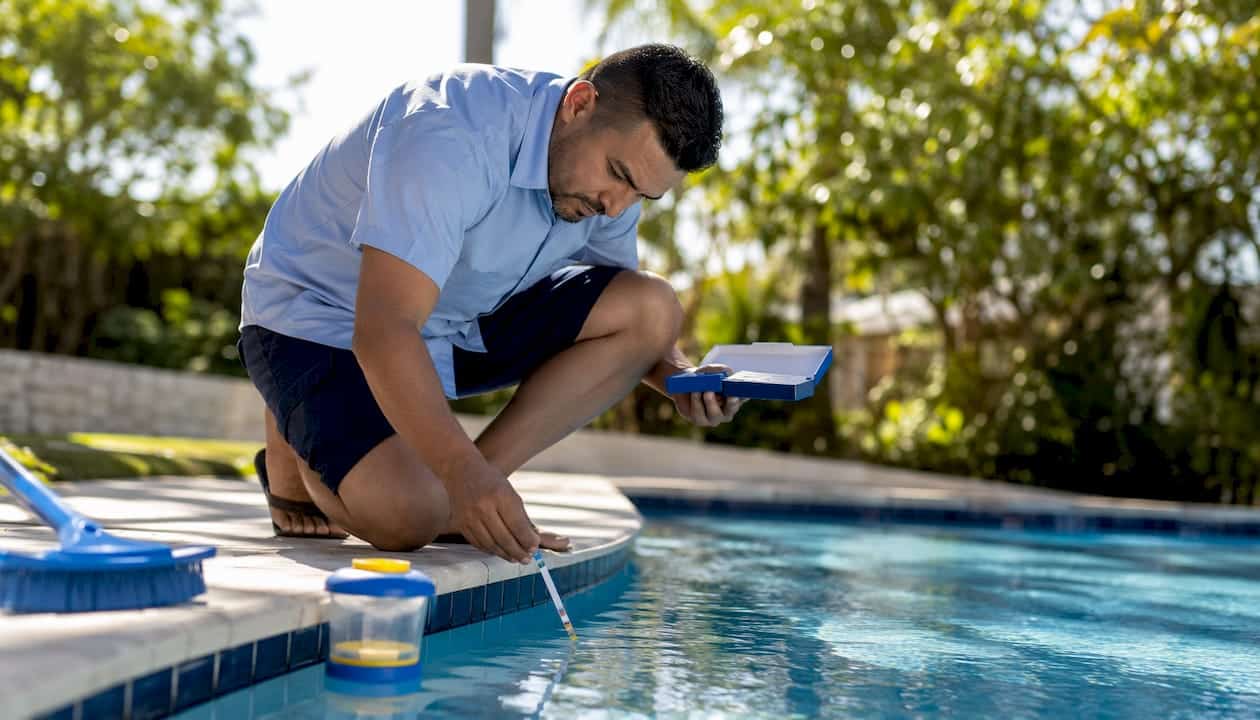
- Maintaining balanced pool water within recommended chemical ranges is crucial to prevent premature finish and equipment damage. Regular testing of pH, calcium hardness, and other parameters ensures water chemistry stays within safe limits, protecting your investment. Proper water balance can significantly extend the lifespan of pool finishes and avoid costly resurfacing.
Balanced pool water is the single most effective thing protecting your finish, equipment, and warranty coverage right now. The National Plasterers Council recommends maintaining pH, calcium hardness, and carbonate alkalinity within ANSI/APSP “balanced” ranges and endorses a Saturation Index of 0.0 to +0.3 as the ideal target. Classicmarcite has resurfaced many pools and sees chemistry-related damage as the most preventable cause of early resurfacing calls.
Act on these right now before reading further:
- Test pH and calcium hardness today; if pH is below 7.2 or calcium hardness is low, stop adding acid immediately
- Call your pool service professional before adding any corrective chemicals
- Log the date, test results, and any chemicals added — your warranty may depend on it
Table of Contents
- Why does pool water balance matter for your finish?
- What chemical parameters should you monitor and test?
- How does imbalanced water damage plaster and pebble finishes?
- What are the warning signs of water chemistry problems?
- How often should you test and what records should you keep?
- What should you do when readings are dangerous?
- When does chemistry damage require resurfacing?
- Why Classicmarcite is the right call for chemistry-related damage
- Key Takeaways
- What pool pros see that homeowners usually miss
- Get a professional assessment from Classicmarcite
- Useful sources
Why does pool water balance matter for your finish?
Pool water balance refers to the relationship between pH, total alkalinity (TA), calcium hardness (CH), temperature, and total dissolved solids (TDS) working together to keep water neither corrosive nor scale-forming. Professionals calculate this relationship using the Langelier Saturation Index (LSI), sometimes called the Calcite Saturation Index (CSI).
Water with a negative LSI is “aggressive” — it is chemically undersaturated and will dissolve calcium carbonate from your finish to satisfy itself. Water with a positive LSI is scale-forming — it deposits calcium carbonate on surfaces and inside equipment. The NPC’s ideal Saturation Index of 0.0 to +0.3 sits just slightly on the scale-forming side, which is intentional: a thin carbonate layer protects cementitious surfaces.
pH alone tells you almost nothing useful. A pool can have a perfect pH of 7.4 and still carry a dangerously negative LSI if calcium hardness is low. That is why single-parameter fixes are misleading and why the full LSI calculation matters.
What chemical parameters should you monitor and test?
| Parameter | Typical Target Range | Notes |
|---|---|---|
| pH | within a slightly acidic to neutral range | Below 7.2 is corrosive; higher pH reduces chlorine efficacy |
| Total Alkalinity (TA) | within a moderate range | Below 100 ppm destabilizes pH buffering |
| Calcium Hardness (CH) | within a standard range; 300–400 ppm during new finish startup | Elevated CH during new finish startup is recommended |
| Free Chlorine | at typical sanitation levels | Higher in heated or heavily used pools |
| Cyanuric Acid (CYA) | maintained within recommended limits to avoid reduced chlorine efficacy | |
| Salt/TDS | Per system spec | High salt levels can increase water aggressiveness |
| Temperature | Around 80°F typical | Higher temps shift LSI; factor into calculations |
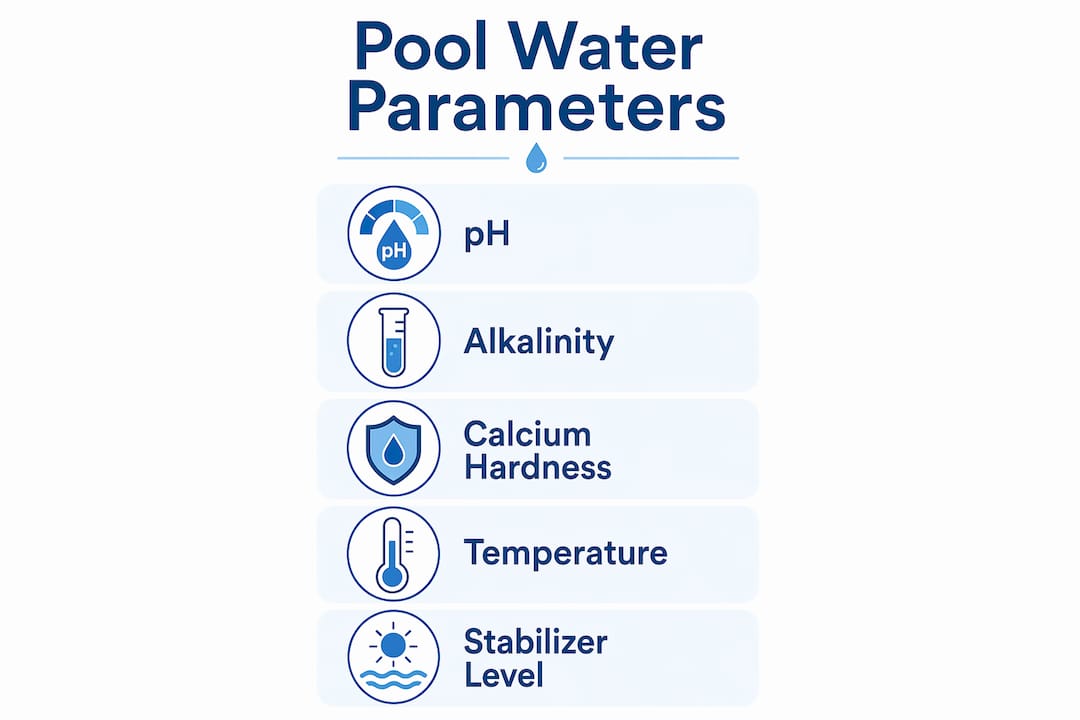
The NPC recommends testing pH, TA, and free chlorine one to two times per week, and calcium hardness, CYA, and TDS once per month. During new Pebble Tec® or aggregate finish startup, target calcium hardness (CH) at 300–400 ppm and avoid chlorine and salt systems for the first 30 days.
Choosing your testing method:
- Test strips: Fast and inexpensive; good for quick daily pH and chlorine checks, but less accurate for CH and CYA
- Liquid titration kits: More precise than strips; reliable for TA and CH readings
- Digital photometers/titrators: Most accurate for routine monitoring; worth the investment for property managers running multiple pools
- Lab testing: Best for dispute documentation, warranty claims, or diagnosing persistent problems that chemistry corrections haven’t resolved
Pro Tip: Keep a pool maintenance checklist with dated test results. If a warranty claim ever arises, that log is your primary evidence.
How does imbalanced water damage plaster and pebble finishes?
About 60% of finish breakdowns trace to water chemistry rather than application errors. That figure should reframe how you think about maintenance costs.
When water is undersaturated (negative LSI), it dissolves calcium hydroxide from the cement matrix. Calcium hydroxide is the most soluble compound in cementitious finishes and the first to go. As it leaches out, the cement binder weakens, porosity increases, and pigment held within that binder releases with it. The NPC’s technical research confirms that aggressive water can leach pigment up to 1/8 inch deep, producing color loss that cannot be reversed by any chemical treatment.
The NPC’s position is direct: “To optimize the long-term durability and appearance of any cementitious interior pool finish, proper materials, proper workmanship, and balanced water chemistry must all be present.” Removing any one of those three factors accelerates failure regardless of the other two.
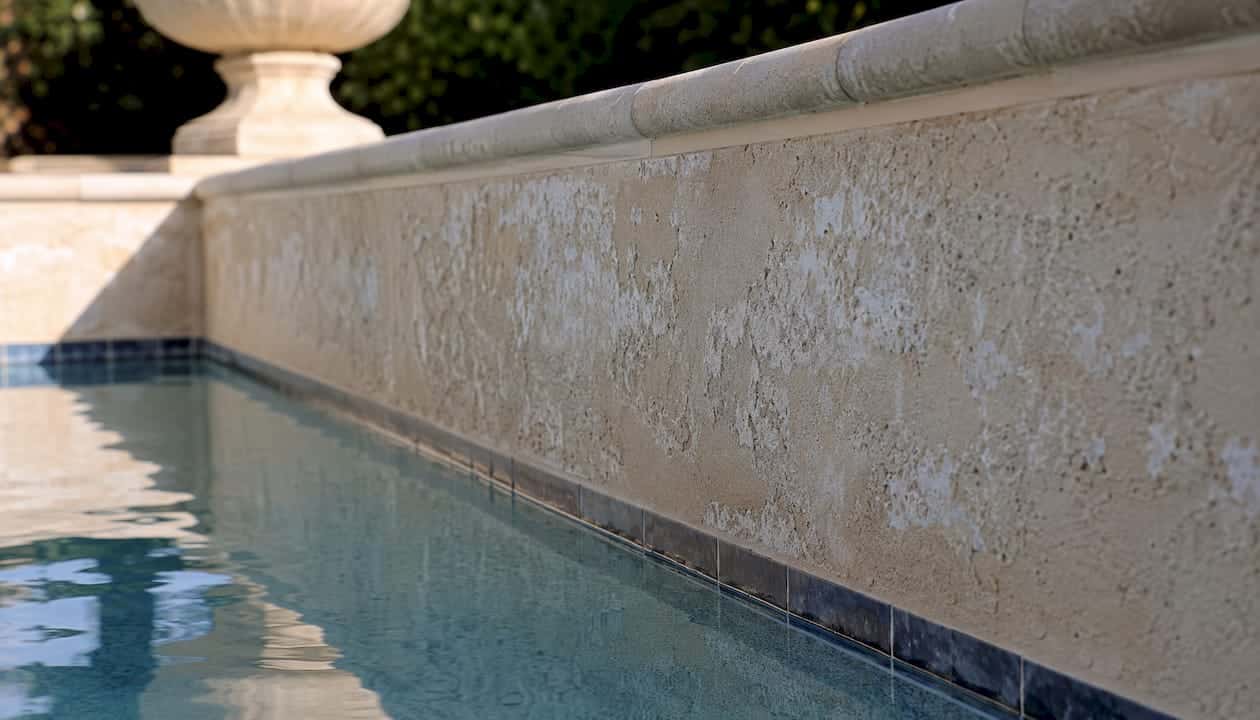
Scale-forming water causes a different problem. Calcium carbonate deposits build up on surfaces, inside pipe walls, and on filter media. On pebble finishes, scale often appears as a white film trapped within the cement matrix between stones — a pattern that is frequently misdiagnosed and treated incorrectly, which makes the underlying problem worse.
Smooth plaster shows etching damage faster than aggregate finishes because the surface is more uniform and any texture change is immediately visible. Pebble and aggregate finishes are more forgiving, but they still require calcium hardness of 300–400 ppm during startup to prevent early pebble loss.
Pro Tip: Elevated CYA and high salt levels alter LSI calculations. If your pool uses a salt chlorine generator, factor salt concentration into your Saturation Index — not just pH and TA.
What are the warning signs of water chemistry problems?
Catch these early and a chemical correction is usually enough. Miss them and you are looking at resurfacing.
Visual signs:
- White calcium dust or powder on the pool floor (early etching)
- Rough or sandpaper-like texture on the walls or steps
- Color fading, mottling, or uneven patches across the finish
- Localized pebble loss or exposed aggregate in specific areas
- Scale rings at the waterline or white deposits on tile and equipment
Operational signs:
- Chlorine levels dropping faster than normal between treatments
- Persistent cloudy water that doesn’t clear after shocking
- Repeated algae outbreaks despite adequate sanitizer
- Unusual pump noises or reduced heater output
The operational signs matter because corrosion to copper heat exchangers, pump seals, and salt cell electrodes progresses internally before any visible failure appears. By the time a heater stops working, the chemistry-driven damage may have been accumulating for months. Rough texture and white dust usually mean chemistry correction can still help. Widespread color fade, exposed aggregate, or pervasive porosity typically mean the damage is already structural.
How often should you test and what records should you keep?
Follow this schedule to stay ahead of problems:
- Daily (or before first swim): Visual check; pH and free chlorine if the pool is in heavy use
- Weekly: pH, TA, and free chlorine
- Monthly: CH, CYA, and TDS
- Immediately after heavy rain: Retest pH and TA; dilution can drive LSI negative fast, especially during new finish hydration
- New finish startup: Daily testing for the first 30 days; follow your applicator’s specific startup protocol
Property managers overseeing vacant or seasonal properties should arrange weekly pool checks to catch chemistry drift before it becomes structural damage. A pool sitting untested for two or three weeks in a Florida summer can shift from balanced to aggressively corrosive in that window.
Accurate documentation of startup chemistry, including dates, test results, and reagent batches, is often decisive for warranty coverage after early finish failures. Keep a physical or digital log and store it with your pool service records.
What should you do when readings are dangerous?
For aggressive water (negative LSI):
- Stop adding any acid immediately
- Test TA and CH to confirm which parameters are low
- Add an alkalinity increaser (sodium bicarbonate) as directed by your pool professional
- Add a calcium hardness increaser if CH is below 200 ppm
- If source water is naturally low in calcium, consider a partial drain and refill with higher-mineral water
- Retest after 24 hours before adding any other chemicals
For scale-forming water (positive LSI):
- Lower pH carefully using muriatic acid, following label directions and keeping swimmers out of the pool
- Reduce TA if it is above 120 ppm
- Use a sequestrant if metal staining is present
- Plan manual scale removal if deposits are already visible on tile or equipment
Safety notes: Always add muriatic acid to water, never the reverse. Never mix chlorine and acid. Keep swimmers out during any active chemical treatment and until levels return to the safe range.
Pro Tip: A partial drain and refill is often the fastest fix for chronically high CYA or TDS. No chemical addition corrects CYA overload; dilution is the only solution.
When does chemistry damage require resurfacing?
Chemical correction works when the damage is still at the surface. These signs indicate the damage has gone deeper:
- Pigment loss that appears as white or faded patches that don’t respond to brushing or acid washing
- Rough, pitted texture across large areas of the finish
- Pervasive porosity that allows algae to re-establish within days of treatment
- Ongoing localized pebble loss despite corrected chemistry
| Condition | Likely Outcome |
|---|---|
| Low pH for 1–3 days, no visible damage | Chemical correction; retest |
| Low pH for 2+ weeks, rough texture | Inspect for etching; resurface if aggregate exposed |
| Widespread color fade, white patches | Resurfacing required; color loss is irreversible |
| Scale on tile and grout lines | Descaling service; tile inspection |
| Excessively high cyanuric acid levels with algae | Partial drain/refill; surface inspection |
Many manufacturer warranties require documented, routine water-balance maintenance. If your maintenance log is missing or incomplete, a warranty claim for early finish failure is likely to be denied. Improper water chemistry is explicitly excluded from most equipment warranties, and finish warranties carry similar language. Resurfacing a standard residential pool typically takes 3–5 days of downtime, and the process addresses appearance and structural integrity but cannot restore pigment that has already been leached from the cement matrix.
Why Classicmarcite is the right call for chemistry-related damage
Classicmarcite has been resurfacing pools since 1988 and has completed over 100,000 projects across residential, commercial, and resort properties. As the largest Pebble Tec® applicator in Central Florida, the company works with finishes that are particularly sensitive to startup chemistry.
What Classicmarcite brings to chemistry-related resurfacing:
- Pre-resurfacing inspection to identify whether damage is surface-level or structural
- Warranty-preserving startup protocols for new marcite and Pebble Tec® finishes
- Guidance on chemistry-sensitive startup schedules, including delayed chlorine introduction and brushing protocols
- Full service scope: resurfacing, tile and deck repair, equipment checks, and interior finish upgrades
- Service areas include Orlando, Dr. Phillips, Winter Park, and The Villages
Browse the residential pool gallery to see before-and-after results, or review the post-resurfacing care guide for startup best practices.
Key Takeaways
Balanced pool water, maintained within the NPC’s ideal Saturation Index of 0.0 to +0.3, is the most controllable factor in preventing premature finish failure, equipment damage, and warranty denial.
| Point | Details |
|---|---|
| Test on a fixed schedule | Weekly pH/TA/chlorine, monthly CH/CYA/TDS, and immediately after heavy rain. Maintain CH at 300–400 ppm during new finish startup. |
| Correct LSI problems early | Aggressive water leaches pigment up to 1/8 inch deep; that color loss is permanent. |
| Maintain a chemistry log | Missing maintenance records are the most common reason warranty claims are denied. |
| Resurfacing has limits | It restores structure and appearance but cannot recover pigment already leached from the finish. |
| Classicmarcite | Offers chemistry-sensitive startup protocols and resurfacing across Orlando, Dr. Phillips, Winter Park, and The Villages. |
What pool pros see that homeowners usually miss
The most expensive resurfacing jobs Classicmarcite handles are not the ones where something went catastrophically wrong. They are the pools where the chemistry drifted slightly negative for six months and nobody noticed because the water looked fine.
Here is the thing about aggressive water: it does not look aggressive. A pool with a pH of 7.1 and calcium hardness of 150 ppm can be crystal clear. The finish is dissolving slowly, the heat exchanger is pitting internally, and the warranty clock is running out. By the time the roughness is obvious underfoot or the color has faded, the damage is already irreversible.
The single most practical thing you can do right now is buy a reliable liquid titration kit, test your calcium hardness this week, and write the result down with today’s date. That one habit, repeated monthly, is what separates a pool that lasts 15 years from one that needs resurfacing in seven.
Get a professional assessment from Classicmarcite
Chemistry damage that has already reached the finish needs more than a chemical correction. Classic Marcite provides professional resurfacing in marcite plaster and Pebble Tec® finishes, full pool remodels, tile and deck repair, and equipment checks across Central Florida.
If your finish shows roughness, color fade, or persistent chemistry problems that corrections haven’t resolved, the next step is a professional inspection. Classicmarcite serves homeowners and property managers in Orlando, Dr. Phillips, Winter Park, and The Villages. Request a free estimate and get a clear answer on whether your pool needs chemical correction, a startup reset, or a full resurface.
Useful sources
- National Plasterers Council (NPC): Chemical etching technical bulletin and finish deterioration overview — primary source for etching mechanisms, LSI targets, and testing frequency
- PoolPro Magazine: The life and death of a pool finish — industry estimate on chemistry vs. application as causes of finish failure
- ProTuff Products: Pool water chemistry and equipment damage — covers warranty exclusions and internal corrosion timelines
- Florida’s Best Pools (plaster startup library): Pebble Tec and aggregate finish startup — startup CH targets, rain retesting guidance, and chlorine delay protocols
- Classicmarcite resource guides: Pool water chemistry for homeowners and pool water quality tips — practical chemistry and maintenance guidance tied to resurfacing outcomes
- Vanguard Home Watch: Pool maintenance for vacant properties — relevant for property managers and absentee homeowners arranging third-party pool care