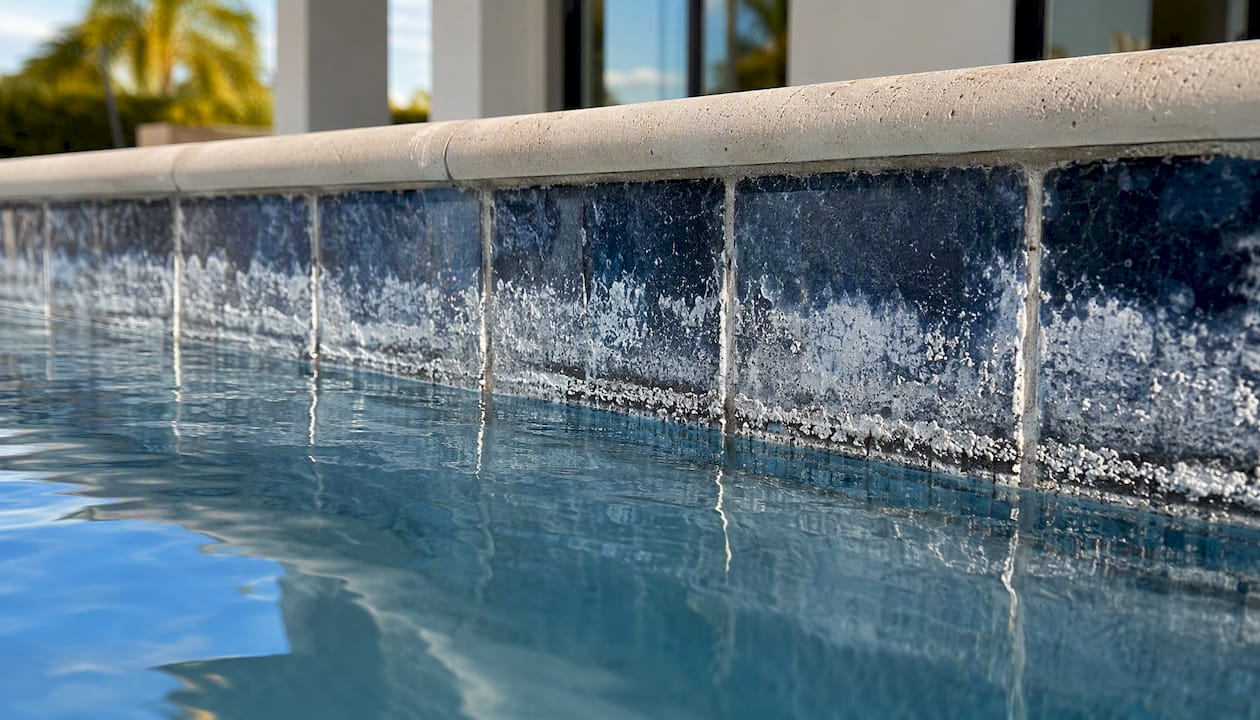
Tile scaling is the buildup of mineral deposits, primarily calcium carbonate or calcium silicate, on pool tile surfaces and adjacent finishes. It causes white haze, hard gray crust, and surface deterioration that worsens over time. Your first move: collect a water sample for a full chemistry test covering pH, total alkalinity, calcium hardness (CH), and the Langelier Saturation Index (LSI), or schedule an on-site inspection. The severity of what you find determines the safe removal method.
- Fresh white haze: water chemistry adjustment and mild cleaning may be enough
- Hard gray or layered crust: requires professional media blasting
- Loose tiles or hollow sound when tapped: structural repair needed, not just cleaning
Table of Contents
- How to spot tile scaling on your pool
- Why tile scaling forms in Florida pools
- Scale versus etching: why the diagnosis matters
- When you can treat scale yourself and when to call a pro
- How professionals remove tile scale
- What a professional tile-scale job looks like
- How to keep scale from coming back
- What cleaning and resurfacing typically cost
- Why Florida owners trust Classicmarcite for scale removal and restoration
- Key Takeaways
- The case for getting the diagnosis right first
- Classicmarcite: free inspection and estimate for Florida pools
- Useful sources and tools
How to spot tile scaling on your pool
The earliest sign is a white chalky film along the waterline. Left alone, it hardens into a rigid gray or white crust that layers up over months. You may also notice discolored or crumbling grout, a rough or sandpaper-like feel on plaster, and flaking at tile edges.
Run your hand along the waterline. Scale on pool surfaces feels gritty or hard, not slick. A gentle tap on individual tiles tells you more: a solid sound means the tile is bonded; a hollow sound means the adhesive has failed and the tile is at risk of falling.
Red flags that rule out DIY:
- Thick gray deposits that resist a fingernail or firm scraping
- Any tile that shifts, wobbles, or sounds hollow when tapped
- Scale visible inside return jets, salt cell plates, or heater elements
- Grout gaps or missing grout sections along the waterline
Untreated scale creates rough, porous surfaces that trap algae, stain plaster, and reduce equipment lifespan. Scale inside plumbing fittings and salt cells reduces operational efficiency and can force earlier, costlier repairs.
Pro Tip: Tap each tile along the affected waterline section before calling a contractor. Note how many sound hollow — that number directly affects the repair scope and estimate.
Why tile scaling forms in Florida pools
Scale forms when pool water is oversaturated with calcium carbonate. The Langelier Saturation Index measures that saturation: an LSI reading above roughly +0.3 puts water in scaling territory. Florida pools hit that threshold regularly.
Florida’s fill water commonly has relatively high calcium hardness, drawn from the Floridan Aquifer and many municipal supplies. That starting point is often near or above the recommended range before any evaporation occurs. Year-round heat accelerates evaporation, concentrating minerals further with every top-off.
Additional triggers that push LSI higher:
- pH above 7.6 (common after rain events)
- Total alkalinity above 120 ppm
- Water temperatures above 84°F
- Heat features, waterfalls, and aeration (all raise pH and accelerate evaporation)
- Frequent top-offs with hard municipal water
Target ranges that keep LSI in check: pH 7.4–7.6, total alkalinity 80–120 ppm, calcium hardness 200–400 ppm. Tracking these monthly with a full water chemistry guide is the single most effective prevention step for Florida pool owners.
Florida context: Tap water calcium hardness often measures 200–450 ppm CH in many Florida municipalities, making scale a long-term maintenance issue rather than a one-time fix.
Scale versus etching: why the diagnosis matters
Scale and etching look similar but need opposite treatments. Applying the wrong one causes surface damage or chemistry problems that cost far more to fix.
Scale is a deposit problem: water oversaturated with calcium leaves mineral crust on surfaces. Etching is material loss: water undersaturated with calcium dissolves the tile finish or plaster, leaving a rough, pitted, sandpaper-like surface.
Quick diagnostic cues:
- Scale: visible crust or haze that sits on top of the surface; can sometimes be lifted with a fingernail on fresh deposits
- Etching: surface feels rough and pitted but has no raised crust; the material itself has been eaten away
Treatment implications are direct. Scale is removed mechanically (media blasting) or with controlled chelants. Etching requires surface repair and carefully raising CH to stop further dissolution. Pouring acid on an etched surface makes it worse.
Pro Tip: Always calculate LSI before attempting any acid or mechanical treatment. A five-minute water test prevents a $500 mistake.
When you can treat scale yourself and when to call a pro
Light, fresh white haze on standard ceramic tile sometimes responds to homeowner treatment. Everything beyond that requires a professional.
Safe DIY options for mild deposits:
- Soft nylon brush along the waterline during regular cleaning
- Manufacturer-approved scale cleaners formulated for your specific tile type
- Pumice stone on appropriate ceramic surfaces only, used wet — never on glass, polished porcelain, or natural stone
Stop and call a professional when you see:
- Hard gray crust that does not respond to mild cleaners
- Any tile that sounds hollow or feels loose
- Scale on glass tile, natural stone, or pebble finishes
- Scale inside equipment or salt cell plates
- Grout gaps or missing sections
Attempting heavy DIY methods — muriatic acid pours, aggressive scraping — often costs more in eventual tile or plaster repair than a single professional restoration job. The risk is not just surface damage; improper acid use can shift water chemistry enough to etch the entire plaster finish.
If tiles show signs of structural failure — hollow sound, visible movement, grout gaps — cleaning alone will not fix the problem. That is a repair job, not a cleaning job. See what pool tile repair involves before deciding on a course of action.
How professionals remove tile scale
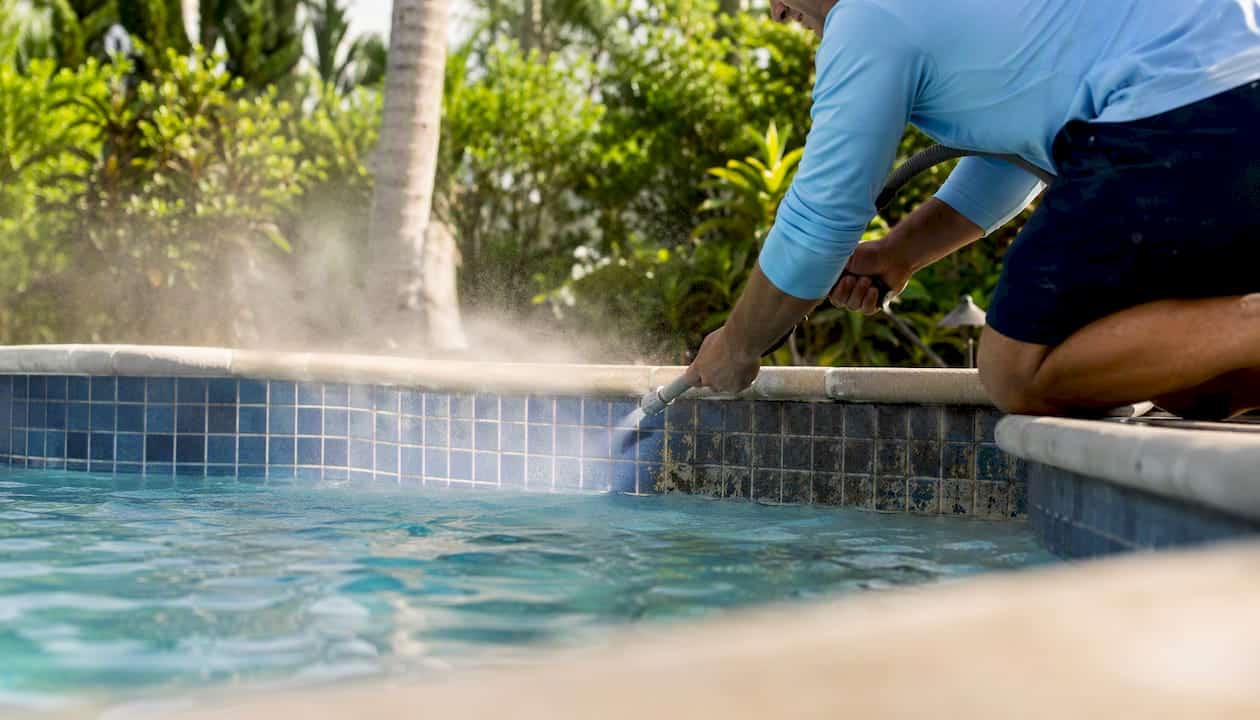
Controlled media blasting is the industry standard for hardened mineral deposits. It strips scale without damaging tile, grout, or finish materials when executed at the correct pressure with the right media.
| Method | Best For | Key Risk |
|---|---|---|
| Glass-bead blasting | Glass tile, delicate finishes | Micro-scratches if pressure is too high |
| Sodium bicarbonate media | Moderate carbonate deposits, ceramic tile | Slight pH buffering effect on pool water |
| Kieserite (magnesium sulfate) media | Heavy silicate scale, standard tile | Requires careful pressure control |
| Controlled pH reduction | Mild carbonate haze, early-stage deposits | Ineffective on thick or silicate scale |
| Targeted chelant soak | Equipment scale, salt cells | Not suitable for surface tile work |
Media blasting often completes residential tile-line scale jobs in a few hours and usually does not require a full pool drain. That efficiency is why professionals prefer it over chemical-only approaches.
Glass beads are the right choice for glass tile because finer media avoids micro-scratching. Sodium bicarbonate media is common for moderate deposits on ceramic. Heavy silicate scale, which forms when calcium silicate bonds to the tile surface over years, needs mechanical abrasion under controlled pressure.
Pro Tip: Ask your contractor which media they plan to use before work begins. The answer tells you whether they have matched the method to your tile type — or are using a one-size-fits-all approach.
What a professional tile-scale job looks like
A standard residential job moves through these steps:
- Inspection and water test — LSI calculation, tap test for hollow tiles, photographic documentation
- Surface protection setup — masking equipment, protecting adjacent surfaces
- Media blasting or targeted chemical treatment — method matched to scale type and tile material
- Rinse and vacuum — removing all media and loosened deposits from the pool
- Water chemistry correction — rebalancing pH, alkalinity, and CH to a safe LSI range
- Follow-up check — confirming surfaces are clean and water is stable
| Scale Severity | Typical Duration | Homeowner Prep |
|---|---|---|
| Light (fresh white haze) | 2–4 hours | Clear pool deck, have water test results ready |
| Moderate (layered crust, no loose tiles) | 4 hours | Arrange access to equipment pad and valves |
| Heavy (thick deposits, tile repair needed) | 1–2 days | Plan for partial drain; confirm tile/grout repair scope |
Timeline varies with tile type, equipment access, and whether regrouting or tile replacement is required after scale removal.
How to keep scale from coming back
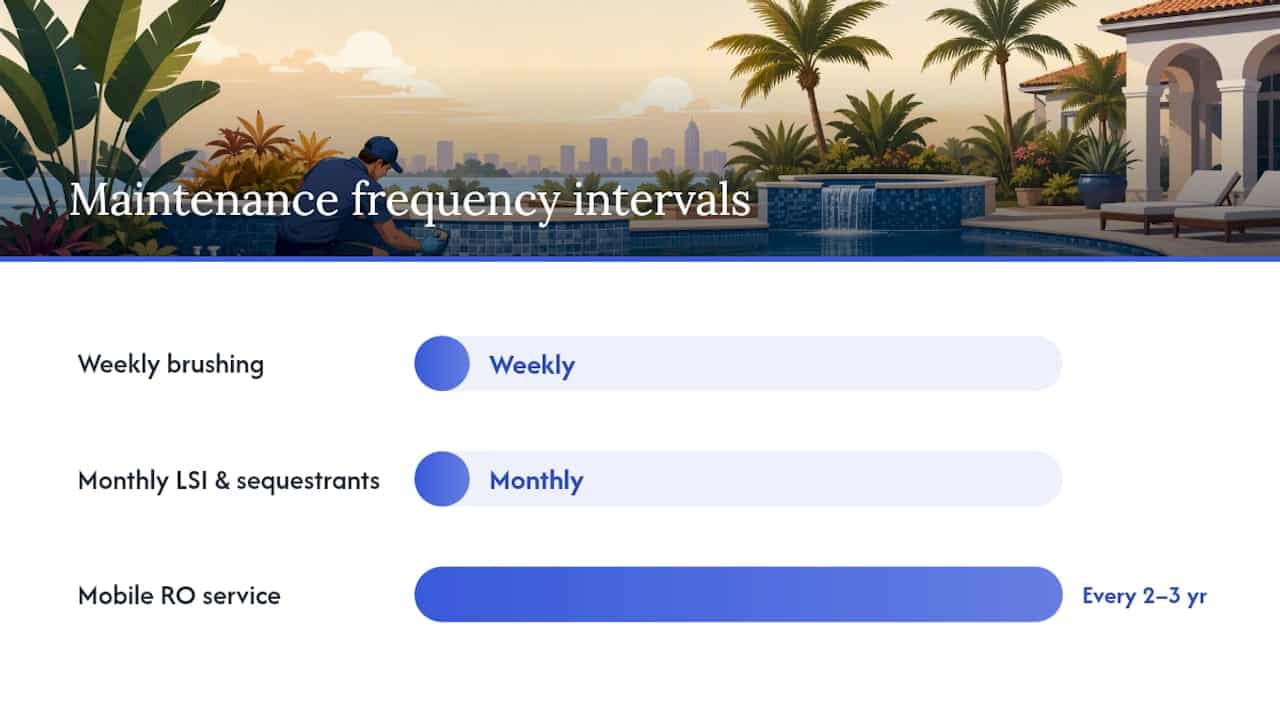
Monthly LSI management and sequestering agents are the foundation of prevention in Florida’s hard-water environment.
- Monthly LSI check: test pH, TA, CH, and temperature; calculate LSI and adjust before it climbs above +0.3
- Sequestering agents: dose monthly; they keep calcium suspended in the water rather than depositing on surfaces — they do not lower hardness but slow deposition significantly
- Weekly soft brushing: run a nylon brush along the waterline to disrupt early mineral adhesion before it hardens
- Manage top-offs: top off with the same water source consistently; consider a fill-line pre-treatment if your municipal supply runs above 400 ppm CH
- Mobile RO service: every 2–3 years for high-CH pools, reverse osmosis water treatment resets total dissolved solids without a full drain
Sequestrants and LSI monitoring are the most effective long-term strategy for Florida pools. Prevention costs a fraction of repeated professional cleanings. For a complete calcium buildup prevention routine, monthly dosing and consistent water testing are non-negotiable.
Pro Tip: A mobile RO service is worth considering after a major scale removal job. It resets your water’s mineral load and gives your prevention program a clean starting point.
What cleaning and resurfacing typically cost
Professional tile-scale cleaning is far less expensive than resurfacing, but chronic scaling that damages the substrate can make resurfacing the smarter investment.
Cost factors for a cleaning job:
- Scale severity and coverage area
- Tile type (glass and natural stone cost more to treat safely than standard ceramic)
- Equipment access and whether a partial drain is required
- Whether tile repair or regrouting is needed after cleaning
Typical residential tile-line cleaning ranges from a few hundred to over a thousand dollars depending on the factors above. Partial regrouting adds to that. Full resurfacing, when scaling has compromised the substrate or finish beyond cleaning, runs several times the cost of a cleaning job. These are typical ranges — get a local estimate for your specific pool.
When resurfacing or tile replacement is the right call:
- Tiles are loose, hollow-sounding, or falling off
- Extensive etching has removed the surface finish
- Staining persists after professional cleaning
- Recurring scale is tied to a failing or porous substrate
Pool tile repair and regrouting are often intermediate steps between cleaning and full resurfacing. A professional inspection tells you which category your pool falls into.
Why Florida owners trust Classicmarcite for scale removal and restoration
Classicmarcite has been resurfacing pools in Orlando and Jacksonville since 1988, with over 100,000 pools completed across residential, commercial, and international projects. The company is the largest Pebble Tec® applicator in Central Florida.
A Classicmarcite inspection covers water testing and LSI calculation, photographic documentation of scale severity and tile condition, a written method recommendation, and a written estimate with warranty options. For pools where cleaning reveals deeper damage, the same team handles tile repair, regrouting, and full resurfacing using marcite plaster and Pebble Tec® finishes.
Professional inspection is the step most Florida pool owners skip — and it is the one that prevents a $300 cleaning job from turning into a $3,000 repair. Knowing the LSI, the tile type, and the scale depth before any tool touches the surface is what separates a clean result from a damaged one.
Browse the residential pool portfolio to see before-and-after documentation from completed Florida projects.
Key Takeaways
Pool tile scaling is a mineral deposit problem driven by oversaturated water chemistry, and Florida’s hard fill water makes it one of the most common maintenance challenges for pool owners in the state.
| Point | Details |
|---|---|
| Scale definition | Calcium carbonate or silicate deposits on tile surfaces caused by LSI above roughly +0.3. |
| Florida risk factor | Fill water commonly measures 200–450 ppm CH, making scale a recurring issue without active prevention. |
| Professional removal | Media blasting (glass beads, sodium bicarbonate, Kieserite) is the industry standard for hardened deposits. |
| Prevention routine | Monthly LSI checks, sequestering agents, and weekly waterline brushing reduce deposition frequency. |
| Classicmarcite | Offers inspection, media-blast cleaning, tile repair, regrouting, and full resurfacing across Orlando and Jacksonville. |
The case for getting the diagnosis right first
Florida pool professionals see the same pattern repeatedly: a pool owner notices white buildup, pours muriatic acid along the waterline, and ends up with etched tile and a water chemistry problem that takes weeks to correct. The scale is still there, or worse, the surface underneath it is now damaged.
The right sequence is inspect first, then treat. In a typical Orlando case, hardened scale removed by bead blasting and followed by an LSI correction program stays clean for years. The same pool treated with repeated acid washes often returns to the contractor with etched grout, loose tiles, and a substrate that can no longer hold a clean finish. Media blasting removes the deposit without touching the material beneath it. Follow-up chemistry keeps new deposits from forming. That combination is what produces a durable result rather than a temporary one.
Classicmarcite: free inspection and estimate for Florida pools
Hardened scale on your pool tile is not a cosmetic problem you can defer. Left untreated, it damages grout, loosens tiles, and forces resurfacing costs that a timely cleaning would have avoided.
Classic Marcite serves homeowners, property managers, and commercial pool owners across Orlando, Jacksonville, and surrounding Central Florida communities. The process starts with an on-site inspection, a full water chemistry assessment, and a written estimate at no charge. For pools where scale has progressed to tile or substrate damage, the same team handles pool repair in Orlando and full pool resurfacing in Orlando under one roof. Most residential cleaning jobs are scheduled within a few weeks. Contact Classicmarcite to book your inspection and get a free estimate.
Useful sources and tools
- LSI and hard water management for Florida pools — water chemistry reference with calcium scaling context
- Scale and etching: diagnosis and treatment — professional guide to distinguishing the two conditions
- Hard water in Florida pools — fill water CH data and sequestering agent guidance
- Calcium scale removal methods — what works, what damages surfaces, and how to prevent recurrence
- Calcium scale on the waterline — diagnostic workflow including tap test and spot acid test
- Classicmarcite pool water chemistry guide — LSI targets and maintenance ranges for Florida homeowners
- Pool enclosure repair after tile or deck work — if your restoration project extends to the pool screen enclosure