TL;DR:
- Hydroblasting uses high-pressure water jets to remove bonded deposits and coatings without abrasive media. It is ideal for cleaning heat exchangers, tanks, concrete, and surfaces requiring surface preparation or coating removal. Safety, containment, and equipment standards are critical due to the hazards involved, especially at pressures above 25,000 psi.
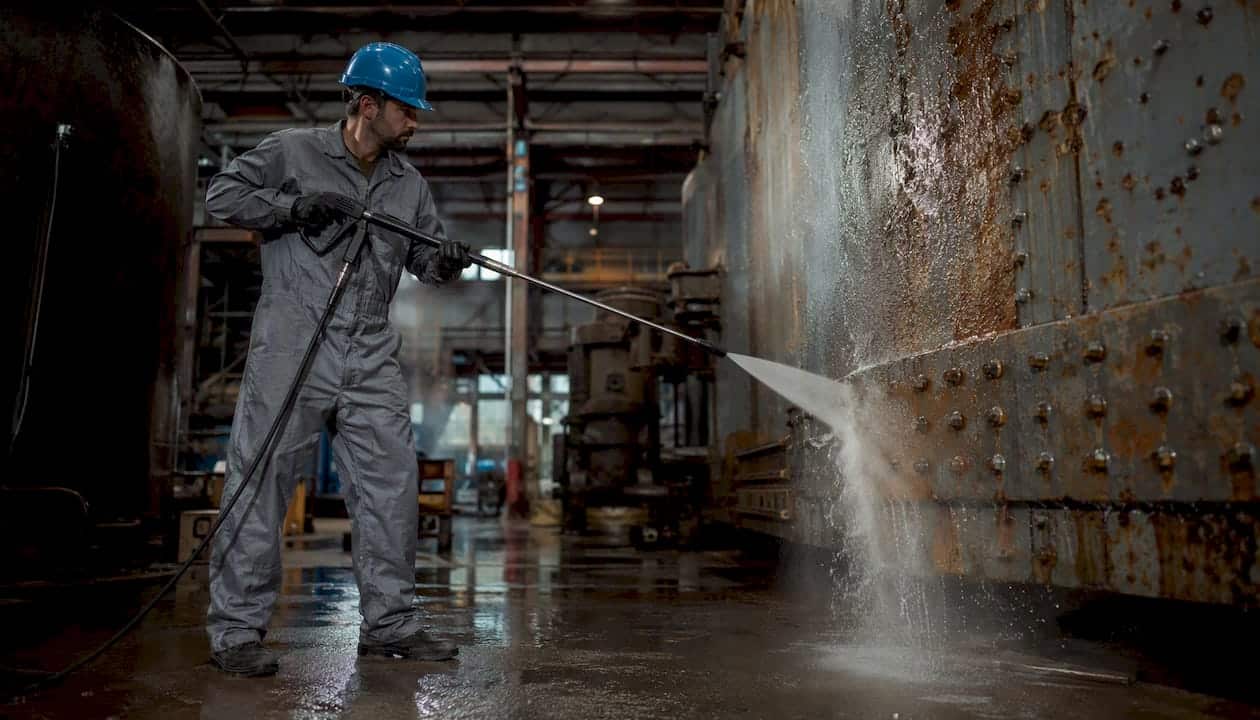
Hydroblasting, also called water blasting, waterjetting, or hydro-demolition, is an industrial cleaning and surface-preparation method that uses ultra-high-pressure water jets to strip bonded deposits, coatings, scale, and concrete from a substrate without introducing abrasive media. The water does the work. No sand, no grit, no chemical solvents.
The method is the right call when:
- Bonded scale, epoxy coatings, or mastic need removal from metal or concrete
- Heat exchanger tubes or process piping require internal cleaning
- Storage tank internals need stripping before inspection or recoating
- Concrete spalling or surface contamination requires hydro-demolition
- Pool surfaces need old plaster or coating removed before resurfacing
TL;DR: Choose hydroblasting when deposits are bonded to the substrate and routine pressure washing cannot remove them. Choose a professional crew when the pressure exceeds roughly 25,000 psi or when the asset is regulated, confined, or structurally sensitive.
Table of Contents
- What Is Hydroblasting and How Does It Work?
- Pressure Ranges, Equipment Classes, and What Each One Removes
- Where Is Hydroblasting Actually Used?
- What Are the Real Benefits of Hydroblasting?
- Is Hydroblasting Safe? Hazards, Controls, and Industry Standards
- Hydroblasting vs. Pressure Washing: Which One Do You Need?
- What Does Hydroblasting Cost and How Long Does It Take?
- When Should You Hire a Professional Hydroblasting Crew?
- Best Practices and Where the Industry Is Heading
- Key Takeaways
- Why Pool Hydroblasting Deserves More Respect Than It Gets
- Classicmarcite Handles Pool Hydroblasting and Resurfacing in Florida
- Useful Sources
What Is Hydroblasting and How Does It Work?
At its core, hydroblasting converts pump energy into a focused, high-velocity water stream. The cleaning power at the surface is a product of pressure, flow rate, nozzle geometry, and the angle and distance of the lance. Change any one of those variables and you change the result entirely.
Pump systems fall into two main categories. Triplex piston pumps use three reciprocating pistons to deliver a relatively steady flow at pressures from roughly 5,000 psi up to 40,000 psi. Intensifier pumps use hydraulic fluid to drive a small-bore plunger, reaching ultra-high pressures with lower flow rates. For most industrial cleaning, triplex units dominate because they balance flow and pressure efficiently across a wide range of jobs.
Nozzles are where most of the engineering happens. A rotating nozzle spreads impact energy across a wider path, useful for surface prep. A pencil-jet nozzle concentrates all energy on a narrow point, useful for tube cleaning or cutting. Wrong nozzle selection converts cleaning energy into wasted splash or substrate damage, which is why engineered process control matters as much as raw psi.
Flow rate, measured in gallons per minute (GPM), determines how much material the water can carry away after impact. High pressure with low GPM can cut but may not flush debris clear. Matching GPM to the job prevents redeposition of loosened material.
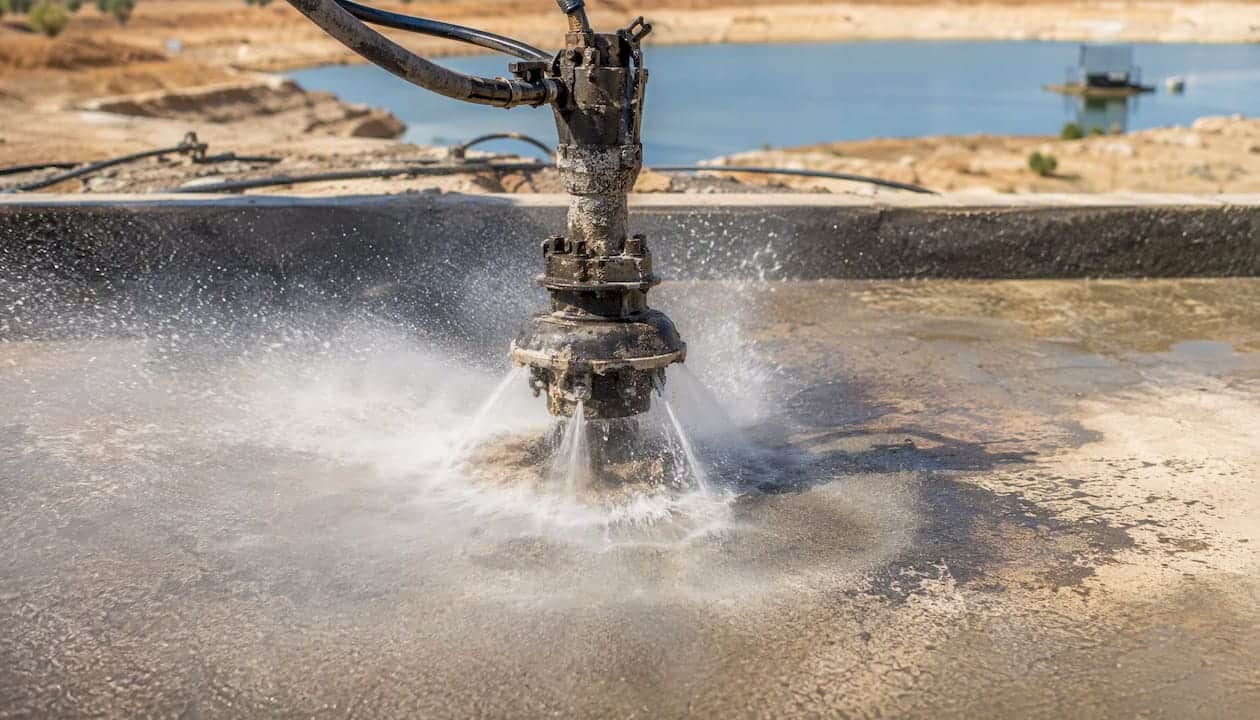
Containment and wash-water recovery are not optional extras. Facilities control the wash water because it carries whatever was on the surface: lead paint particles, process chemicals, hydrocarbons, or biological matter. Proper berms, vacuum recovery units, and waste manifolds are part of the job scope, not an afterthought.
Pro Tip: Before starting, verify the lance reaction force against the operator’s body weight and grip strength. At pressures above 25,000 psi, the kickback from a standard lance can exceed what one person can safely control. Use a chain manipulator or support bracket to stabilize the lance and keep the operator out of the direct hazard zone.
Pressure Ranges, Equipment Classes, and What Each One Removes
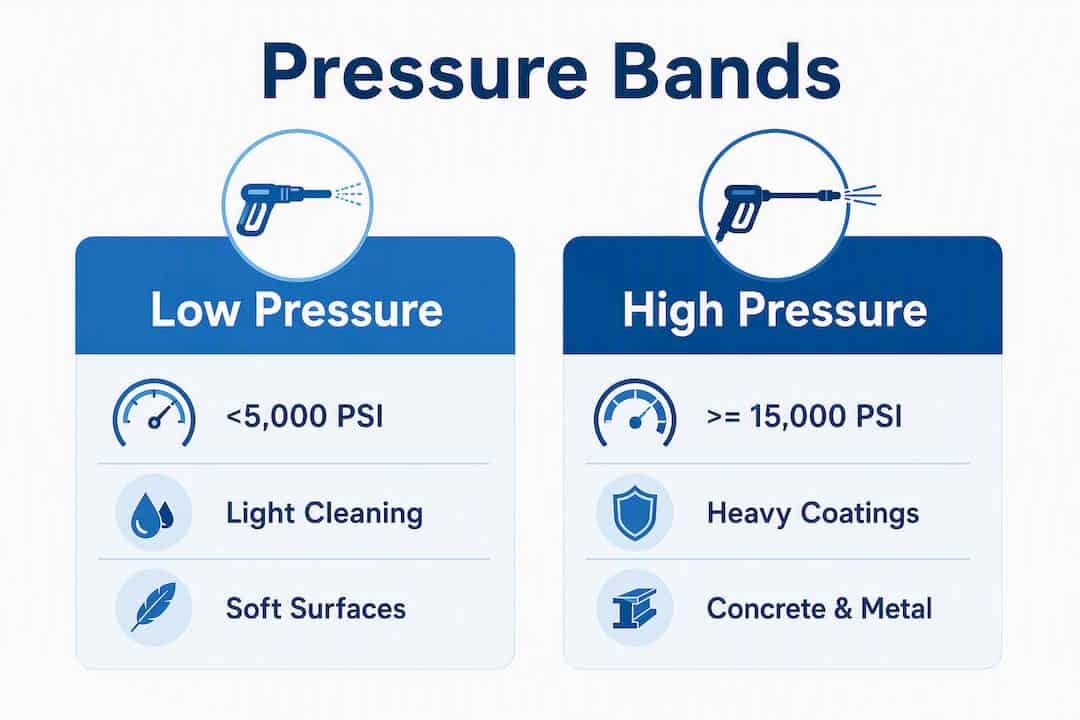
Pressure bands are the practical shorthand contractors use to scope a job and select equipment. The table below maps the four common bands to typical applications and equipment.
| Pressure Band | Approximate PSI Range | Typical Removals | Common Equipment |
|---|---|---|---|
| Low pressure | Up to ~5,000 psi | Light grime, algae, loose paint, general surface washing | Consumer/commercial pressure washers, low-flow pumps |
| High-pressure cleaning | 5,000–10,000 psi | Moderate scale, road film, light coatings, pool deck buildup | Mid-range triplex pumps, flat-fan nozzles |
| Water jetting | 10,000–25,000 psi | Bonded scale, epoxy coatings, mastic, pipe internals, heat exchanger tubes | Industrial triplex pumps, rotating nozzles, flex lances |
| Ultra-high pressure | Above ~25,000 psi | Concrete removal, heavy coatings, structural hydro-demolition | High-output triplex or intensifier pumps, specialty cutting nozzles |
Some providers operate equipment capable of reaching very high pressures for specific coating or concrete applications. At those pressures, the water stream cuts through hardened materials the way a blade would.
When GPM matters more than pressure: cleaning large tank floors or flushing long pipe runs requires volume to carry debris out. A 20,000 psi unit running 3 GPM will cut but not flush. A 10,000 psi unit running 15 GPM often clears the same job faster because it moves material.
Accessory tooling extends what the pump alone can do:
- Remote lances and flex-shaft systems reach inside tubes and confined spaces without putting an operator inside
- Magnetic crawlers and rail-mounted manipulators hold the lance steady on vertical steel surfaces
- Vacuum recovery units capture wash water and debris at the point of impact, reducing containment spread
- Rotating bundle cleaners spin a multi-nozzle head through heat exchanger tubes at a controlled feed rate
Where Is Hydroblasting Actually Used?
Hydroblasting is the preferred method when deposits are bonded to the substrate or when surface preparation requires exposing bare metal or concrete without introducing abrasive dust. The application list spans most heavy industries.
Primary application categories:
- Heat exchangers and boiler tubes: Rotating bundle cleaners clear scale and fouling from tube bundles, restoring heat-transfer efficiency without mechanical damage to tube walls
- Process piping: Flex-lance systems clean pipe internals from access points, removing hydrocarbon buildup, scale, and polymer deposits
- Storage tanks: Internal tank cleaning strips coatings, sludge, and corrosion products before inspection or recoating
- Concrete and masonry (hydro-demolition): Ultra-high-pressure jets remove deteriorated concrete selectively, leaving sound aggregate intact for rebar exposure and repair
- Heavy floor buildup: Refineries and food processing plants use hydroblasting to strip hardened process residue from concrete floors
- Coating removal: Epoxy, mastic, paint, and thin-set are stripped from steel and concrete without the silica dust hazard of abrasive blasting
- Pool surface preparation: Old plaster, marcite, and failed coatings are removed before resurfacing, exposing the shell for new finish application
Case example — heat exchanger tube cleaning: A refinery running a crude unit notices a drop in heat-transfer efficiency. Tube-side fouling has built up a scale layer that chemical cleaning cannot fully dissolve. A hydroblasting crew runs a rotating bundle cleaner through each tube at 15,000–20,000 psi, clearing the scale in a fraction of the time manual rodding would require. The tubes are inspected immediately after cleaning because the surface is bare metal with no abrasive residue to mask defects. That clean-and-inspect sequence in a single mobilization is one of the clearest operational advantages of the method.
Where hydroblasting replaces abrasive blasting, the trade is straightforward: no airborne silica dust, but a heavier wet waste stream that needs containment and proper disposal. For regulated materials like lead paint, that wet waste requires testing and licensed disposal, which adds to job cost but keeps the site OSHA-compliant.
What Are the Real Benefits of Hydroblasting?
The core advantages are technical, not marketing language. Each one has a direct operational consequence.
- No abrasive media or dust: Workers are not exposed to silica or other abrasive particulates. The site does not require the same respiratory controls as sandblasting, and there is no grit to clean up from adjacent equipment.
- Effective on bonded deposits: Water at sufficient pressure and the right nozzle geometry removes materials that mechanical scraping and chemical treatment cannot fully address, including epoxy, mastic, and carbonate scale.
- Substrate preservation: Properly scoped hydroblasting removes the coating or deposit without cutting into the base material. Concrete aggregate stays intact. Steel surface profile is preserved for recoating.
- Faster inspection readiness: Because the surface is clean and free of abrasive residue immediately after the job, inspectors can assess the substrate the same day. That compresses the maintenance window.
- Reduced thermal and chemical exposure: No heat, no solvents, no chemical neutralization steps. The process is water in, contaminated water out.
- Improved heat-transfer recovery: In exchanger applications, removing fouling directly restores thermal efficiency, which has measurable energy cost implications for the facility.
The environmental tradeoff is real. Wet waste streams are heavier and more complex to manage than the dry waste from abrasive blasting. Containment berms, vacuum recovery, and licensed disposal add cost and planning time. For jobs involving regulated materials, that cost is non-negotiable.
Is Hydroblasting Safe? Hazards, Controls, and Industry Standards
Hydroblasting can cause catastrophic injury without proper controls. The hazard profile is different from most industrial cleaning methods, and underestimating it is the most common mistake on job sites.
The most serious hazards:
- Injection injuries: A high-pressure water stream can penetrate skin and deposit contaminants deep into tissue. These injuries look minor on the surface but are surgical emergencies requiring immediate medical assessment to prevent deep-tissue infection or necrosis.
- Hose whip: A failed hose fitting under pressure releases a whipping hose that can strike anyone in the area with lethal force. Hose life-cycle management and formal inspection programs exist specifically because hose failure is a primary cause of hydroblasting incidents.
- Ricochet: High-pressure streams deflect off hard surfaces unpredictably. Exclusion zones protect workers not directly involved in the operation.
- Fall and electrical hazards: OSHA identifies fall hazards as a leading cause of fatalities in surface preparation work. Wet surfaces, scaffolding, and proximity to electrical equipment compound the risk.
Required planning elements for any hydroblasting job:
- Documented Job Safety Analysis (JSA) prepared before work begins
- Defined exclusion zones with physical barriers
- Written hose management policy covering inspection intervals, pressure testing schedules, and retirement criteria
- Full PPE: face shield, high-pressure rated gloves, cut-resistant clothing, and steel-toed footwear
- Medical response plan with the nearest emergency facility identified
Industry standards from the Water Jet Technology Association (WJTA) and NAHAD provide the recognized framework for hose management and operator competency. OSHA’s surface preparation guidance covers fall and electrical hazards in the same work environment.
Contractor safety checklist:
- Written JSA available before mobilization
- Documented hose inspection and pressure testing records
- Operator training certifications on file
- Equipment rated for the specified pressure band
- Proof of liability insurance with adequate limits
- Waste handling and disposal plan in writing
Hydroblasting vs. Pressure Washing: Which One Do You Need?
The difference is not just pressure. It is the type of deposit and the consequence of leaving it behind.

Pressure washing operates at roughly 1,000–4,000 psi and handles loose dirt, algae, road film, and light surface grime. Hydroblasting starts where pressure washing stops: bonded scale, cured coatings, carbonate deposits, and concrete that has deteriorated past what a surface wash can address. Industrial water jetting operates at much higher pressures than those achievable by standard pressure washing equipment.
Matching the method to the deposit:
- Loose dirt, algae, mildew on pool decks → pressure washing
- Light paint chalking or surface oxidation → pressure washing
- Bonded epoxy or mastic coating on concrete → hydroblasting (water jetting range)
- Carbonate scale inside heat exchanger tubes → hydroblasting
- Deteriorated concrete requiring selective removal → ultra-high-pressure hydro-demolition
- Old plaster or marcite on a pool shell before resurfacing → hydroblasting
Pro Tip: Hydroblasting is not always the first step. On pool decks and lightly fouled surfaces, a pressure wash pass first removes loose material and reduces the volume of contaminated wash water the hydroblasting step generates. A two-step approach lowers overall cost and simplifies waste handling.
The cost and risk gap between the two methods is significant. Pressure washing is a commodity service. Hydroblasting requires specialized pumps, trained operators, containment equipment, and documented safety planning. Specifying hydroblasting for a job that pressure washing can handle wastes money. Specifying pressure washing for a job that needs hydroblasting leaves bonded deposits in place and the substrate unprepared.
What Does Hydroblasting Cost and How Long Does It Take?
Setup and safety costs are higher than pressure washing, but for heavy deposits, hydroblasting removes material significantly faster than many mechanical alternatives. The cost equation favors it on jobs where the alternative is days of manual labor or multiple chemical treatment cycles.
Primary cost drivers:
- Pressure band required (higher pressure = more specialized equipment and higher mobilization cost)
- Flow rate and recovery equipment (vacuum recovery units add rental and labor cost)
- Containment setup (berms, manifolds, and collection tanks scale with site complexity)
- Waste disposal (regulated materials like lead paint require licensed disposal and testing)
- Access and rigging (confined spaces, elevated work, or remote locations add time)
- Permits and pre-job testing (lead paint testing, hot work permits, confined space entry permits)
| Cost Driver | Effect on Price | Effect on Timeline |
|---|---|---|
| Higher pressure band | Increases equipment rental and operator rate | Faster removal per square foot |
| Vacuum recovery | Adds daily equipment cost | Reduces post-job cleanup time |
| Regulated waste (lead, asbestos) | Adds testing and licensed disposal fees | Adds pre-job testing time |
| Confined space entry | Adds permit, gas monitoring, and standby rescue | Extends mobilization and setup |
| Remote/elevated access | Adds rigging, scaffolding, or lift equipment | Extends setup significantly |
Typical job durations vary widely. A residential pool shell prep for resurfacing, stripping old plaster, typically runs several days for a professional crew depending on pool size. A heat exchanger tube bundle cleaning on a mid-size unit runs several hours to a full shift. Concrete hydro-demolition on a bridge deck or parking structure is measured in days to weeks depending on the area and depth of removal required.
For pool deck maintenance that does not require full surface stripping, pressure washing is faster and less expensive. The decision point is always the deposit type and the required surface condition afterward.
When Should You Hire a Professional Hydroblasting Crew?
Hydroblasting above moderate pressure levels is a specialist task. The equipment is industrial, the hazards are severe, and the margin for error on a confined-space or regulated-material job is close to zero. Documented safety planning is not a formality; it is what separates a controlled operation from an incident.
Questions to ask any hydroblasting contractor before signing a work order:
- Can you provide a written JSA specific to this job before mobilization?
- What is your hose management policy, and can I see the last inspection and pressure test records?
- What operator training certifications do your crew members hold?
- What pressure band and GPM will you use, and why is that the right spec for this deposit?
- What are your insurance limits, and does your policy cover this type of work?
- How will you contain and dispose of wash water, and do you have a plan for regulated materials if testing finds them?
- Can you provide references or case studies from similar jobs?
Red flags that indicate an underqualified provider:
- No written hose management program or refusal to show inspection records
- Inability to produce operator training documentation
- No vacuum recovery equipment on a job that generates contaminated wash water
- Vague or verbal-only safety planning with no written JSA
- Insurance limits that do not cover the asset value or potential third-party liability
- No pre-job material testing on a structure with unknown coating history
Large industrial clients increasingly require documented hose management and proof of inspection as a precondition to allow hydroblasting work on site. If a contractor cannot meet that standard for an industrial client, they should not be working on your asset either.
Best Practices and Where the Industry Is Heading
The clear trend in professional hydroblasting is toward automation and remote operation. The goal is to reduce direct human exposure to the hazard zone while improving consistency on long or repetitive runs.
Recognized best practices:
- Formal hose management: treat hose assemblies as managed assets with visual inspection before each job and scheduled pressure testing. Inconsistent hose management is a documented source of incidents and unplanned downtime.
- Planned water recovery: design the containment and recovery system before the job starts, not after the pump is running
- Pre-job material testing: test for lead, asbestos, and other regulated materials before any stripping work on structures with unknown coating history
- Remote tooling: use magnetic crawlers, rail-mounted systems, and manipulators whenever the geometry of the job allows, keeping operators out of the direct splash and ricochet zone
- Documented operator training: formal competency records, not just on-the-job familiarity
The automation trend is driven by two forces: liability reduction and consistency. A manipulator-mounted nozzle traveling at a controlled feed rate delivers more uniform surface preparation than a fatigued operator holding a lance for hours. On long tube runs or large tank floors, the quality difference is measurable.
Pro Tip: On high-risk assets, run a phased test pass on a small representative area before committing to full-scale operations. A test pass confirms that the pressure, nozzle, and feed rate combination achieves the target surface condition without damaging the substrate. Adjusting parameters after a test pass costs minutes; adjusting after a full run costs the job.
Key Takeaways
Hydroblasting is the technically correct choice when deposits are bonded to the substrate, when abrasive dust is unacceptable, and when surface preparation must expose bare material for inspection or recoating.
| Point | Details |
|---|---|
| Pressure determines the job | Pressure bands range from under 5,000 psi for light cleaning to above 25,000 psi for concrete removal; match the band to the deposit. |
| Safety is non-negotiable | Injection injuries are surgical emergencies; every job requires a written JSA, hose inspection records, and defined exclusion zones. |
| Cost scales with complexity | Regulated waste, confined space entry, and vacuum recovery are the biggest cost multipliers beyond equipment rental. |
| Hire professionals above 25,000 psi | Specialist training, documented competency, and industrial equipment are required; verify JSAs, hose programs, and insurance before signing. |
| Classicmarcite for pool prep | Classicmarcite uses hydroblasting in pool surface preparation before resurfacing with materials like Pebble Tec®, serving both residential and commercial pools in Orlando and Jacksonville, Florida. |
Why Pool Hydroblasting Deserves More Respect Than It Gets
Most homeowners and even some facility managers treat pool resurfacing as a straightforward refinishing job. Strip the old surface, apply the new one. The hydroblasting step gets treated as a formality. That framing misses the point entirely.
The condition of the substrate after prep determines how long the new finish lasts. A pool shell with residual plaster, failed bonding layers, or surface contamination will delaminate a new finish in two to three years regardless of how good the material is. Hydroblasting done correctly exposes the bare shell uniformly, removes every layer of failed material, and gives the new finish a clean, mechanically sound surface to bond to. That is not a prep step. That is the foundation of the entire resurfacing investment.
The other thing practitioners underestimate is containment. Pool hydroblasting generates wash water carrying old plaster, algae, calcium deposits, and whatever else has accumulated on the shell. On a residential job, that water needs to go somewhere that is not the neighbor’s yard or the storm drain. A contractor who does not plan for wash-water recovery is cutting corners on the part of the job that protects the homeowner from liability and the environment from contamination.
Classicmarcite has been doing this work since 1988, with extensive experience resurfacing many residential, commercial, and resort pools. That volume of experience shows up in the details: the right pressure spec for the shell condition, the containment setup, and the surface profile that makes a Pebble Tec® finish last. For more on the pool resurfacing process and what to expect at each stage, the resources below are worth reviewing before you hire anyone.
Classicmarcite Handles Pool Hydroblasting and Resurfacing in Florida
Stripping a pool shell to bare substrate and applying a finish that lasts 15 to 25 years takes more than a pressure washer and a bag of plaster. Classicmarcite brings the full process: hydroblasting prep with proper wash-water containment, substrate assessment, and application of premium finishes including Pebble Tec®, the most durable pool interior material available in Florida.
As the largest Pebble Tec® applicator in Central Florida and a company with over 100,000 pools resurfaced since 1988, Classic Marcite works with homeowners, property managers, resorts, and commercial facilities across Orlando and Jacksonville. The process starts with a free estimate and a clear scope of work before any equipment arrives on site.
If your pool surface is failing, staining, or simply past its service life, the right next step is a professional assessment. Request a free estimate for Pool Resurfacing in Orlando and find out exactly what your shell needs before committing to a material or a timeline.
Useful Sources
The following primary references were used to verify technical claims in this article. Consult them directly when scoping regulated-material projects or evaluating contractor competency standards.
- NAHAD / WJTA Whitepaper: Hose Safety and Best Practices — The recognized industry reference for hose life-cycle management, inspection protocols, and pressure testing requirements. Use this when evaluating a contractor’s hose management program.
- WJTA / OSHA Safety Manual: Hydroblaster Safety — Covers equipment pressure ranges, operational hazards, and basic safety requirements for high-pressure water cleaning. Useful for understanding what a compliant operation looks like.
- Hydro-Blasting Safety Guidance (LLCP-083) — Detailed safety planning guidance covering JSAs, exclusion zones, PPE requirements, and operator training expectations.
- Role of Hydroblasting in Heavy Industrial Maintenance (Enviro Remedies) — Practical overview of pressure bands, application categories, automation trends, and engineered process requirements. Primary source for pressure range data and application examples in this article.
- Industrial Pressure Washing vs. Hydroblasting (Enviro Remedies) — Explains the wet waste tradeoff and when each method is appropriate for industrial cleaning jobs.
- Hydroblasting: Techniques, Applications, Benefits, Hazards and Controls (HSENation) — Covers injection injury risk, hazard controls, and operational safety in detail. Recommended reading before permitting any hydroblasting work on a regulated site.
- How Does Industrial Water Jetting Differ from Standard High-Pressure Cleaning? (Derc Salotech) — Technical comparison of pressure ranges and equipment classes between industrial water jetting and standard pressure washing.