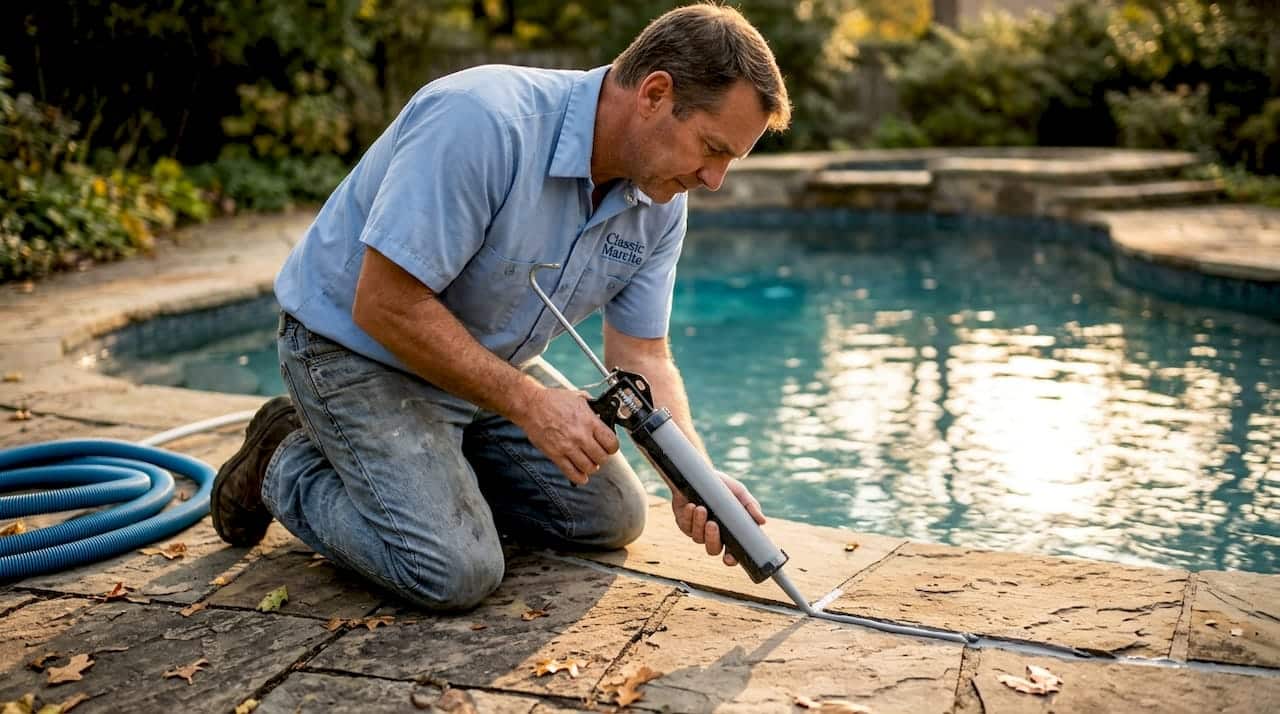
TL;DR:
- Pool caulking seals expansion joints between the pool coping and deck, preventing water intrusion and structural damage. Regular re-caulking, ideally every five years, ensures the joint’s flexibility and longevity, especially in harsh climates like Florida. Using pool-grade polysulfide or polyurethane sealants with proper installation techniques is essential for effective, long-lasting protection.
Most pool owners spend money on chemicals, pumps, and cleaning equipment, yet completely ignore the thin line of sealant sitting between their pool coping and the surrounding deck. That gap is not decorative. The role of pool caulking is to protect one of the most structurally vulnerable points on any pool. Skip it, let it deteriorate, or fill it with the wrong material, and you are setting yourself up for cracked beams, dislodged coping stones, and water undermining the soil beneath your deck. This guide covers why caulking matters, what materials work best, and how to keep it in shape.
Table of Contents
- Key takeaways
- The role of pool caulking and expansion joints
- Why proper caulking protects more than you think
- Choosing the best pool caulking materials
- How to maintain and apply pool caulking effectively
- My honest take on pool caulking maintenance
- Keep your pool protected with expert services
- FAQ
Key takeaways
| Point | Details |
|---|---|
| Caulking is structural, not cosmetic | Pool caulking seals expansion joints that protect beams, coping, and the deck from movement damage. |
| Material selection changes outcomes | Pool-grade polysulfide or polyurethane sealants outlast household silicone in chemical and UV exposure. |
| Re-caulk every five years | Waiting until caulk visibly fails allows water intrusion and debris buildup to cause expensive repairs. |
| Backer rods are not optional | Foam backer rods control sealant depth and prevent three-point adhesion, letting the joint move freely. |
| Florida pools face unique stress | Heat cycles and heavy rain in Florida accelerate caulk deterioration faster than in most other climates. |
The role of pool caulking and expansion joints
Before you can appreciate why pool caulking matters, you need to understand what it is actually sealing. A pool is not one solid structure. It consists of the pool shell, the coping stones that cap the edge, and the surrounding concrete deck. All three expand and contract with temperature changes, and they do not move at the same rate.
That is why builders deliberately leave a gap between the coping and the deck. This gap is called an expansion joint, and its entire purpose is to let both surfaces move independently without forcing one to crack the other. Pool caulk fills this joint with a flexible sealant that can compress and stretch with each thermal cycle while still blocking water, debris, and insects.
Here is what happens when the expansion joint is left unsealed or poorly sealed:
- Water enters the joint, saturates the sub-base soil, and undermines concrete slabs, causing the deck to settle and crack.
- Debris such as dirt, gravel, and leaves pack into the joint and eliminate the expansion space, transferring load stress directly to the pool beam.
- In climates with cold winters, frozen water expands up to 10%, generating enough pressure to crack beams and dislodge coping stones.
- Without flexible caulk absorbing movement, concrete deck expansion can crack pool beams or push coping out of alignment entirely.
The expansion joint is the shock absorber of your pool perimeter. Pool caulking is what keeps that shock absorber working.
Even in Florida, where hard freezes are rare, the daily temperature swings between summer nights and afternoon heat create constant stress on pool materials. Pools here experience thermal movement and expansion just as aggressively as pools in colder regions, which means caulking is not a northern concern. It is a universal one.
Why proper caulking protects more than you think
The pool caulking benefits that matter most are not visible to the naked eye. You cannot see water quietly migrating beneath your deck. You cannot see soil shifting or a pool beam slowly developing stress fractures. By the time the damage is obvious, the repair bill is already substantial.
Here is a closer look at what intact, properly installed caulking actually prevents:
- Water infiltration under the deck. Water that enters the expansion joint seeps into the sub-base, erodes compacted fill, and causes slab settlement. That is how flat pool decks develop an unexpected slope or crack across the middle without any obvious impact event.
- Freeze-thaw cycle damage. Water trapped in the joint expands when it freezes, and that pressure does not have anywhere to go except into the surrounding material. Over several winters, this destroys coping mortar and fractures pool beams.
- Joint lockout from debris. When leaves and gravel fill the gap, the joint cannot do its job. Both slabs press against each other under thermal expansion, and the weakest point gives. Typically that is the pool beam or a coping stone.
- Long-term repair costs. Neglected caulking turns a $200 maintenance task into a structural repair that can reach several thousand dollars depending on the extent of beam or deck damage.
Pool caulking repair tip: When inspecting your pool perimeter, press gently on the coping stones near the joint. Any movement or hollow sound suggests the joint has failed and water has already started undermining the mortar bed.
The importance of pool caulking becomes especially clear when you consider that caulk deterioration leads to water intrusion that builds quietly over months before causing visible damage. Proactive re-sealing costs a fraction of reactive repairs.
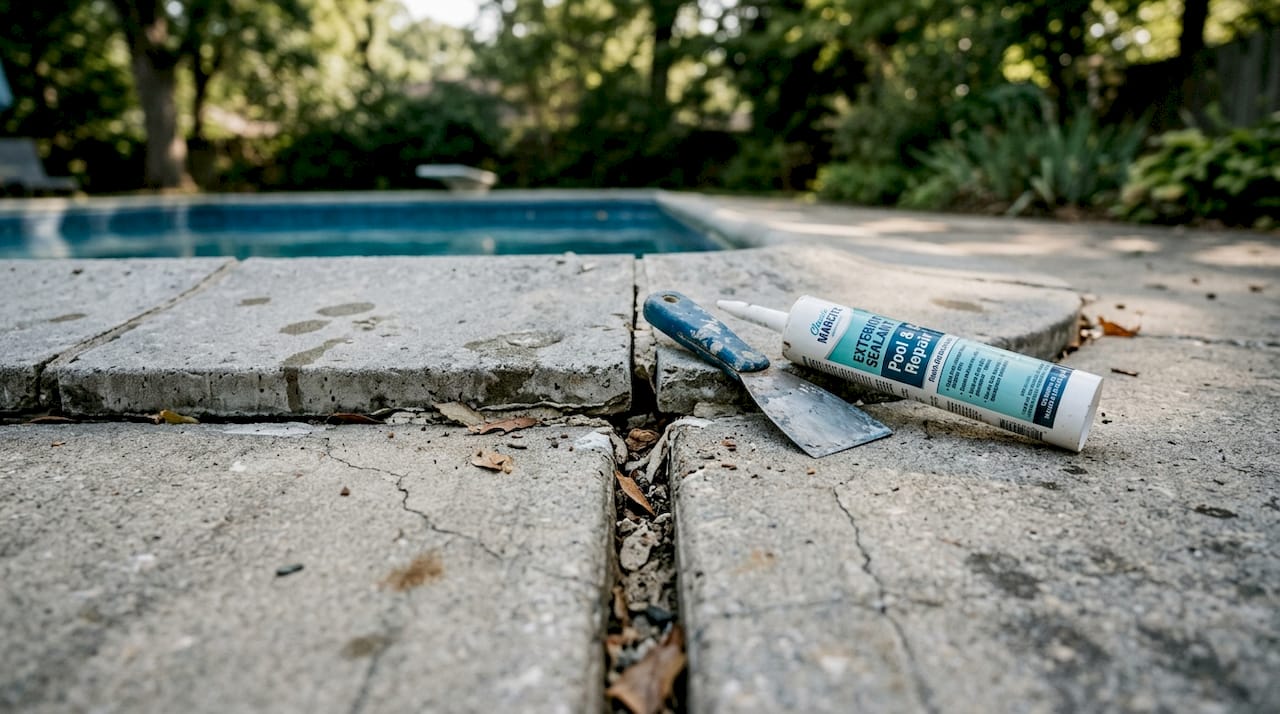
Pro Tip: Inspect your pool’s expansion joint every spring and every fall. Look for gaps, crumbling caulk, cracks wider than 1/4 inch, or debris packed deep into the joint. Catching issues early is the difference between a simple re-caulk and a full coping repair.
Choosing the best pool caulking materials
Not every caulk belongs near a pool. Standard bathroom or kitchen silicone fails quickly in a pool environment because it cannot handle simultaneous exposure to pool chemicals, UV radiation, and constant thermal movement. Standard household silicone fails prematurely in these conditions, often within a single season.
Pool caulk needs to do all of the following at once: resist water and chlorine without breaking down, flex repeatedly without tearing, bond to concrete and stone, and hold up against direct sunlight. That combination eliminates most general-purpose sealants from consideration.
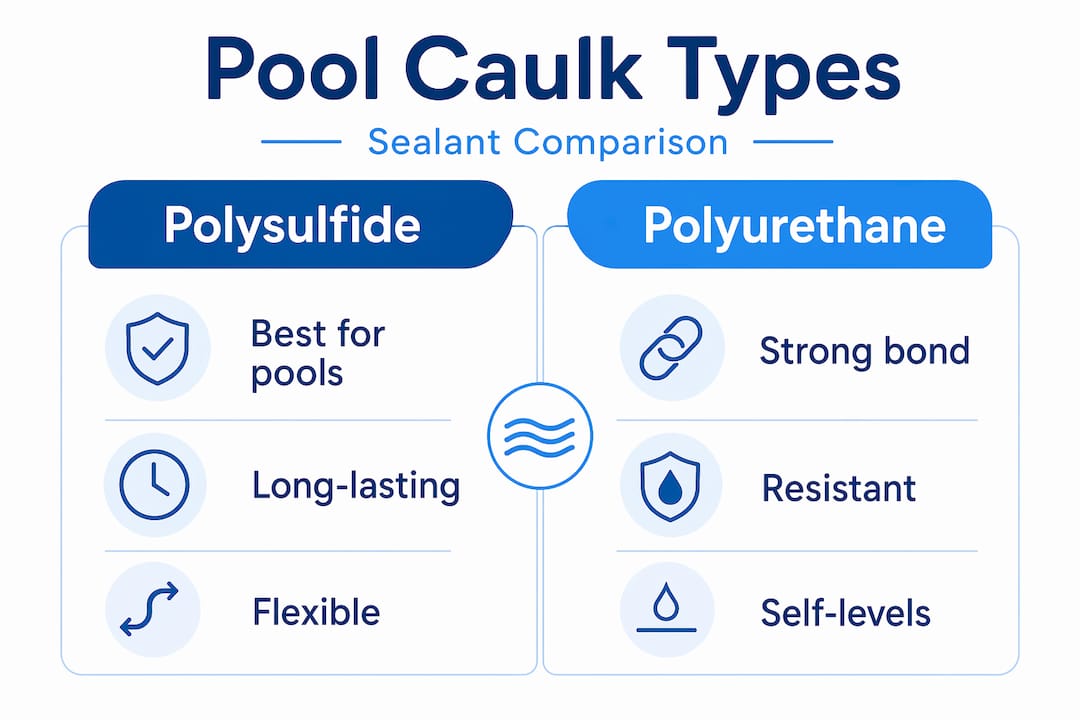
The three main categories of pool-grade sealants are polysulfide, polyurethane, and premium silicone.
| Sealant type | Best use case | Key advantage | Key limitation |
|---|---|---|---|
| Polysulfide | Horizontal expansion joints | Exceptional chemical resistance | Requires careful mixing; two-part products |
| Polyurethane | Horizontal and vertical joints | Strong adhesion; paintable | Less UV-resistant than silicone over time |
| Premium silicone (pool-grade) | Joints with heavy UV exposure | Superior UV and weather resistance | Typically not paintable |
Pool-grade polysulfide and polyurethane sealants are the industry standard for expansion joints. They are specifically engineered for constant water exposure and the repetitive stress of thermal expansion cycles. For Florida pools where the sun beats down on deck joints year-round, UV resistance is not a bonus feature. It is a minimum requirement.
Self-leveling sealants are worth seeking out for horizontal joints because they flow into the joint without air pockets, creating a more uniform seal. Gun-grade sealants work well for vertical surfaces or irregular joints where a thicker consistency is needed to prevent sagging.
Pro Tip: Before applying any sealant, install a foam backer rod into the joint first. The rod controls how deep the sealant sits, prevents three-point adhesion that would cause tearing, and ensures the caulk can move as the joint expands and contracts. Skipping this step is one of the most common reasons DIY caulking fails early.
The right sealant choice directly affects how long you get before the next maintenance cycle. Choosing correctly the first time is critical for pool longevity and reduces the overall cost of pool ownership over a decade.
How to maintain and apply pool caulking effectively
Knowing how to use pool caulk correctly separates a seal that lasts five or more years from one that peels away within twelve months. The process is not complicated, but shortcuts at any stage compromise the result.
When to re-caulk
Re-caulk expansion joints every five years as standard practice, regardless of visible condition. In Florida’s climate, some pools benefit from inspection every three years due to the intensity of UV exposure and summer rain. Do not wait for visible cracking or shrinkage. By then, water has likely already been entering the joint.
Step-by-step application
- Drain the pool below the coping line or at least reduce water level so the joint is accessible and dry.
- Remove all old caulk using a utility knife or oscillating tool. Get everything out, including any debris or sand packed into the joint.
- Clean the joint thoroughly with a wire brush and let it dry completely. Any moisture left in the joint will prevent proper adhesion.
- Install a foam backer rod sized to fit snugly but not so tight it stretches. The rod should sit roughly 1/4 inch below the surface of the coping.
- Apply the pool-grade sealant either with a caulk gun for gun-grade products or by pouring for self-leveling types. Work in sections to maintain a consistent bead.
- Tool the surface smooth with a wet finger or caulk tool before the sealant skins over. This improves both adhesion and appearance.
Signs that your caulk has failed
- Visible cracking, shrinking, or separation from the coping or deck surface
- Caulk that feels hard and brittle rather than flexible when pressed
- Sections where the sealant has pulled completely away from one or both sides
- Debris visibly packed beneath or around existing caulk
For pools managed by property managers overseeing multiple units, sealing pool deck surfaces and tracking re-caulking cycles across properties is a straightforward way to avoid clustered repair costs.
Pro Tip: Never caulk over old caulk. Layering sealant does not restore the bond, and the old material underneath will continue to fail. A proper job always starts with a clean, empty joint.
Caulking is not a permanent fix for structural cracks. Moisture expansion cracks require structural repair before relying on caulk alone. If you see active cracking in the pool shell or coping, address the underlying issue first, then seal.
My honest take on pool caulking maintenance
I’ve worked around pools long enough to see the same pattern repeat itself. A homeowner invests in beautiful coping, premium tile, and a quality resurfacing job, then completely ignores the expansion joint for a decade. The pool looks great right up until it doesn’t.
What I’ve learned is that most people skip caulking maintenance not because they don’t care, but because nobody told them it mattered. It doesn’t look like much. A thin line of sealant sitting at the edge of the deck. Easy to overlook, easy to assume it’s fine.
But in my experience, that joint is where avoidable damage almost always starts. I’ve seen pool beams cracked by years of unchecked joint pressure that would have cost nothing to prevent with timely re-caulking. I’ve seen deck slabs settle six inches in areas where water infiltration went unaddressed for years.
My view on DIY versus professional application is straightforward. If the joint is in good shape, the old caulk removes cleanly, and you are comfortable working with sealant products, this is a manageable DIY project. If you see signs of beam damage, shifting coping, or active water intrusion, get a professional assessment before touching the joint. Caulk applied over an undiagnosed structural problem will fail quickly and mask the issue until it gets worse. Understanding why pools crack before you start any sealing work is the smartest first step.
Prioritize caulking the same way you prioritize water chemistry. It is not glamorous, but it is genuinely protective.
— Classicmarcite
Keep your pool protected with expert services
Pool caulking is one piece of a larger maintenance picture. When the expansion joint is properly sealed, it works in concert with quality pool surfaces, sound coping, and a well-maintained deck to give your pool the longest possible service life.

At Classic Marcite, we have been restoring and resurfacing pools in Florida since 1988, with over 100,000 pools completed across residential, commercial, and resort properties. If your pool needs more than just re-caulking, our team handles everything from pool resurfacing in Winter Park to full pool resurfacing in The Villages and beyond. We use materials like Pebble Tec® to give pools lasting durability and real visual appeal. Contact us for a free estimate and find out what your pool actually needs.
FAQ
What is the main role of pool caulking?
Pool caulking seals the expansion joint between pool coping and the surrounding deck, preventing water infiltration, debris buildup, and structural damage caused by thermal movement. Without it, the joint cannot do its job of allowing independent movement between surfaces.
How often should pool caulking be replaced?
Most pool expansion joints should be re-caulked every five years as a standard maintenance schedule. Pools in harsh climates or those showing visible deterioration may need attention sooner.
What is the best material for pool caulking?
Pool-grade polysulfide or polyurethane sealants are the most reliable choices for expansion joints because they resist chlorine, UV exposure, and repeated expansion and contraction. Standard household silicone is not suitable for pool environments and tends to fail prematurely.
Can I apply pool caulk myself?
Yes, if the joint is structurally sound and the old caulk removes cleanly. Proper preparation, including installing a foam backer rod and fully drying the joint, is critical. If there are signs of beam damage or shifting coping, consult a professional before proceeding.
Does pool caulking prevent pool leaks?
Pool caulking protects the expansion joint from water infiltration into the deck and sub-base, but it is not a substitute for repairing active leaks in the pool shell. Structural cracks in the pool itself require dedicated crack repair before any sealant is applied.