TL;DR:
- Choosing epoxy grout over cement-based options offers Florida pool owners longer-lasting protection against heat, saltwater, and storms. Proper maintenance, including sealing cement grout and monitoring water chemistry, is essential for preserving pool tile integrity. Investing in professional resurfacing and using durable grout types prevents costly repairs and maintains pool aesthetics over time.
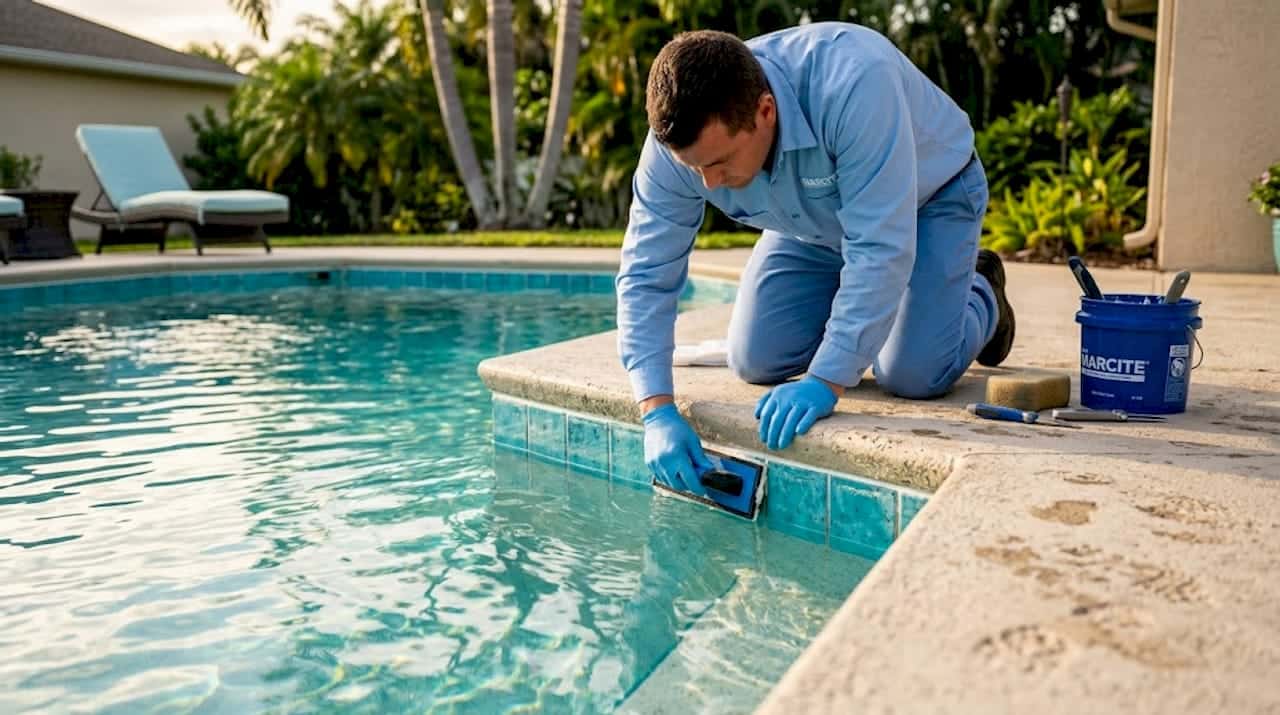
Many Florida homeowners spend thousands on beautiful pool tiles, only to watch the spaces between them crumble, stain, or crack within a few years. The grout holding those tiles together is often treated as an afterthought, yet it is one of the most critical decisions you will make during any pool renovation. Pool tile grout fills the joints between tiles, providing structural support, preventing water seepage, and blocking the growth of algae and bacteria. Get it right, and your pool stays gorgeous for decades. Get it wrong, and you are back to square one before the warranty expires.
Table of Contents
- What is pool tile grout and why does it matter?
- Types of pool tile grout: Epoxy vs. cement vs. urethane
- Florida’s climate: How grout holds up against heat, saltwater, and storms
- Maintenance essentials: Cleaning, sealing, and repairs
- The hidden costs of choosing the wrong grout
- Upgrade your Florida pool with expert resurfacing and tile solutions
- Frequently asked questions
Key Takeaways
| Point | Details |
|---|---|
| Understand grout types | Choosing the right grout for your Florida pool saves time, money, and effort in the long run. |
| Epoxy lasts longest | Epoxy grout stands up best to Florida’s climate, saltwater, and pool chemicals with minimal maintenance. |
| Regular maintenance is key | Weekly cleaning and proper chemical balance protect your pool tile grout from deterioration. |
| Sealing matters | Cement grout needs to be resealed every 1-2 years—epoxy offers a maintenance-free alternative. |
| Professional help pays off | Having professionals upgrade your grout and pool surface prevents costly issues down the road. |
What is pool tile grout and why does it matter?
At its most basic, pool tile grout is the material packed into the narrow spaces between each tile on your pool’s waterline, steps, or interior surface. It looks simple. It is not. Grout is quietly doing several jobs at once every single day.
Pool grout provides structural support, seals against water seepage behind tiles, blocks chemical and contaminant penetration, and resists algae and bacteria growth. In a Florida pool, all of those roles are under constant assault from heat, UV rays, humidity, chlorine, and in many cases saltwater.
Here is what quality pool tile grout actually does for you:
- Structural support: Grout locks tiles in place, distributing stress so individual tiles do not shift or pop off.
- Waterproofing: It keeps water from sneaking behind tiles, which can cause the bond between tile and shell to fail.
- Chemical resistance: Pool water is treated with chlorine, stabilizers, and pH adjusters. Grout must not break down when exposed to these.
- Hygiene: A tight, non-porous grout line leaves nowhere for algae or bacteria to take hold.
- Aesthetics: Clean, consistent grout lines are a major part of what makes a well-tiled pool look polished. If you want pool tile design inspiration, grout color and condition play a bigger role in the final look than most people realize.
“Using the wrong grout in a Florida pool is not just an aesthetic mistake. It is a structural one. Water behind tiles leads to delamination, shell damage, and repairs that cost far more than the original grout upgrade ever would have.”
Florida’s environment is uniquely punishing. Summer surface temperatures can push 95°F or higher, and UV intensity in Central Florida is among the strongest in the continental United States. Humidity sits above 70% for much of the year. These conditions accelerate the breakdown of any material that is not specifically rated for this kind of exposure. If you are exploring the best pool tile types, pairing those tiles with the right grout is just as important as the tiles themselves.
Now that we have set the stage for what makes grout important, let us break down the specific materials you might see when upgrading or maintaining your pool.
Types of pool tile grout: Epoxy vs. cement vs. urethane
Not all grout is created equal. The three primary grout types are epoxy grout, cement-based grout, and urethane grout. Each has a different makeup, different strengths, and very different lifespans in Florida conditions.
Cement-based grout
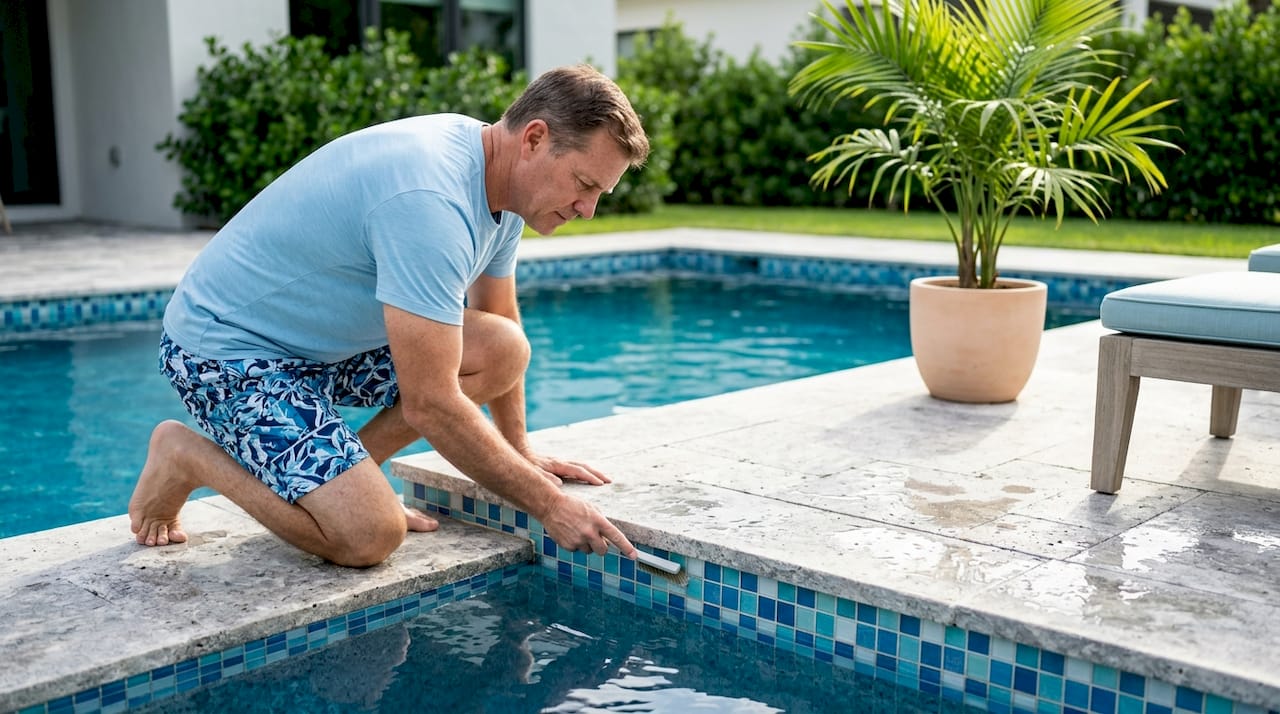
This is the most familiar type. It is made from Portland cement, sand, and water, and it has been used in pools for decades. It costs less upfront and is straightforward to install. However, cement grout is porous, meaning water and chemicals soak into it over time. Without regular sealing, it degrades faster and needs resealing every one to two years, and it is prone to cracking and discoloration. In Florida’s climate, that timeline shrinks even further.
Epoxy grout
Epoxy grout is made from resin and hardener rather than cement. It is non-porous, meaning liquids cannot penetrate it. Because of this, epoxy grout resists mold, mildew, chlorine, UV damage, and thermal cycling without requiring any sealing. It costs more to purchase and takes more skill to install, but it is genuinely the best option for Florida pools. Once in place, it largely takes care of itself.
Urethane grout
Urethane grout is flexible, which makes it useful in situations where slight movement is expected. It is less common in Florida pools, partly because it does not handle prolonged chemical exposure as well as epoxy. You will occasionally see it recommended for very specific edge cases, but most experienced Florida pool contractors reach for epoxy first.
| Grout type | Cost | Lifespan in Florida | Sealing required | Chemical resistance | Best use case |
|---|---|---|---|---|---|
| Cement-based | Low | 3 to 7 years | Yes, every 1 to 2 years | Moderate | Budget-first projects |
| Epoxy | Higher | 10 to 30+ years | No | Excellent | All Florida pools |
| Urethane | Moderate | Variable | Sometimes | Good | Special movement areas |
Pro Tip: If a contractor quotes you a pool tile job and defaults to cement grout without explaining why, ask specifically about epoxy. The price difference per square foot is modest compared to the long-term savings in repairs and resealing.
The choice of grout also connects directly to your pool’s overall surface quality. Exploring popular pool finishes will show you how grout interacts with different surface materials, from plaster to pebble finishes. For pools built on pool surface durability principles, epoxy grout is the natural companion. And if you are weighing construction options, the grout demands of vinyl vs. concrete pools differ significantly because concrete pools experience more thermal movement.
Understanding these options makes it easier to choose the right grout for your pool’s specific needs, but Florida’s climate adds unique challenges. Let us explore those next.
Florida’s climate: How grout holds up against heat, saltwater, and storms
Florida is genuinely one of the hardest environments on the planet for pool materials. The combination of intense sun, high humidity, heavy rain, and in many communities, saltwater pool systems, creates conditions that standard grout simply cannot survive long-term.
Cement grout in a Florida or saltwater pool environment lasts roughly 3 to 7 years before significant deterioration sets in. Epoxy grout, by contrast, can last 10 to 30 years or more with minimal maintenance. That is not a small difference. Over the life of a pool, choosing epoxy can eliminate multiple full regrout projects, each of which typically involves draining the pool, labor costs, and days of downtime.
| Climate factor | Impact on cement grout | Impact on epoxy grout |
|---|---|---|
| UV exposure | Fading, surface breakdown | Minimal degradation |
| High humidity | Moisture absorption, mold | No absorption, mold resistant |
| Saltwater | Accelerated erosion | Strong resistance |
| Thermal cycling | Cracking, joint gaps | Flexible enough to handle |
| Jet stream pressure | Surface wear | Abrasion resistant |
Florida UV and humidity accelerate grout wear in ways that homeowners in cooler, drier states never have to think about. Saltwater pool systems are particularly damaging to cement grout because the salt content slowly dissolves the cement binders. If your pool has jets, waterfalls, or other dynamic features, the constant water movement adds mechanical wear on top of chemical wear.
Storm season also plays a role. Heavy rains dilute pool chemistry, pushing pH levels off balance. Debris impact during storms can chip already-weakened grout. And the rapid temperature swings that follow storm fronts accelerate the expand-and-contract cycle that causes cracking.
Pro Tip: After any major storm, do a quick visual inspection of your waterline tile and grout. Early detection of hairline cracks lets you address them before water gets behind the tiles. Understanding the importance of pool sealing will also help you protect the surrounding pool surface.
Armed with this understanding, let us look at how to keep your grout in top shape year-round.
Maintenance essentials: Cleaning, sealing, and repairs
Good grout maintenance in Florida is not complicated, but it does require consistency. The main enemies are neglect and incorrect water chemistry. Both are preventable.
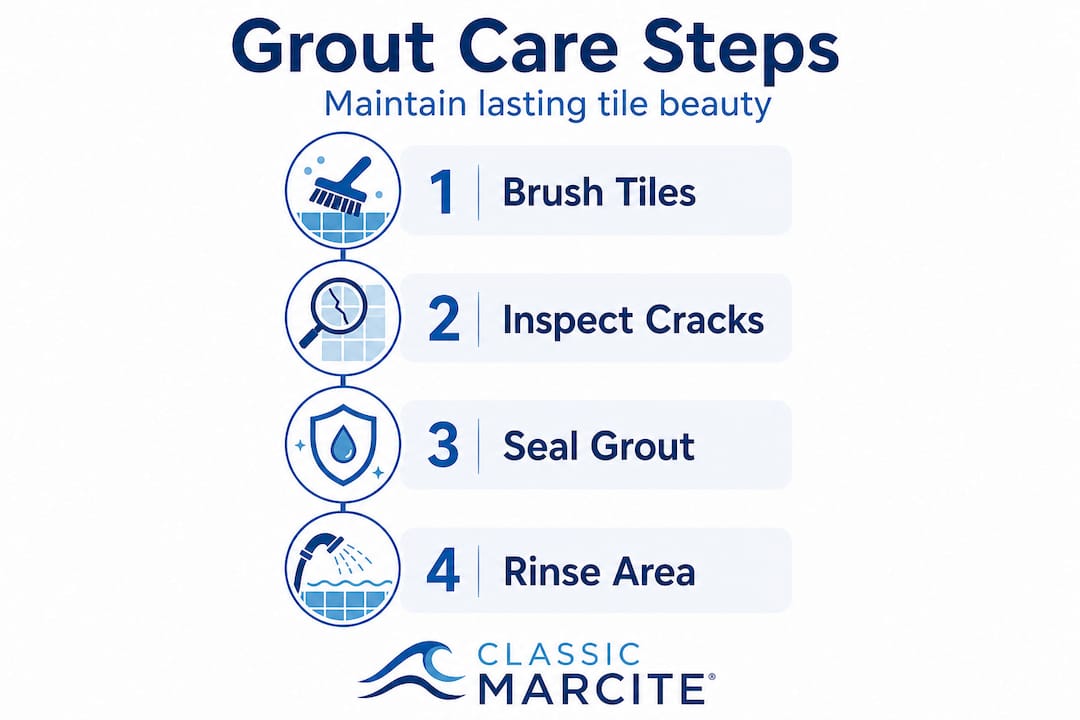
Weekly brushing and proper water chemistry form the foundation of grout care. Target a pH of 7.2 to 7.6 and chlorine levels between 1 and 3 ppm. Deviating outside these ranges consistently is one of the fastest ways to damage even high-quality grout. Low pH creates acidic water that etches and erodes cement grout quickly. High pH causes scaling that can discolor grout and build up in joint lines.
Here is a practical maintenance routine for Florida pool owners:
- Weekly: Brush tile grout lines with a pool-safe nylon brush to remove algae and mineral buildup before they bond to the surface.
- Monthly: Check water chemistry carefully and adjust as needed. Test pH, chlorine, alkalinity, and calcium hardness.
- Every 1 to 2 years (cement grout only): Apply a pool-grade sealer to cement grout lines. This is non-negotiable in Florida’s climate.
- Seasonally: Inspect grout lines for cracks, voids, or discoloration. Look especially at corners, steps, and waterline tiles where stress concentrates.
- After storms: Do a visual check for chipped or displaced grout, especially around jets and fittings.
- At first sign of damage: Address small cracks immediately. A minor repair now prevents major tile delamination later.
If you spot isolated cracks or small voids early, a DIY pool crack repair may be appropriate for minor surface issues. However, recurring cracking or any sign that tiles are beginning to loosen means the problem is structural, and that calls for professional assessment.
Pro Tip: Never use acidic tile cleaners on cement grout. Products designed to remove calcium scaling can also dissolve the grout binders, weakening the joint. Always choose cleaners specifically formulated as pool-safe and pH-neutral.
Having covered care and maintenance, let us turn to a unique perspective based on years of experience with Florida pools.
The hidden costs of choosing the wrong grout
After resurfacing more than 100,000 pools across Florida since 1988, we have seen the same pattern play out hundreds of times. A homeowner saves a few hundred dollars by choosing cement grout over epoxy. Within four years, they are calling us back because the grout is cracking, staining, or allowing water behind the tiles. By the time we factor in draining the pool, labor, materials, and the tile repairs that come with grout failure, that original “savings” has multiplied into a much larger bill.
The real cost of wrong grout is not just financial. It is visual. Stained, crumbling grout makes even the most expensive tile look cheap. It also creates hygiene risks, since degraded grout lines harbor algae and bacteria that resist normal chlorine levels.
For Florida homeowners, epoxy grout is the smart long-term choice against humidity, saltwater, and storm exposure. The upfront cost difference is real but small relative to the savings over a decade of ownership.
Here is the part most articles skip: the hidden structural cost. When water gets behind tiles repeatedly, it does not just loosen those tiles. It reaches the pool shell, potentially causing cracking in the plaster or shotcrete beneath. A grout failure that goes unnoticed for a season can turn into a shell repair that costs five to ten times more than the original tile work. Healthy grout is genuinely invisible protection for everything below it.
Our honest recommendation, especially for saltwater pools, pools with jets, and any pool near the coast, is to specify epoxy grout from the start. Do not wait for cement grout to fail before upgrading. If you are already regrouting or retiling, the incremental cost to go with epoxy is minimal compared to doing it twice.
Upgrade your Florida pool with expert resurfacing and tile solutions
If your pool’s grout is cracking, staining, or overdue for an upgrade, getting a professional assessment is the fastest way to understand what you are dealing with and what it will take to fix it right.

At Classic Marcite, we have been resurfacing and retiling Florida pools since 1988, and we know exactly what holds up in this climate and what does not. Whether you need a full retile with premium epoxy grout, a targeted repair, or a complete pool resurfacing to go with new tile work, our team brings the experience to do it correctly the first time. We also offer professional pool repair for tile, grout, and surface issues of all sizes. Contact us today for a free estimate and find out exactly what your pool needs to look great and last longer in Florida’s demanding environment.
Frequently asked questions
How long does pool tile grout last in Florida?
Cement-based grout lasts around 3 to 7 years in Florida’s climate, while epoxy grout can last 10 to 30 years or more even in saltwater and high-UV conditions.
Does all pool tile grout need to be sealed?
Cement-based grout needs sealing every one to two years to prevent water absorption and deterioration, but epoxy grout requires no sealing because its non-porous surface blocks moisture from the start.
What causes pool grout to crack or discolor?
Florida UV and saltwater erode cement grout faster than in most other climates, and improper water chemistry with pH levels outside the 7.2 to 7.6 range causes etching, cracking, and fading.
Can I repair loose or cracked grout myself?
Small surface cracks or isolated missing grout can be a reasonable DIY fix, but recurring cracks or any tiles beginning to loosen indicate a deeper issue that a professional pool contractor should evaluate.