TL;DR:
- A proper Florida pool reopening involves a strict sequence of equipment inspection, physical cleaning, and chemical balancing to ensure safe, clear water. Skipping steps or reordering procedures can lead to wasted chemicals, equipment damage, and unsafe water conditions. Following a detailed checklist and retesting after circulation guarantees a successful, swim-ready pool for the season.
A checklist for pool reopening is a structured, step-by-step process that Florida homeowners and property managers use to prepare a pool safely and efficiently for use after seasonal closure. Done correctly, it covers everything from pulling the winter cover to achieving swim-ready water chemistry. Skip a step or change the order, and you risk wasted chemicals, equipment damage, or a pool that stays cloudy for days. Products like Pentair pumps and chemicals such as calcium hypochlorite are part of every serious reopening, but the sequence matters as much as the supplies.
1. Essential steps on your pool opening checklist
The standard reopening sequence runs from cover removal through equipment inspection, water leveling, physical cleaning, chemical balancing, and finally a 24 to 48-hour pump run before any swimmer sets foot in the water. Each step feeds the next. Skipping physical cleaning before adding chemicals, for example, forces your sanitizer to fight debris instead of pathogens.
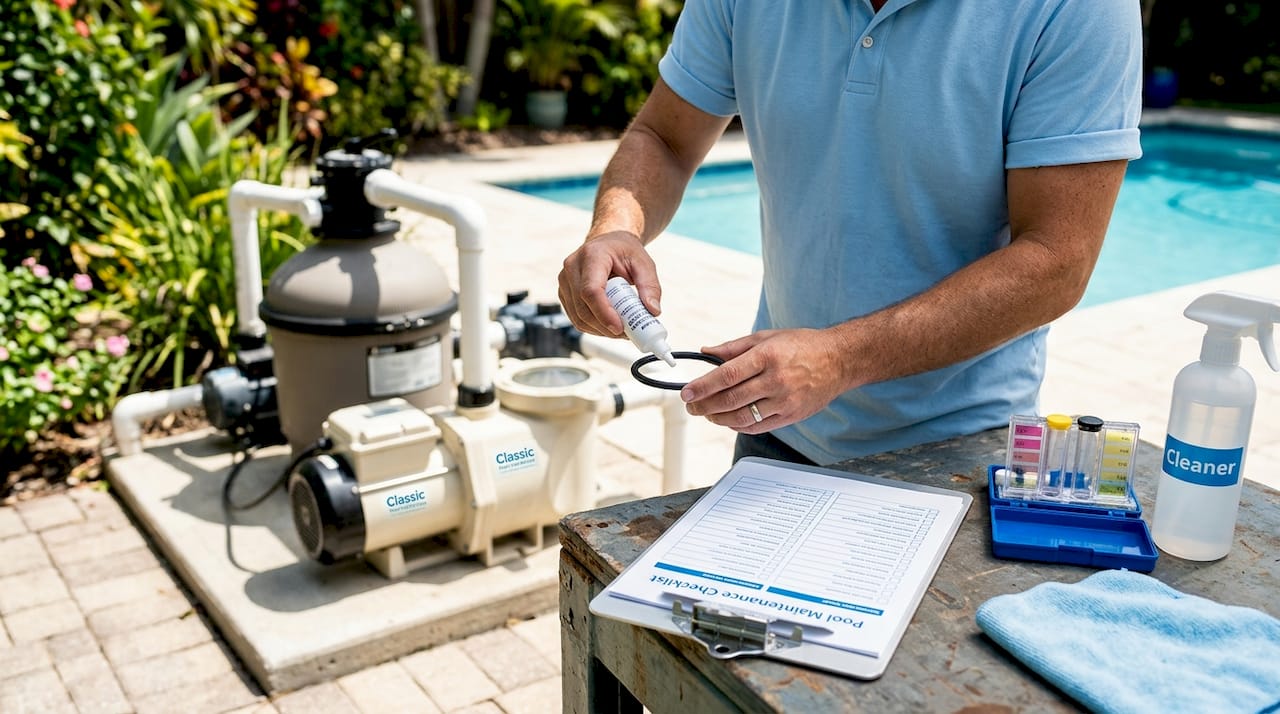
Start with timing. Florida nights rarely drop below 50°F for long, so most homeowners can open earlier than northern states. A consistent overnight temperature above 50°F signals that algae growth is accelerating and the pool needs active treatment.
Pro Tip: Remove and clean your winter cover on a flat surface before storing it. A dirty cover folded wet will grow mold and degrade faster, costing you a replacement within two seasons.
Once the cover is off, fill the pool to the middle of the skimmer opening. Too low and the pump runs dry. Too high and skimming efficiency drops. Both conditions damage equipment over time.
2. How to inspect pool equipment during reopening
Equipment inspection is the step most homeowners rush, and it is the one that causes the most mid-season failures. Common Florida pool issues include cracked pump lids, worn O-rings, and clogged filters. Florida’s heat and UV exposure accelerate wear on rubber and plastic components faster than in cooler climates.
Work through this inspection order before you prime the pump:
- Pump lid and O-rings: Look for cracks, brittleness, or deformation. A bad O-ring causes air leaks that kill prime.
- Filter media: Cartridge filters need cleaning or replacement annually. Sand filters need backwashing. Diatomaceous earth (DE) filters need fresh DE powder after backwashing.
- Heater heat exchanger: Check for corrosion or mineral deposits, especially in areas with hard water.
- Plumbing unions and winterization plugs: Remove all winterization plugs before starting the pump. A single forgotten plug can crack a pipe under pressure.
- Automation controls and time clocks: Verify settings are correct and that GFCI outlets are functioning. Electrical faults near water are a serious safety hazard.
- Valves: Open all return and suction valves fully before startup. Partially closed valves cause pressure spikes.
Pro Tip: Before priming the pump, lubricate all O-rings with a silicone-based lubricant. Never use petroleum-based products. They degrade rubber within weeks.
A thorough pool inspection also covers the pool shell itself. Look for cracks, spalling plaster, or loose tiles. These issues do not prevent reopening, but they signal that resurfacing may be needed before the next season.
3. Water chemistry parameters and how to balance them
Water chemistry is where most reopening mistakes happen. The correct target ranges for a Florida residential pool are pH 7.4 to 7.6, free chlorine 1 to 3 ppm, total alkalinity 80 to 120 ppm, calcium hardness 200 to 400 ppm, and cyanuric acid 30 to 50 ppm. These numbers are not arbitrary. pH outside the 7.2 to 7.6 range makes chlorine significantly less effective, meaning you use more chemical for less sanitation.
The order of adjustment is non-negotiable:
- Total alkalinity first. Alkalinity acts as a buffer for pH. Adjust it with sodium bicarbonate (raise) or muriatic acid (lower) before touching pH.
- pH second. Use muriatic acid to lower or sodium carbonate (soda ash) to raise.
- Calcium hardness third. Low calcium causes plaster erosion. High calcium causes scaling. Calcium chloride raises it; dilution lowers it.
- Cyanuric acid (stabilizer) fourth. This protects chlorine from UV degradation. Florida’s intense sun burns off unprotected chlorine within hours.
- Shock with calcium hypochlorite fifth. Shocking before balancing pH wastes product and can damage surfaces.
- Algaecide last. Add a polyquat algaecide after shocking, not before.
| Parameter | Target Range | Adjustment Chemical |
|---|---|---|
| pH | 7.4 to 7.6 | Muriatic acid / soda ash |
| Free chlorine | 1 to 3 ppm | Calcium hypochlorite |
| Total alkalinity | 80 to 120 ppm | Sodium bicarbonate / muriatic acid |
| Calcium hardness | 200 to 400 ppm | Calcium chloride |
| Cyanuric acid | 30 to 50 ppm | Stabilizer granules |
Salt pools target slightly higher free chlorine levels, typically 2 to 4 ppm, because the salt cell generates chlorine continuously and needs a buffer against demand spikes.
Pro Tip: Always add chemicals to water, never water to chemicals. Broadcast granular shock across the deep end with the pump running to avoid bleaching the pool floor.
4. Physical cleaning before chemicals
Cleaning before adding chemicals is one of the most impactful decisions you make during reopening. Organic debris consumes chlorine on contact. A pool full of leaves, pollen, and algae will burn through an entire shock treatment without clearing the water.
Skim the surface first to remove floating debris. Then brush all walls, steps, and the floor to dislodge algae and biofilm. Vacuum last, either manually or with an automatic cleaner. Florida pools accumulate heavy pollen loads in spring, so expect to vacuum twice before the water clears. Empty the skimmer and pump baskets after vacuuming, not before, or you will clog them immediately.
5. How long does pool reopening take in Florida?
Florida pool reopening takes 3 to 5 days from cover removal to swim-ready water. That timeline assumes the pool is in reasonable condition. Green or heavily algae-laden water adds days. Here is a realistic breakdown:
- Day 1: Remove cover, inspect equipment, fill to proper level, skim and brush.
- Day 1 to 2: Vacuum, balance alkalinity and pH, add stabilizer if needed.
- Day 2: Shock with calcium hypochlorite, add algaecide, run pump continuously.
- Day 3 to 4: Retest water chemistry after 24 to 48 hours of circulation. Adjust as needed.
- Day 4 to 5: Confirm all parameters are within range. Clear water and proper chemistry signal swim readiness.
Active work across those days totals roughly 2 to 4 hours. Most of the time is the pump doing its job. Retesting after circulation is critical because early chlorine readings after shocking are often misleadingly high and drop sharply once the water stabilizes.
Log every test result with a date and time. This record helps you spot patterns, troubleshoot faster next season, and demonstrates due diligence if you manage a community or HOA pool.
6. Compliance and safety requirements for public and HOA pools in Florida
Florida public and HOA-managed pools face a higher bar than residential pools. Florida law requires that pool operators hold either a Certified Pool Operator (CPO) credential or a Florida Pool and Spa Professional Services (FPPS) license before a public pool can reopen. The credential is not optional. An uninspected or uncredentialed reopening exposes property managers to fines and liability.
Documentation requirements include:
- Time-stamped chemistry logs for every test
- Corrective action records with photos when parameters are out of range
- Signed inspection reports from the county health department
- Current emergency action plan (EAP) on file and posted
Florida Administrative Code 64E-9 mandates that emergency action plans cover fecal incidents specifically, with different protocols for formed stool versus diarrheal contamination. Staff must be trained on these procedures annually, and drills must be documented.
Florida public pools cannot reopen without a current operator credential on file. Compliance at reopening is as much about paperwork as it is about water chemistry.
Mandatory safety equipment checks before reopening include life rings, reaching poles, first aid kits, and current lifeguard certifications. Signage covering pool rules, depth markers, and emergency contact numbers must be posted and legible. For HOA managers, a Florida commercial pool compliance review before reopening day prevents last-minute delays from inspectors.
7. What to do if the pool has been closed for repairs
A pool reopened after structural repairs follows a modified sequence. The surface needs a full cure period before filling, and the chemistry startup process differs depending on the finish material. Pebble Tec® surfaces, for example, require a startup brush-down protocol to remove surface dust and prevent calcium nodule formation. Classicmarcite’s post-repair reopening guide covers the 3 to 7-day process specific to Florida conditions, including how to handle new plaster chemistry and when to call a professional for water balance.
New surfaces are more sensitive to pH swings during the first 30 days. Keep pH between 7.4 and 7.6 and avoid shocking aggressively until the surface has fully cured. Running the pump continuously for the first 72 hours after filling accelerates the cure and reduces surface staining risk.
Key takeaways
A complete pool reopening checklist covers equipment inspection, physical cleaning, and chemical balancing in strict sequence before the pump runs for 24 to 48 hours and water is retested for swim readiness.
| Point | Details |
|---|---|
| Sequence is non-negotiable | Clean physically before adding chemicals to avoid wasting sanitizer on debris. |
| Chemistry order matters | Adjust alkalinity, then pH, then stabilizer, then shock, then algaecide. |
| Pump runtime is mandatory | Run the pump 24 to 48 hours after shocking before retesting or allowing swimmers. |
| Florida compliance is documentation-heavy | Public and HOA pools need CPO or FPPS credentials and time-stamped logs before reopening. |
| Retest before swim-ready | Initial post-shock chlorine readings are unreliable. Always retest after full circulation. |
Why the checklist is the most underrated tool in pool ownership
Most pool problems I see in Florida trace back to one of two mistakes: skipping steps or doing them in the wrong order. Homeowners who shock before balancing pH waste product and sometimes damage their pool surface. Property managers who open without retesting after circulation let swimmers into water that looks clear but is not chemically safe.
Florida adds specific complications that northern pool guides ignore. Spring pollen loads here are heavy enough to consume a full shock treatment before the water even looks dirty. The sun’s UV intensity means cyanuric acid is not optional. It is the difference between chlorine that lasts 24 hours and chlorine that burns off in 4. And the heat accelerates algae growth so fast that a pool left unchecked for a week in April can turn green in ways that take three days to reverse.
The checklist I trust covers equipment inspection before startup, physical cleaning before chemicals, and a mandatory retest window before anyone swims. The pool maintenance checklist Classicmarcite publishes for Florida homeowners reflects exactly this approach. The pools that open cleanly every season are the ones where the owner treats the checklist as a fixed protocol, not a rough guide.
— Classicmarcite
Ready to take your pool further than just reopening?
Reopening a pool reveals what a season of closure has done to the surface. Staining, etching, and plaster erosion are common findings during a proper pool inspection checklist walkthrough, and they do not fix themselves with chemicals.

Classic Marcite has resurfaced over 100,000 pools across Florida since 1988, and the team knows exactly what Florida’s sun, chemistry, and seasonal cycles do to pool finishes. Whether your pool needs a fresh Pebble Tec® application or a full renovation, the work starts with an honest assessment. If you are in Central Florida, explore pool resurfacing in The Villages or Winter Park resurfacing options to see what a professional finish upgrade looks like after reopening season.
FAQ
What is the correct order for a pool reopening checklist?
The correct order is cover removal, equipment inspection, water level adjustment, physical cleaning (skim, brush, vacuum), chemical balancing (alkalinity, pH, stabilizer, shock, algaecide), and then a 24 to 48-hour pump run before retesting. Skipping or reordering these steps reduces effectiveness and wastes chemicals.
How long does it take to reopen a Florida pool?
Most Florida pools take 3 to 5 days from cover removal to swim-ready water, with active work totaling 2 to 4 hours. Green or heavily contaminated water can extend the timeline by several additional days of treatment and filtration.
Do Florida HOA pools need special credentials to reopen?
Yes. Florida law requires a CPO or FPPS-licensed operator before a public or HOA pool can legally reopen. Documentation including chemistry logs, corrective action records, and an emergency action plan must also be current and on file.
What chemicals are needed to open a pool in Florida?
The standard chemical kit includes calcium hypochlorite for shocking, muriatic acid or sodium bicarbonate for pH and alkalinity adjustment, cyanuric acid as a stabilizer, calcium chloride for hardness, and a polyquat algaecide. Florida’s UV intensity makes cyanuric acid particularly critical.
When should you retest pool water after shocking?
Retest water chemistry after 24 to 48 hours of continuous pump circulation following the shock treatment. Early readings after shocking are unreliable and often show falsely elevated chlorine levels that drop once the water stabilizes.