TL;DR:
- Operating a Florida commercial pool requires strict adherence to complex legal and safety regulations beyond water chemistry. Proper compliance involves layered standards from design, permits, safety equipment, and diligent recordkeeping, enforced by county health departments. Proactive management, routine inspections, and thorough documentation help ensure safety, legality, and long-term asset protection.
Running a commercial pool in Florida means operating under one of the most detailed regulatory frameworks in the country. Many property managers assume compliance is mostly about keeping the water clear and the pH balanced, but the reality covers far more ground than water chemistry. Commercial pool compliance is the full set of legally enforceable requirements governing whether a public or semi-public swimming pool can be legally constructed, operated, and inspected for patron safety. A missed permit, a worn anti-entrapment cover, or a gap in your maintenance logs can trigger enforcement action just as easily as a chemistry failure. This guide covers everything you need to know.
Table of Contents
- What is commercial pool compliance?
- The legal framework: Florida laws and codes
- Risks and enforcement: what happens if you fall out of compliance
- Building a proactive compliance strategy for your property
- Industry perspective: why pool compliance is more than ticking boxes
- How Classic Marcite helps with Florida pool compliance
- Frequently asked questions
Key Takeaways
| Point | Details |
|---|---|
| Beyond water chemistry | Compliance covers design, operation, permits, safety equipment, and documentation, not just clean water. |
| Florida’s strict legal standards | State codes and local enforcement set rigid requirements and allow for immediate pool closure in case of violations. |
| Lifecycle approach is essential | Effective compliance is an ongoing process from construction through daily operation and recordkeeping. |
| Proactivity minimizes risks | Regular reviews, well-kept logs, and up-to-date safety measures can avert fines, closures, and legal issues. |
| Go beyond minimum code | The best managers adopt a culture of safety that exceeds checklist requirements to protect users and property value. |
What is commercial pool compliance?
Commercial pool compliance is not a single checklist. It is a layered system that touches every phase of a pool’s life, from the day the design is submitted to the county to the daily logs your staff fills out at opening. Understanding what falls inside that system is the first step to running your facility without fear of an unexpected shutdown.
Florida distinguishes between three pool categories: public pools (hotels, resorts, apartment complexes, fitness centers, theme parks), semi-public pools (homeowner associations and similar controlled-access settings), and private pools (single-family homes). Public and semi-public pools face the full weight of state and local regulation. Private pools operate under a much lighter standard. If you manage a property where guests, tenants, or members have access to the pool, you are almost certainly operating a public or semi-public facility.
Compliance is not just about water chemistry. It covers facility design, construction standards, operational protocols, safety equipment, and detailed recordkeeping. Every layer carries legal weight.
The regulatory framework pulls from multiple sources. The CDC Model Aquatic Health Code (MAHC) is a nationally recognized guidance document that shapes how many states, including Florida, write their own rules. Florida’s specific floor for operations and safety is Florida Administrative Code (FAC) Chapter 64E-9, while design and construction come under Florida Building Code (FBC) Section 454.
| Area | What it covers | Primary standard |
|---|---|---|
| Design and construction | Pool dimensions, barriers, depth markings | FBC Section 454 |
| Permits | Initial build, renovation, re-opening permits | DOH and local building dept |
| Operations and sanitation | Water chemistry, disinfection, turnover rates | FAC Chapter 64E-9 |
| Safety equipment | Anti-entrapment drains, lifeguard rules, signage | FAC Chapter 64E-9 |
| Documentation and logs | Daily water testing, inspection records | FAC Chapter 64E-9 |
Key compliance checkpoints your team should be monitoring include:
- Valid operating permit displayed at the facility
- Daily chemical test logs on file and up to date
- Functional anti-entrapment drain covers that meet ANSI/APSP standards
- Correct bather load and pool volume calculations on record
- Depth markings and safety signage visible and in good condition
- Backflow prevention devices properly installed and certified
Your Florida pool maintenance checklist should reflect each of these areas. If any category is blank, that gap is visible to inspectors.
The legal framework: Florida laws and codes
Florida’s compliance structure for commercial pools comes from three primary legal sources, and each one covers a different slice of what you are required to do.
Florida Administrative Code Chapter 64E-9 governs the day-to-day operation of public pools. It sets standards for water chemistry, disinfection equipment, filter maintenance, bather load limits, and the documentation your staff must keep. It also defines the conditions under which a pool can be immediately closed.
Florida Building Code Section 454 governs how pools are physically designed and built. Barrier requirements, depths, circulation systems, and materials all fall here. Any renovation or structural change to your pool requires you to re-engage this code as well as your local building department.
Chapter 514, Florida Statutes gives the Florida Department of Health (DOH) the authority to permit and inspect public bathing places. Every public pool in Florida must hold a valid permit issued by the county health department. That permit is not a one-time milestone. It must be renewed and kept current at all times the pool is open to the public.
The CDC Model Aquatic Health Code is referenced by many county health departments and provides useful operational guidance, but it is not directly enforceable. Florida’s state and county rules are what inspectors actually cite.
The typical permitting flow looks like this:
- Submit facility design plans to the local building department and county DOH for review
- Complete all required building code checks under FBC Section 454
- Receive DOH sign-off and an initial operating permit before opening
- Schedule and pass an opening inspection by the county health department
- Maintain the permit annually through continued compliance and renewal fees
- Apply for a separate renovation or modification permit any time structural or mechanical changes are made
County health departments are the front-line enforcement authority. They conduct routine inspections, respond to complaints, and have direct authority to issue violations or close a pool on the spot. Understanding pool contractor certifications is also important because only licensed contractors can legally perform many categories of pool work in Florida.
One area that trips up many property managers is renovation. The difference between commercial and residential pools in terms of regulatory scrutiny is significant. Replacing a pool surface, modifying drain covers, or upgrading circulation equipment all require permits on a commercial property. Doing that work without the correct approvals can void your operating permit and expose you to enforcement action even if the physical work is done correctly.
Risks and enforcement: what happens if you fall out of compliance
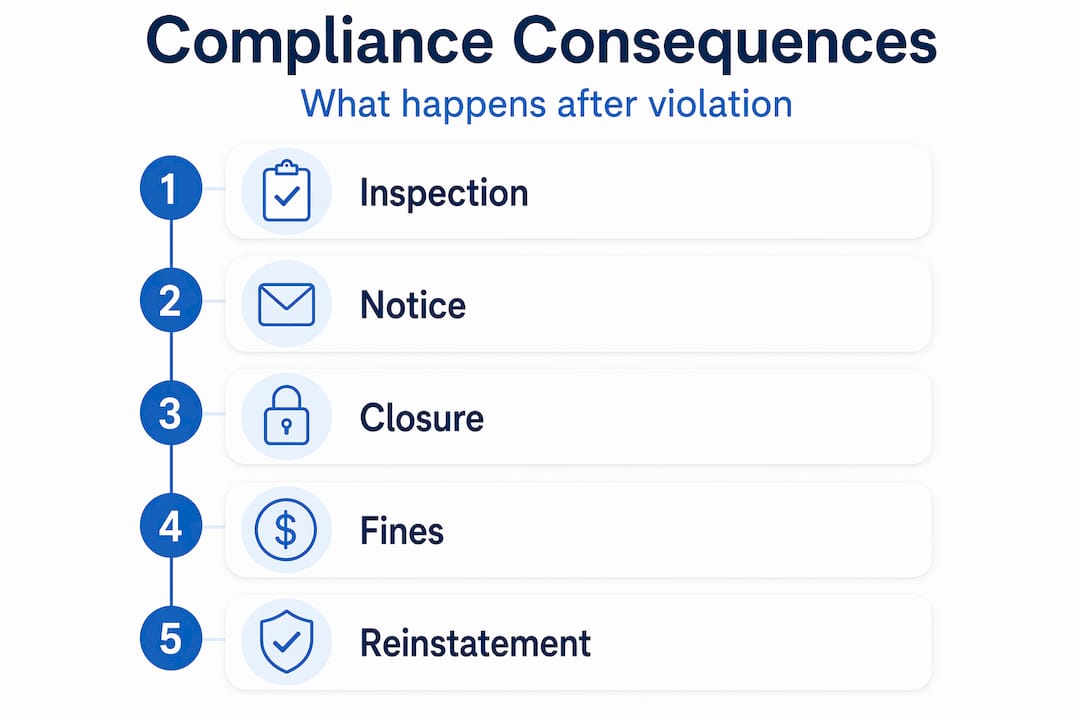
Enforcement in Florida is not gradual. Inspectors have authority to act immediately when they find specific conditions, and the consequences move fast.
Common triggers for enforcement action include:
- Operating without a valid or current DOH permit
- Nonfunctional or absent disinfection feeding equipment
- Anti-entrapment drain covers that are missing, broken, or not rated for the pool’s flow rate
- Water chemistry outside the legal ranges (pH, free chlorine, cyanuric acid levels)
- Missing or incomplete daily testing logs
- Bather load exceeded without documentation
- Failure to correct previously cited violations within the required timeframe
Florida law under FAC 64E-9.017 authorizes immediate closure of a public pool when conditions endanger health or safety, including missing disinfection equipment, nonfunctional anti-entrapment systems, or operation without a valid permit.
The financial and operational consequences extend well beyond the closure itself. Fines accumulate per day of violation. If a patron is injured or becomes ill at a pool that was out of compliance at the time of the incident, your legal exposure increases substantially. Insurance carriers may deny claims if the pool was operating in violation of state law.
Pro Tip: Never let your documentation fall behind your physical operations. An inspector who finds a well-maintained pool but no logs may issue a violation just as readily as one who finds a chemistry problem. Your records are your legal evidence that you operated correctly every single day.
Your Florida pool inspection guide can help you understand what inspectors are looking for and how to prepare your facility for both routine and complaint-driven inspections. Reviewing commercial pool safety examples from properties that have built strong compliance records can also give you a practical baseline.
Building a proactive compliance strategy for your property
The most effective approach treats compliance as an ongoing lifecycle rather than a reaction to inspections. Properties that think about compliance only when an inspector shows up are always playing catch-up. The ones that build it into daily operations run with far fewer disruptions.
Hillsborough County’s commercial pool requirements reflect what most Florida counties expect: a full-cycle approach starting at design and running continuously through every operating day. Here is how to structure that for your property:
- Plan and design. Any new pool or renovation project must engage licensed designers and contractors who understand both FBC Section 454 and FAC Chapter 64E-9 before construction begins.
- Permit. Secure all required permits from your local building department and county DOH before any work starts or any structural change is made.
- Operate and sanitize. Follow the chemical ranges, turnover rates, and disinfection equipment maintenance schedules required by FAC Chapter 64E-9 every single day.
- Document. Keep complete daily logs of water testing, equipment checks, bather loads, and any incidents or corrections. Store logs for the minimum period required by law.
- Inspect and respond. Treat both internal self-audits and official inspections as opportunities to find gaps. Respond to any cited violation within the required timeframe and document the correction.
Assign clear ownership for each step. Your pool operator or certified pool technician handles daily chemistry and logs. Your property manager or facilities director oversees permits, renewal timelines, and vendor compliance. Any contractor doing physical work must hold the appropriate Florida pool contractor certifications.
Pro Tip: Schedule an internal self-audit at least 60 days before your anticipated inspection date. Walk through the entire facility with your logs, check every piece of safety equipment, and review your permit renewal date. Fixing small issues on your own timeline is always faster and cheaper than responding to a violation notice.
A well-organized commercial pool renovation workflow also helps you stay ahead of maintenance-driven compliance needs. Surfaces that are cracked or pitting can harbor bacteria and fail inspection. Addressing common pool compliance problems before they become enforcement items protects both your guests and your operating permit.
Industry perspective: why pool compliance is more than ticking boxes
After more than 35 years working with commercial pool properties across Florida, one pattern stands out clearly. The properties that treat compliance as a minimum bar to clear tend to face the most disruption. The ones that treat it as a management discipline run more smoothly, have fewer liability events, and protect asset value over the long term.
Passing an inspection is not the same as being safe. An inspector can only verify what is visible and documented during their visit. Faded safety signage that technically meets the letter of the code but is unreadable to a guest, a log that is filled out but not reviewed, a drain cover that is in place but approaching the end of its rated service life. All of these can pass inspection and still carry real risk.
The contrarian view here is this: minimum code compliance is a starting point, not a strategy. Smart property managers use the regulatory framework as a floor and build above it. They document more than required, inspect more frequently than scheduled, and replace equipment before it fails rather than after.
Properties that invest in pool upgrades and compliance improvements proactively also tend to avoid the compounding costs of deferred maintenance. A resurfacing project that is planned and permitted correctly is a fraction of the cost of an emergency closure followed by emergency repairs and the revenue loss that comes with it. The compliance framework, followed with real discipline, is also a business protection tool.
How Classic Marcite helps with Florida pool compliance
Keeping a commercial pool compliant requires more than operational diligence. The physical condition of the pool surface, the integrity of the drain system, and the quality of tiles and deck materials all feed directly into your compliance status.

Classic Marcite has been working with commercial pool properties across Orlando and Jacksonville since 1988, completing over 100,000 pools. Our team understands the intersection of renovation quality and regulatory compliance, from selecting commercial pool finish options that meet Florida standards to coordinating work within the permitting process so your operations stay protected. Whether you need a full resurfacing, a drain cover upgrade, or a compliance-oriented pool renovation, we approach every project with the regulatory environment in mind. Contact us today for a free estimate and see how we can help keep your facility safe, legal, and operating.
Frequently asked questions
What defines a commercial pool in Florida?
A commercial pool in Florida is any pool open to the public or used by multiple non-family groups, regulated under Chapter 64E-9 and Chapter 514. Whether a pool is classified as public or semi-public determines which specific rules apply.
What are the most common compliance failures leading to pool closure?
Common failures include missing permits, broken disinfection systems, nonfunctional anti-entrapment devices, and missing safety logs, all of which can trigger immediate enforcement action under Florida law. Inspectors do not need to find multiple issues to act.
How often must a Florida commercial pool be inspected?
Public pools in Florida are inspected at least twice per year by the county health department, and more frequently if complaints are filed or violations are found. Routine inspections can be supplemented by your own internal audits.
Who is legally responsible for pool compliance on a commercial property?
The property owner or designated pool operator is responsible for meeting all compliance requirements and can face fines, permit suspension, or legal liability if those requirements are not met. Responsibility cannot be delegated away by hiring a contractor.
Is following the CDC Model Aquatic Health Code enough for compliance?
No. The MAHC is a model framework from the CDC and is not directly enforceable. Legal compliance in Florida is determined by FAC Chapter 64E-9, FBC Section 454, and the requirements of your county health department.