
A focused preventative-maintenance program, a stocked critical-spares kit, and a vendor SLA with after-hours access will cut most commercial pool closures from days to hours. Three actions you can take today: start timestamped digital chemistry logs, order your critical-spares inventory, and lock emergency response times into your service contracts.
Immediate priority checklist for this shift:
- Test free chlorine, combined chlorine, and pH now and log results with a timestamp. Health department guidance requires chemistry tests at least twice daily, and timestamped records are your first line of defense at any inspection.
- Empty skimmer and pump baskets. This single task prevents flow restriction that cascades into pump cavitation and heater lockouts.
- Read filter differential pressure and note it against your baseline. A rising differential is the earliest mechanical signal most facilities ignore.
- Confirm your VGB-compliant drain covers are secure and undamaged. A failed cover is an immediate closure.
- Verify you have a direct after-hours phone number for a qualified technician. Without it, a Saturday-night pump failure becomes a Monday repair.
- Check that your automation controller is online and that the last probe calibration date is within your service window.
Pro Tip: If chemistry is out of range and your technician is unavailable, add a measured dose of the appropriate chemical, retest in 30 minutes, and post a “pool closed for water quality adjustment” sign. A documented, proactive hold is far better than a health-department-ordered closure on your record.
Key Takeaways
A structured preventative-maintenance program with stocked critical spares, locked-in vendor SLAs, and daily digital chemistry logs is the most direct path to reducing unplanned commercial pool closures.
| Point | Details |
|---|---|
| Daily chemistry logging | Log free CI, pH, and alkalinity at least twice daily with timestamps to satisfy health department requirements and catch drift early. |
| Critical-spares on-site | Stock pump motors, mechanical seals, multiport valves, and key controller modules on-site to convert multi-week closures into same-day repairs. |
| Vendor SLA with emergency terms | Negotiate 15–60 minute response for safety-critical issues and prioritized parts access before the next event weekend. |
| PM program ROI | Hospitality case data shows up to a 75% reduction in unplanned closures, with program costs often recovered within 60–90 days. |
| Classicmarcite surface survey | When aging finishes drive recurring water-quality or leak issues, a no-obligation commercial site survey from Classicmarcite identifies infrastructure problems that PM alone cannot resolve. |
Table of Contents
- What a commercial preventative-maintenance program must include
- Your practical PM schedule: daily through annual tasks
- Warning signs that predict closures before they happen
- How to stock spare parts so missing inventory never closes your pool
- Work-order workflow and vendor SLAs that cut repair times
- How continuous monitoring and automation actually reduce downtime
- Which equipment upgrades deliver the fastest downtime reduction
- How to roll out your PM program without disrupting operations
- The real ROI of commercial pool downtime planning
- What operators actually do differently to keep pools open
- When aging pool surfaces are the real source of your downtime
- What operators actually do differently to keep pools open
- Sources
What a commercial preventative-maintenance program must include
Effective commercial pool downtime planning is not a checklist you run once. It is a living program with defined components, assigned owners, and measurable targets. Facilities that treat it as a project rather than a program are the ones calling emergency vendors on holiday weekends.
Core components:
| Component | What it covers | Why it matters |
|---|---|---|
| Asset registry | Every piece of equipment tagged with model, serial, install date, and service history | Speeds diagnosis and warranty claims |
| Digital chemistry logging | Timestamped pH, free chlorine, combined chlorine, alkalinity, and cyanuric acid records | Inspection-ready records; required by most health departments |
| Scheduled mechanical PM | Pump, filter, heater, and controller inspections on defined intervals | Catches wear before failure |
| Spare-parts plan | Classified inventory of critical, important, and standard spares | Eliminates multi-week wait times for common failure parts |
| Work-order system | Detection → assignment → resolution → documentation flow | Creates an auditable repair history |
| Certification-based routing | CPO/AFO-level technicians assigned to safety and technical items | Meets regulatory expectations; reduces liability |
Roles and responsibilities should be explicit, not assumed. Your operator runs daily rounds and logs chemistry. Your on-call technician responds to alarms and performs mechanical PM. Your vendor contacts hold SLAs for parts and emergency dispatch. One person owns escalation decisions, and that person’s name and cell number are posted at the equipment room door.
KPIs worth tracking:
- Uptime target: 98% or higher for commercial facilities
- Time-in-balance: percentage of daily readings where CI and pH are within target range
- Mean time to repair (MTTR): from issue detection to pool reopening
- PM completion rate: percentage of scheduled tasks completed on time each month
The workflow that ties these components together runs in a single direction. Detection triggers a work order. The work order routes to the right technician by certification level. Resolution is documented with photos, timestamps, and post-repair chemistry readings. That documentation feeds your inspection-ready log and your next PM interval decision. Documented work-order flows that include photo evidence and timestamped chemistry readings materially speed health inspections and vendor diagnostics after an incident.
Your practical PM schedule: daily through annual tasks
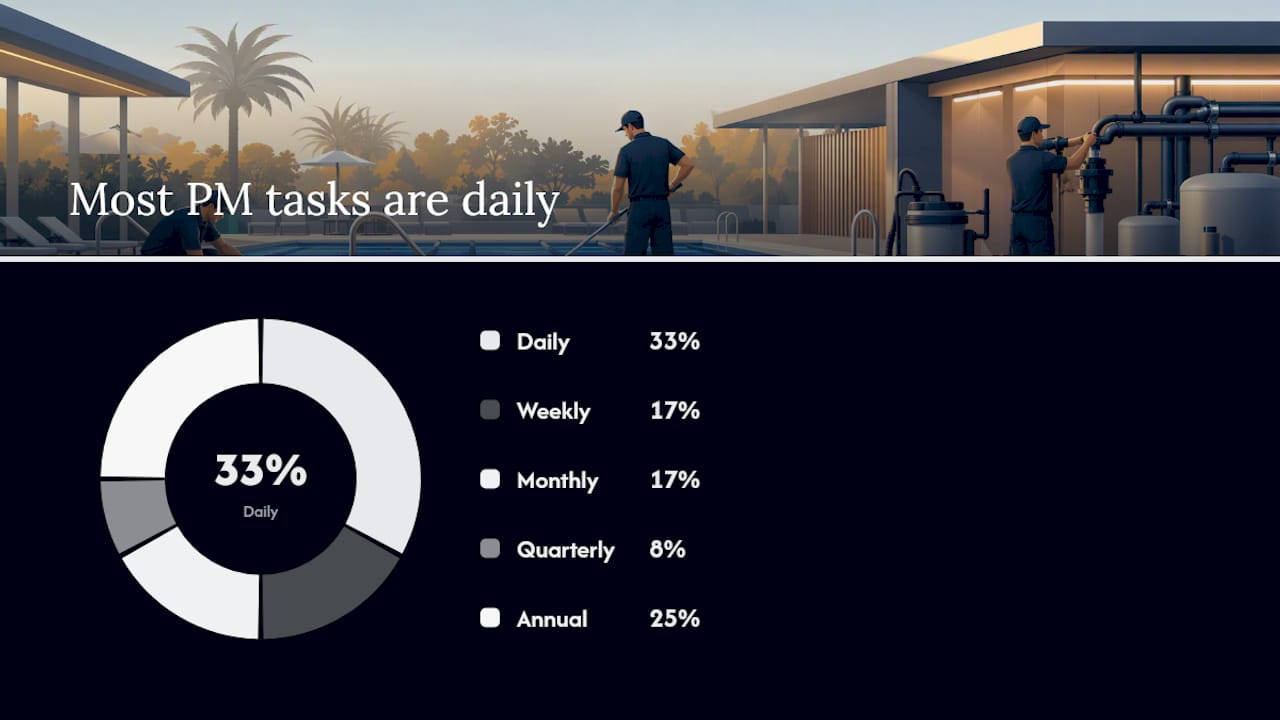
A commercial pool maintenance schedule that covers every interval from daily rounds to annual teardowns is the backbone of any downtime-reduction effort. High-bather-load facilities should target a 4–6 hour turnover rate, which means your circulation and chemistry systems must be performing consistently, not just on inspection days.
PM interval reference:
| Interval | Task | Target / Threshold |
|---|---|---|
| Daily (AM) | Chemistry test: free CI, pH, alkalinity | Free CI 1–4 ppm; pH 7.2–7.6 |
| Daily (AM) | Empty skimmer and pump baskets | Clear before bathers arrive |
| Daily | Read filter differential pressure | Log against baseline; backwash when delta rises 8–10 psi |
| Daily | Visual check: pump operation, heater status, controller online | Note any alarms or unusual sounds |
| Weekly | Backwash or clean filter (pressure-triggered or scheduled) | Per manufacturer threshold |
| Weekly | Calibrate probes (ORP and pH sensors) | Validate against grab sample |
| Monthly | Heater inspection: scale check, burner condition, heat exchanger | Log temperature differential |
| Monthly | Controller and automation review: alarm log, probe drift trend | Compare sensor vs. manual readings |
| Quarterly | Pump motor amp draw check | Compare to nameplate; flag rising draw |
| Annual | Electrical safety inspection, GFCI testing | Per NEC and local code |
| Annual | VGB drain cover inspection and certification | Replace covers at or before end of rated service life |
| Annual | Full mechanical teardown where applicable | Pump seals, impeller, filter media condition |
Sample daily checklist (copy for staff rounds):
- 7:00 AM: Test and log free CI, combined CI, pH, and alkalinity
- 7:15 AM: Empty skimmer baskets and pump strainer baskets
- 7:20 AM: Read and log filter differential pressure
- 7:25 AM: Confirm pump is running at correct flow; listen for cavitation or vibration
- 7:30 AM: Check heater status display; note any fault codes
- 7:35 AM: Confirm automation controller is online; review overnight alarm log
- 7:45 AM: Conduct a visual walk of the deck, drain covers, and handrails
- 8:00 AM: Second chemistry test if opening readings were borderline; log results
For a 40,000-gallon pool with a 6-hour turnover target, your circulation system needs to move roughly 111 gallons per minute continuously. If your flow readings drop below that threshold on morning rounds, that is your first signal to check baskets, valves, and pump performance before bathers arrive.
Warning signs that predict closures before they happen
Most commercial pool closures are not sudden. They are the result of ignored signals that accumulated over days or weeks. Knowing what to look for, and what to do before calling a technician, is the difference between a 30-minute fix and a 3-day closure.
Pump failure indicators and triage:
- Rising amp draw on the motor (compare monthly readings to nameplate rating). A motor drawing 10–15% above nameplate is approaching failure.
- Unusual noise: grinding suggests bearing wear; cavitation sounds like gravel in the casing and usually means a flow restriction upstream.
- Vibration at the pump housing: often a sign of impeller damage or misalignment.
- Low flow despite correct valve positions: check baskets first, then verify suction-side valves are fully open, then inspect the impeller.
Quick triage: clear all baskets, confirm all valves are in the correct position, and check the pump strainer lid O-ring for air leaks. If the problem persists, restrict bather load and call your technician. Pentair’s safety-first triage guidance recommends assessing hazards, isolating electrical risk, photographing conditions, and clearing visible blockages before calling emergency contacts.
Filter and backwash indicators:
- Differential pressure rising more than 8–10 psi above clean baseline: initiate backwash. If pressure returns to baseline after backwash, the media is functioning. If it does not drop, the media may be channeled or fouled and needs inspection.
- Cloudy water despite correct chemistry: often a filter media problem, not a chemical one. Check filter pressure and run time before adding chemicals.
Heater and controller symptoms:
- Temperature drift of more than 2°F from setpoint without a load change: check heat exchanger for scale buildup. Scale reduces heat transfer efficiency and eventually causes lockouts.
- Repeated heater lockouts: pull the fault code before resetting. A pattern of the same code points to a specific component, not a nuisance alarm.
- Probe drift on your automation controller: if the controller reads 7.6 pH but your manual grab sample reads 7.2, the probe needs cleaning or replacement. Never dose chemicals based on a drifted probe reading.
Automation and controller alerts:
- Communication loss between controller and remote monitoring: confirm local panel control is still active. A cloud-connected system that loses its internet connection should still operate locally.
- Nuisance alarms (repeated alerts that clear without intervention): log them. Three nuisance alarms from the same sensor in a week is a calibration or sensor-replacement issue, not a system quirk.
When to restrict access vs. keep the pool open:
- Restrict access immediately if: free chlorine falls below 1 ppm and cannot be corrected within 30 minutes, a VGB drain cover is missing or damaged, or any electrical fault is present near water.
- Keep the pool open with mitigation if: chemistry is borderline but trending toward target, a non-safety mechanical issue is being actively managed, and you have documented the condition and your corrective steps.
For a comprehensive troubleshooting reference covering common failure modes by equipment type, the Classicmarcite resource library is a practical starting point.
How to stock spare parts so missing inventory never closes your pool
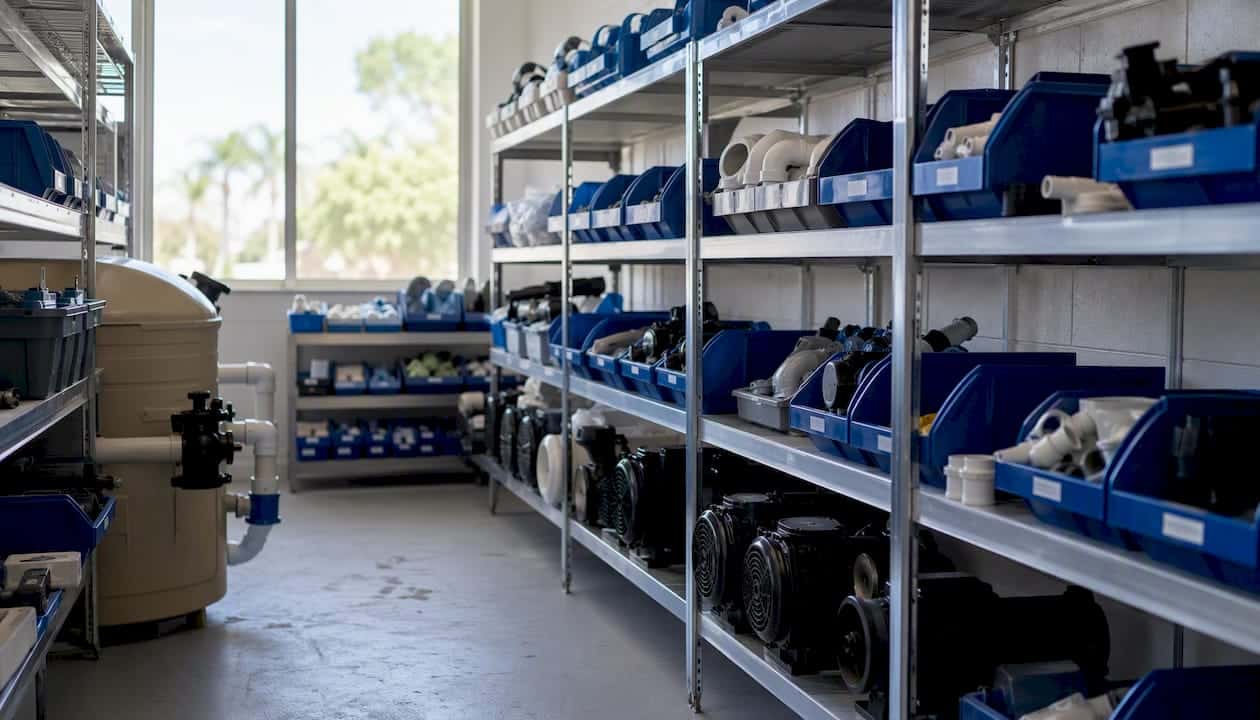
The most preventable cause of extended commercial pool closures is waiting for a part. A pump motor that fails on a Friday afternoon can sit unrepaired until Tuesday if you have not pre-positioned the right inventory. The solution is a three-tier classification system.
Spare-parts classification:
| Tier | Definition | Stock strategy | Typical lead time if not stocked |
|---|---|---|---|
| Critical | Parts whose failure closes the pool; cannot be sourced locally within 24 hours | Stock on-site at all times | 1–6 weeks |
| Important | Parts that degrade performance significantly; available from regional distributors | Min/max inventory with reorder triggers | 3–10 days |
| Standard | Consumables and common wear parts; widely available locally | Order as needed | 1–3 days |
Critical spares to stock on-site:
- Pump motor (matched to your primary circulation pump)
- Mechanical seal kit for each pump model on-site
- Multiport valve (if your filter uses one; these are frequently backordered)
- Key automation controller modules (probe amplifiers, relay boards)
- Replacement pH and ORP probes
- VGB-compliant drain covers (one full set per drain configuration)
Important spares (min/max inventory):
- Filter pressure gauges
- Pump strainer baskets and lid O-rings
- Heater igniter and thermocouple kits
- Automation controller fuses and communication cables
Reorder rules: calculate your reorder point by multiplying your average usage rate by the part’s lead time, then add a safety buffer equal to one additional lead-time period. For a pump motor with a 4-week lead time and a historical replacement rate of once per 18 months, keep one on-site and reorder immediately after use.
Inventory governance: assign each spare a bin location with a QR code label linking to the part number, supplier contact, and installation notes. Audit the inventory quarterly. A bin that shows “1 on hand” but is actually empty is worse than no bin at all, because it creates false confidence during an emergency.
Pro Tip: Negotiate with your primary equipment supplier for a “priority pull” agreement. In exchange for consolidating your parts purchases, many distributors will hold a reserved unit of your critical pump motor and ship same-day on request. Get this in writing.
Work-order workflow and vendor SLAs that cut repair times
A repair that takes 6 hours without a work-order system often takes 2 hours with one. The difference is not the technician’s skill. It is the information available at the moment of dispatch.
Recommended work-order fields:
- Issue capture: plain-language description of the symptom, when it was first noticed, and who noticed it.
- Timestamps: time of detection, time of work-order creation, time of technician assignment, time of arrival, time of resolution.
- Photos: at least one photo of the fault condition before any work begins, and one after resolution.
- Initial readings: chemistry values, filter pressure, pump amp draw, and any controller fault codes at the time of detection.
- Assigned certification level: flag whether the issue requires a CPO/AFO-level technician or can be handled by a trained operator.
- Priority code: Safety-Critical (pool closed or imminent risk), Operational (pool open but degraded), Routine (scheduled PM item).
SLA elements to lock into vendor contracts:
- Emergency response time by severity: 15–60 minutes for safety-critical issues (drain cover failure, electrical fault, complete circulation loss); 4–8 hours for operational issues (single pump failure, heater lockout).
- Prioritized parts access: the vendor commits to sourcing critical parts within a defined window, not “as available.”
- After-hours escalation contacts: a direct cell number for a qualified technician, not a call center.
- Escalation path: if the first technician cannot resolve the issue within a defined time, a senior technician or specialist is dispatched automatically.
Without explicit SLA language in your service contract, repair delays commonly extend to multiple days. That is not a vendor failure. It is a contract gap.
Certification-based routing matters most for safety items. A VGB drain cover failure, an electrical fault near water, or a controller alarm that could indicate a chemical dosing error must go to a CPO or AFO-certified technician, not the nearest available person. Build that routing rule into your work-order system so it is automatic, not a judgment call under pressure.
Documentation best practices: every closed work order should include the before-and-after photos, the post-repair chemistry readings, and the technician’s certification level. That file is your defense at a health inspection and your data source for the next PM interval decision. For compliance-ready documentation guidance tailored to property managers, Classicmarcite’s compliance resource covers the audit trail in detail.
How continuous monitoring and automation actually reduce downtime
Smart monitoring systems are moving from premium add-ons to standard equipment in commercial aquatics. The realistic benefit is not eliminating manual rounds. It is catching trends between rounds and giving your team better data for PM decisions.
What continuous monitoring typically measures:
- pH and ORP (oxidation-reduction potential, which correlates to sanitizer effectiveness)
- Water temperature
- Flow rate and system pressure
- Pump amperage (some platforms)
Those data streams are most valuable when reviewed as trends over days and weeks, not as single-point snapshots. A pH probe that reads 7.4 today but has been drifting 0.1 units per week for a month is telling you something a single daily test will not catch.
Ecolab’s AquaIQ program positions continuous monitoring and control as a way to keep pool chemistry in balance with 24/7 visibility and proactive alerts, reducing the frequency of manual corrections. Pentair’s controller line offers similar real-time monitoring with automation capabilities for chemical dosing and equipment scheduling. Both platforms claim meaningful reductions in manual intervention. Validate those claims against your own baseline during a 60–90 day pilot before committing to a full rollout.
Integration checklist before going live:
- Confirm offline/local control: if the cloud connection drops, the system must still operate from the local panel. Industry guidance is explicit that projects must prove offline control before relying on automation for compliance.
- Force alarm conditions during commissioning: trigger a low-flow alarm, a pH out-of-range condition, and a communication loss. Confirm the right person receives the alert and that it is actionable, not just a notification.
- Validate sensor readings against grab samples: for the first 30 days, run a manual grab sample every time the controller logs a reading. If the sensor and the grab sample diverge by more than 0.2 pH units or 0.5 ppm CI, recalibrate or replace the probe before trusting automated dosing.
- Confirm calibration cadence: most pH and ORP probes need calibration weekly in high-bather-load conditions.
- Define alarm routing: every alarm must have a named recipient and a response protocol. An alarm that goes to a shared inbox and gets ignored is worse than no alarm.
Benefits when the system is properly commissioned:
- Fewer after-hours callouts because trending data catches drift before it becomes a crisis
- Inspection-ready logs generated automatically with timestamps
- PM scheduling informed by actual equipment performance data rather than fixed calendar intervals
Pro Tip: *Use your monitoring platform’s trend data to adjust PM intervals, not just to respond to alarms.
For a deeper look at pool automation integration and what to verify before scaling a system, the Classicmarcite resource on automation covers commissioning considerations in practical terms.
Which equipment upgrades deliver the fastest downtime reduction
Not every capital upgrade pays back at the same rate. The facilities that cut unplanned closures fastest tend to prioritize in a specific order, starting with the items that most directly prevent closures rather than the items with the best marketing materials.
Upgrade priority list:
- Automation and probes first. A probe-fed chemical controller that catches a pH spike at 2 AM prevents the morning closure that a manual-only program misses. This is the highest-impact upgrade for most facilities that do not already have it.
- Critical-spare pump motor second. Having a matched replacement motor on-site converts a potential 2-week closure into a same-day repair. The capital cost is a fraction of one closure’s lost revenue.
- Redundant circulation pump third. A backup pump on a manual or automatic failover switch means a primary pump failure does not close the pool. This is most justified for facilities with high daily revenue at risk (hotels, resorts, water parks).
- Filter area increase fourth. Oversizing filter capacity reduces backwash frequency, extends media life, and gives you a buffer during high-bather-load periods. The payback is slower than the first three but meaningful over a 5-year horizon.
Cost vs. benefit considerations: variable-speed pumps are frequently cited for energy savings, and those savings are real on a site-specific basis. However, the downtime-reduction benefit of a variable-speed pump is secondary to the automation and redundancy items above. Prioritize what closes pools first, then optimize for energy.
When redundancy is worth the capital: if your facility generates more than $2,000 per day in pool-dependent revenue (F&B, room premiums, admission), a redundant pump pays back in fewer than two unplanned closures avoided. Below that threshold, improved PM and a stocked critical-spare motor often deliver faster ROI.
Scheduling upgrades: pilot one system at a time. Install the automation controller, run it for 60–90 days, measure the change in emergency callouts and time-in-balance, then decide on the next upgrade. Stacking multiple capital changes simultaneously makes it impossible to attribute performance improvements to specific investments.
For facilities where aging pool surfaces are contributing to recurring water-quality issues, a commercial pool renovation workflow addresses how surface condition affects long-term maintenance burden.
How to roll out your PM program without disrupting operations
A PM program that exists on paper but is not executed consistently delivers no uptime benefit. The rollout sequence matters as much as the program design.
Five-phase rollout:
-
Equipment audit and tagging (weeks 1–2). Walk every piece of equipment with a technician. Tag each asset with a QR code linking to its service history, model number, and PM interval. Identify any equipment with no service history on file and schedule an immediate inspection.
-
PM schedule setup and SLA negotiation (weeks 3–4). Build your PM interval table (use the template in the PM schedule section above). Simultaneously, review your service contracts and negotiate SLA language for emergency response times, prioritized parts access, and after-hours contacts. Do not start the pilot until both are in place.
-
Vendor SLA finalization and critical-spares ordering (weeks 4–5). Place orders for critical-spare parts. Confirm your vendor’s priority-pull agreement in writing. Set up bin locations and QR labels for the inventory room.
-
Pilot monitoring and PM tuning (weeks 6–14). Run the full PM program for 60–90 days. Track PM completion rate, time-in-balance, number of emergency callouts, and MTTR. Use the data to adjust intervals and identify any gaps in the spare-parts plan.
-
Full rollout with staff training and mock inspection (weeks 15–18). Train all staff by role. Operators learn daily rounds and chemistry logging. Technicians learn work-order protocols and escalation rules. Run a mock health inspection: pull your logs, verify timestamps, and confirm every required record is present and legible.
Pilot metrics to measure:
- PM completion rate: target 95% or higher
- Time-in-balance: percentage of daily readings within target range for CI and pH
- Emergency callouts per month: track the trend, not just the count
- MTTR: from detection to pool reopening
Staff training outline by role:
- Operators: daily rounds checklist, chemistry testing and logging, skimmer and basket maintenance, when to escalate
- Lead technicians: work-order creation, mechanical PM tasks, escalation protocols, photo documentation standards
- Facility manager: KPI review cadence, SLA monitoring, vendor performance review, mock inspection preparation
Change-control communication: when phased upgrades require brief planned closures, notify guests and staff at least 48 hours in advance. Post the planned closure window, the reason, and the reopening time. A planned closure communicated clearly is a minor inconvenience. An unplanned closure with no explanation damages guest trust far more.
The real ROI of commercial pool downtime planning
Hospitality-focused maintenance programs have reported up to a 75% reduction in unplanned pool closures, 40% longer equipment lifespans, and payback on program costs often within 60–90 days. Those figures come from multi-site case summaries and should be treated as benchmarks, not guarantees. Your results will depend on your current baseline, your facility’s bather load, and how consistently the program is executed.
Cost impact of a single closure:
A hotel or resort pool closure typically affects more than just admission revenue. Lost food and beverage sales, room-rate premiums tied to pool access, and guest satisfaction scores all move together. A conservative estimate for a mid-size hotel pool closure runs $500–$2,000 per day in direct and indirect losses, depending on the property type and season. That figure is not sourced from a single study; it is a reasonable range based on the revenue categories affected.
Business-case template:
| Input | Your figure |
|---|---|
| Average unplanned closures per year | ___ |
| Average cost per closure day (direct + indirect) | $___ |
| Total annual avoidable loss | $___ × ___ = $___ |
| Estimated PM program cost (annual) | $___ |
| Payback period | $___ ÷ $___ = ___ months |
Fill in your own numbers. If your facility has had 8 unplanned closure days in the past year at $1,000 per day, your avoidable loss is $8,000 annually.
How to baseline current performance: before starting the pilot, pull 12 months of chemistry logs (or reconstruct from service invoices), count emergency callouts, and note any health department citations. That baseline is your before-state. Without it, you cannot prove the program’s value to leadership or adjust it intelligently after the pilot.
Pool equipment lifecycle management data also feeds the business case: knowing when a pump or heater is approaching end of useful life lets you budget for replacement proactively rather than absorbing an emergency capital expense.
What operators actually do differently to keep pools open
The facilities with the best uptime records tend to share a few habits that are not in any manual. They are governance choices and daily disciplines that make the PM program stick when conditions are imperfect.
The most consistent habit is the morning round as a non-negotiable ritual, not a task that gets skipped when the facility is busy. Operators who do the round every morning, regardless of how the previous day went, catch problems before bathers arrive. The ones who skip it on busy mornings are the ones calling emergency vendors at 10 AM.
QR-coded spare bins are a small investment with a disproportionate return. When a technician can scan a bin label and immediately see the part number, supplier contact, and last audit date, the time from “we need a part” to “part is ordered” drops from an hour to five minutes. Facilities that still use handwritten bin labels or no labels at all routinely discover empty bins during emergencies.
A single escalation owner for weekend and holiday events is the governance change that matters most. When everyone is responsible for escalation, no one escalates quickly. Naming one person, posting their cell number, and giving them authority to call vendors and restrict pool access removes the hesitation that turns a 2-hour problem into a 2-day closure.
Cross-training is underused. Most facilities have one operator who knows the chemistry system and one technician who knows the mechanical side. When either is unavailable, response slows dramatically. A 4-hour cross-training session where each person learns the other’s basic triage steps costs almost nothing and has prevented closures at facilities that had no other redundancy in place.
Mock inspections, run quarterly rather than only before a known health department visit, reveal documentation gaps before they become citations. Pull your logs, verify every timestamp is present, and confirm that every work order has a photo and a resolution note. The gaps you find in a mock inspection are the ones a health inspector would find on a real visit.
When aging pool surfaces are the real source of your downtime
Some commercial pools cycle through the same maintenance problems year after year not because of poor PM execution, but because the underlying surface and infrastructure are deteriorating. Rough or pitted marcite finishes harbor bacteria that resist normal sanitizer levels. Failing tile-to-deck transitions allow water intrusion that undermines equipment pads and creates recurring leak issues. A PM program can manage these symptoms, but it cannot fix the root cause.
Classicmarcite has resurfaced more than 100,000 pools since 1988, including commercial properties at hotels, resorts, and theme parks across Florida. During a commercial site survey, the team inspects surface integrity, tile and coping transitions, equipment pad condition, and finish wear patterns that predict where the next maintenance problem will originate. That inspection is offered at no obligation.
If your facility has had recurring water-quality issues tied to surface condition, or if your finish is approaching the end of its service life, a commercial pool resurfacing assessment in Orlando is a practical next step. Classicmarcite’s commercial work uses materials including Pebble Tec®, which is rated for durability in high-bather-load environments and reduces the surface-related maintenance burden that drives chronic closures. Contact Classicmarcite to schedule your free commercial site survey and get a written scope of what the inspection covers.
What operators actually do differently to keep pools open
See the perspective section above for the full operator habits discussion.
Sources
- Hotel Pool And Spa System Maintenance
- San Diego Commercial Pools: Reducing Downtime During Peak Season
- San Diego County pool operations guidance (PDF)
- What to do for your pool after a power loss (Pentair)
- Smart Swimming Pools: Facility Manager’s Guide 2026 – Facility Management Insights