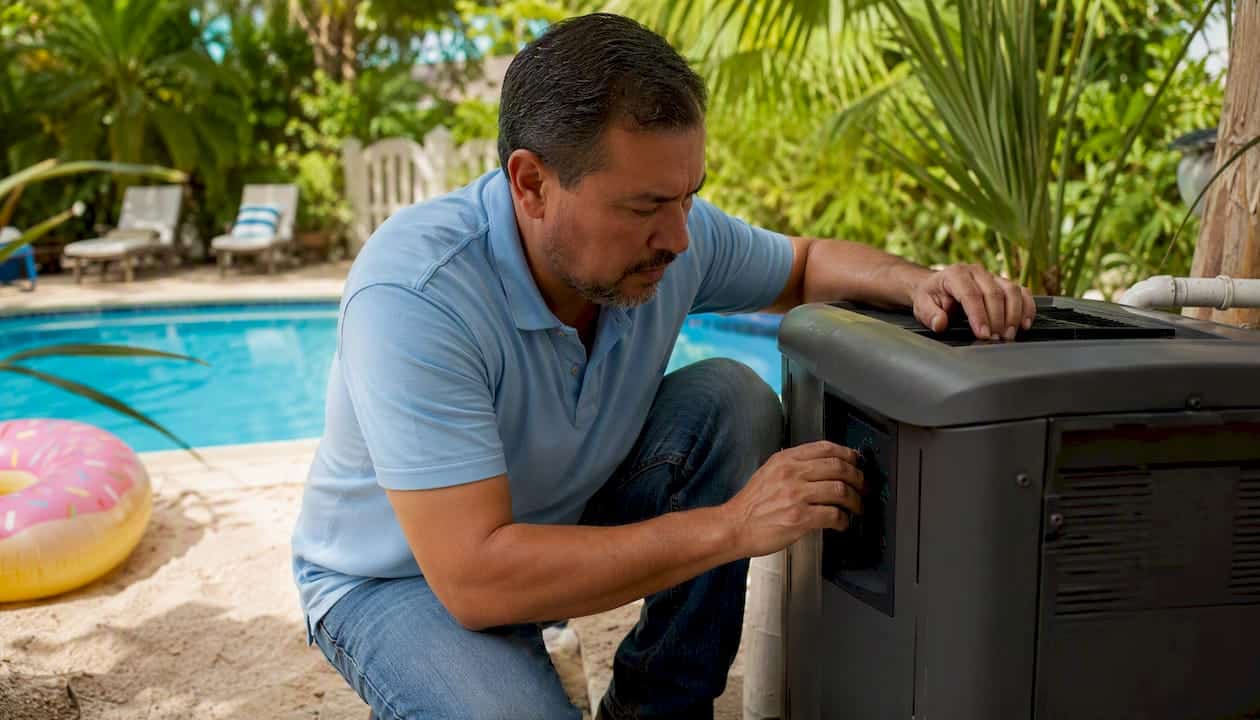
Run these six checks before calling anyone: (1) confirm the breaker hasn’t tripped, (2) verify the thermostat is set above the current water temperature, (3) make sure the pump is running and circulating, (4) check filter pressure and clean if needed, (5) confirm the gas valve is open or heat-pump airflow is clear, (6) attempt one power-cycle reset if an error code appears. A large majority of reported heater faults trace back to low water flow, not internal heater failure. That means a dirty filter or a closed valve is the most likely culprit. Stop there if you smell gas, hear hissing near the gas line, or see a breaker that keeps tripping. Those are licensed-technician situations, not DIY ones.
Safety line: Gas lines, electrical circuits above 120V, and refrigerant systems require a licensed professional. Do not open those components.
Table of Contents
- What should you never attempt on your own?
- Step-by-step troubleshooting checklist you can do safely
- What does each symptom usually mean?
- When should you stop and call a licensed technician?
- What tools and documentation should you gather first?
- What routine maintenance prevents most heater problems?
- How long does troubleshooting take, and what does repair cost?
- How Classicmarcite can help when you need professional service
- Key Takeaways
- Classicmarcite’s perspective on heater troubleshooting
- Useful sources and further reading
What should you never attempt on your own?
Gas-line work, electrical repairs above 120V, and refrigerant servicing are restricted to licensed technicians under Florida building codes, and attempting them yourself can void your manufacturer warranty and invalidate your homeowner’s insurance claim. The risks are concrete: a gas leak can ignite; a 240V circuit can kill; refrigerant exposure causes chemical burns and environmental violations.
Recognize a high-risk symptom immediately. A sulfur or rotten-egg smell near the heater, a hissing sound from the gas line, or a breaker that trips repeatedly after reset are all stop-everything signals. Evacuate the equipment area, shut the main gas valve only if you have been trained to do so, and call emergency services or your gas utility before doing anything else.
Pro Tip: Before any service call, photograph the heater’s data plate (model number, serial number, BTU rating) and the full equipment pad. That photo set cuts diagnostic time and protects you if a warranty dispute arises later.
Tasks homeowners must leave to licensed professionals:
- Any repair or adjustment to gas supply lines, manifolds, or gas valves beyond confirming the shutoff is open
- Electrical work inside the heater cabinet or at the sub-panel above 120V
- Refrigerant recharge, leak detection, or compressor servicing on heat pumps
- Heat exchanger replacement or acid flushing
- Persistent fault codes that return after a single reset attempt
Step-by-step troubleshooting checklist you can do safely
Many unnecessary service calls disappear when owners verify thermostat, flow, and filter status first. Work through these steps in order.
- Check the breaker. Locate the heater’s dedicated breaker at the sub-panel. If it has tripped, reset it once. If it trips again immediately, stop and call a technician.
- Verify the thermostat setpoint. The setpoint must be higher than the current pool temperature. Automation systems and manual dials get bumped accidentally.
- Confirm pump operation and flow. The heater will not fire without adequate circulation. Listen for the pump, check that all valves between the pump and heater are fully open, and confirm no bypass valve is diverting flow away from the heater.
- Read the filter pressure gauge. Note your clean baseline (usually written on a log or the filter housing). If pressure reads significantly above that baseline, clean the filter before any other diagnosis. Backwash a sand filter, rinse a cartridge, or perform a DE filter cleaning per your filter type.
- Gas heater: confirm the gas valve is open. Visually verify the supply valve on the gas line to the heater is in the open position. Do not open the heater cabinet to inspect internal gas components.
- Heat pump: check airflow and coil. Confirm at least 2–3 feet of clearance around the evaporator coil. Rinse the coil gently with a garden hose if debris has accumulated. Frost or ice on the coil in cool weather may indicate a defrost issue or low refrigerant, both of which need a technician.
- Record and reset error codes. Write down the exact code and timestamp. Power-cycle the heater for 30–60 seconds, then restore power and allow the startup sequence to complete. If the same code returns, do not reset again. Call a pro.
Pro Tip: The pressure/flow switch is a safety device that prevents the heater from firing without adequate water movement. You can visually inspect its wiring connections for corrosion or looseness. Testing the switch electrically with a multimeter is a job for a technician.
| Check | What you need | Pass condition |
|---|---|---|
| Breaker | Visual inspection | Breaker in ON position, no repeat trip |
| Thermostat | Pool thermometer | Setpoint above current water temp |
| Filter pressure | Pressure gauge reading | Within 8–10 PSI of clean baseline |
| Gas valve | Visual only | Valve handle parallel to pipe |
| Heat pump coil | Garden hose, flashlight | No ice, no debris blockage |
| Error code | Pen and phone camera | Code clears after one power cycle |
What does each symptom usually mean?
Matching the symptom to the likely cause gets you to the right fix faster.
- No display, no ignition: Start with power. A tripped breaker, a disconnected control cable, or a failed water temperature sensor all produce a dead panel. If the breaker is fine and the display stays dark, the control board or sensor likely needs professional diagnosis.
- Runs but produces no heat: Low flow is the most common cause. A clogged heat exchanger, a bypass valve diverting too much water, or an undersized heater for the pool volume can all produce this symptom. Scale buildup inside the exchanger from high calcium hardness is a frequent Florida culprit.
- Short cycling (starts and stops repeatedly): The high-limit switch is tripping because water isn’t moving fast enough to carry heat away from the exchanger. Clean the filter first. If cycling continues with a clean filter and confirmed flow, the pressure or high-limit switch may be tripping due to an internal fault that requires professional diagnosis.
- Ignition attempts but no flame: Heaters lock out after three failed ignition attempts. A single power-cycle can clear the lockout. Recurring lockouts point to a gas supply problem, a failed igniter, or a dirty flame sensor. All three require a technician.
- Error codes (PS, HLS, IGN FAIL, E01): PS or LO codes typically indicate a flow or pressure switch fault. HLS or high-limit codes usually mean restricted flow or a high-limit switch trip. IGN FAIL codes point to ignition system problems. Record the code, attempt one reset, and escalate if it returns.
Pro Tip: If other gas appliances in your home are also underperforming, the issue may be low gas pressure at the meter. Call your gas utility before scheduling a pool heater technician.
When should you stop and call a licensed technician?
Call a licensed technician when any of the following apply:
- The gas supply line, manifold, or internal gas valve needs adjustment or replacement
- Any electrical repair inside the heater cabinet or at the sub-panel involves circuits above 120V
- The heat pump compressor or refrigerant system needs service
- A fault code returns after one reset attempt
- You see visible corrosion, water leaks, or scale on the heat exchanger
- You smell gas or hear hissing near the heater at any point
Improper DIY work on these components can void the manufacturer warranty and may violate Florida building codes, creating liability exposure for property managers in particular. Early engagement when persistent fault codes appear protects both the warranty and code compliance.
Pro Tip: When you call for service, have this information ready: heater brand and model number, serial number, the exact error code with timestamp, current filter pressure reading, and a brief history of recent maintenance or chemical changes. Attach your photo inventory. A prepared call shortens the diagnostic visit.
When contacting a technician, a useful script: “My [brand/model] heater is displaying [error code] since [date]. I’ve confirmed the breaker is on, the filter pressure is [X PSI], and the pump is running. I have photos of the data plate and equipment pad ready to send.”
What tools and documentation should you gather first?
Collect these before touching anything or making a call:
- Flashlight (for reading the data plate and inspecting the equipment pad)
- Phone or camera (for photographing the data plate, error codes, and any visible corrosion)
- Pool thermometer (to confirm current water temperature against the thermostat setpoint)
- Pen and notepad (to log error codes with timestamps and filter pressure readings)
- Your filter’s clean-baseline pressure reading (check your maintenance log or the filter housing label)
Pro Tip: Keep a short running log: when the problem started, any recent chemical additions, whether the issue is constant or intermittent, and whether other gas appliances are affected. That log is the single most useful thing you can hand a technician.
Photograph the heater nameplate, the full equipment pad, any visible error code on the display, and the filter pressure gauge. Also note whether the pool has had recent resurfacing, chemical shock treatments, or plumbing work, since all three can affect flow and water chemistry.
What routine maintenance prevents most heater problems?
Florida’s heat and humidity accelerate corrosion and scale. A consistent pool maintenance schedule eliminates the majority of heater faults before they start.
- Weekly: Clean skimmer and pump baskets. Restricted baskets reduce flow and trigger pressure switch faults.
- Monthly: Check filter pressure against the clean baseline. Backwash or rinse as needed.
- Seasonally: Full filter service (DE filter breakdown and cleaning, cartridge soak, or sand filter inspection). Check heat-pump coil for debris and rinse with a garden hose.
- Annually: Professional heat exchanger inspection. Imbalanced water chemistry damages heat exchangers: low pH causes corrosion; high calcium hardness causes scale. Both can void warranties.
Water chemistry targets that protect your heat exchanger:
| Parameter | Target range |
|---|---|
| pH | 7.4–7.6 |
| Total alkalinity | 80–120 ppm |
| Calcium hardness | 200–400 ppm |
For heat pumps specifically, maintain at least 3 feet of clearance around the evaporator coil year-round. Florida winters are mild, but heat pumps lose efficiency below 50°F ambient. If you run the heat pump during an unusual cold snap, expect longer run times and monitor for coil icing. For summer startup, Classicmarcite recommends a full filter service and chemistry balance before the first heat call of the season. See the summer preparation checklist for a complete Florida-specific sequence.
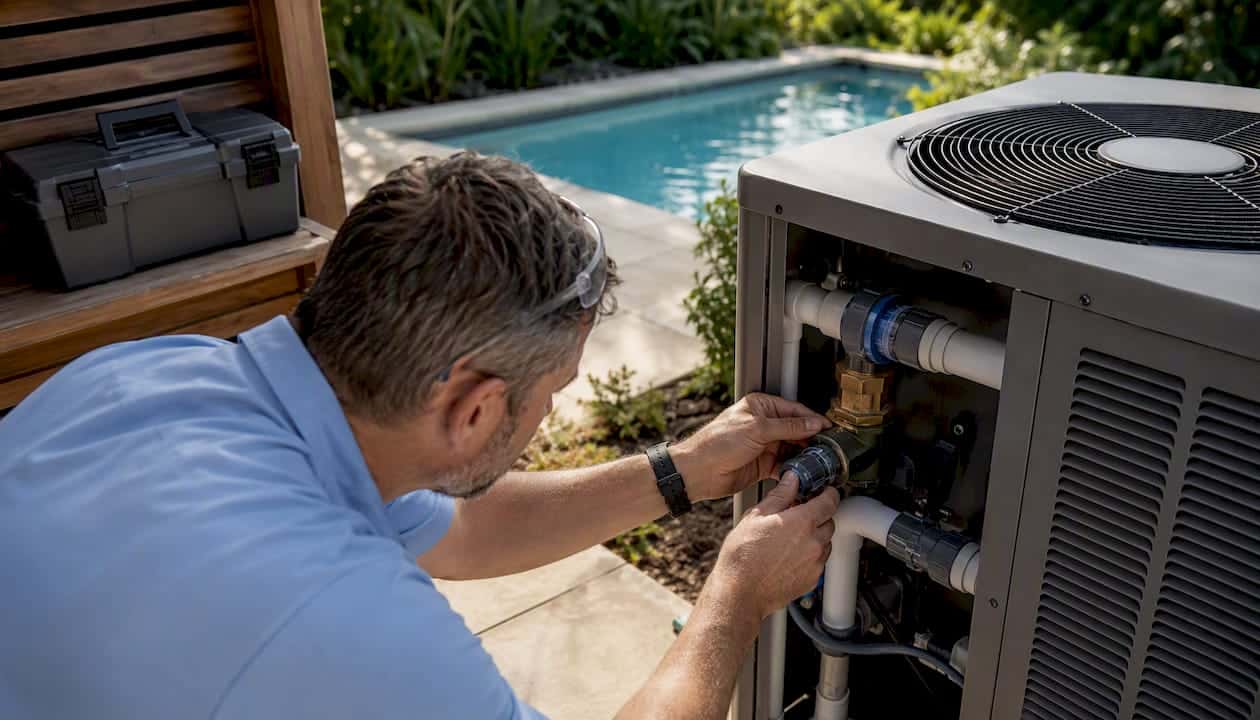
Pro Tip: Keeping your pool deck clean and clear of debris also protects the equipment pad. Organic debris blown against the heater cabinet accelerates corrosion and blocks heat-pump airflow. A clean deck is part of heater maintenance.
How long does troubleshooting take, and what does repair cost?
| Task | Typical time | Rough cost range |
|---|---|---|
| DIY checklist (breaker, thermostat, filter, flow) | minutes to about an hour | — |
| Technician diagnostic visit | 1–2 hours | service call fee applies |
| Minor part replacement (igniter, flame sensor, thermostat) | 2–4 hours total | $100 parts and labor |
| Major component (heat exchanger, gas valve, control board) | 4–6 hours | — |
| Full heater replacement | Multi-day (permit, installation) | Varies by unit and installation |

For older units, a repair estimate exceeding roughly $500 often makes replacement the smarter financial decision. Heat exchanger parts alone frequently cost $500–$800, and an aging unit will likely need another repair within a season or two. If you’re already planning a pool equipment upgrade, combining it with a resurfacing project can reduce total labor costs significantly.
Pro Tip: Always ask for a written estimate with labor and parts listed separately. That breakdown lets you compare bids accurately and confirms you’re not paying inflated parts markups.
How Classicmarcite can help when you need professional service
Classic Marcite has been serving Florida pool owners since 1988, with more than 100,000 pools resurfaced across residential, commercial, and resort properties. As Central Florida’s largest Pebble Tec® applicator, the team regularly coordinates equipment upgrades alongside resurfacing and remodeling projects, which means heater-related issues come up on job sites regularly.
If your troubleshooting checks haven’t resolved the problem, or if you’re looking at a repair estimate that makes replacement worth considering, Classicmarcite can help you think through the full picture. Combining a heater upgrade with a pool resurfacing project in Orlando or a full pool remodel reduces mobilization costs and gives you a fresh, fully functional pool in a single project.
When you reach out, have ready: heater model and serial number, the error codes you recorded, your filter pressure reading, and the photo inventory from your equipment pad. That information speeds the initial conversation and gets you to a solution faster.
- Established 1988, with a portfolio spanning residential pools, commercial properties, resorts, and theme parks
- Largest Pebble Tec® applicator in Central Florida
- Services include pool resurfacing, remodeling, tile and deck repair, equipment upgrades, and water feature installation
- Serving Orlando, Jacksonville, and surrounding Florida communities
Pro Tip: If your heater is 8 or more years old and you’re already budgeting for a repair, ask about pool resurfacing options at the same time. Scheduling both together saves a second mobilization and often extends the overall life of the pool system.
Key Takeaways
Most pool heater problems in Florida trace back to low water flow, and a six-step checklist covering the breaker, thermostat, pump, filter, gas valve, and error-code reset resolves the majority before a technician is needed.
| Point | Details |
|---|---|
| Flow is the first check | Over 70% of heater faults are flow-related; clean the filter and confirm pump operation before anything else. |
| Filter pressure threshold | A pressure reading notably above your clean baseline means clean the filter immediately. |
| Gas, electrical, refrigerant: stop | Any work on gas lines, circuits above 120V, or refrigerant systems requires a licensed technician. |
| Error code protocol | Record the code, power-cycle once for 30–60 seconds, and call a pro if the code returns. |
| Repair vs. replace threshold | For older units, a repair estimate above a moderate cost level often makes replacement the smarter decision. |
Classicmarcite’s perspective on heater troubleshooting
The pattern we see most often during resurfacing and remodel jobs is a heater that’s been struggling for months because the owner assumed the problem was internal. Nine times out of ten, it’s a filter that hasn’t been serviced, a chemistry imbalance that’s scaled the heat exchanger, or a flow switch that’s been tripping because the pump speed was reduced after a variable-speed upgrade without adjusting the heater’s minimum flow requirement. None of those are catastrophic failures. All of them are preventable.
What we’d push back on is the idea that heater maintenance and pool renovation are separate decisions. When a pool is due for resurfacing, the equipment pad is already being evaluated. That’s the right moment to assess whether the heater is worth keeping, whether the plumbing supports the current heater’s flow requirements, and whether an upgrade makes financial sense over the next decade. Doing that work in isolation costs more and creates more disruption. The homeowners and property managers who get the most out of their pools treat the surface, the equipment, and the chemistry as one system, not three separate line items.
Useful sources and further reading
- Pool Heater Problems Guide: Troubleshooting Common Failures — safety rules and pressure/flow switch guidance
- Pool Heater Not Working? 7 Causes and Fixes — quick checklist and repair-vs-replace guidance
- Pool Heater Troubleshooting: Fix by Symptom — error code reference and reset procedures
- Pool Heater Troubleshooting: Gas, Electric, Heat Pump — type-specific diagnostic guidance
- Hayward: How to Troubleshoot Heater Problems — manufacturer-level guidance for Hayward units
- Classicmarcite Pool Maintenance Checklist for Homeowners — seasonal Florida maintenance schedule
- Classicmarcite: Replace Pool Equipment the Right Way — repair-vs-replace decision framework
- Water Heater Repair Guide for Homeowners — appliance-repair perspective on gas and electrical hazards
Always keep your heater’s owner’s manual accessible and note the model and serial number before any service call. Manufacturer manuals contain model-specific error code tables and reset procedures that generic guides cannot replicate.