TL;DR:
- Automation in commercial pools involves integrated hardware like sensors, chemical controllers, and robotic cleaners, not just management apps. Proper implementation improves operational efficiency, boosts upsell rates, reduces energy costs, and ensures regulatory compliance, but success relies on staff acceptance and infrastructure readiness. Focusing on layered, integrated systems and maintaining a well-resurfaced pool maximizes automation benefits and enhances overall value.
Commercial pool operators today face a perfect storm of rising labor costs, tightening health regulations, and guests who expect flawless water quality every time they step in. The role of automation in commercial pools has shifted from a luxury upgrade to an operational necessity. Yet most operators still think “automation” just means scheduling software or a mobile app. The reality is far more layered, and the financial impact is far larger than most facility managers realize. This article breaks down exactly how automation works, what it actually costs you to avoid it, and how to implement it without disrupting your staff.
Table of Contents
- Key Takeaways
- The role of automation in commercial pools: core technologies
- Operational and financial benefits worth knowing
- Common misconceptions about automation adoption
- A practical guide to implementing automation
- My honest take on what automation actually delivers
- How Classic Marcite supports your automation investment
- FAQ
Key Takeaways
| Point | Details |
|---|---|
| Automation spans hardware and software | True automation includes physical sensors, chemical controllers, and robotic equipment, not just management apps. |
| Financial gains are measurable | Upsell capture rates can jump from under 15% to over 50% with systematic automation in place. |
| Energy savings are significant | Smart pump scheduling and robotic cleaners can cut filtration runtimes by roughly one-third. |
| Staff adoption is the real risk | Most automation failures trace back to workflow rejection by staff, not technical malfunction. |
| Resurfacing extends automation ROI | A properly resurfaced pool protects sensors, equipment, and plumbing, making your automation investment last longer. |
The role of automation in commercial pools: core technologies
When operators say they have “automation,” they often mean a route management app on a tablet. That is one thin layer of a much deeper system. True commercial pool automation stacks multiple technologies that work together.
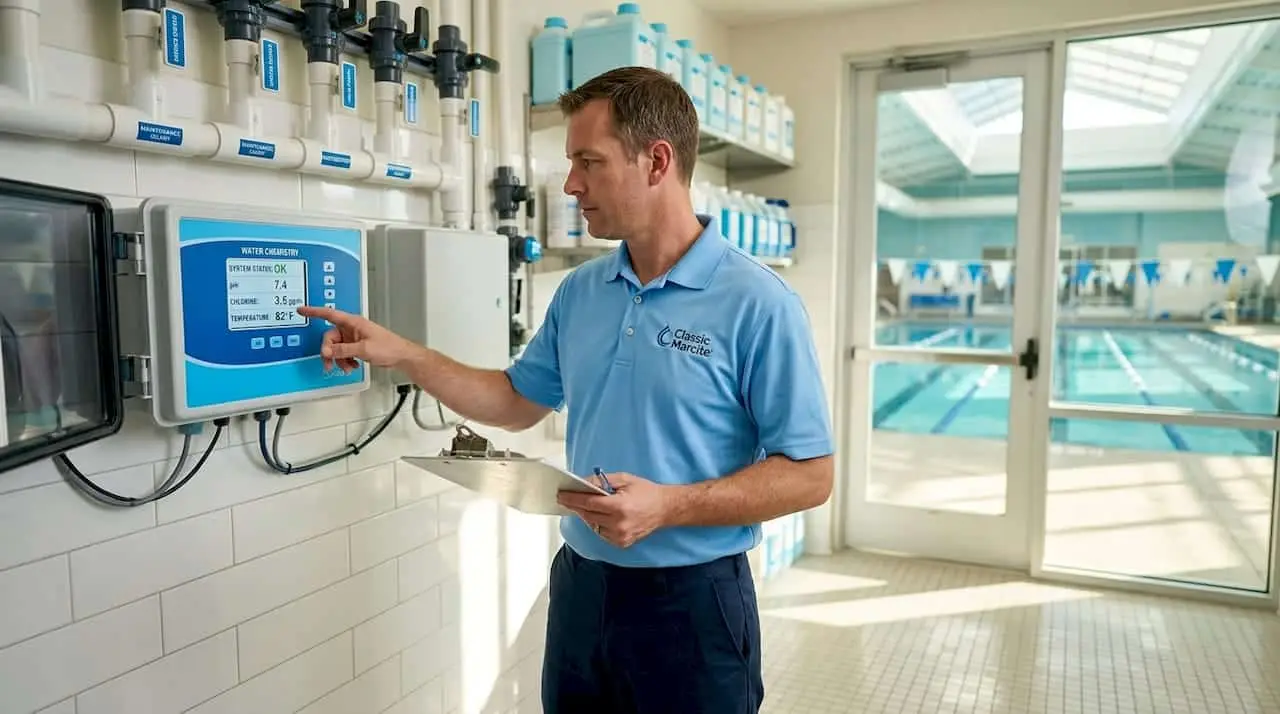
Water chemistry controllers and sensors are the foundation. These devices continuously measure pH, free chlorine, oxidation-reduction potential (ORP), and temperature. They feed that data to a closed-loop dosing system that injects precisely the right amount of chemical at the right time. Closed-loop chemical dosing prevents the spike-and-crash pattern that strains motors, heaters, and interior surfaces while keeping water compliant with health codes around the clock.
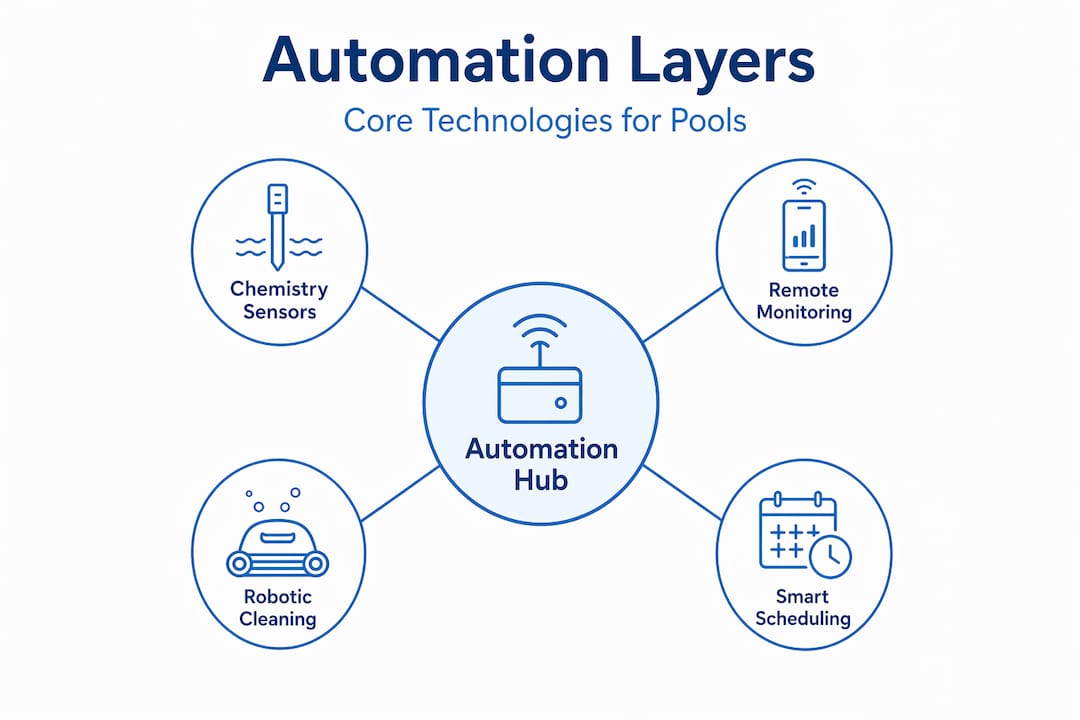
Remote monitoring platforms sit on top of those sensors. Cloud-connected dashboards give your technicians real-time visibility into every piece of equipment across every facility they manage. Early anomaly alerts from remote monitoring cut costly downtime before a small problem becomes a full equipment failure.
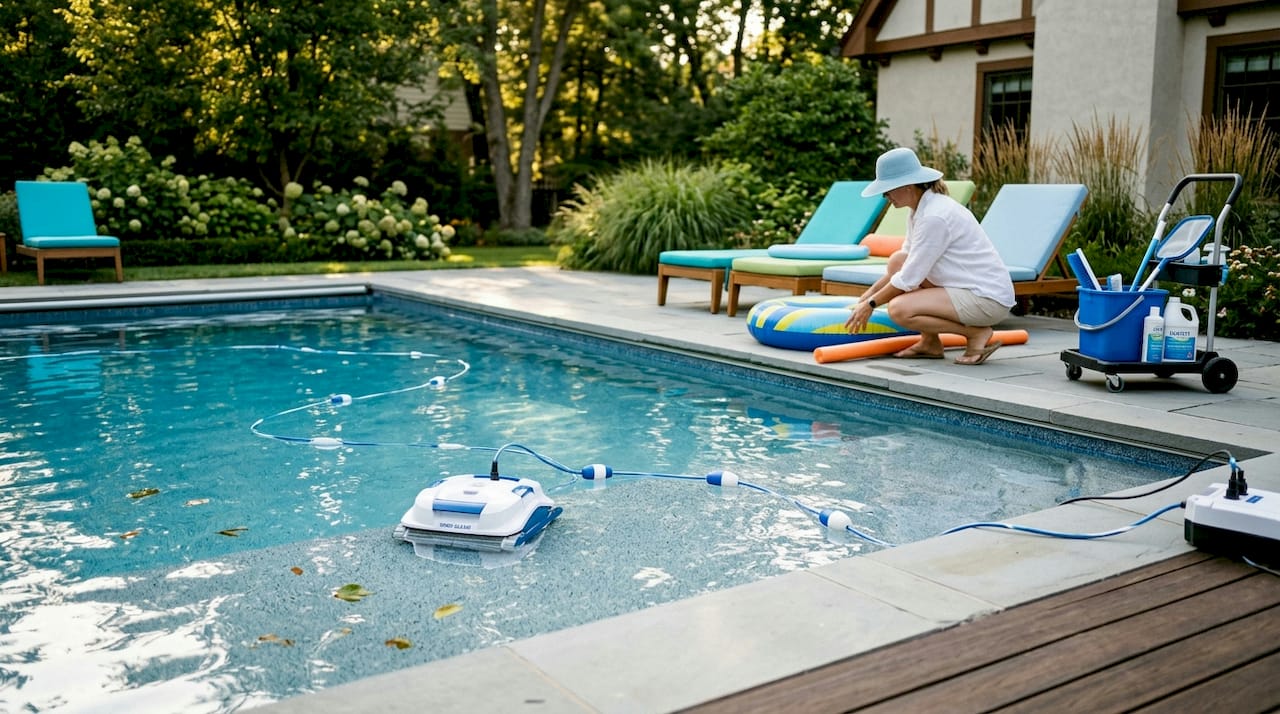
Robotic cleaners and smart pump scheduling handle the physical work. Variable-speed pumps paired with scheduling software reduce primary filtration runtimes by about 33% in energy use, which lowers both your electricity bill and mechanical wear on motors and impellers. Robotic cleaners handle debris removal on a set schedule, freeing technicians for higher-value inspection and maintenance tasks. You can find detailed breakdowns of these systems and their cost impact in this resource on energy-efficient pool solutions.
The mistake most operators make is buying one layer and calling it done. A dosing controller without remote monitoring gives you good chemistry but no visibility. Remote monitoring without smart pump control saves alerts but not energy. These tools generate their best return when integrated together.
Pro Tip: Before purchasing any automation hardware, map your current operational gaps: chemistry failures, energy waste, or missed service calls. Buy the layer that solves your most expensive problem first, then build outward.
Operational and financial benefits worth knowing
The operational case for automation is well established. The financial case is where most operators get surprised.
Consider upsell capture on a commercial pool service route. Most teams running manual inspections capture repair and upgrade opportunities at a 5 to 15% rate, largely because technicians notice issues opportunistically rather than systematically. Systematic automation pushes that capture rate to 35 to 55%. On a typical commercial route generating $444,000 annually, that shift produces a revenue lift between $67,000 and $133,000 per year without adding a single new client.
Payment recovery is another area where the numbers are stark. Manual follow-up on failed recurring payments loses 30 to 50% of clients within 60 days. Automated payment dunning recovers 60 to 75% of those failed transactions, protecting cash flow that operators rarely think to attribute to their automation budget.
The table below shows how the effects of automation on pool efficiency translate into measurable financial outcomes:
| Automation Area | Manual Baseline | Automated Result |
|---|---|---|
| Upsell capture rate | 5 to 15% | 35 to 55% |
| Failed payment recovery | Loss of 30 to 50% of clients | Recovery of 60 to 75% of payments |
| Filtration runtime | Standard full cycle | Reduced by approximately 33% |
| Chemical dosing accuracy | Manual batch adjustments | Continuous closed-loop correction |
| Compliance documentation | Manual logs, audit risk | Automated digital records |
Compliance is worth its own paragraph. Health departments in Florida and across the country are tightening inspection standards for commercial facilities. Automated digital logs remove the manual paperwork burden and give your team clean audit trails without scrambling before an inspection. The risk reduction here is not just regulatory. Automated chemical management also reduces direct staff contact with hazardous substances, which lowers liability exposure and improves staff safety across your entire operation.
For operators who manage multiple commercial pools or are building a portfolio for eventual sale, automation directly affects exit valuation. Routes with documented automation systems, clean compliance records, and consistent upsell revenue command higher multiples because buyers can see repeatable, defensible cash flow.
Common misconceptions about automation adoption
The biggest misconception in commercial pool management is that automation means replacing your team with software. It does not. The operators who fail at automation almost always make one of two mistakes: they buy a platform that fights their existing workflows, or they hand the system to staff without training and expect results.
Most automation failures come from staff workflow rejection, not from technical flaws in the system itself. A platform that forces technicians to change every habit they have built over years will be ignored or worked around. The platforms that succeed are the ones that layer on top of what staff already do, making familiar tasks faster rather than replacing them entirely.
Here is what effective automation adoption actually looks like in practice:
- Start with one system. Do not automate chemistry, routing, billing, and equipment monitoring at the same time. Pick the highest-impact gap and solve that first.
- Choose tools that integrate with existing software. Automation layers that support your current route management platform produce better results than standalone systems requiring parallel workflows.
- Train before you launch. Staff need to understand why the change is happening and what success looks like for them personally. Adoption follows understanding.
- Assign an internal champion. One person who is bought in and accountable for the new system makes a measurable difference in how quickly the rest of the team follows.
- Build in a review period. Set a 60-day checkpoint to assess what is working and what needs adjustment before expanding to additional automation layers.
There is also a sizing problem operators run into. Commercial-grade automation hardware is not the same as residential controllers scaled up. Commercial automation requires sensors and controllers rated for higher bather loads, greater chemical demand, and continuous operation. Buying undersized equipment to save money upfront is one of the most reliable ways to generate expensive failures within two years.
Pro Tip: When evaluating vendors, ask specifically how their system integrates with your existing route management software. If the answer is vague, that is a warning sign.
A practical guide to implementing automation
Getting from “we should automate” to “automation is working for us” takes a structured approach. Here is how to move through it without wasting budget on the wrong tools.
- Audit your current pain points. Pull your last 12 months of service records and identify where failures, compliance notices, or revenue leaks happened most often. Your first automation investment should target the highest-cost problem on that list.
- Assess your infrastructure. Older pool equipment may need upgrades before automation hardware can be installed effectively. A pool with a degraded surface, cracked plumbing, or aging pumps will underperform with automation in place, because the automation system is only as reliable as the physical infrastructure beneath it. Explore commercial pool upgrade ideas to understand what your facility may need before installing new technology.
- Evaluate vendors on integration capability, not features. The vendor with the longest feature list rarely wins. The vendor whose system fits cleanly into how your team already works will deliver faster ROI and fewer adoption headaches.
- Pilot on one facility. Run your chosen automation system at a single location for 60 to 90 days before rolling out to your full portfolio. This gives you real performance data and catches configuration issues before they scale.
- Define success metrics before launch. Know exactly what you are measuring: energy cost per month, chemical spend, service call frequency, compliance incidents. Without a baseline and a target, you cannot prove the value of what you are implementing.
- Plan for continuous improvement. Automation is not a one-time installation. Software updates, sensor calibration, and periodic system reviews keep performance from degrading. Assign someone the ongoing responsibility of monitoring system health and initiating upgrades.
If you want to understand the full cost-saving potential before committing to a full build-out, the resource on pool automation savings is worth reviewing alongside your current operating costs.
My honest take on what automation actually delivers
I have watched operators buy expensive automation systems and see no return, and I have seen others retrofit a modest controller setup and cut their chemical costs by a third within one season. The difference was never the technology. It was always the readiness of the operation beneath it.
Automation is a necessary evolution for any commercial pool operation that wants to stay competitive as labor costs rise and regulations tighten. It is not, however, a substitute for skilled people who understand water chemistry, equipment behavior, and guest safety. The best results in commercial maintenance come from using automation to handle the routine work precisely and consistently, then freeing your experienced staff to handle the judgment calls that machines cannot make.
What I find most underappreciated is the compounding effect. Automation does not just save you money today. It builds a documented track record of compliance, efficiency, and service quality that makes your operation worth more tomorrow, whether you are growing, selling, or attracting institutional clients who require proof of professional management.
The future of this space is moving toward predictive analytics, where systems flag equipment failures before they happen based on performance trend data rather than waiting for an alert threshold to trip. That shift will make the role of automation in pool operations even more central than it already is. The operators who start building these systems now will have a significant advantage when that capability becomes standard.
— Results
How Classic Marcite supports your automation investment
Automation delivers its full return only when the physical pool is in the condition to support it. Sensors embedded near cracked or pitted surfaces give inaccurate readings. Aging interiors create chemistry imbalances that override even the best dosing controller. Equipment fittings corroded by years of chemical exposure shorten the lifespan of anything connected to them.

Classic Marcite has resurfaced more than 100,000 pools across Florida since 1988, including high-traffic commercial facilities at resorts, hotels, and theme parks. Their team understands what commercial pool infrastructure needs to perform reliably alongside modern automation systems. Whether your facility needs pool resurfacing in The Villages or a full renovation in Central Florida, Classic Marcite provides the durable finishes that protect your equipment and extend the value of every automation dollar you invest. Contact them for a free estimate and build a pool that your automation system can actually work with.
FAQ
What does the role of automation in commercial pools actually include?
Automation in commercial pools covers physical hardware like chemical dosing controllers and sensors, remote monitoring platforms, robotic cleaners, and smart pump scheduling systems. It goes well beyond management software.
How much can automation reduce energy costs in a commercial pool?
Smart pump scheduling and robotic cleaners can reduce primary filtration runtimes by approximately 33%, cutting both energy consumption and mechanical wear on pool equipment.
Why do most commercial pool automation projects fail?
Most failures stem from staff rejecting new workflows rather than from technical problems. Automation systems that layer onto existing processes and tools see significantly higher adoption rates.
Does automation help with health code compliance?
Yes. Automated chemical dosing maintains consistent water quality, and automated digital logs create clean audit trails that reduce the risk and time burden of health department inspections.
When should I resurface my pool before installing automation equipment?
If your pool surface is pitted, cracked, or chemically degraded, resurface it before installing sensors or new equipment fittings. A compromised surface undermines sensor accuracy and accelerates corrosion of automation hardware.
