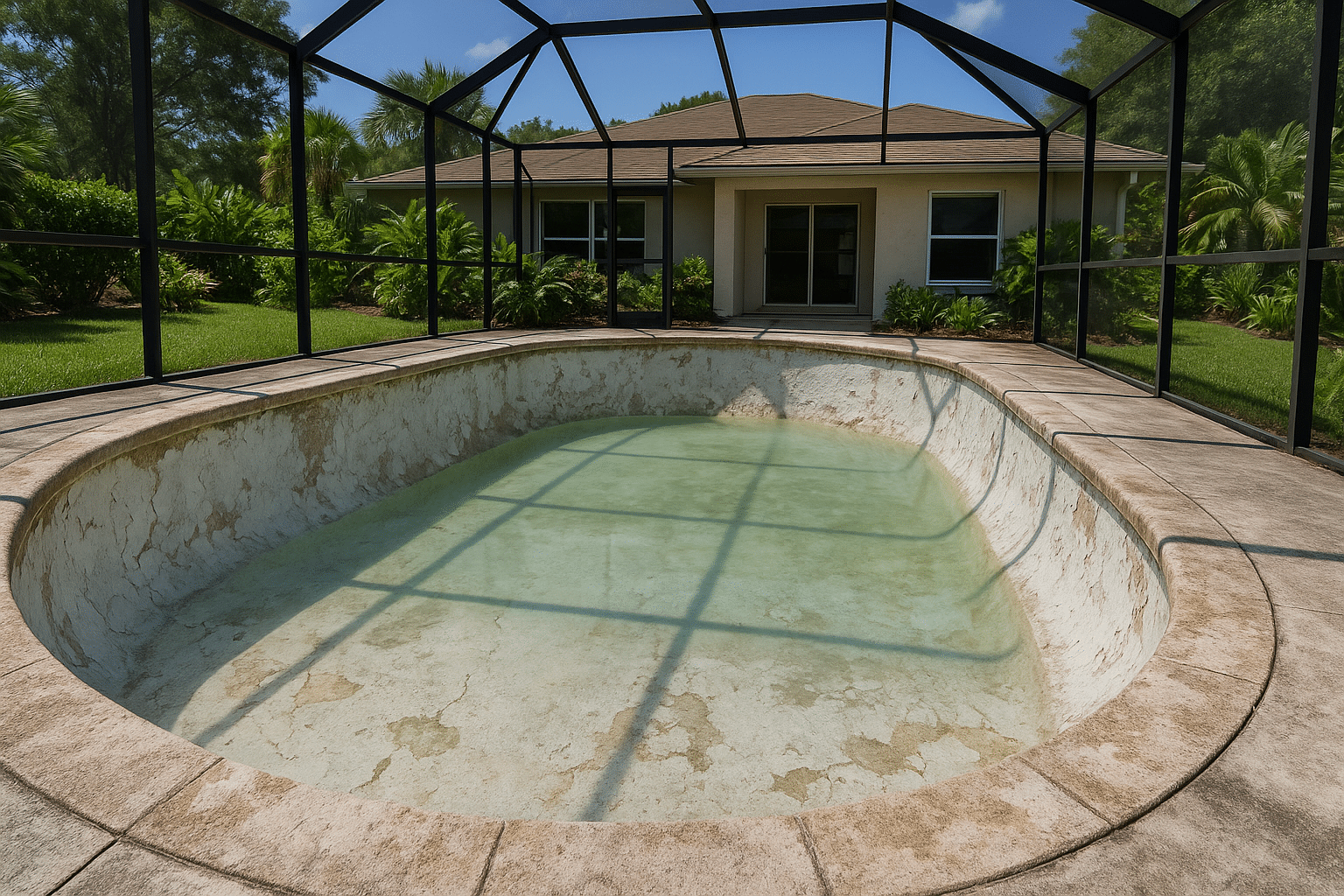
TL;DR: Most plaster pool surfaces last 7–12 years before showing serious wear. If you notice rough textures, persistent stains, visible cracks, unexplained water loss, or spiking chemical costs, your pool is likely overdue for resurfacing. Catching these warning signs early keeps repair costs lower and protects the structural shell underneath.
Florida pools work hard. Between year-round sun, heavy swim seasons, and the chemistry demands that come with warm water, a pool interior takes a beating that pools in cooler climates simply never face. Most homeowners don’t think about their pool surface until something looks or feels obviously wrong — by which point the damage is often deeper than the surface itself.
Below are the seven most reliable warning signs that your pool interior is due for resurfacing. If you’re seeing even two or three of these at the same time, it’s time to call a professional for an assessment.
How Long Should a Pool Surface Actually Last?
CDC guidelines recommend keeping pool pH between 7.0 and 7.8, and that balance matters more than most owners realize — pH that consistently drifts outside that range is one of the primary accelerators of surface deterioration. Material choice is the other big factor.
- Standard white plaster (marcite): In Florida’s climate, typically 5–10 years
- Quartz aggregate: 10–15 years
- Premium pebble finishes (Pebble Tec®, Pebble Sheen®, Pebble Fina®): 15–20 years or more
Heavy-use commercial pools — hotels, resorts, HOA communities — can wear through a standard plaster surface in as few as five years because of higher bather loads, more aggressive chemical demand, and more frequent brushing. Knowing your surface type and its age is the starting point for any honest condition assessment.
Sign 1: The Surface Feels Rough or Abrasive
Run your hand or bare foot slowly along the pool floor and walls. A sound surface should feel smooth and consistent. If it feels gritty, scratchy, or outright sharp in spots, the protective top layer has eroded and the underlying aggregate is exposed.
This matters for two reasons: safety and maintenance. Rough surfaces scrape swimmers’ feet, knees, and hands — children are especially vulnerable. They also act like Velcro for algae and debris, making the pool harder to keep clean no matter how diligently you brush or shock it.
A rough texture is one of the clearest physical indicators that resurfacing is no longer optional.
Sign 2: Stains That Won’t Come Out
Not every pool stain means the surface is failing. Algae blooms, leaf tannins, and minor mineral deposits can usually be addressed with targeted chemicals or a careful acid wash. The stains that signal a resurfacing need are different — they keep coming back, resist repeated treatment, or have permanently discolored the surface in irregular patches.
Common culprits include iron, calcium, and copper minerals that precipitate out of unbalanced water and bond to a surface that has become too porous to resist them. Once the surface reaches that level of porosity, no amount of chemical treatment restores it. The surface itself needs to be replaced.
Rust-colored stains deserve particular attention. These can indicate that the tie wire or rebar inside your pool’s shell is beginning to oxidize — a structural concern that goes well beyond aesthetics.
Sign 3: Visible Cracks in the Surface
Hairline cracks in plaster are common and don’t always mean structural trouble. Surface crazing — a fine network of shallow cracks from normal thermal expansion and contraction — can be cosmetic. The cracks you cannot ignore are those that are growing, running along the floor or walls in straight lines, or feel noticeably deep when you press your finger into them.
Cracks create a direct pathway for water to work behind the plaster and against the concrete or gunite shell underneath. Once water gets between the plaster and the shell, delamination accelerates and the prep work required before the next resurfacing becomes more extensive — and more expensive. Delaying a resurfacing job when visible cracks are present is a false economy.
Sign 4: Peeling, Flaking, or Spalling Plaster
Spalling is the technical term for plaster that is delaminating — lifting or flaking away from the underlying structure in thin layers, leaving a pockmarked, uneven surface beneath. It typically appears first on the pool floor, steps, and corners where water chemistry stress concentrates.
Spalling is usually caused by prolonged imbalances in water chemistry, particularly low pH or low calcium hardness, which makes the water chemically aggressive enough to eat into the plaster from the inside out. Once spalling starts, spot repairs are not a real solution: they’re visible, they don’t address the ongoing chemistry-driven degradation happening across the rest of the surface, and they tend to fail within a season or two. A full resurface is the appropriate response, and waiting only increases the scope of the structural prep required.
Sign 5: Unexplained Water Loss
Every outdoor pool loses water to evaporation. In Florida’s heat and sun, that’s normal. What isn’t normal is losing noticeably more water than evaporation accounts for.
A useful first step is the bucket test, recommended by leak detection professionals: fill a five-gallon bucket with pool water, set it on a pool step so it’s partially submerged, and mark the water level inside the bucket and on the pool wall. After 24 hours, compare the two. If the pool’s water level has dropped more than the bucket’s, you likely have a leak — not just evaporation. American Leak Detection recommends this as a reliable DIY screening method before calling a professional.
Deteriorated plaster develops micro-cracks and porous patches that allow water to seep through continuously. A leak losing just half an inch of water per day can waste thousands of gallons per month and, left unchecked, can erode the soil beneath the shell and compound into a far more serious structural problem.
If your auto-fill valve is running constantly or your water bill has climbed without explanation, take that seriously.
Sign 6: Spiking Chemical Usage
If you’re adding significantly more chlorine, acid, or other balancing chemicals than you used to — and your water still looks dull or cloudy — a deteriorating surface is often why. As plaster becomes porous, it becomes harder to maintain proper water balance. The surface actively leaches calcium and other minerals into the water, constantly pulling chemistry out of spec and demanding more product to correct it.
The CDC recommends maintaining pool pH between 7.0 and 7.8 to keep chlorine working effectively and protect both swimmers and pool surfaces. When your surface is no longer intact, hitting and holding that range becomes a constant, expensive battle.
Rising chemical costs are a real operational burden — especially for HOA pools, apartment communities, hotels, and resorts that manage large volumes of water. If your chemical spend has climbed noticeably year over year with no change in bather load, have the surface evaluated.
Sign 7: Persistent Discoloration or Fading
A fresh pool interior is bright and vibrant — white plaster gives water that classic blue clarity, while aggregate finishes hold rich, consistent color. When the surface has aged past its useful life, that brightness fades into a dull, chalky, or blotchy appearance that cleaning cannot restore.
Fading isn’t just cosmetic. Surface coatings wear thin over time, making it harder to repel stains and maintain water clarity. If your pool consistently looks dingy even right after it’s been cleaned and balanced, the surface is past the point where maintenance alone can help. For homeowners preparing to sell — or HOA boards and property managers whose pool is a visible amenity — a faded, tired-looking pool interior signals neglect to every visitor who sees it.
When Multiple Signs Appear Together, Act Now
Individual signs can sometimes be monitored for a season. But when you’re seeing a combination — rough texture plus persistent staining plus increased chemical use, for example — that combination typically indicates a surface that is past the point where waiting makes financial sense. Each additional season on a deteriorating surface increases the prep work required and raises the risk of underlying damage that must be addressed before a new finish can be applied.
Central Florida’s year-round swim season and intense UV exposure mean plaster here often reaches its limit closer to the lower end of the 5–10 year range for traditional marcite. If your pool is approaching or past that mark and you’re seeing any of the signs above, a free professional assessment is the logical next step.
Classic Marcite has resurfaced more than 100,000 residential and commercial pools across Central Florida and Northeast Florida since 1988. Every crew member is a direct employee — no subcontractors — which is how we hold quality consistent across more than 1,000 projects a year. If you’d like to understand what resurfacing costs before committing to anything, see our pool resurfacing cost guide for Central Florida. Or contact us directly for a free, no-obligation estimate.