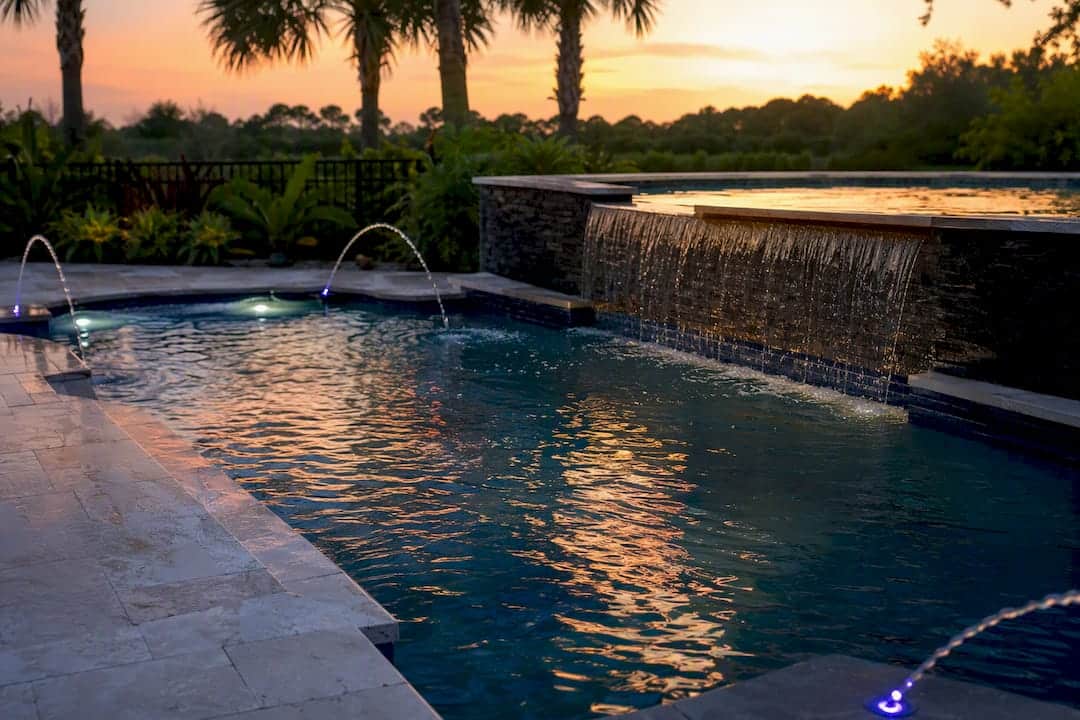
For a low-cost play upgrade, install bubblers on the sun shelf. For a sleek, modern look, choose laminar deck jets or a sheer descent waterfall. For resort-style drama, go with a rock waterfall or grotto, and for a retrofit with zero plumbing work, a floating fountain gets you movement and light without touching your equipment pad.
Each of these pool water feature ideas fits a different budget, pool style, and skill level for retrofitting. Deck jets and laminar arcs suit contemporary rectangular pools and can often be added to an existing pool with the right pump upgrade. Sheer descents work as accent walls behind raised spas or tanning ledges. Bubblers are the cheapest entry point and the safest for small children. Scuppers and spouts split the difference: low cost, minimal plumbing, and a nice trickle sound. Spa spillovers only make sense if you already have or plan to build a raised spa.
The one technical snag that trips up almost every retrofit conversation: your existing pump probably cannot supply the extra flow these features need without robbing your main circulation. That single fact decides whether a feature is a simple add-on or a full remodel.
Key Takeaways
The right pool water feature depends on matching pump capacity and flow rate to the visual effect you want, since undersized plumbing is the most common reason a retrofit disappoints.
| Point | Details |
|---|---|
| Match flow to feature | Deck jets need 5 to 12 GPM per jet; sheer descents need 12 to 18 GPM per foot of blade. |
| Budget for retrofit premiums | Adding a feature to an existing pool typically costs 30 to 50% more than building it new. |
| Prioritize sound and usage | Choose features you’ll actually run often and that fit your household’s tolerance for noise. |
| Protect against water loss | Expect roughly an extra inch of weekly evaporation and offset it with covers or timers. |
| Call a specialist for complex work | Classicmarcite handles pool renovation, resurfacing, and hydraulic retrofit work for features requiring dedicated pumps or structural changes. |
Table of Contents
- 10 Pool Water Feature Ideas Worth the Plumbing
- Adding a Feature to an Existing Pool: What to Check First
- What Pool Water Features Actually Cost
- Lighting That Makes a Feature Worth Running at Night
- What a Water Feature Changes About Your Maintenance Routine
- When to Bring In a Pool Professional
- Noise Considerations and Sound Level Management
- Water Conservation and Eco-Friendly Feature Options
- Automation and Smart Control Options
- Safety Considerations Related to Water Features
- What Homeowners Get Wrong About Water Features
- Ready to Add a Water Feature the Right Way?
- Sources
10 Pool Water Feature Ideas Worth the Plumbing
1. Deck jets and laminar jets
These shoot a clean, glassy arc of water from the pool deck back into the water, and they read as modern from ten feet away or fifty. A typical laminar jet needs 5 to 12 GPM with a throw distance of 5 to 15 feet, and fixtures alone run $200 to $600 each before installation. Space them in odd numbers (three or five) for a more natural rhythm along a straight pool edge.
2. Sheer descent (blade) waterfalls
A sheer descent sends a thin, uniform sheet of water off a raised wall or spa edge, and it’s become the go-to backdrop for spas and raised planters. Plan on 12 to 18 GPM per linear foot of blade, which means even a modest 3 foot unit often needs its own dedicated pump rather than a tap off the main line.
3. Rock waterfalls and grottos
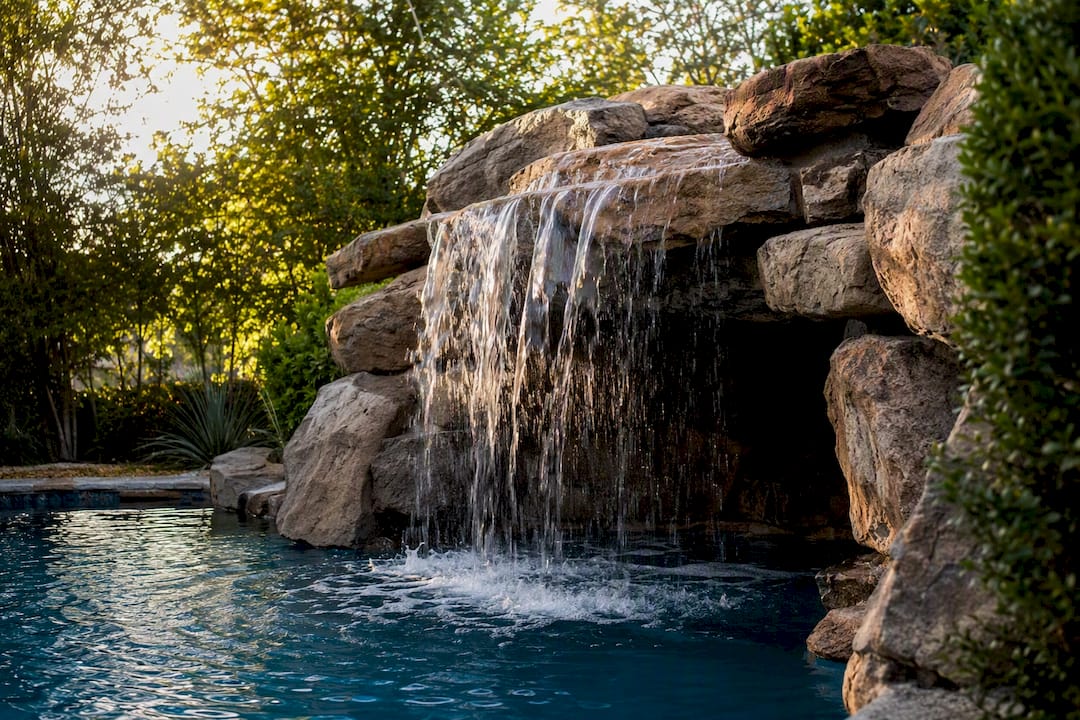
Nothing says resort quite like boulders stacked into a cascading waterfall with a cave behind it. It’s also the heaviest lift on this list: structural footings, extensive plumbing, and often a crane for larger stone. Retrofitting one into an existing pool deck typically adds 30 to 50% to the total cost compared to building it during new construction.
4. Scuppers and spouts
These are simple wall-mounted spouts, often bronze or stone, that pour a steady stream from a raised wall into the pool below. They’re the budget entry point among decorative waterfall ideas, with simple new-construction units starting around $900 installed and needing nothing more than a standard line tap in most cases.
5. Bubblers and gushers
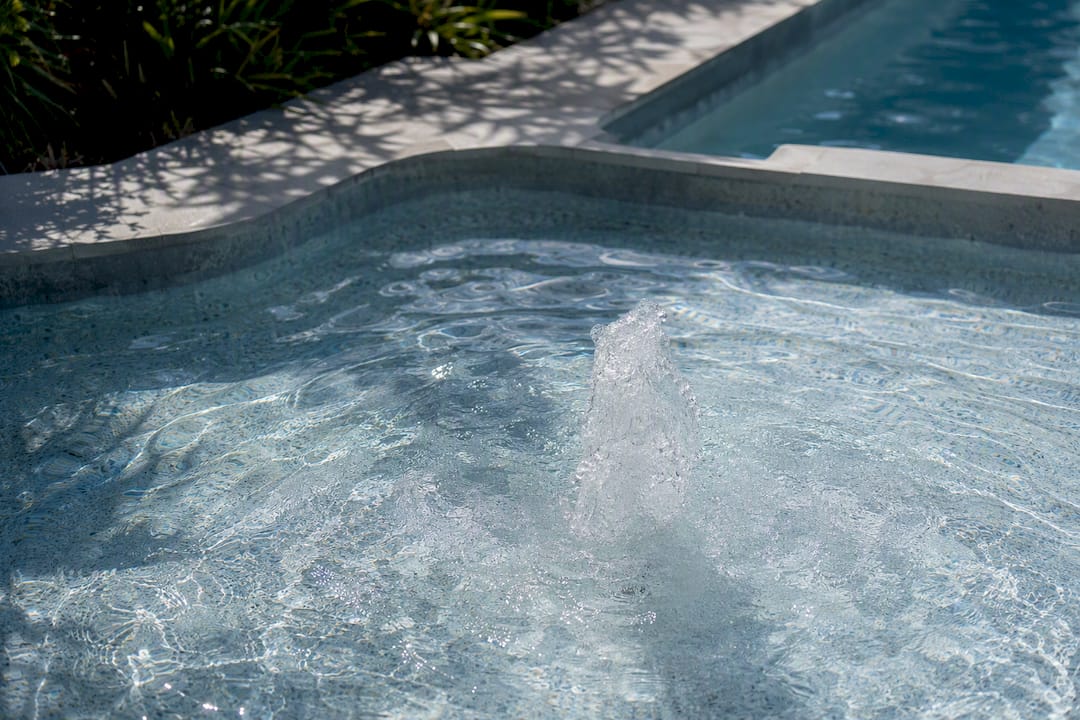
Bubblers push a gentle column of aerated water up through a shallow shelf or baja step, and kids treat them like a personal fountain. They run at low flow, sit in water shallow enough for toddlers, and rarely need a dedicated pump. This is often the easiest of all in-pool fountains to retrofit.
6. Spa spillovers
If your pool has an attached raised spa, a spillover wall turns the connection into a visual and audible feature instead of a plain overflow edge. The sound carries well, which makes spillovers one of the better choices when you want water noise you’ll actually notice from the patio.
7. Rain curtains
A rain curtain drops a wide, even sheet of water from an overhead structure, typically a pergola beam or raised wall, straight down into the pool. It’s theatrical and works best paired with a pergola or covered lounge area you’re already building, since retrofitting overhead structure purely for a rain curtain gets expensive fast.
8. Floating fountains
A floating or solar-powered fountain sits on the water’s surface and needs no plumbing or electrical trenching at all, which makes it the most practical retrofit choice when you want movement and light without touching your pool’s infrastructure. Move it, remove it for parties, or swap it out seasonally.
9. Fire-and-water bowls
Fire bowls set along a raised wall, paired with a small water spillway beneath each one, deliver serious drama at night. They need gas lines in addition to plumbing, and any fire feature near a pool deck should sit far enough from swimmers and pool chemicals to meet local fire-safety clearance rules.
10. Deck-mounted fountains and statuary
A cast stone or bronze fountain piece mounted at the pool’s edge is the lowest-commitment way to add visual interest. Many models connect to a single dedicated line and small submersible pump, making them one of the simpler creative poolside features to add without major deck work.
Adding a Feature to an Existing Pool: What to Check First
Retrofitting any of these ideas comes down to one question: does your current pump have spare capacity, or does the feature need its own?
- Tapping the return line works for low-flow additions like bubblers or a single scupper, but it steals flow from your filtration and skimmers.
- A dedicated booster pump is usually required for sheer descents and multi-jet laminar arrays, since a 3-foot blade module alone can call for a 3/4 to 2 HP pump depending on head height and width.
- Flow math matters: multiply GPM per foot (sheer descents) or GPM per jet (laminars, bubblers) by your feature’s width or jet count before you ever call a contractor.
- Placement affects performance: laminar jets need stable, fluctuation-free supply pressure to hold their glassy arc, and wind exposure can wreck the effect on an otherwise perfect installation.
- Overflow and vanishing-edge pools need a balance tank sized for the extra water displaced by a waterfall or spillover, which is not a DIY calculation.
Pro Tip: Ask your contractor for the exact GPM and head pressure your chosen feature requires, in writing, before signing anything. If they can’t give you a number, they haven’t sized the pump yet.
Rock features, grottos, and anything touching your electrical panel or balance tank size crosses into territory where a hydraulic engineer or experienced remodeler should be involved, not a general handyman.
What Pool Water Features Actually Cost
Budget conversations go smoother when you know the range before you call anyone. Simple new-construction scuppers start around $900 installed, a pair of deck jets typically lands in the low thousands once wiring and plumbing are added, and a basic sheer descent module runs $1,500 to $5,000. Custom rock waterfalls and grottos can climb past $15,000 once stonework, structural footing, and dedicated pumps enter the picture.
- Retrofitting into an existing pool, rather than building during new construction, typically adds 30 to 50% to the total cost.
- Dedicated pumps, new electrical circuits, and specialty lighting are the line items that push a modest feature into a bigger number.
- Always request the flow specification (GPM) and a line-item estimate, not a lump sum. A vague quote usually means the pump hasn’t been sized correctly yet.
Lighting That Makes a Feature Worth Running at Night
RGB LEDs behind a sheer descent or laminar jet turn a daytime accent into the pool’s nighttime centerpiece, while warm white fixtures give a quieter, more architectural look for grottos and stonework. Retrofitting lighting is usually easier than retrofitting plumbing since low-voltage transformer kits can often run alongside existing wiring with minimal deck disruption.
Pro Tip: Program your color-changing lights to a dimmer scene for late-night swims and a brighter, functional white setting for safety around the water’s edge.
Pairing feature lighting with broader deck and pathway lighting ties the whole backyard together instead of leaving the water feature as an isolated glow.
What a Water Feature Changes About Your Maintenance Routine
Running a waterfall or jet array daily changes three things: water loss, cleaning frequency, and pump wear.
- Expect roughly an extra inch of evaporation per week when a feature runs regularly, more in dry Florida heat, so budget for more frequent top-offs or consider an autofill.
- Inspect nozzles and jet heads monthly for scale buildup, especially in hard water areas, and clean strainer baskets on any dedicated feature pump separately from your main pump basket.
- Run variable-speed pumps at a lower setting for ambient trickle effects overnight and reserve full flow for hours you’re actually poolside, which cuts energy use without shutting the feature off entirely.
Material choice affects how often you’re dealing with repairs at all: AISI 316 stainless steel resists corrosion far better than standard steel on jet fixtures and scupper spouts exposed to chlorine or salt systems.
When to Bring In a Pool Professional
Grotto and rockwork, major plumbing rerouting, balance tank sizing for overflow edges, and any integrated LED or electrical work are the four situations where DIY or general handyman work turns into a liability. Classic Marcite has resurfaced more than 100,000 pools since 1988 and holds the position as the largest Pebble Tec® applicator in Central Florida, with a residential project gallery showing completed water feature integrations.
Pro Tip: Before hiring anyone, ask for the pump GPM/head calculation, a written warranty term, three references from jobs completed in the last two years, and a realistic start-to-finish timeline.
Noise Considerations and Sound Level Management
Water sound is not a fixed volume knob. It’s a function of drop height, flow rate, and the surface the water lands on, and getting it wrong is one of the most common regrets among pool owners who chose a feature for looks alone.
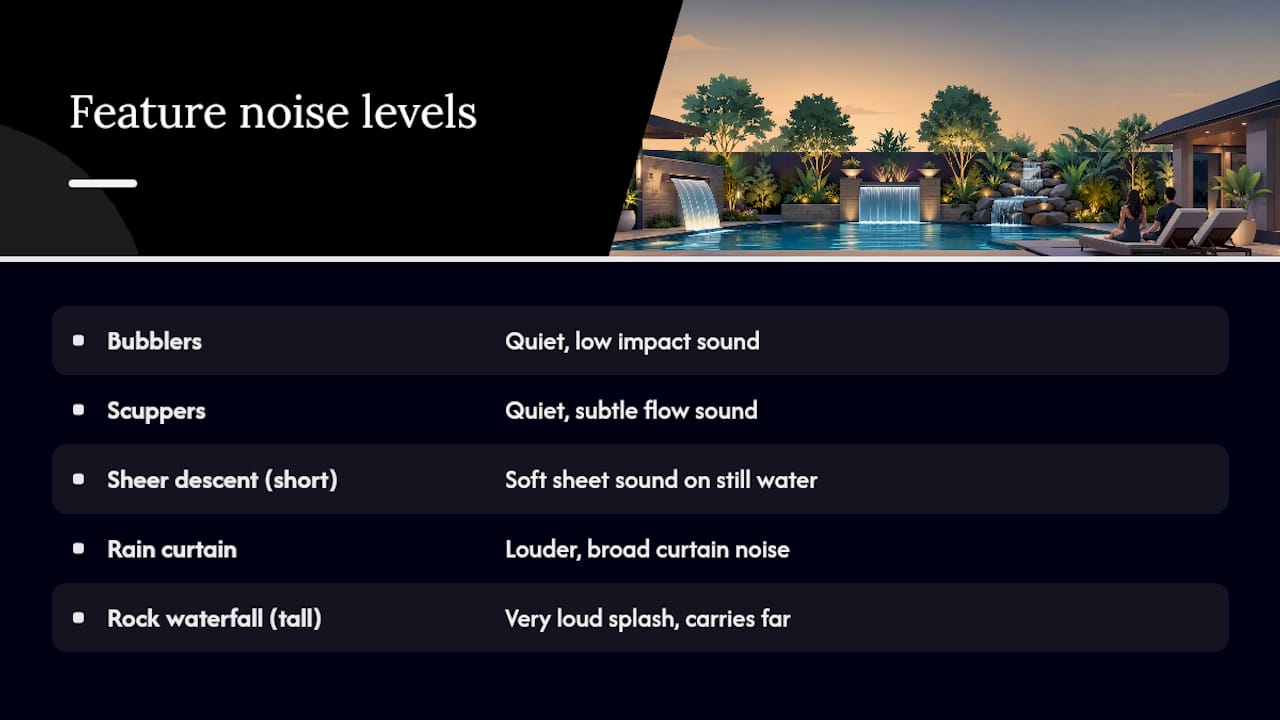
A sheer descent dropping two feet onto still water produces a soft, continuous sheet sound. Drop that same sheet from six feet onto a textured rock ledge, and you get a much louder splash that can carry into bedrooms with open windows or annoy neighbors in tighter suburban lots. Bubblers and scuppers sit at the quiet end of the spectrum, while rain curtains and tall rock waterfalls sit at the loud end.
Design professionals specifically warn against choosing a feature for its visual appeal without weighing how the sound will actually land day to day. A dramatic waterfall that gets turned off within a month because it’s too loud for evening conversation was money spent for nothing.
A few practical fixes if you already love a louder feature: angle the drop so water lands on a submerged ledge rather than open water, which softens impact noise. Add a variable-speed pump so you can run the feature at a lower, quieter flow most of the time and reserve full power for when guests are over. Position deck jets and laminar arcs away from bedroom-facing walls when you have a choice in layout. None of these fixes cost much, but they only work if you plan for sound before construction starts, not after.
Water Conservation and Eco-Friendly Feature Options
Every water feature adds some evaporation, but the amount varies enormously by design, and that variance is where conservation choices actually live.
Sheet-style features like sheer descents and rain curtains expose more surface area to air movement than a contained bubbler, so they tend to lose more water on windy days. Running any feature on a timer rather than continuously cuts total exposure time without eliminating the effect you paid for. A pool cover used overnight, paired with a feature that only runs during swim hours, can meaningfully offset the roughly one extra inch per week that regular feature use tends to add.
Floating solar-powered fountains are the standout eco-friendly option on this list. They draw no grid electricity, need no dedicated circulation pump, and can be unplugged (literally lifted out) whenever water conservation is a priority, like during a drought advisory. For plumbed features, variable-speed pumps use meaningfully less energy than older single-speed models when running a waterfall or jet array for hours at a stretch, since you can dial flow down for ambient effect instead of running at full output around the clock.
If your area has watering restrictions or you’re simply conservation-minded, ask your contractor about smaller-scale features (a single scupper or a bubbler pair) over large sheet waterfalls. Less surface area exposed to air simply means less water lost to the atmosphere, full stop.
Automation and Smart Control Options
Modern pool controllers let you run water features on programmed schedules rather than manual on/off switches, which changes both your energy bill and how much you actually use the feature. A schedule that turns your sheer descent on at 4 PM and off at 10 PM means you’re not paying to run a booster pump all day for an effect nobody’s watching.
Smart controllers, whether app-based or a wall-mounted touch panel, typically let you group your water feature pump with your lighting so both fire up together for an evening “scene.” Some systems also allow separate scheduling for feature-only lighting versus general pool lighting, so you can run a dim ambient glow on the waterfall late at night for security without lighting the whole pool.
The practical upside for retrofits: adding smart control to an existing pump is usually a far smaller job than the plumbing work for the feature itself. Most pool automation systems can integrate a new dedicated feature pump alongside your existing main pump and heater controls without rewiring your whole equipment pad, as long as you have spare relay capacity on the control panel. Ask about this specifically if automation is a priority, since older panels sometimes max out and need an upgrade to add a new zone.
Safety Considerations Related to Water Features
Water features change the physical layout of a pool, and that matters for supervision and injury prevention, not just aesthetics.
Bubblers and shallow shelf features are genuinely kid-friendly because the water depth stays low, but slippery wet surfaces around scuppers, spillovers, and waterfalls need slip-resistant decking, especially on stone or tile finishes near the drop zone. Raised walls behind sheer descents or spa spillovers should have rounded edges and adequate clearance so swimmers don’t strike their heads climbing in or out near the flow.
Fire-and-water combination features carry an extra layer of risk. Gas lines need professional installation with proper clearance from the pool edge and pool chemicals, and any fire bowl should sit far enough back that a swimmer can’t brush against it while exiting the water. Electrical work for lighting or pumps near a wet deck always needs GFCI protection and should be installed and inspected by a licensed electrician, not bundled informally into a plumbing job.
Grottos and rockwork add one more consideration: enclosed or semi-enclosed spaces under rock ledges can create blind spots for anyone supervising swimmers, particularly small children. If a grotto is on your wish list, plan sight lines from the main patio or lounge area before construction locks in the final shape.
What Homeowners Get Wrong About Water Features
Most homeowners shop for pool water feature ideas the same way they shop for a couch: pick the one that looks best in the photo. That’s backward. The photo never shows you the pump noise at 9 PM, the extra inch of water you’re topping off every week, or the invoice line for a dedicated booster pump nobody mentioned during the sales pitch.
The conventional advice, “pick a style you love and find someone to build it,” skips the part that actually determines whether you’ll love the feature in six months. Flow rate and acoustics decide daily satisfaction far more than the finish material does. A gorgeous sheer descent that’s too loud for evening conversation gets shut off and forgotten. A modest bubbler that runs every single afternoon because the kids adore it delivers more real value than a grotto that only gets turned on for guests.
If you’re prioritizing anything first, prioritize honesty about how often you’ll actually use it and how much noise your household and neighbors will tolerate. Budget and plumbing complexity follow from that answer, not the other way around. Get the hydraulics right, and the aesthetics take care of themselves.
— Results
Ready to Add a Water Feature the Right Way?
Classicmarcite is the direct route to a properly engineered water feature retrofit in Orlando and Jacksonville, not just another design consultation that leaves the plumbing math to you. Since 1988, the company has resurfaced more than 100,000 pools and holds the title of largest Pebble Tec® applicator in Central Florida, which means the crew sizing your dedicated booster pump has done this hundreds of times before, not once.

Whether you’re adding a sheer descent behind a raised spa or converting to Pebble Tec® while the deck is already open for feature plumbing, bundling the work saves you a second disruption to your backyard. Classicmarcite’s pool renovation services in Orlando cover the resurfacing, plumbing, and finish work in one project instead of three separate contractor visits. Request a free estimate through the Orlando pool resurfacing page and get a real flow-rate and cost breakdown before you commit to a design.
Sources
- Pool Water Features and Waterfalls: Types Costs & How to Add — Larry’s Pool
- Swimmingpool
- Pool water features: design, integration and water effects — Morana Water Design
- Sound advice: how to create a pleasing soundscape with water features — Pool & Spa News