TL;DR:
- Pool grout plays a vital structural and protective role, preventing water infiltration and chemical damage. Epoxy grout offers superior longevity and resistance but requires skilled installation, while cement-based grout needs regular sealing. Proper installation, maintenance, and water chemistry management are essential to extend grout life and preserve pool integrity.
Most pool owners treat grout like caulking on a bathroom sink: necessary, forgettable, and easy to ignore until something goes wrong. That framing is expensive. The role of tile grout in pools goes far beyond filling gaps between tiles. It is the barrier keeping water from reaching your pool shell, the line of defense against chemical erosion, and a direct driver of your property’s visual appeal and structural condition. For pool owners and property managers in Orlando and Jacksonville, where Florida’s heat, humidity, and aggressive chemical demands push every material to its limit, understanding grout is not optional. It is fundamental.
Table of Contents
- Understanding the critical role of tile grout in swimming pools
- Types of pool tile grout: epoxy versus cement-based options
- Installation best practices and standards for pool tile grout
- Maintaining pool tile grout for durability and value preservation
- Impact of water chemistry and environment on grout longevity
- Our perspective: grout is where pools actually age
- Protect your pool with expert grout and tile services
- Frequently asked questions
Understanding the critical role of tile grout in swimming pools
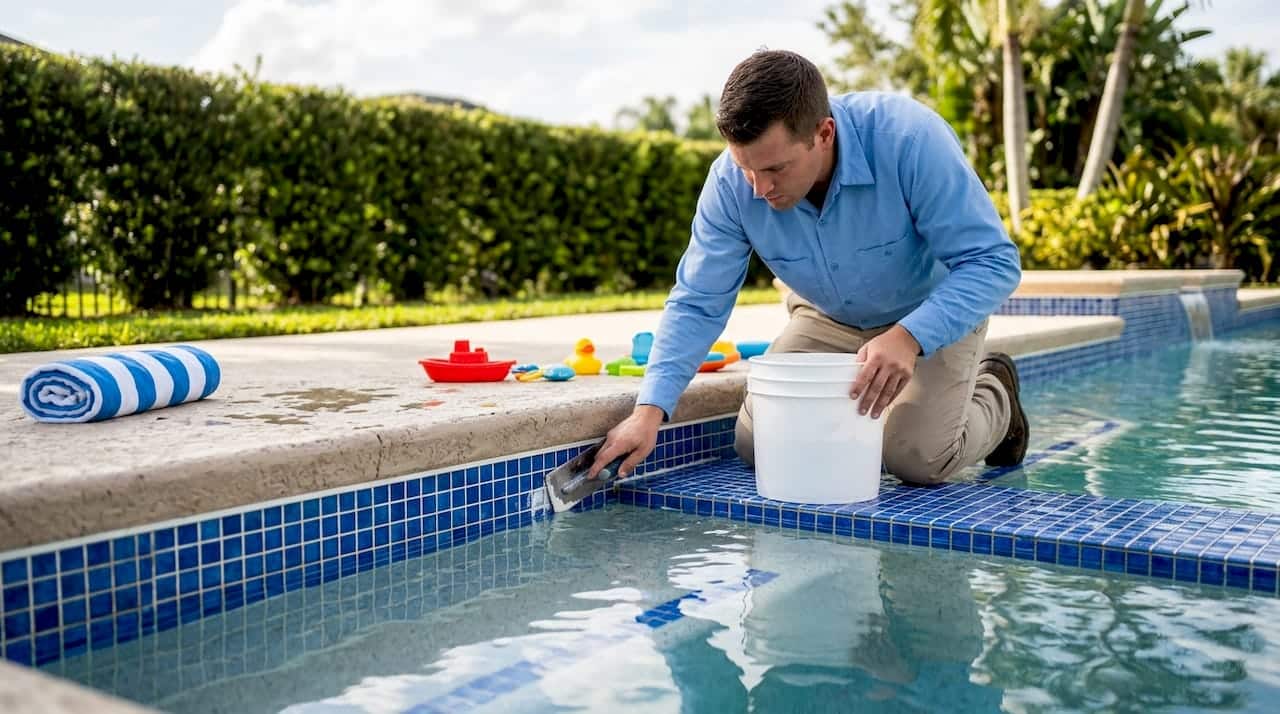
Grout is one of the most load-bearing materials in a pool that nobody talks about. Every tile installation depends on it. The moment grout fails, water finds a path behind the tiles, the substrate deteriorates, tiles pop loose, and you are looking at a repair bill that dwarfs what proper grout maintenance would have cost.
The pool tile grout basics tell a clear story: grout is not decorative. It is structural. As one technical resource notes, grouting in swimming pools is critical for durability, hygiene, and structural integrity under constant chemical and mechanical stress. That means your grout is working around the clock even when the pool is not in use.
Here is what grout actually does in a pool environment:
- Waterproofing: Sealed grout lines prevent water infiltration behind tiles, protecting the pool shell from moisture damage and freeze-thaw stress.
- Chemical resistance: Pool water contains chlorine, pH adjusters, algaecides, and other chemicals. Quality grout withstands this chemical cocktail without breaking down.
- Hygiene control: Dense, non-porous grout resists bacteria, mold, and algae colonization in joint lines, reducing both health risks and cleaning frequency.
- Structural support: Grout distributes mechanical load across tile installations, preventing individual tiles from cracking under thermal expansion or physical impact.
- Aesthetic integrity: Clean, well-maintained grout lines define the visual finish of a tiled pool. Stained or crumbling grout makes even new tiles look neglected.
None of these functions are optional. Miss one, and the others start to fail in sequence.
Types of pool tile grout: epoxy versus cement-based options
Choosing the best grout for pool tiles is not just a product decision. It is a long-term cost decision. The two dominant options are epoxy grout and cement-based grout, and they perform very differently in a pool environment.
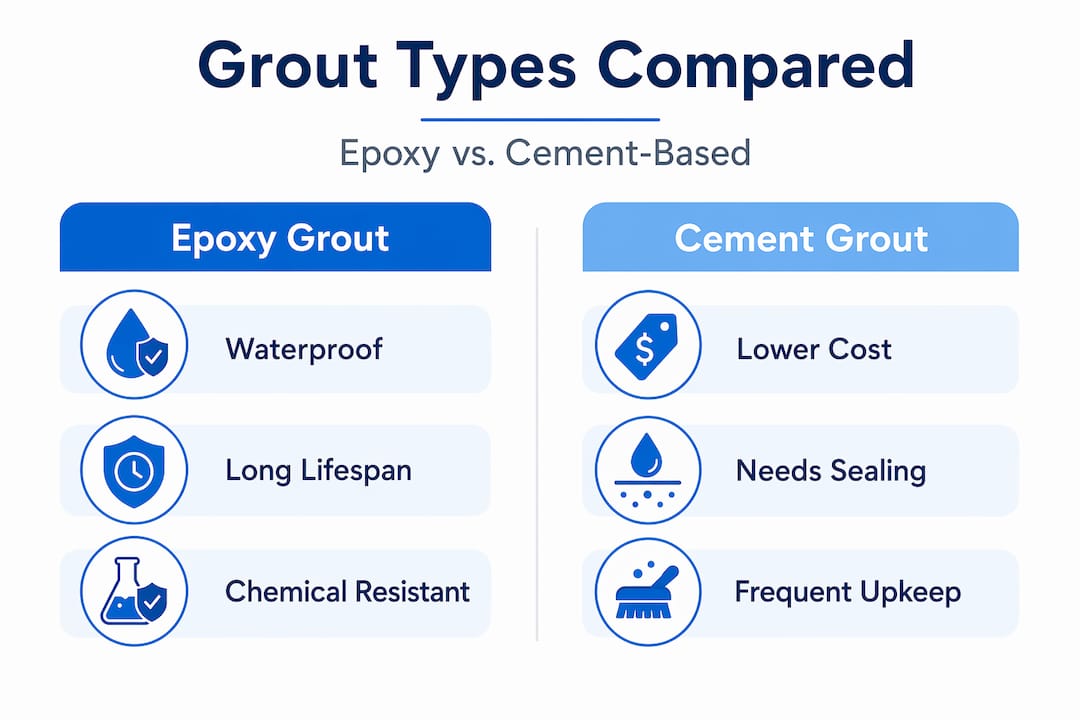
| Feature | Epoxy grout | Cement-based grout |
|---|---|---|
| Waterproofing | 100% waterproof | Porous, requires sealing |
| Chemical resistance | Excellent | Moderate |
| Lifespan | 25 to 30 years | 5 to 10 years with sealing |
| Maintenance | Minimal | Reseal every 1 to 3 years |
| Installation difficulty | High, requires skilled applicator | Moderate |
| Upfront cost | Higher | Lower |
| Best for Florida pools | Yes | In low-budget applications |
Epoxy grout is 100% waterproof with strong chemical resistance and a lifespan reaching 25 to 30 years, while cement-based grout is porous and requires periodic sealing to stay functional. That gap in durability matters significantly in Florida, where pools run year-round and chemical demand is higher than in cooler climates.
Cost is where cement grout tempts buyers. Epoxy grout costs roughly twice as much upfront, but cement grout requires resealing every one to three years to maintain any water resistance at all. Over a decade, the cost difference shrinks. Over two decades, epoxy often wins on total investment.
There is a catch with epoxy: installation requires advanced skills to avoid defects, and it typically suits high-use or chemically aggressive pools. Epoxy has a short working window before it sets, which means amateur application leads to haze, uneven lines, and bonding failures. This is not a DIY product for most pool owners.
The comparison of grout types comes down to your timeline and how often you want to think about resealing. For commercial pools, hotel pools, and any property where maintenance downtime is costly, epoxy is the clear answer. For residential pools with tighter upfront budgets, cement grout with a disciplined sealing schedule can work, but it demands consistency.
Pro Tip: If you are using cement-based grout in a Florida pool, choose a polymer-modified formula. The added polymers increase flexibility and water resistance, giving you better performance without the full cost of epoxy.
These pool grout maintenance tips apply regardless of which type you choose: the material only performs as well as the installation and upkeep behind it.
Installation best practices and standards for pool tile grout
How grout affects pool tiles is not just a material question. It is an installation question. Grout applied incorrectly under excellent conditions still fails. Getting installation right from day one protects everything that follows.
Follow these steps for grout installation that holds up in Florida pool conditions:
- Select the correct joint width. BS 5385 recommends 2mm joints for wall tiles and 3mm for floor tiles. Narrower joints trap stress; wider joints collect debris and weaken the seal.
- Install movement joints at regular intervals. Movement joints at 6-meter intervals and at all plane changes accommodate thermal expansion, which is substantial in Florida’s heat. Without them, the tile field buckles.
- Prepare the substrate properly. Grout is only as strong as what it bonds to. Surfaces must be clean, structurally sound, and free of any residual oils or release agents.
- Apply grout at the right temperature and humidity. Hot, dry conditions cause cement grout to cure too fast, creating surface cracking. Florida’s humidity can slow epoxy curing and affect adhesion if not properly managed.
- Allow full curing before filling the pool. Epoxy grout requires 10 to 14 days of curing before pool filling to avoid chemical leaching and bond failure. Rushing this step causes problems that appear weeks later.
- Clean grout haze immediately. Epoxy haze sets permanently within hours. Remove it during installation, not after.
“Movement joints are not optional extras. They are the reason tile fields survive thermal cycling without cracking. In Florida’s climate, skipping them is a guarantee of early failure.”
Pro Tip: Schedule pool tile installations during cooler months in Orlando and Jacksonville when ambient temperatures are lower. Cooler conditions give both cement and epoxy grouts better working time and more consistent curing results.
Proper post-grout maintenance starts the moment installation is complete. The curing window is not downtime; it is when the bond is forming.
Maintaining pool tile grout for durability and value preservation
Tile grout maintenance is the category most pool owners under-invest in. You cannot see a failing grout line from the deck until the damage is visible. By then, water has already been infiltrating for months.
Neglecting grout maintenance can reduce property value by 10% to 20% due to cracking or discoloration. For property managers in Jacksonville overseeing commercial or rental properties, that is a measurable loss on the asset.
Here is what a sound maintenance routine looks like:
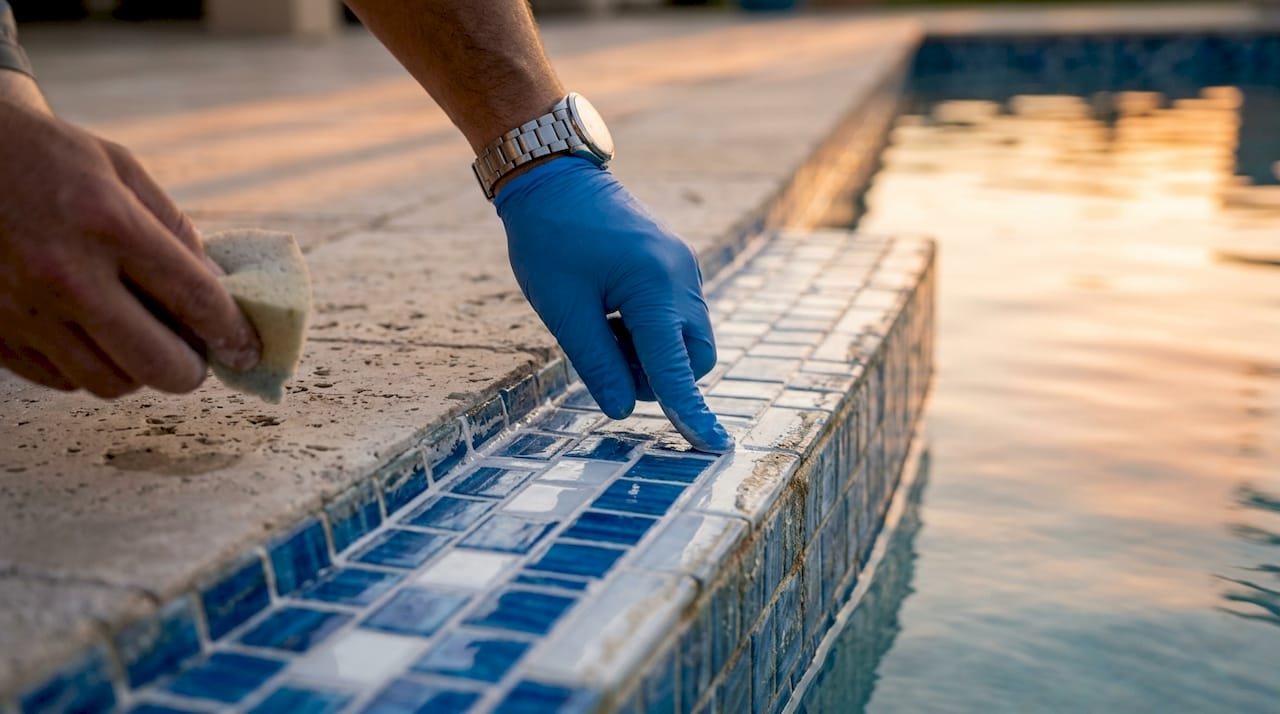
- Monthly cleaning: Brush grout lines with a stiff nylon brush and a non-abrasive cleaner. Never use wire brushes; they damage grout surfaces and accelerate erosion.
- Inspect quarterly: Look for cracks, discoloration, soft spots, or missing sections. Catching a 2-inch crack early costs a fraction of regrouting an entire tile field.
- Reseal cement grout on schedule. Sealing cement grout every 1 to 3 years is mandatory to maintain the barrier against water and chemical damage.
- Manage water chemistry tightly. pH levels outside the 7.2 to 7.8 range accelerate grout breakdown. Acidic water etches; alkaline water scales.
- Address staining immediately. Stains that sit in porous grout penetrate deeper over time. Early treatment avoids grinding or replacement.
“The cost difference between regrouting one section and replacing a full tile installation is not incremental. It is roughly 10 times the price. Maintenance is not optional; it is economics.”
Pro Tip: After resealing cement grout, run your fingertip across the grout line. It should feel smooth and slightly repel water. If it feels chalky or absorbs water immediately, the sealer did not bond properly and you need to reapply.
Good pool surface maintenance extends beyond grout, but grout condition is often the first indicator of whether a pool’s overall maintenance program is working. It is the canary in the coal mine.
You also want to actively manage chlorine levels within safe ranges. Excess chlorine does not just affect bathers; it attacks grout at the chemical level.
Impact of water chemistry and environment on grout longevity
Pool tile installation tips that ignore water chemistry are incomplete. Chemistry is where most grout damage originates, and Florida pools face higher chemical loads than average due to year-round operation, heavy swimmer traffic, and UV intensity.
Key factors affecting grout performance:
- pH balance is non-negotiable. Maintain pH between 7.2 and 7.8 consistently. Even short dips below 7.0 create acidic conditions that etch grout surfaces. The erosion is cumulative and invisible until it is advanced.
- Chlorine levels need close monitoring during curing. Chlorine above 3.0 ppm in the first 30 days can cause permanent grout staining, and levels above 6.0 ppm combined with pH swings erode both grout and plaster surfaces.
- Chemical fluctuations do the most damage. Consistent chemistry at the correct levels causes far less damage than alternating extremes. pH and chemical fluctuations accelerate grout deterioration and cause scaling or erosion even in otherwise well-maintained pools.
- UV and heat create surface stress. Tiles above the waterline in Orlando and Jacksonville face direct UV exposure that dries out grout faster than submerged sections. Expansion and contraction cycles in these areas are more severe.
- Salt water pools require specific grout. Salt systems generate chlorine through electrolysis, which can be more aggressive on porous cement grout. Epoxy grout performs significantly better in salt water applications.
Smart chlorine management tips protect not just the water, but every surface material in contact with it, including your grout.
Our perspective: grout is where pools actually age
After resurfacing more than 100,000 pools across Central Florida, we have a clear view of where pools fail first. It is almost never the tile. It is the grout. Specifically, it is grout that was either the wrong type, installed incorrectly, or maintained on a reactive rather than proactive schedule.
Here is what gets overlooked: most pool owners evaluate grout when they are choosing tiles, not when they are choosing how to protect their investment. The tile gets the attention because you can see it. The grout gets whatever is left. That sequence is backwards.
The pools we renovate that needed the most invasive work were not necessarily old. Some were under 10 years old with grout that had never been sealed, or with cement grout in high-chlorine environments that ate through the surface in half the expected lifespan. The renovation cost was multiples of what a proper grout specification and maintenance plan would have cost at the start.
Our recommendation is direct: if you are in Orlando or Jacksonville and your pool has cement-based grout that has not been sealed in the last two years, that is your first maintenance call. If you are planning a tile installation or renovation, ask specifically what grout is being specified and why. The right grout for your environment is worth the cost difference.
Protect your pool with expert grout and tile services
The importance of grout in pools is clear, and so is the cost of getting it wrong. At Classic Marcite, we have been applying this knowledge across residential, commercial, and resort properties in Orlando and Jacksonville since 1988.

Whether you need a grout inspection, a full tile renovation, or expert advice on the best grout for pool tiles in your specific environment, our team has the experience to get it right the first time. As the largest Pebble Tec® applicator in Central Florida, we bring the same precision to grout and tile work that we bring to every surface we touch. Request a free estimate today and find out what professional pool tile and grout service looks like from a team that has done it more than 100,000 times.
Frequently asked questions
What is the main role of tile grout in swimming pools?
Tile grout seals joints between tiles to prevent water infiltration, supports structural integrity, resists chemical exposure, and enhances pool hygiene and aesthetics. As technical standards confirm, grouting in swimming pools is critical for durability and structural performance under constant chemical and mechanical stress.
Why is epoxy grout preferred over cement grout for pools?
Epoxy grout is completely waterproof, chemically resistant, and longer lasting, requiring far less maintenance than porous cement grout. It is considered the gold standard for pool tile installations due to its 100% waterproof nature and chemical resistance lasting up to 25 to 30 years.
How often should cement-based grout be sealed in pools?
Cement-based grout should be resealed every one to three years to maintain water resistance and protect against chemical damage and mold growth. Sealing on this schedule is mandatory to maintain any meaningful barrier against water and chemical infiltration.
What installation standards affect grout durability in pools?
Proper joint widths, movement joints at regular intervals, and full curing times are the three factors that most determine grout longevity after installation. BS 5385 recommendations cover joint sizing and movement joint placement, while epoxy grout requires a full 10 to 14 day cure before pool filling to reach its design strength.
How does pool water chemistry influence grout lifespan?
Maintaining pH between 7.2 and 7.8 and keeping chlorine within safe limits prevents the erosion, staining, and structural degradation that aggressive water chemistry causes. Unbalanced pH and high chlorine accelerate grout deterioration and can cause scaling and surface damage that shortens grout life significantly.