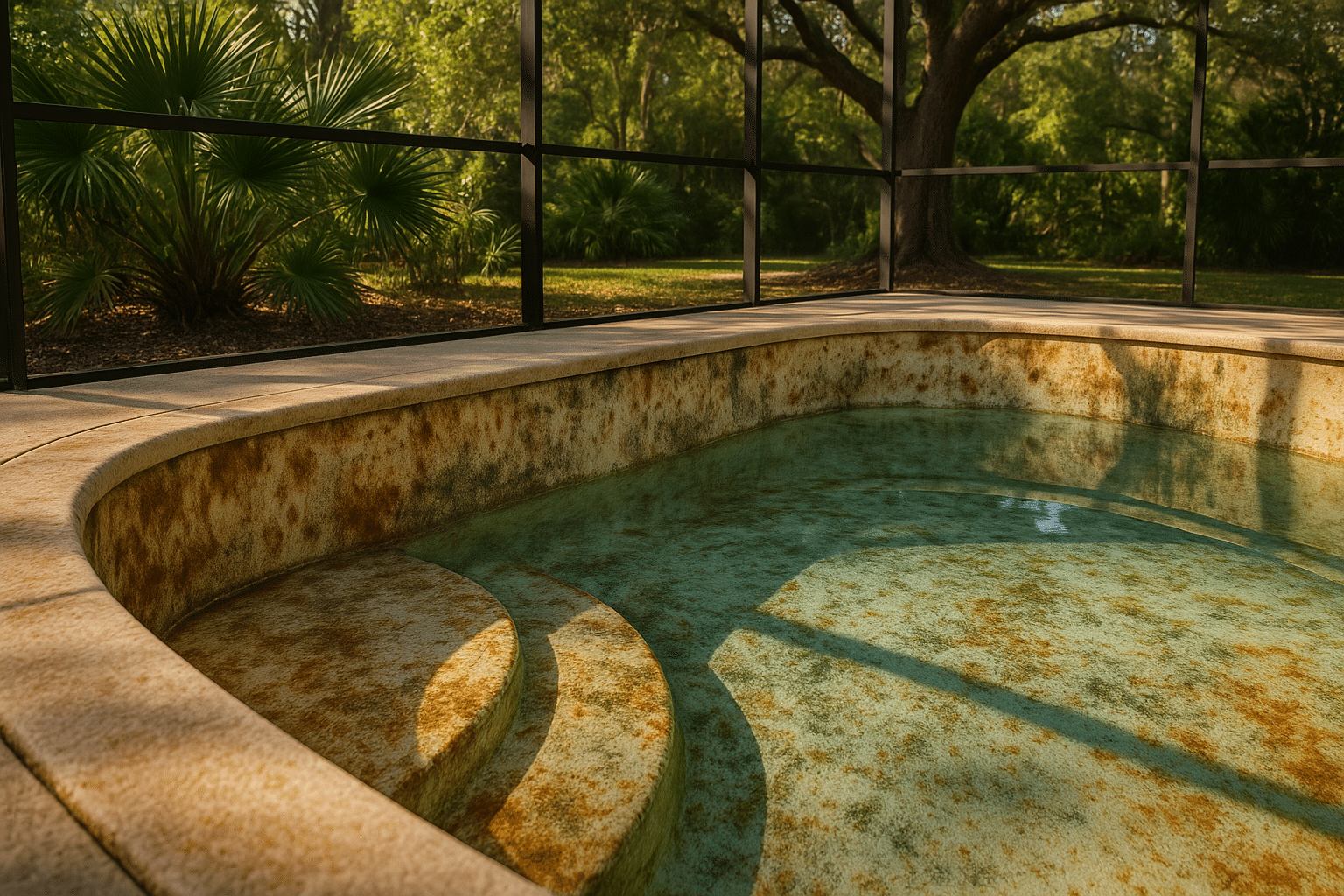
TL;DR: Pool stains fall into three categories — organic, metal/mineral, and surface-failure — and each requires a completely different treatment. Color and location are your fastest diagnostic clues. When stains no longer respond to chemical treatment, the finish itself has broken down and resurfacing is the only lasting fix.
A stain on your pool surface is rarely just cosmetic. The color, shape, and location all tell you something specific about what is happening to your water chemistry, your equipment, or your finish. Treating the wrong type of stain with the wrong product wastes money and can make things worse.
This guide walks you through every major stain type, how to identify it, what it means for your pool’s health, and what to actually do about it.
The Two-Category Framework: Organic vs. Metal/Mineral
Swim University puts it plainly: pool stains are either organic (from debris like leaves, algae, and berries) or metal-based (from iron, copper, or manganese in the water). A third category — surface failure — overlaps with both but has its own causes and fixes.
Getting the category right before you treat is critical. Shocking a metal stain, for example, can oxidize the dissolved metals and make the staining significantly worse.
Stain Color Quick-Reference Chart
- Brown, green, or yellowish patches → Likely organic (leaves, algae, tannins, berries)
- Rust, reddish-brown, or orange → Iron from well water, corroded pipes, or metal fittings
- Blue-green or teal → Copper from a corroded heat exchanger, copper-based algaecide, or low-pH erosion of copper plumbing
- Black or dark purple → Manganese, black algae, or deep organic matter
- White or gray crusty deposits → Calcium scale (especially at the waterline)
- Dull, overall gray film → Mineral or calcium scale coating the entire surface
Type 1: Organic Stains
What causes them
Organic stains come from natural debris — leaves, berries, algae, worms, pollen, and tannins from nearby trees — that sit on the pool surface long enough to break down and transfer color into the finish. They are the most common pool stain type and, fortunately, the easiest to treat.
How to confirm it
Sprinkle a small amount of granular chlorine directly on the stain and brush it in. If the stain fades within 30 seconds, you are dealing with an organic stain. If it stays put or darkens, move on to the metal-stain test below.
How to treat it
For localized spots, a chlorine application and scrubbing usually handles it. For widespread staining, shock the pool at a triple dose and run the filter for at least eight hours. Stubborn organic stains may need two rounds of treatment. Rebalance water chemistry to a pH of 7.2–7.6 and alkalinity of 100–150 ppm before and after treatment.
Why they keep coming back
Persistent organic staining often signals poor circulation, a dirty or undersized filter, or debris sitting on the floor too long. Fix the root cause — it is not just a chemistry problem.
Type 2: Metal Stains
What causes them
Metal stains happen when iron, copper, or manganese enter the pool water and then precipitate out onto the surface. Sources include well water (especially common in Central and Northeast Florida), corroded metal ladder rails, bolts, or heat exchangers, and copper-based algaecides. Chemical imbalances — particularly low pH — accelerate this process by dissolving metals out of pipes and equipment faster.
A note specific to Florida: well water in this region is notoriously high in iron. If you fill or top off your pool from a well, test for metals first and use a metal sequestrant before adding chlorine.
How to confirm it
Rub a vitamin C tablet (ascorbic acid) directly on the stain. If it fades or disappears immediately, the stain is metal-based. You can also use a small pinch of dry acid (sodium bisulfate): if that fades the stain, you are likely looking at rust.
How to treat it
Do not shock a metal stain. Oxidizing the water precipitates more metal onto the surface and worsens the discoloration. Instead:
- Lower pool pH to 7.0–7.2.
- Broadcast ascorbic acid (vitamin C powder) across stained areas at roughly 1–2 lbs per 10,000 gallons.
- Stains typically lift within 24–48 hours.
- Follow immediately with a metal sequestrant to keep dissolved metals suspended and filtered out. Without this step, metals will re-deposit and the staining returns.
For copper specifically, blue-green or teal staining is often traced to a corroded copper heat exchanger. Lowering pH accelerates this corrosion, so maintaining pH above 7.2 is essential. If your heater is the source, chemical treatment alone is a temporary fix — the equipment needs inspection or replacement.
Type 3: Calcium Scale and Mineral Deposits
What causes them
When pool water is out of balance on the high end — too much calcium hardness, high pH, or high alkalinity — dissolved calcium carbonate comes out of solution and deposits on surfaces as a whitish crystallized scale. The National Plasterers Council (NPC) notes that scale-forming tendencies are usually related to high pH or elevated levels of alkalinity and calcium hardness, while the opposite condition — low pH and low calcium — leads to corrosive etching that pulls calcium right out of the plaster.
Industry standards call for maintaining calcium hardness in the range of 200–400 ppm in plaster, gunite, and concrete pools. Letting levels run significantly above or below that range damages the surface finish and invites staining.
How to identify it
Calcium scale most often appears as white, gray, or tan crusty deposits at the waterline. In certain water conditions, it can also deposit a dull, all-over gray film across the entire pool floor and walls.
How to treat it
Scale at the waterline can often be reduced with a pH adjustment and a commercial scale remover. Pumice stones work on tile and plaster. For whole-surface scale, a professional acid wash may be warranted. Prevent recurrence by testing calcium hardness at least monthly and keeping it in the 200–400 ppm range.
Type 4: Surface-Failure Discoloration
Sometimes what looks like a stain is not a stain at all — it is the finish itself deteriorating. Signs include:
- Gray or mottled patches that do not respond to any chemical treatment
- Dark streaks or blotches in the same spots after every treatment
- Rough texture accompanying the discoloration
- Discoloration that appears to originate from beneath the surface, not on top of it
Aggressive or “soft” water is a common culprit in Florida. The NPC warns that filling a pool with water below 200 ppm calcium hardness can cause damage ranging from severe discoloration to a weakened cement binder and a shortened surface life. Over years, unbalanced water leaches calcium hydroxide from the plaster, leaving behind etched, discolored areas that cannot be cleaned away.
When stains penetrate below the surface layer and no longer respond to acid washing or chemical treatment, resurfacing is the only effective solution. For a look at how often Florida pools typically reach that point, see our guide on how often you should resurface a pool in Florida.
The Two-Minute Diagnostic Sequence
- Read the color. Brown/green/yellow = likely organic. Red/rust/orange = likely iron. Blue-green/teal = likely copper. White/gray crusty = likely scale.
- Test with chlorine. Sprinkle granular chlorine on the stain. Fades fast = organic. No change = metal or mineral.
- Test with ascorbic acid. Rub a vitamin C tablet on the stain. Fades = metal. No change = calcium scale or surface failure.
- Check the location. Stains concentrated at the waterline point to calcium scale. Stains near fittings, ladders, or lights point to corroding metal. Stains spread across the entire floor often indicate well-water metal issues or overall water imbalance.
- Consider the timing. Did staining appear right after shocking? Oxidization likely precipitated dissolved metals. Did it appear after filling with well water? Iron or copper content in the source water is the probable cause.
When Chemical Treatment Is Not Enough
Chemical treatment works when the stain is on the surface. When it has penetrated the finish — or when the finish itself is the problem — the pool needs professional attention. The warning signs that treatment has reached its limit:
- Stains return within days of treatment
- Discoloration worsens despite correct chemical application
- The surface feels rough or abrasive in the stained areas
- Staining is accompanied by pitting, peeling, or flaking
If any of these apply, read our breakdown of 7 warning signs your pool needs resurfacing to understand whether you are looking at a resurfacing project. And if surface failure is already underway, our article on why pool plaster peels and how to fix it explains the structural causes in detail.
Prevention: How to Stop Stains Before They Start
- Test water chemistry weekly — pH, chlorine, and alkalinity. Test calcium hardness monthly. Keep pH between 7.2 and 7.8 and calcium hardness between 200 and 400 ppm.
- Remove organic debris promptly. Leaves, berries, and twigs left sitting on the pool floor long enough will stain any finish.
- Test well water for metals before filling or topping off. If iron or copper levels are elevated, add a metal sequestrant before you add chlorine.
- Use copper-free algaecides. Many algaecides contain copper sulfate, which causes blue-green staining.
- Inspect metal equipment regularly. Ladder rails, light rings, bolts, and heat exchangers corrode over time and bleed iron and copper into the water.
- Maintain a metal sequestrant program if you have a history of metal staining or use well water. A maintenance dose every one to two weeks keeps metals suspended and filterable rather than settled on your finish.
A Note on Finish Type
Stain resistance varies significantly by finish. Standard white plaster is the most porous option and absorbs stains most readily — especially metal stains from iron and copper. Quartz-blend and pebble finishes are denser and more resistant to both staining and chemical etching, which is one reason they are popular in Florida where well water and long swim seasons are common. If recurring staining has been a problem on a plaster pool, a higher-performance finish is worth considering at the next resurfacing cycle.
Bottom Line
Match the treatment to the stain type. Organic stains respond to chlorine. Metal stains respond to ascorbic acid and sequestrants — not to shock. Calcium scale responds to pH management and scale removers. And when the staining is coming from inside a degraded finish rather than from the water, no chemical will fix it permanently.
If you are in Central Florida or the Jacksonville area and are not sure whether you are dealing with a treatable stain or a failing surface, Classic Marcite offers free estimates. We have resurfaced more than 100,000 pools since 1988 and can tell you quickly whether a chemical treatment or a new finish is the right answer for your pool.
Recommended Reads
- Quartz vs. Plaster Pool Finish: Pros, Cons, and What Lasts Longer in Florida
- How Often Should You Resurface a Pool in Florida?
- Why Is My Pool Plaster Peeling? Causes, Types of Damage, and How to Fix It