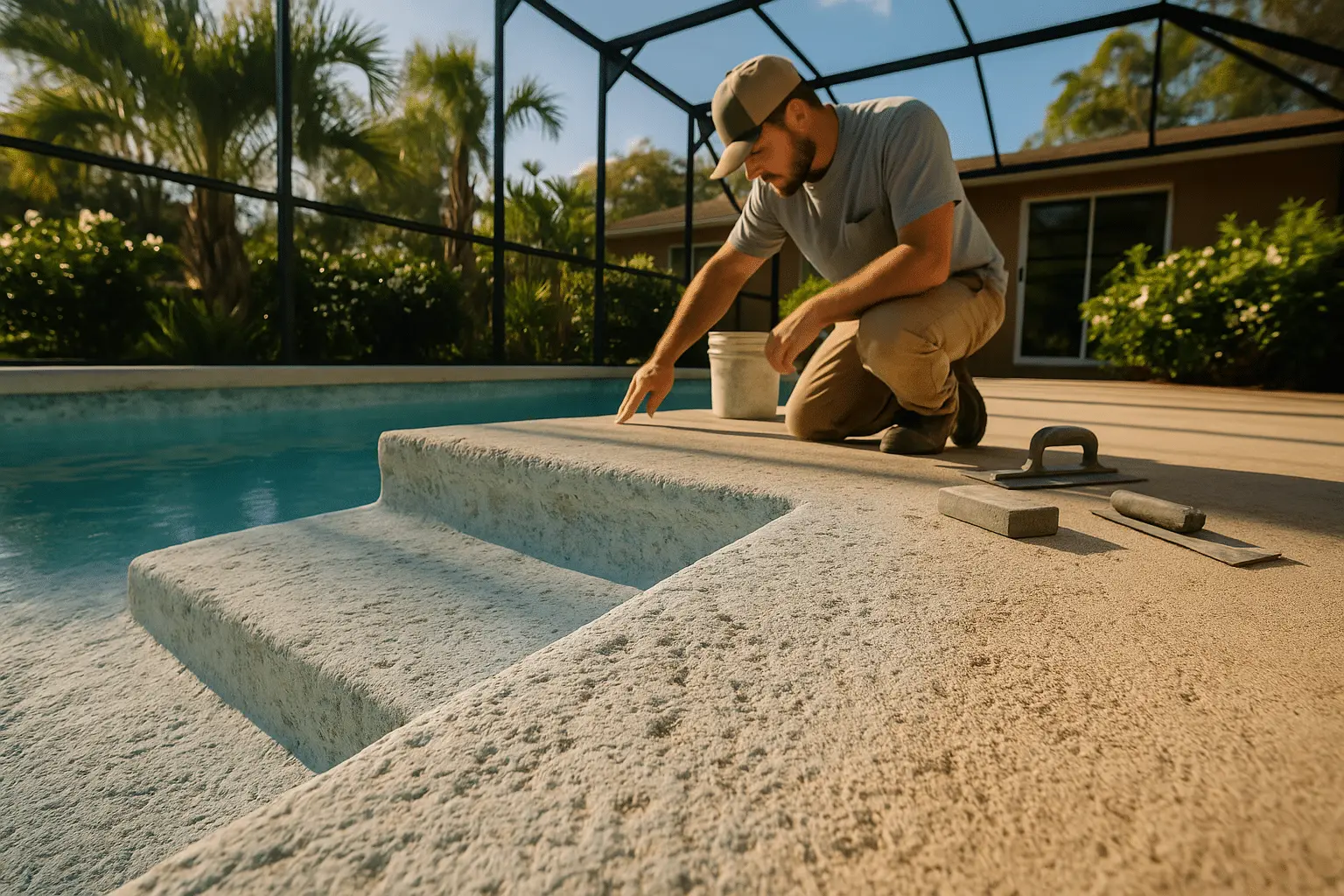
TL;DR: A rough pool surface is almost always caused by calcium scale, chemical etching, normal finish wear, or repeated acid washing — and the right fix depends on which problem you actually have. Mild roughness can sometimes be treated; widespread pitting or etching that has gone deep into the plaster means the finish has reached the end of its life and needs resurfacing. Acting early is always cheaper than waiting.
You step onto the first pool step and wince. The surface feels like coarse sandpaper instead of smooth plaster. Your kids are coming home with scraped knees, and swimsuit fabric is pulling after every lap. A rough pool surface is one of the most common complaints pool owners have — and one of the most misdiagnosed ones, too.
Before you can fix it, you have to know what caused it. The right treatment for calcium scale is nearly the opposite of the right treatment for etching, and using the wrong approach makes things worse.
What Makes a Pool Surface Feel Rough?
There are four main culprits, and more than one can be happening at the same time.
1. Calcium Scale Buildup
Calcium buildup forms when water has high calcium hardness, high pH, high alkalinity, or poor overall water balance over time. Instead of staying dissolved in the water, calcium deposits onto the pool surface, steps, tile line, and fittings — creating a chalky, gritty, or crusty texture that feels uncomfortable underfoot.
Calcium scale typically appears as white or light grey-brown deposits that are rough and gritty to the touch, like rough sandpaper, and often forms a white crust along the waterline or lumpy deposits on the floor. You can do a quick field test: place a drop of diluted muriatic acid on the deposit at the waterline — if it fizzes, it is calcium carbonate.
2. Etching (Surface Erosion)
On plaster and cement-based finishes, aggressive water can pull calcium and other minerals out of the finish. Over time, that leaves tiny pits, rough patches, uneven color, and a chalky or sandy texture.
Etching and scale can both make a surface feel rough, but they are nearly opposite problems. Scale is usually a deposit on top of the surface, often caused by high pH, high calcium hardness, high alkalinity, warm water, or a combination of those conditions. Etching is surface loss or pitting, commonly linked to water that is too aggressive. This distinction matters because the wrong treatment can make things worse.
A rough surface is the primary characteristic of etched pool plaster, and the damage is irreversible — it can only be partially mitigated through surface sanding. In other words, once the finish has been eaten away, no chemical treatment fully restores it.
3. Normal Age and Finish Wear
Even in a well-maintained pool, plaster will eventually age and show signs of degradation. The typical lifespan of traditional marcite plaster is 7 to 10 years. In Florida’s climate specifically, intense UV radiation and frequent acidic rain accelerate the breakdown of less resistant finishes like standard plaster.
As the smooth cement-cream layer on the surface wears through, the aggregate beneath becomes exposed. That exposed aggregate is what you feel scratching your feet — and no amount of chemical adjustment will smooth it back down.
4. Repeated Acid Washing
Too much acid washing can wear away the smooth cement layer, leaving the aggregate exposed and the surface uncomfortable. An acid wash is inherently destructive: it etches and dissolves the pool finish, creating a more porous and rough surface where calcium can easily start forming again. Each acid wash removes a thin layer of finish, so pools that have been treated aggressively year after year often feel rough long before their finish would otherwise be due for replacement.
The Langelier Saturation Index: Why Water Chemistry Is Everything
Most rough-surface problems trace back to water chemistry that drifted out of balance — sometimes for years. The industry tool for measuring this is the Langelier Saturation Index (LSI).
The target LSI range is between -0.3 and +0.5. An LSI below -0.3 indicates corrosive water that can cause etching; an LSI above +0.5 indicates scaling water that can lead to calcium deposits.
The National Plasterers Council (NPC) — the industry body that sets technical standards for pool plaster — emphasizes that water chemistry plays an important role in the life expectancy of a cementitious coating, and a finish’s overall life expectancy can be severely reduced whenever water is allowed to remain in an aggressive condition for extended periods of time.
According to the NPC, the three most important water chemistry parameters for “balanced” water are pH, carbonate alkalinity, and calcium hardness — all kept within their correct ranges. As a practical guideline, calcium hardness content is best maintained in the range of 200–400 ppm. For pH and total alkalinity, common target ranges include pH around 7.4 to 7.6 and total alkalinity around 80 to 120 ppm.
How to Tell How Serious the Problem Is
Not every rough pool surface needs a full resurfacing. Use this quick framework to gauge severity before calling anyone.
- Mild roughness confined to the waterline or steps: Likely calcium scale. May respond to a professional scale-removal treatment without draining.
- Rough texture across the floor and walls, but plaster still intact: Could be early-stage etching or light aggregate exposure. A professional inspection will determine whether any non-invasive treatment buys time.
- Sandpaper feel throughout the pool, visible pitting, or peeling: The surface cream layer is gone. Sometimes etching progresses too far for chemical correction alone — if your pool feels rough on feet or is visibly discolored, it may be time for resurfacing.
- Cracks, hollow spots, or flaking plaster in addition to roughness: Structural and finish issues together. See our 7 Warning Signs Your Pool Needs Resurfacing for a full checklist.
Your Repair Options, Ranked by Severity
Option 1: Scale Removal Treatment (Minor Scale Only)
For pools where a drop of acid fizzes at the waterline, the problem is surface scale — not finish damage. A professional can apply a controlled descaling treatment, sometimes without draining the pool. This removes the mineral crust and restores a smoother feel.
Important caveat: these problems can become more expensive or harder to correct if the underlying cause continues. Aggressive water can keep etching plaster, while high calcium levels can continue building scale. Descaling without fixing your water chemistry is a temporary fix at best.
Option 2: Acid Wash (Moderate Staining and Scale)
An acid wash strips the outermost layer of plaster and is sometimes used for heavy calcium deposits or staining. For severe scaling and stains, acid washing can remove the top layer of deposits — but it must be performed carefully to avoid plaster damage.
Use this option sparingly. Each acid wash removes finish material and shortens the remaining life of your surface. If a pool has already been acid-washed multiple times, the next step is usually full resurfacing.
Option 3: Full Pool Resurfacing (Widespread Roughness or End-of-Life Finish)
When roughness is widespread, the finish has pitted through, or the pool is approaching or past its expected lifespan, resurfacing is the only real solution. There comes a time in every plastered pool’s life where it becomes necessary to replaster. It’s often an aesthetic decision to improve appearance or reduce roughness; a new coat of plaster covers rough and stained plaster with a soft new coat about 3/8 inch thick, right on top of the old plaster.
Resurfacing also gives you the opportunity to upgrade your finish. If your current marcite is already showing wear at 7–10 years, moving up to a pebble or aggregate finish at replacement time can dramatically extend the interval before your next project. More durable aggregate finishes like quartz or pebble often last significantly longer — quartz finishes often last 10–15 years, while premium pebble finishes can last 15–20 years or more. While the upfront cost of a pebble finish is higher, you won’t have to go through the renovation process as frequently.
For a deep comparison of your finish choices, see our guide on Pebble Tec vs. Marcite: Which Pool Finish Is Right for Your Florida Pool?
What to Do Right Now: A Quick Action Plan
- Test your water chemistry today. Check pH, total alkalinity, calcium hardness, and cyanuric acid. Calculate your LSI or have a professional do it. Disregarding LSI parameters promotes leaching, etching, and discoloration on the negative side, and scaling and discoloration on the positive side.
- Stop using abrasive or acidic cleaners until you know whether the roughness is scale or etching. Using acid on an etched surface makes pitting worse.
- Get eyes on the surface. Have a licensed pool resurfacing professional (not just a weekly maintenance tech) look at the finish. Scale and etching require very different responses, and misreading the surface type wastes money.
- Plan around your pool’s age. Plaster typically lasts 7–10 years in Florida conditions before requiring complete replacement. Pebble Tec® finishes routinely achieve 15–25 year lifespans. If your marcite is already 8+ years old and feeling rough, resurfacing now — rather than treating repeatedly — is usually the better economic decision.
Wondering how long you have before resurfacing becomes unavoidable? Our guide, How Often Should You Resurface a Pool in Florida?, walks through the specific factors that affect timing in Central Florida’s climate.
How Classic Marcite Approaches Rough Pool Surface Repair
Classic Marcite has been resurfacing pools in Orlando and Jacksonville since 1988, with more than 100,000 pools completed. Every crew member is a direct Classic Marcite employee — not a subcontractor — which means the same trained hands do the surface prep, the mix, and the finish on every job.
When a homeowner calls us about a rough pool, we start with a thorough inspection to determine the actual cause: scale, etching, aggregate exposure, or a combination. We never recommend resurfacing when a less invasive treatment genuinely fits the problem — but we also won’t sell a descaling treatment to a pool that needs a new surface. Free estimates and transparent pricing mean you know exactly what you’re getting and why before any work begins.
If the finish does need replacing, we’re the largest licensed Pebble Tec® applicator in Central Florida and also licensed to install Pebble Sheen®, Pebble Fina®, and Beadcrete® finishes — so you have real upgrade options, not just a like-for-like plaster patch.
Recommended Reads
- How Often Should You Resurface a Pool in Florida?
- Pool Surface Stains and Discoloration: What They Mean and What to Do
- 7 Warning Signs Your Pool Needs Resurfacing
