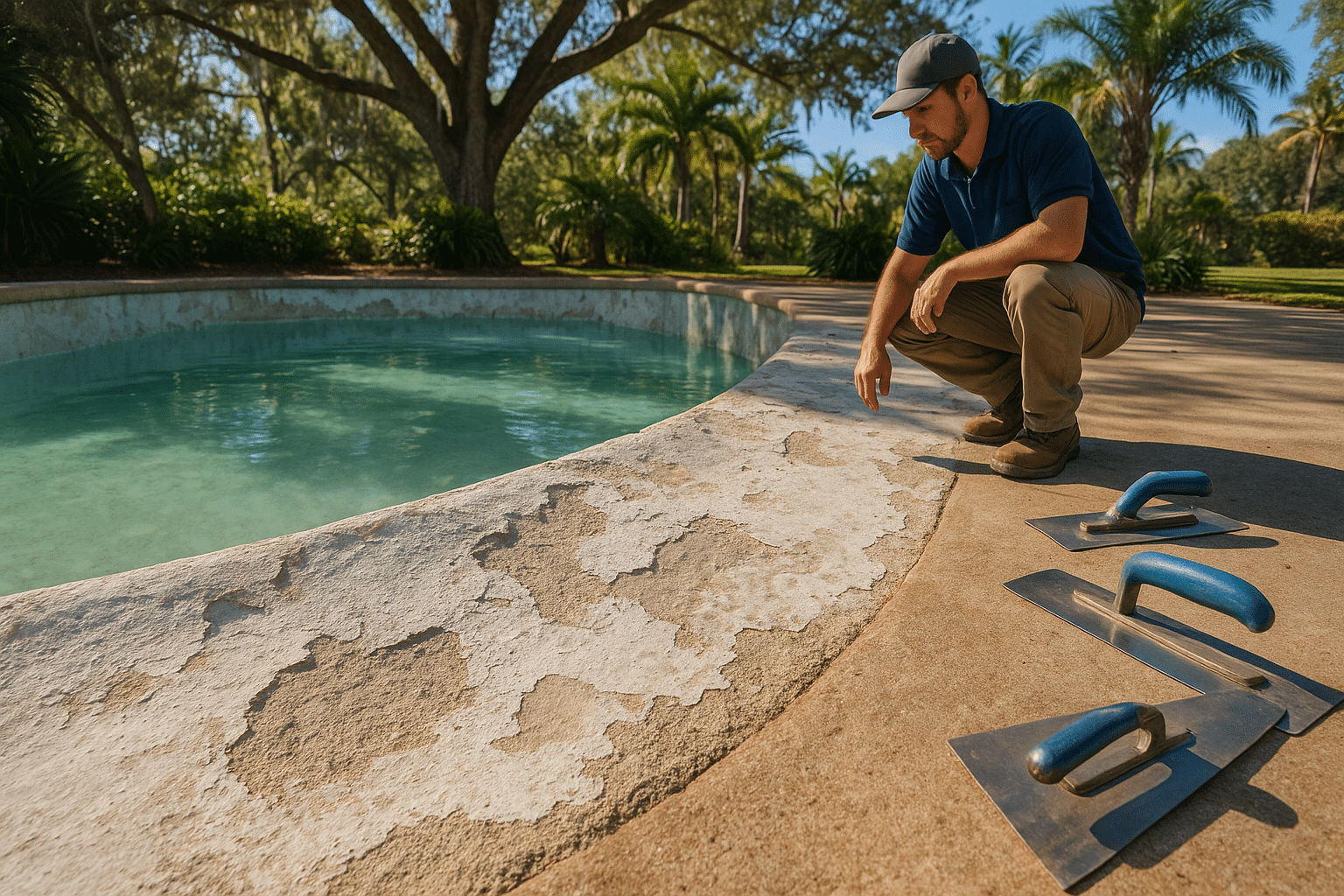
TL;DR: Pool plaster peels due to three main culprits: chronically imbalanced water chemistry, faulty application workmanship, and simple age. Patching buys time only on new surfaces; once peeling is widespread, full resurfacing is the only lasting fix. In Florida’s hot, high-use climate, standard plaster typically lasts 5–10 years before showing significant wear.
You notice a flake on the pool floor. Then another. Soon there are rough patches on the walls and steps that scratch bare feet. Pool plaster peeling—technically called spalling or delamination—is one of the most common problems pool owners face, and it almost always signals that something has gone wrong beneath the surface.
This guide explains exactly what peeling plaster is, why it happens, and what your realistic options are to fix it.
What Is Pool Plaster, and How Long Should It Last?
Pool plaster (also called marcite) is a cement-based interior finish applied directly to a pool’s concrete or gunite shell. It creates the smooth, watertight surface you swim against every day.
Most traditional pool plaster typically lasts between 5 and 10 years in Florida’s climate, and that range depends heavily on the materials used and how well the pool is maintained. In cooler, less-used pools, a well-maintained plaster finish can last between 7 to 12 years on average.
High-use commercial pool environments often wear much faster—more swimmers, more chemical demand, and more exposure usually push replacement closer to the 5-year mark.
If your plaster is peeling before that window, something accelerated the damage. If it’s well past it, you may simply be overdue.
The 4 Main Causes of Pool Plaster Peeling
1. Chronically Imbalanced Water Chemistry
This is the most common culprit homeowners can directly influence. The pool industry uses the Langelier Saturation Index (LSI) to measure whether water is balanced, scale-forming, or corrosive.
The LSI tells us how saturated water is with calcium carbonate (CaCO₃). Perfect saturation is 0.00 LSI, and the acceptable range is between −0.30 to +0.30. If the LSI is −0.31 or below, water is aggressive because it is under-saturated with calcium carbonate—essentially, the water is hungry for more calcium and will do anything to find it.
If the LSI is low enough, water will dissolve calcium from the most available sources first—in pools, that means the cement in the plaster or pebble finish.
According to the National Plasterers Council (NPC), cementitious surface coatings are susceptible to chemically aggressive pool water, and water that is not in the ideal range of acceptable tolerance as defined by ANSI/APSP Standards is considered detrimental to those coatings.
Langelier found that five key parameters determine whether pool water is balanced or aggressive: pH, calcium hardness, alkalinity, water temperature, and total dissolved solids. Let any one of these drift outside range for too long, and the surface pays the price.
Rain is an often-overlooked disruptor—when water from a big downpour lands in a pool, the levels of pH, free chlorine, and total alkalinity almost always take a big hit, creating an unfavorable environment for pool plaster.
2. Poor Workmanship During Application
Bad chemistry gets most of the blame, but faulty application is an equally serious—and far less forgivable—cause of early plaster failure. The key variable is troweling technique.
One of the core skills in the plastering trade is properly timing the troweling process. If troweling is performed when water is present on the surface, forcing water back into the plaster paste causes excessively high water-to-cement ratios in the surface finish, weakening it.
Sometimes the surface dries too fast. If a dry crust forms on the surface while the paste underneath is still wet, a weakened zone develops just below the surface. This can happen when plastering on dry, hot days, during low humidity, or in wind.
The NPC emphasizes that improper plaster mixes—such as those containing too much water or too much calcium chloride accelerant—often contribute to surface damage, and improper troweling can be a culprit as well.
The bottom line: if a crew rushed the job, worked in extreme heat, or used the wrong mix ratios, the plaster was compromised before the pool ever filled with water. This is why hiring crews with deep, documented experience in plastering—not just general construction—matters enormously.
3. Delamination (Bond Failure Between Layers)
Peeling is not always the same as spalling. Sometimes the plaster separates from the shell beneath it—a process called delamination.
Pool plaster delamination occurs when there is a bond failure between the gunite and the plaster that covers it. This bond failure creates an air cavity, or void.
The problem becomes visible when impact or stress on the plaster allows the void to reach the pool surface via a small pinhole or hairline crack. These openings allow water to get behind the plaster mass and dissolve calcium hydroxide.
Certain environmental factors—such as low humidity and excessive sun exposure or heat before filling the pool—may also cause delamination. This is especially relevant in Florida, where summer plastering days can push surface temperatures into ranges that dry the finish unevenly before the fill water arrives.
4. Normal Age and Wear
Sometimes there is no single villain. Peeling plaster—technically called spalling—is one of the clearest indicators that a surface has reached the end of its life. It typically appears as thin layers lifting or flaking off the pool floor, steps, or walls, often leaving an uneven, pockmarked texture beneath.
Plaster is easier to crack than other surfaces, and when it wears down, water can seep in between the plaster and the concrete, compromising the structural integrity of the pool shell itself. At that point, cosmetic repair is no longer enough.
How to Identify What You Are Looking At
Not every surface problem is the same. Here is a quick field guide:
- Spalling / Peeling flakes: Thin chips lifting off the floor or walls. Usually a workmanship defect that develops early, or advanced age wear.
- Delamination bubbles: Hollow-sounding areas when tapped, sometimes with a visible bulge. Bond failure between plaster and shell.
- Etching / Pitting: A rough, sandpaper-like texture across a broad area. Typically the result of prolonged chemistry imbalances—particularly low pH or low calcium hardness—which cause the water to become aggressive and eat away at the plaster surface.
- Scaling: White or gray crusty deposits. Caused by buildups of calcium and harmful minerals, often linked to high pH and alkalinity.
- Mottling / Discoloration: Discoloration of pool plaster that can occur due to a high amount of calcium chloride, incorrect construction, and unbalanced water chemistry.
Not sure which problem you have? Our 7 warning signs your pool needs resurfacing gives a broader checklist to work through.
Can You Patch Peeling Pool Plaster?
In limited cases, yes—but with important caveats.
Underwater epoxy putty or pool plaster patching compound can fill isolated chips on a relatively new surface. This makes sense if:
- The plaster is under 5 years old and damage is confined to one or two spots.
- You have confirmed the root cause (a one-time impact, for example) and corrected it.
- The surrounding plaster is still structurally sound.
Patching does not make sense if:
- Peeling is widespread across the floor, walls, or steps.
- The plaster is past its expected lifespan.
- The surface sounds hollow in multiple areas when tapped.
- Water chemistry has been chronically out of balance.
While acid washing is sometimes suggested for discoloration issues, the only real fix for widespread plaster breakdown is replastering the entire pool. Patches on a failing surface will not bond well and will themselves begin to lift—leaving you with a patchwork that looks worse than the original problem and costs more in the long run.
Your Fix Options: From Patch to Full Resurfacing
Option 1: Spot Repair
Best for: isolated damage on plaster under 5–6 years old. Least expensive short-term, but offers no guarantee of longevity if underlying issues are not addressed.
Option 2: Full Replaster (Marcite)
Best for: pools where plaster has reached end of life but the shell is structurally sound. Standard white marcite is the most economical resurfacing choice and restores a clean, watertight surface.
Option 3: Upgrade to a Premium Finish
If you are already draining and resurfacing, it costs relatively little extra to step up to a longer-lasting finish. Plaster pool finishes typically last around 7–10 years, while quartz finishes have a longer lifespan of about 12–20 years. Exposed-aggregate finishes like Pebble Tec® can last even longer with proper care.
Thinking about what finish makes sense? Compare your options in our guide to Pebble Tec vs. Marcite: Which Pool Finish Is Right for Your Florida Pool? or dig into the finish comparison at Quartz vs. Plaster Pool Finish: Pros, Cons, and What Lasts Longer in Florida.
How to Prevent Plaster Peeling in the Future
Whether you are protecting a new finish or trying to squeeze more life out of an aging surface, these habits make a measurable difference:
- Test and balance water weekly. The five key parameters to monitor are pH, calcium hardness, alkalinity, water temperature, and total dissolved solids. Use the LSI as your guide, not just pH alone.
- Keep calcium hardness in range. The NPC recommends maintaining water within the ANSI/APSP ideal range. A target of pH 7.2–7.6 and calcium hardness 200–400 ppm is a common starting benchmark.
- Rebalance after heavy rain. A big downpour almost always hits pH, free chlorine, and total alkalinity hard—and that unfavorable environment can damage plaster if not corrected promptly.
- Brush weekly. Regular brushing prevents calcium buildup and algae from taking hold in the porous surface.
- Hire experienced applicators. Since workmanship is a primary cause of early failure, choosing a plastering crew with a verifiable track record is one of the highest-value decisions you can make at resurfacing time.
The Bottom Line
Peeling pool plaster is telling you something is—or was—wrong: the water was too aggressive, the application was rushed, or the finish has simply reached the end of its service life. Identifying the real cause determines whether a spot patch is appropriate or whether you need a full resurfacing.
If your pool is showing widespread peeling, rough patches, or hollow-sounding areas, the honest answer is almost always a complete resurface. Done right, with quality materials and an experienced crew, it gives you a fresh 7–15+ year surface depending on the finish you choose.
Classic Marcite has resurfaced more than 100,000 residential and commercial pools across Central Florida and Northeast Florida since 1988. Every crew member is a direct employee—no subcontractors—so quality is consistent on every project. Contact us for a free estimate and we will assess your pool’s condition and give you a straight answer on what it actually needs.
Recommended Reads
- Quartz vs. Plaster Pool Finish: Pros, Cons, and What Lasts Longer in Florida
- 7 Warning Signs Your Pool Needs Resurfacing
- How Long Does Pool Resurfacing Take? A Step-by-Step Timeline