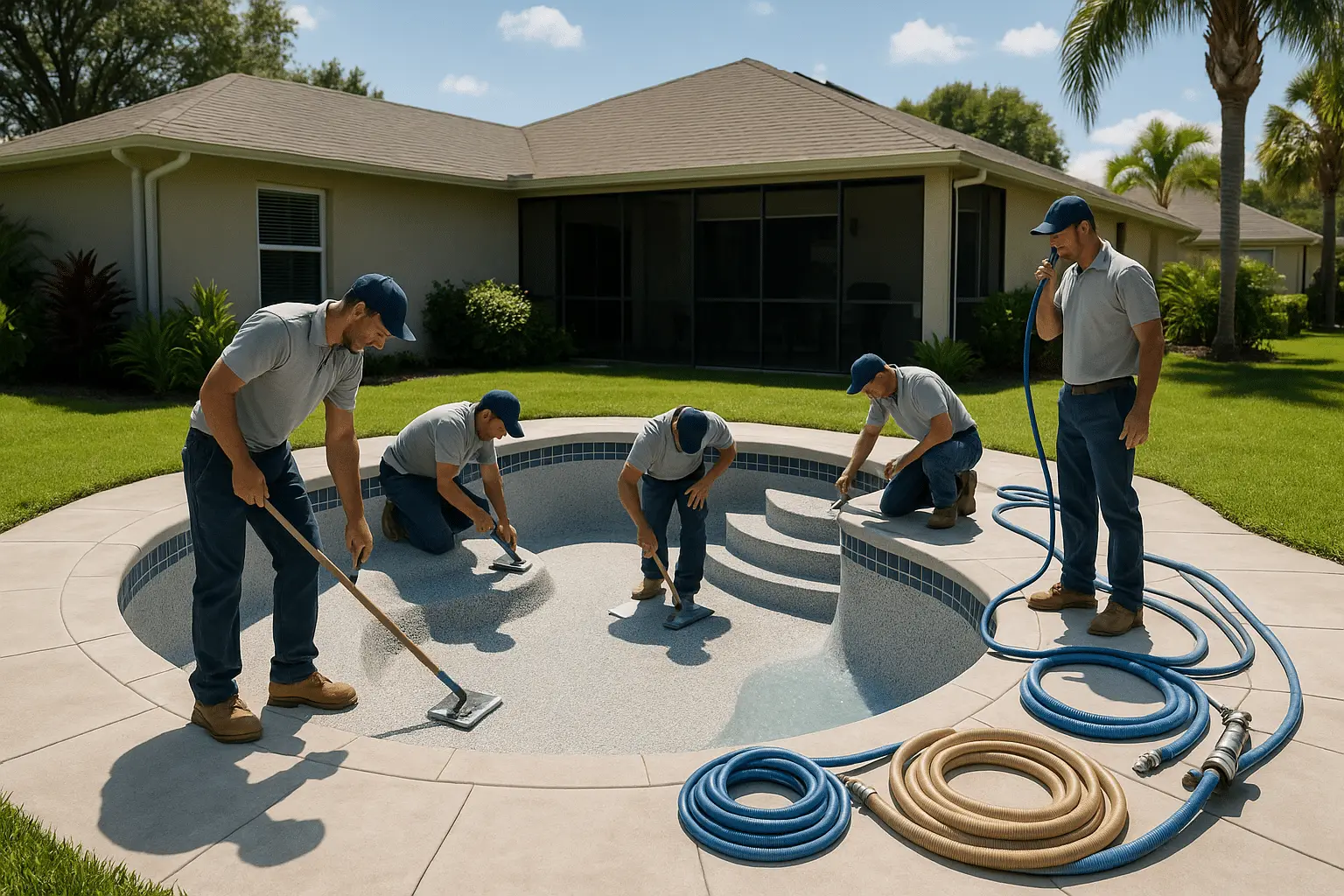
TL;DR: Florida law requires pool renovation work to be done under a DBPR-licensed Certified Pool/Spa Contractor, and skipping that check can leave you with an unenforceable contract and code violations. This guide walks Central Florida homeowners, HOAs, and property managers through verifying licenses, checking insurance, comparing bids, and avoiding the most common hiring mistakes.
An aging pool in a Central Florida backyard isn’t just cosmetic wear — it’s a structure governed by Florida building code, state health rules, and licensing law. Before you let anyone drain your pool in Winter Park, College Park, Pine Castle, or Meadow Woods, you need to know who is legally allowed to do that work and how to prove it.
This guide walks through the exact steps to vet a pool renovation contractor in Florida, what documents to demand before signing anything, and the mistakes that cost homeowners and HOA boards the most money.
Why Licensing Matters More in Florida Than Most States
Florida regulates pool work more strictly than general home improvement.
Florida pool service licensing is governed primarily by Florida Statute §489, Part II and administered by the Florida Department of Business and Professional Regulation, which defines two distinct license categories: the Swimming Pool/Spa Contractor license and the Pool/Spa Servicing registration.
That distinction isn’t a technicality.
A Class C Swimming Pool/Spa Servicing Contractor is limited to nonstructural repair and equipment servicing of pools, cannot build a pool, and cannot pull a permit.
Resurfacing, remodeling, and structural repair fall under the full Certified Pool Contractor (CPC) classification, not the servicing registration.
Getting this wrong has real legal teeth:
performing contractor-level work under a servicing registration constitutes unlicensed contracting, a first-degree misdemeanor under Florida law (§489.127, F.S.)
. If you knowingly hire an unlicensed contractor for licensed-level work, you can lose contract protections and recourse if the job goes wrong.
What You’ll Need Before You Start Calling Contractors
- Your pool’s age, last resurfacing date, and current finish type (marcite, quartz, pebble, or paint)
- Photos of visible problems: cracking, staining, rough spots, exposed rebar, or tile loss
- Your property address and HOA documents, if applicable (many Orlando-area HOAs restrict finish colors or require approval before work begins)
- A general budget range and timeline, especially if you’re renovating ahead of a home sale or rental season
Step-by-Step: How to Vet and Hire a Licensed Pool Renovation Contractor
-
Confirm the license type, not just that a license exists
Ask directly whether the company holds a Certified Pool/Spa Contractor (CPC) license versus a servicing registration.
A CPC license lets a contractor build new in-ground pools, install pool decks, coping, tile, and finishes, perform structural repairs and re-plastering, and run a pool company statewide with full authority.
A servicing-only registration does not cover any of that. -
Verify the license yourself through the state database
Florida’s DBPR maintains a free online database where you can verify any contractor’s license in about two minutes, showing whether a license is active, what work the contractor is authorized to perform, and any disciplinary action.
Don’t rely on a logo or certificate photo on a website — pull the license number and confirm the status yourself.
Under Florida law, a contract with an unlicensed contractor is unenforceable, meaning you could lose your money with no legal path to get it back. -
Check whether the license is certified (statewide) or registered (local only)
Certified contractors hold a statewide license, while Registered contractors are limited to the county or municipality where they registered.
If a contractor is only registered in a neighboring county, they may not be legally authorized to pull your permit in Orange or Seminole County. -
Confirm insurance and workers’ compensation — separately from the license check
DBPR’s database confirms licensure, not active coverage.
The DBPR confirms licensure but not active liability insurance; verification of insurance requirements requires a certificate of insurance directly from the contractor’s carrier.
Ask for a current certificate naming your address, and confirm workers’ comp coverage or a valid exemption — your building department will require this anyway before issuing a permit. -
Ask who pulls the permit and confirm it will actually happen
Resurfacing is not a handshake job in Florida.
Before any work begins you’ll need permits from your local municipality, since in Florida all pool renovations — including structural changes, plumbing, electrical work, or resurfacing — typically require a permit that ensures the work adheres to Florida’s building codes and safety standards.
Permit requirements and fees vary by jurisdiction, so confirm your contractor knows your specific city or county’s process for Orlando-area work. -
Get a written, itemized proposal — not a verbal price
A legitimate proposal should separate drain/dewatering, surface prep (acid wash, sandblasting, or mechanical chipping), substrate repair, finish material and brand (marcite, Pebble Tec®, Pebble Sheen®, Pebble Fina®, or Beadcrete®), tile/waterline work, deck work, and permit fees into distinct line items. Vague lump-sum quotes make it hard to compare bids or catch corners being cut.
-
Ask how crews are staffed
Find out whether the people working in your backyard are direct employees or rotating subcontractors. Crew consistency affects both workmanship and accountability if something needs to be corrected under warranty.
-
Compare at least two or three detailed bids
Price spreads in pool resurfacing are usually explained by finish material, substrate condition, and scope — not random discounting. If one bid is dramatically lower, ask what’s being left out: substrate repair, tile replacement, or proper dewatering and stormwater protection during drainage.
-
Review the contract for code and inspection language
The agreement should reference obtaining the permit, scheduling required inspections, and bringing the finish back to code-compliant slip-resistance and smoothness standards. If you manage a commercial, hotel, or HOA-owned pool, ask specifically how the contractor will handle Department of Health notification requirements for public pools, since
a building permit is required and numerous items must be addressed at resurfacing, including a completed Notice of Resurfacing of Public Swimming Pool form submitted to the local health department before the Building Department can issue permits. -
Confirm warranty terms in writing
Ask exactly what’s covered (finish defects vs. staining from water chemistry, for example), for how long, and what voids it. Get this in the contract, not a verbal promise.
Common Mistakes Homeowners and HOAs Make
- Confusing a pool cleaning company with a licensed renovation contractor.
Pool service technicians are not licensed contractors
, even if they’ve maintained your pool for years. Weekly cleaning and chemical balancing is a different license category than structural resurfacing work. - Skipping the permit to save time. Unpermitted resurfacing can surface as a problem later during a home sale, insurance claim, or HOA inspection, and
building departments have code authority and jurisdiction to require a repair/alteration permit for resurfacing
. - Assuming all finishes are interchangeable. Marcite, quartz, and pebble finishes have different lifespans, costs, and application requirements. A contractor should explain trade-offs, not just upsell the most expensive option.
- Not checking county-specific rules. Permit thresholds and inspection counts vary across Central Florida counties, so what applied to a neighbor’s pool in another county may not apply to yours.
- Hiring based on price alone. The cheapest bid often means skipped substrate repair, no permit, or uninsured labor — all of which become your liability, not the contractor’s.
Local Considerations for Orlando-Area Pools
Central Florida’s heat, humidity, and heavy summer rain accelerate finish wear and make proper surface prep and cure time especially important. Homeowners in established neighborhoods with older pools — including many homes being renovated for resale — often need both finish and tile/waterline work done together rather than patched piecemeal. If you’re located in or near Alafaya, Conway, or Clermont, confirm with any contractor that they regularly pull permits in your specific county, since processes and inspection counts differ across the Orlando metro.
Final Checklist Before You Sign
- License type confirmed as CPC (certified), not servicing-only
- License status verified as active on the state database
- Certificate of insurance and workers’ comp proof in hand
- Permit process and who pulls it clearly stated in writing
- Itemized written proposal, not a verbal quote
- Warranty terms specified in the contract
Recommended Reads
- Pool Renovation In Alafaya, FL | Classic Marcite
- Pool Renovation In Conway, FL | Classic Marcite
- Pool Renovation In Gotha, FL | Classic Marcite
Sources
- casselberrypoolcleaning.com
- sarasota.floridahealth.gov
- floridasbestpools.com
- legalclarity.org
- floridapoolservicedirectory.com
- floridapoolplastering.com
