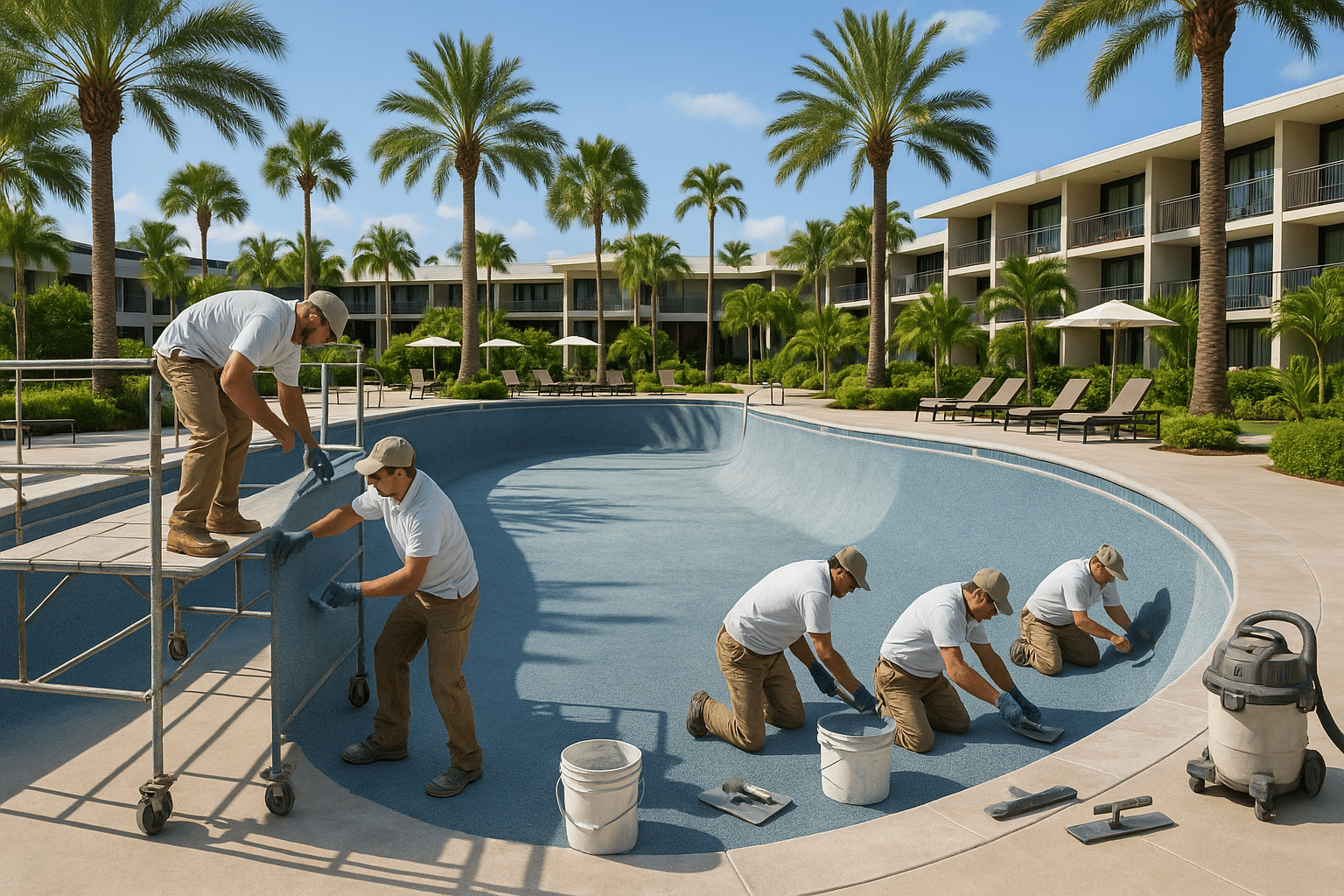
TL;DR: Commercial pool resurfacing is more regulated and higher-stakes than a backyard project, since Florida treats community, resort, and hotel pools as public pools subject to Florida Building Code and Department of Health rules. This guide covers how the process works, which finishes hold up best under heavy bather loads, and how Central Florida HOAs and hospitality operators can plan a resurfacing project with minimal downtime.
If you manage a community pool in Winter Park, a resort pool near International Drive, or an apartment pool in Meadow Woods, resurfacing isn’t just a cosmetic upgrade. It’s a code-regulated construction project with safety requirements, inspection steps, and liability considerations that a typical residential backyard pool never has to deal with.
This guide explains what commercial pool resurfacing is, how the process works in Florida, what it costs to delay, and what HOA boards, property managers, and hotel operators in Central Florida should expect from a qualified contractor.
What Counts as a ‘Commercial’ Pool in Florida?
Florida law doesn’t only apply commercial pool rules to hotels and water parks.
The Florida Statutes define a public swimming pool as any swimming pool serving five or more cooperative, joint living, or housing units, as well as pools that are open to the public or operated for a commercial purpose.
That means most HOA pools, condo pools, and apartment community pools are legally classified the same as a hotel or resort pool.
Because of that classification,
the construction, repair, remodel, and operation of these pools is highly regulated in Florida, and public pools must be built and repaired according to the Florida Building Code.
Day-to-day operation is separately regulated by the Florida Department of Health.
How Commercial Pool Resurfacing Works
The physical resurfacing process (draining, surface prep, applying the new finish, and curing) follows the same basic steps on a community pool as it does on a backyard pool. What’s different for commercial projects is the paperwork and inspection trail layered around that work.
Permitting and Licensing
A permit is required to resurface a public swimming pool, per Section 105.1 of the Florida Building Code.
In Florida, pool renovations including resurfacing typically require a permit to ensure the work adheres to the state’s building codes and safety standards.
Contractors also need the right license class.
A Class A Commercial Pool & Spa Contractor license is unlimited in the pool industry and covers both commercial and residential pools
work, while more limited license types cannot perform structural resurfacing on public pools.
Pre- and Post-Resurfacing Compliance Checks
Florida’s Department of Health requires a formal notification before a public pool is resurfaced, and the Florida Building Code spells out exactly what must be verified during that work. Depending on the scope, this can include:
- Leveling the gutter lip to within 1/4 inch between the highest and lowest point, with the downward slope to the drain maintained or improved.
- Verifying depth markers and ‘No Diving’ markers remain properly installed.
- Confirming pool ladders maintain 3 to 6 inches of clearance from the pool wall.
- Making sure no step riser exceeds 12 inches and that intermediate risers are uniform.
- Confirming the wet deck meets original approval or current ADA requirements if deck work is part of the scope.
On top of the FBC resurfacing checklist, every public pool must also comply with the federal Virginia Graeme Baker Pool and Spa Safety Act.
Under the law, all public pools and spas must have ASME/ANSI A112.19.8 (or successor standard) compliant drain covers installed, along with a second anti-entrapment system when there is a single main drain or multiple drains less than 3 feet apart.
Resurfacing is a natural time to confirm drain covers and anti-entrapment systems are current, since the pool is already drained and the gutter and floor are being disturbed.
Skipping this paperwork isn’t a minor risk.
Errors in resurfacing that aren’t code-compliant will be cited by the Department of Health on the next routine inspection and must be corrected by the owner, which should also be reported to the local Building Department.
For an HOA board or hotel operator, that can mean a forced pool closure during peak season.
Why Commercial Pools Wear Out Faster in Central Florida
Community and resort pools in Orlando, Winter Park, College Park, and surrounding areas take more abuse than the average residential pool, and the climate doesn’t help.
In Florida’s climate, pool surface degradation is measurable within 8 to 12 years rather than the 15 to 20 year benchmarks common in cooler states, due to sustained UV exposure, year-round chemical demand, and high bather loads.
Amenity pools at apartment complexes, HOAs, and hotels see all three factors at a larger scale: more swimmers per square foot, more frequent chemical treatment, and near-constant sun exposure since Central Florida pools are rarely closed for winter.
Chemistry mistakes compound the problem.
Chemical imbalance, particularly low calcium hardness below 200 parts per million or persistent low pH, etches plaster surfaces, producing rough textures that increase bather abrasion risk and accelerate algae attachment.
Rough, etched surfaces aren’t just unattractive; on a property with hundreds of visitors a month, they’re a liability and a guest-experience problem.
Finish Options for Commercial Pools
Not every residential pool finish is suited to heavy commercial use. The right choice depends on bather load, budget, and how long the board or ownership group wants to go before the next resurfacing cycle.
Pebble Finishes (Pebble Tec®, Pebble Sheen®, Pebble Fina®)
Pebble aggregate finishes are widely used on commercial pools because of their durability and warranty backing.
Commercial pools qualify for a 5-year product warranty and a 2-year applicator workmanship warranty when registered within 30 days of installation; without registration, only a one-year warranty applies.
For HOAs and hospitality operators, registering the pool promptly after the project is a simple step that protects the investment.
Within the pebble family,
PebbleQuartz® is a silica-based quartz finish that delivers much greater durability than traditional, marble-based quartz and plaster finishes,
and
PebbleFina® is made from the smallest pebbles and fortified for extra strength, providing a whisper-smooth surface with leading durability
— a detail that matters for properties concerned about surface feel on bare feet around a pool deck used by hundreds of guests.
Beadcrete® and Other Specialty Finishes
Glass-bead aggregate finishes like Beadcrete® offer an alternative aesthetic and texture profile for commercial applications where a brighter, reflective finish is preferred. The right fit depends on the property’s design goals and maintenance program, which is why a free on-site estimate and consultation matters more for commercial jobs than a one-size-fits-all quote.
Pros and Cons of Commercial Resurfacing Projects
Pros
- Restores a smooth, code-compliant surface and resolves etching, staining, and rough texture that create liability exposure.
- An opportunity to upgrade tile, waterline, and deck finishes at the same time, reducing the number of times the pool needs to close.
- Modern finishes carry manufacturer-backed warranties when installed by an authorized applicator and properly registered.
- A resurfacing project is a natural checkpoint to verify VGBA drain cover compliance and other federal/state safety requirements.
Cons
- The pool must be fully drained and closed to swimmers for the duration of the project, which requires scheduling around resident use, hotel occupancy, or event bookings.
- Permits and DOH notification add lead time compared with a simple residential refinish.
- Commercial-scale pools (especially resort and HOA pools with large square footage, multiple drains, or zero-entry designs) take longer and cost more than a standard backyard pool.
When HOAs, Hotels, and Property Managers Should Plan for Resurfacing
Boards and operators shouldn’t wait for a visible failure. Warning signs worth acting on include:
- Rough, sandpaper-like texture on the pool floor or walls that guests or residents start to complain about.
- Visible staining, discoloration, or exposed aggregate in high-traffic areas like steps and benches.
- Cracking around the waterline tile or at structural transitions.
- A pool nearing or past the 8-12 year mark common for Florida commercial surfaces.
- An upcoming sale, refinance, or franchise inspection where pool condition affects valuation or brand standards.
Scheduling resurfacing for shoulder season (late fall or winter, when pool use is lower) minimizes disruption to residents and guests, though Central Florida’s mild winters mean many properties still see steady pool use year-round, so timing should be coordinated with the HOA calendar or hotel occupancy forecasts.
Why Direct-Employee Crews Matter for Commercial Work
Commercial projects involve more moving parts: permit coordination, DOH notification paperwork, code checklist items, and warranty registration all have to be handled correctly and in the right order. Classic Marcite has resurfaced more than 100,000 residential and commercial pools since 1988 and is the largest Pebble Tec® applicator in Central Florida, with every crew member a direct employee rather than a subcontractor. That consistency matters on commercial jobs where an HOA board, hotel ownership group, or property management company needs a single point of accountability from estimate through final inspection.
Learn more about our pool resurfacing services or visit our Orlando pool resurfacing and remodeling company page for a full overview of finishes and project types. We also serve surrounding communities, including Maitland.
Getting Started
Every commercial resurfacing project should start with a site visit, not a phone quote. A qualified contractor needs to see the pool’s current surface condition, gutter and drain configuration, deck layout, and any ADA or code items that may need to be addressed during the same scope of work. Classic Marcite provides free estimates and transparent pricing for HOA boards, property managers, and hospitality operators across Orlando, Winter Park, College Park, Pine Castle, Meadow Woods, and the broader Central Florida and Northeast Florida markets.
Recommended Reads
- Pool Resurfacing & Remodeling Company In Orlando, FL
- Pool Resurfacing In Orlando, FL & Beyond | Classic Marcite
- DeLand Pool Resurfacing Company | Classic Marcite