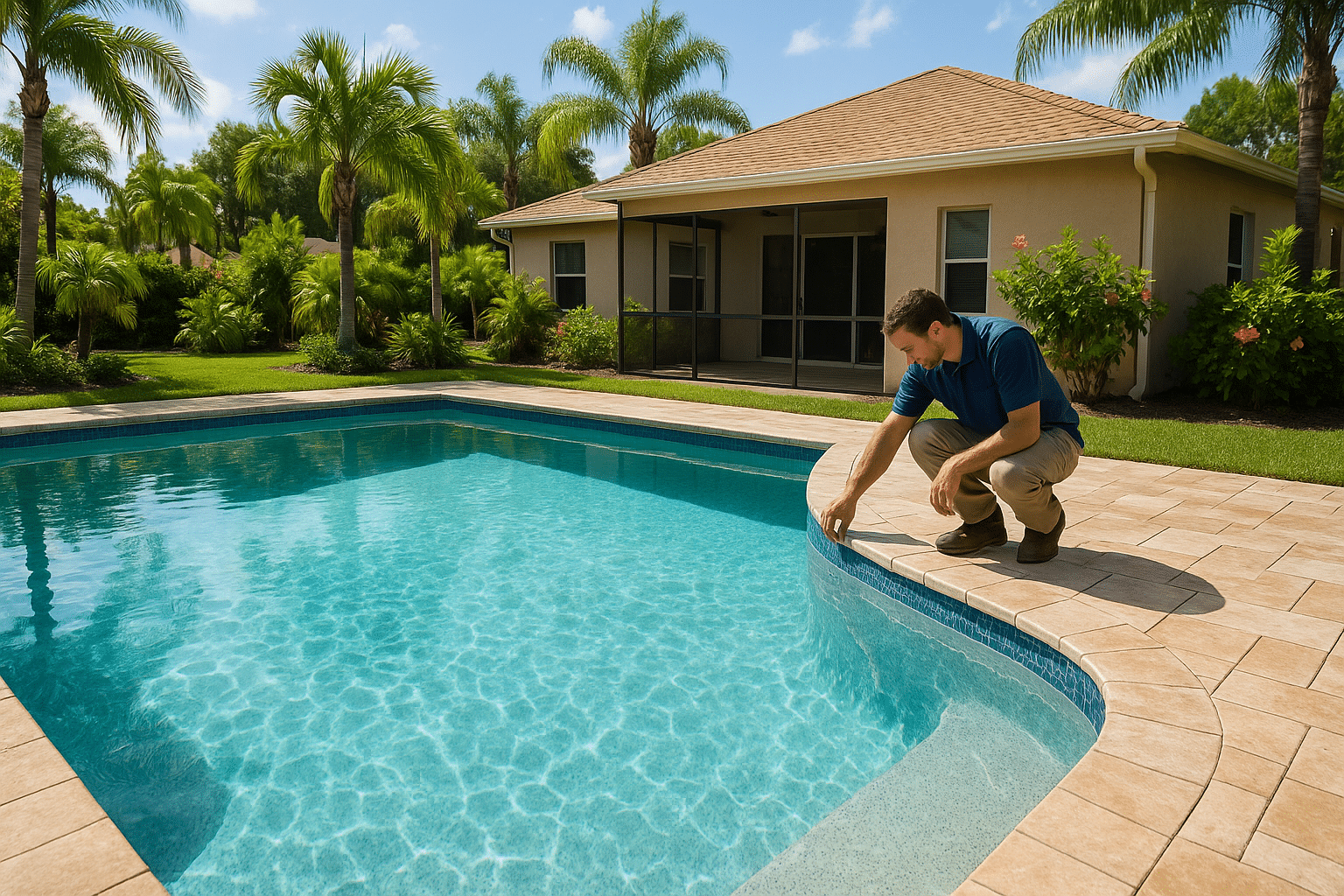
TL;DR: Saltwater chlorine generators are standard in most Orlando-area backyards, but not every pool finish holds up the same way under salt chemistry and Florida’s heat and sun. This guide ranks the main surface options — Pebble Tec, Pebble Sheen, Pebble Fina, Beadcrete, quartz, and plaster — by how they perform in saltwater pools, with guidance on cost, lifespan, and maintenance for homeowners and property managers in Orlando, Winter Park, College Park, Pine Castle, and Meadow Woods.
Most pools built or renovated in Central Florida over the last decade run on a saltwater chlorine generator instead of manual chlorine dosing. That’s good news for swimmers’ skin and eyes, but it changes the math on which pool interior finish makes sense. Not every surface ages the same way once salt, sun, and Florida’s year-round swim season get involved.
Below is a rundown of the pool surface options we install most often for saltwater pools across Orlando, Winter Park, College Park, Pine Castle, and Meadow Woods, ranked by how they actually hold up in salt chemistry, not just how they look on day one.
1. Pebble Tec: the long-term standard for saltwater pools
Pebble Tec is an exposed-aggregate finish made of polished pebbles set in a cement base. Because the surface is mostly stone rather than exposed cement, it handles salt chemistry better than smoother, cement-heavy finishes.
Typically 90% of the finish exposed to the water is stone that is not affected by the water’s chemistry, leaving only 10% (cement) that can be affected by the water.
That matters directly for saltwater pools: industry reporting on how salt systems affect finishes notes that
pebble finishes hold up better than plaster in many saltwater pools because the aggregate surface is more durable and less prone to obvious etching, making them a strong option for owners who want better long-term resilience.
The manufacturer also notes
pebble resists the salt-line etching that can plague plaster and quartz finishes.
As the largest Pebble Tec applicator in Central Florida, this is the finish we recommend most often for homeowners replacing an aging plaster pool with a saltwater system, especially on pools that get heavy year-round use.
2. Pebble Sheen: a smoother, finer-texture pebble option
Pebble Sheen uses smaller, finer pebbles for a smoother underfoot feel while keeping the same aggregate construction and chemical resistance as standard Pebble Tec. It’s a popular pick for homeowners who want the durability of a pebble finish with less texture, particularly on pools used often by kids or guests who prefer a softer surface. Maintenance is similar to other pebble finishes:
regular scrubs and balanced water chemistry are the best way to prevent scaling so it looks bright and clean.
3. Pebble Fina: the finest, most polished pebble finish
Pebble Fina uses the smallest pebble size in the lineup, producing a finish that’s nearly as smooth as plaster but with the aggregate durability pebble finishes are known for. It’s a strong fit for luxury renovation projects in neighborhoods like Winter Park where homeowners want a refined look without giving up salt-chemistry resistance.
4. Beadcrete: a glass-bead finish built for brightness and durability
Beadcrete uses recycled glass beads instead of stone aggregate, giving pools a reflective, brighter-blue water tone. The glass beads are chemically inert, which is an advantage in saltwater pools where surface wear typically concentrates at the waterline and shallow areas. It’s a good option for homeowners who want a premium look that’s distinct from the traditional pebble aesthetic.
5. Quartz finishes (like Diamond Brite): a mid-range option for saltwater pools
Quartz-aggregate finishes sit between plaster and pebble in both cost and durability.
Quartz holds sharp for 10 to 15 years at a mid-range price, which is why it’s a common pick among owners who want more than plaster without pebble pricing.
For saltwater pools specifically, quartz is considered one of the two better-performing options:
running a saltwater system favors quartz or pebble
over plain plaster.
6. Plaster (marcite): the lowest upfront cost, but the most salt-sensitive
Traditional white plaster, sometimes called marcite, is still installed in Central Florida because of its lower upfront cost. But it’s the most vulnerable finish in a saltwater environment.
Plaster/marcite is a combination of cement, sand, and calcium carbonate; the hardened cream layer that protects it is only about the thickness of two to three sheets of paper, which is why even an acid wash can be damaging to it.
Because that protective layer is so thin, it’s also the first to show the effects of imbalanced salt chemistry.
That doesn’t mean plaster can’t work in a saltwater pool. Industry guidance on the subject notes
protection starts with consistency, keeping the water balanced and brushing the surface regularly; a protective sealant can help in some cases, but no coating replaces basic maintenance, and plaster can work in a saltwater pool, but it needs more attention than a more durable surface.
If you’re seeing rough patches, chalky texture, or discoloration already, our guide on why pool surfaces turn rough and how to fix it walks through what’s normal wear versus a sign you need to resurface sooner.
7. Why salt chemistry management matters more than the finish alone
Whatever surface you choose, saltwater pools still need the same water balance discipline as any chlorinated pool. The Council for the Model Aquatic Health Code notes that
a generally accepted level for total dissolved solids (TDS) in aquatic venues is 1,500 ppm above the TDS level in the fill water, and for pools using chlorine generators, startup TDS should be measured on the initial fill after adding salt.
Left unchecked,
a high Langelier Saturation Index can lead to scale formation, cloudy water, and filtration problems, and excess minerals can deposit on the pool as rough, lightly colored blotches on the walls.
The CDC’s Model Aquatic Health Code guidance also reinforces that
pH should be kept between 7.0 and 7.8 with a chlorine concentration of at least 1 ppm in pools
, which applies whether your sanitizer comes from a salt cell or a feed pump. Keeping those numbers in range protects whichever finish you choose and extends the life of tile, coping, and pool equipment too.
8. Matching the finish to your pool’s age and use
If your pool was originally plastered in the 1990s or early 2000s and you’ve since added a saltwater system, it’s worth having the surface evaluated before problems show up. Most plaster pools in Central Florida need attention well before the 20-year mark that pebble finishes can reach. Our guide on how often to resurface a pool in Florida breaks down realistic timelines by finish type and water chemistry so you can plan a renovation before staining or roughness becomes a bigger repair.
9. Don’t forget the deck, tile, and waterline when renovating
A saltwater conversion or resurfacing project is also the right time to look at the pool deck and waterline tile. Salt spray and splash-out can affect deck coatings and grout lines just as much as the pool shell. If you’re planning a fuller renovation, our pool deck resurfacing guide for Florida pools covers which deck surfaces hold up best against sun, humidity, and salt exposure around Orlando-area backyards.
10. Timing your resurfacing project around Florida’s swim season
Finish choice aside, timing a resurfacing project matters in Central Florida, where pools get used nearly year-round. Scheduling around slower demand periods can mean a shorter wait and more flexibility on start dates. See our breakdown of the best time of year to resurface a pool in Florida for guidance on planning ahead, whether you’re an HOA board coordinating a shared pool or a homeowner in Meadow Woods or Pine Castle managing a single backyard project.
The bottom line for Orlando-area saltwater pools
For most saltwater pools in the Orlando metro, pebble finishes (Pebble Tec, Pebble Sheen, Pebble Fina) and Beadcrete offer the best combination of durability and appearance, with quartz finishes as a reasonable mid-range alternative. Plaster remains the lowest-cost option but requires more vigilant water chemistry management in a salt environment. As a licensed, insured applicator working with homeowners, HOAs, property managers, and hospitality clients across Orlando, Winter Park, College Park, Pine Castle, and Meadow Woods, we provide free estimates to help you weigh cost against long-term performance for your specific pool.
Recommended Reads
- Pool Deck Resurfacing Options: Which Surface Is Best for a Florida Pool?
- How Often Should You Resurface a Pool in Florida?
- Pool Surface Stains and Discoloration: What They Mean and What to Do