
TL;DR:
- Commercial pools must comply with federal regulations like the VGB Act, ADA, and OSHA, which set minimum safety standards. Maintaining water chemistry, safety equipment, physical barriers, and proper documentation is essential for ongoing compliance and injury prevention. Regular proactive maintenance and detailed record-keeping help avoid costly violations and ensure safe, lawful operation.
Safety regulations for commercial pools are legally enforceable standards that set minimum requirements for water chemistry, physical barriers, safety equipment, accessibility, and operational procedures to prevent accidents, illnesses, and legal liability. Property managers and commercial pool operators in Florida and across the United States must comply with a layered framework of federal, state, and local codes. Failing to meet these standards results in facility closures, fines, and personal injury lawsuits. This guide covers every major compliance area, from the Virginia Graeme Baker Pool and Spa Safety Act to daily chemical log requirements, so you know exactly where your obligations stand.
What federal laws govern safety regulations for commercial pools?
Three federal frameworks form the legal floor for commercial pool safety compliance. The Virginia Graeme Baker Pool and Spa Safety Act (VGB Act), the Americans with Disabilities Act (ADA), and OSHA chemical handling standards each address a distinct risk category. State and local health codes then layer additional requirements on top of these minimums.
The VGB Act and anti-entrapment requirements
The VGB Act requires all commercial pools to use ANSI/APSP-16 compliant drain covers installed per manufacturer guidelines, with documented service life tracked from the installation date. Single main drain pools must also install supplemental anti-entrapment devices such as a Safety Vacuum Release System (SVRS). An expired or damaged drain cover triggers immediate facility closure. Drain cover service life for polymer covers is typically five years, and replacement timing starts at the installation date, not the manufacture date. That distinction catches many operators off guard during inspections.
ADA accessibility standards
Under the ADA, commercial pools must provide at least one accessible entry point for pools with a perimeter under 300 feet, and two accessible entry points for pools exceeding 300 feet. Acceptable entry methods include pool lifts and sloped entries. This requirement applies regardless of whether a lifeguard is on duty. Inoperable ADA lifts are one of the most cited compliance failures at hotel and resort pools, making routine lift testing a non-negotiable part of your maintenance schedule.
OSHA chemical handling rules
OSHA regulates how commercial pool operators store, handle, and document pool chemicals. Violations can result in fines up to $16,131 per serious citation. Oxidizers and acids must be stored separately, and staff must have access to current Safety Data Sheets (SDS) for every chemical on site. Personal protective equipment (PPE) is required when handling concentrated chlorine, muriatic acid, or other treatment chemicals.
Pro Tip: Post SDS binders in the chemical storage area and confirm staff know their location before every health department inspection. Inspectors check this routinely.
- VGB Act: ANSI/APSP-16 drain covers, SVRS for single main drains, documented replacement dates
- ADA: one or two accessible entries based on pool perimeter, lifts or sloped entries accepted
- OSHA: separated chemical storage, SDS on site, PPE required, fines up to $16,131 per citation
- State and local codes: always apply the strictest standard among all applicable jurisdictions
How to maintain water chemistry and safety equipment for health code compliance
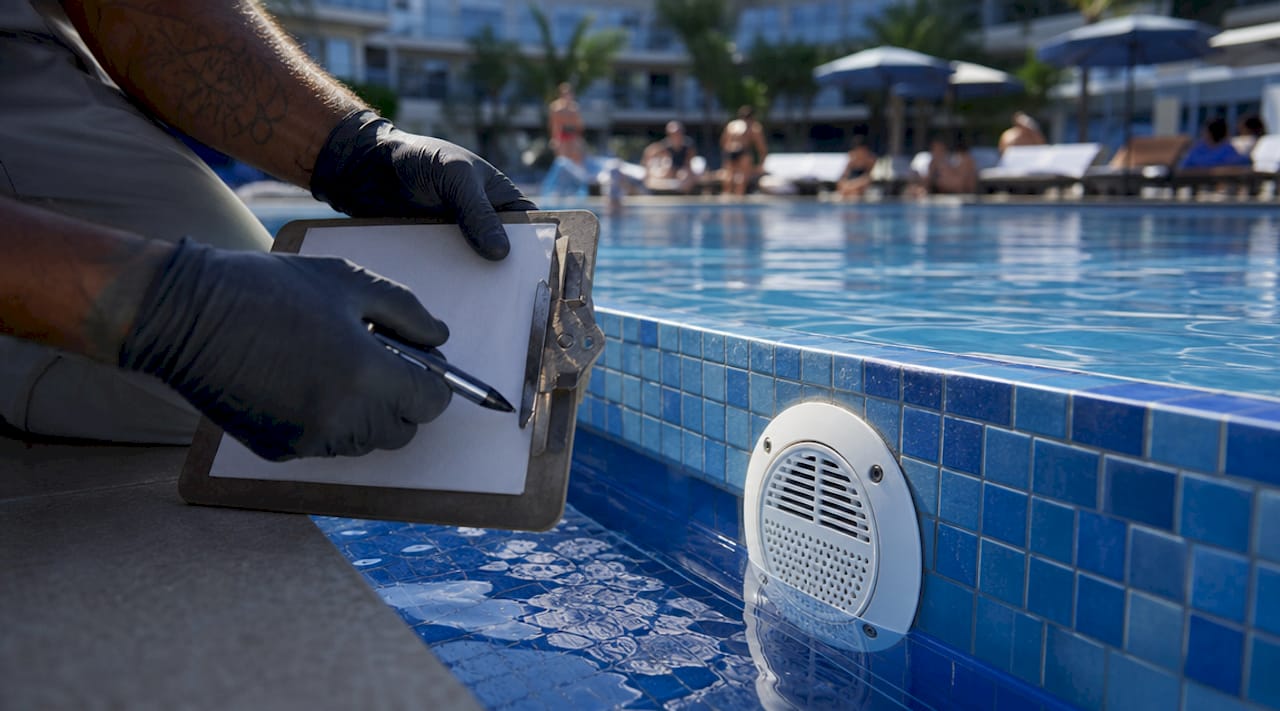
Water quality is the most frequently inspected element of any commercial pool. Health departments use chemical logs as the primary evidence of operator diligence, and gaps in those logs carry the same weight as an actual out-of-range reading.
Required chemical ranges
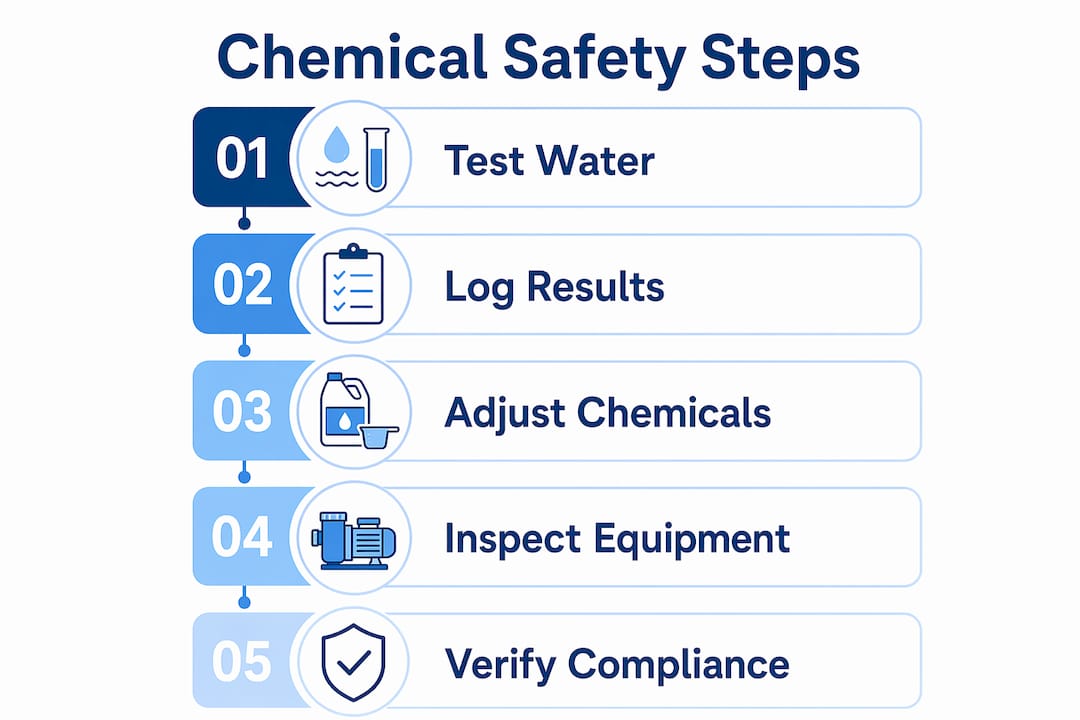
Commercial pool operators must maintain pH between 7.2 and 7.8, total alkalinity between 60 and 180 ppm (with 80 to 120 ppm as the ideal range), and free chlorine levels within the range specified by their local health authority. Testing must occur at least twice daily, and every result must be logged with the time, tester’s name, and any corrective action taken. The table below summarizes the core parameters.
| Parameter | Acceptable Range | Ideal Target |
|---|---|---|
| pH | 7.2 to 7.8 | 7.4 to 7.6 |
| Total alkalinity | 60 to 180 ppm | 80 to 120 ppm |
| Free chlorine | Per local code | Typically 1.0 to 3.0 ppm |
| Log frequency | Twice daily minimum | Every 4 hours recommended |
An out-of-range reading without a documented corrective action is treated as a severe compliance violation by most health departments. That means recording “added 2 lbs. of sodium bicarbonate, retested at 7.4” is not optional. Logs must typically be retained on site for one to three years depending on your jurisdiction.
Mandatory safety equipment
Every commercial pool must have specific rescue and first aid equipment on deck at all times. The steps below outline what inspectors expect to find.
- A U.S. Coast Guard-approved ring buoy with at least 50 feet of attached rope, mounted within reach of the pool.
- A shepherd’s hook (reaching pole) at least 12 feet long, positioned at the pool edge.
- A fully stocked first aid kit, checked and restocked after each use.
- A spine board with immobilizers for any pool deeper than five feet.
- Posted emergency contact numbers, including local EMS, visible from the pool deck.
Pro Tip: Assign a specific staff member to inspect and photograph safety equipment weekly. That photo log becomes your defense if equipment condition is disputed during an inspection.
Check the pool water quality tips resource from Classicmarcite for a practical breakdown of chemical balancing protocols that align with Florida health department standards.
What are the physical barrier and signage requirements for commercial pools?
Physical barriers and signage are the first line of defense against unauthorized access and drowning incidents. They are also among the most visible compliance failures during inspections.
Fence and gate standards
Pool barriers must be at least 4 feet high, though many jurisdictions require 5 feet for commercial facilities. Gates must be self-closing and self-latching, with the latch positioned at least 54 inches above the ground on the pool side to prevent children from reaching it. No opening in the fence or gate may allow passage of a 4-inch sphere, and the design must not include horizontal rails or footholds that aid climbing. For properties in the Carolinas, code-compliant pool fencing specialists can confirm regional height and hardware requirements before installation.
The table below compares minimum federal standards against the stricter commercial requirements common in Florida and similar states.
| Requirement | Federal Minimum | Common Commercial Standard |
|---|---|---|
| Barrier height | 4 feet | 5 feet |
| Gate latch height | 54 inches (pool side) | 54 inches, key-lockable |
| Maximum opening size | 4-inch sphere | 4-inch sphere |
| Gate operation | Self-closing, self-latching | Self-closing, self-latching, alarmed |
Signage requirements
Missing or illegible signage is one of the most common inspection failures at commercial pools. Depth markers must display numerals at least 4 inches tall in a contrasting color, visible from both the pool deck and the water. Required signage includes:
- Depth markers at every change in depth and at the shallow and deep ends
- “No Diving” warnings in areas shallower than 5 feet
- Maximum bather load posted at the pool entrance
- Pool rules (no running, no glass, shower before entry)
- Emergency contact numbers and address of the facility
Signage must be permanently mounted, weather-resistant, and replaced immediately when faded or damaged. Faded depth markers at the shallow end have been cited as contributing factors in diving injury lawsuits.
What are the common challenges in maintaining ongoing pool safety compliance?
Compliance is not a one-time event. It is a continuous operational responsibility, and the gaps that lead to citations almost always come from routine neglect rather than deliberate violations.
The most frequent inspection failures across commercial pools include expired drain covers, incomplete chemical logs, inoperable ADA lifts, faded or missing signage, and deteriorated fencing with gaps or broken latches. Each of these is preventable with a documented maintenance schedule. Passing inspections consistently requires persistent audit-ready documentation and proactive remediation, not reactive fixes after a citation is issued.
Commercial pool regulations vary widely at the state and local level. Florida, for example, enforces Chapter 514 of the Florida Statutes alongside county health department rules that can exceed state minimums. The correct approach is always to apply the strictest standard among federal, state, and municipal codes. Never assume that meeting one level of regulation satisfies all others.
Any modification to circulation equipment, including pump replacements or plumbing changes, may require a formal plan review and approval from local health authorities. Unauthorized equipment changes can result in fines and forced restoration to the previously approved configuration. This surprises operators who treat a pump swap as routine maintenance.
Pro Tip: Build a compliance calendar with monthly, quarterly, and annual tasks. Include drain cover expiration dates, ADA lift service dates, staff CPR certification renewals, and signage condition reviews. Share it with your maintenance team and review it at every staff meeting.
The commercial pool compliance guide from Classicmarcite provides a detailed breakdown of documentation practices and inspection preparation strategies specifically for Florida property managers. Operators managing multiple properties benefit from standardizing these checklists across all sites. A certified pool operator (CPO) credential, issued through the Pool and Hot Tub Alliance (PHTA), is the recognized industry standard for demonstrating technical competency in water chemistry and equipment management.
Key takeaways
Commercial pool safety compliance requires simultaneous management of federal mandates, water chemistry documentation, physical barriers, and safety equipment, with the strictest applicable standard always governing.
| Point | Details |
|---|---|
| Federal laws set the floor | VGB Act, ADA, and OSHA establish minimum standards; state and local codes often exceed them. |
| Chemical logs are legal records | Twice-daily testing with corrective actions documented protects against citations and liability. |
| Barriers and signage must be maintained | Faded depth markers and broken gate latches are among the most cited inspection failures. |
| Drain covers are consumables | Track installation dates, not manufacture dates, and replace before the stamped service life expires. |
| Proactive documentation beats reactive fixes | Audit-ready records reduce inspection stress and prevent costly facility closures. |
Why a reactive approach to pool compliance will cost you more than you expect
Most compliance failures I see at commercial pools are not the result of operators ignoring the rules. They result from operators who passed their last inspection and assumed that status would hold indefinitely. That assumption is the real liability.
Water chemistry drifts. Drain covers age. ADA lifts develop mechanical faults. Signage fades under Florida sun faster than most property managers budget for. The operators who avoid citations and closures are the ones who treat their compliance checklist as a living document, not a box checked once a year before the health department arrives.
Training your maintenance staff to recognize a non-compliant condition, not just fix it when told, changes the dynamic entirely. A pool attendant who knows that a gate latch must be 54 inches above grade will notice when a repair crew installs a replacement at the wrong height. That kind of embedded knowledge prevents the violation before it happens.
Documentation is also undervalued. Inspectors are not just looking at the pool on the day they visit. They are reviewing your logs to understand how you have managed the facility over time. A complete, continuous log with corrective actions recorded is evidence of a well-run operation. A log with gaps is evidence of negligence, regardless of what the water looks like that morning.
Engaging professionals for technical work, whether resurfacing, equipment replacement, or barrier installation, also reduces your liability exposure. When a certified contractor performs the work and provides documentation, you have a defensible record if a question arises later.
— Classicmarcite
Keep your commercial pool surfaces compliant and inspection-ready

A deteriorating pool surface creates more than an aesthetic problem. Rough, cracked, or pitted plaster harbors bacteria, disrupts chemical balance, and can create physical hazards that trigger health department citations. Classic Marcite has resurfaced over 100,000 pools across Florida since 1988, including commercial properties at resorts, hotels, and theme parks. Using materials like Pebble Tec®, the team delivers surfaces that are durable, visually clean, and easier to maintain within required chemical ranges. If your pool surface is showing wear, explore commercial pool resurfacing options that support long-term compliance and reduce your maintenance burden. Contact Classicmarcite for a free estimate tailored to your facility.
FAQ
What are pool safety regulations for commercial facilities?
Safety regulations for commercial pools are legally enforceable standards covering water chemistry, physical barriers, safety equipment, accessibility, and operator documentation. They are set by federal laws like the VGB Act and ADA, with additional requirements from state and local health codes.
How often must commercial pool water be tested and logged?
Commercial pool operators must test and log water chemistry at least twice daily, recording pH, free chlorine, total alkalinity, the time of testing, the tester’s name, and any corrective actions taken. Logs must be kept on site for one to three years depending on jurisdiction.
What drain cover does a commercial pool legally require?
The VGB Act requires ANSI/APSP-16 compliant drain covers installed per manufacturer guidelines, with service life tracked from the installation date. Single main drain pools must also have a supplemental anti-entrapment device such as an SVRS.
What fence height is required for a commercial pool?
Federal standards require pool barriers to be at least 4 feet high, but many states and municipalities require 5 feet for commercial pools. Gates must be self-closing, self-latching, with the latch at least 54 inches above grade on the pool side.
Does a “no lifeguard on duty” sign remove compliance obligations?
No. Posting a “no lifeguard” sign does not remove the legal obligation to maintain water quality, safety equipment, accessible entry, or any other regulatory requirement. Active adherence to all applicable standards remains mandatory regardless of staffing.