TL;DR:
- Pool filtration removes debris and contaminants to ensure clear water and swimmer safety. The best system depends on maintenance willingness, water quality goals, and pool size, with cartridge filters offering balance and DE filters providing optimal clarity. Proper circulation and regular maintenance are essential for effective water treatment regardless of filter type.
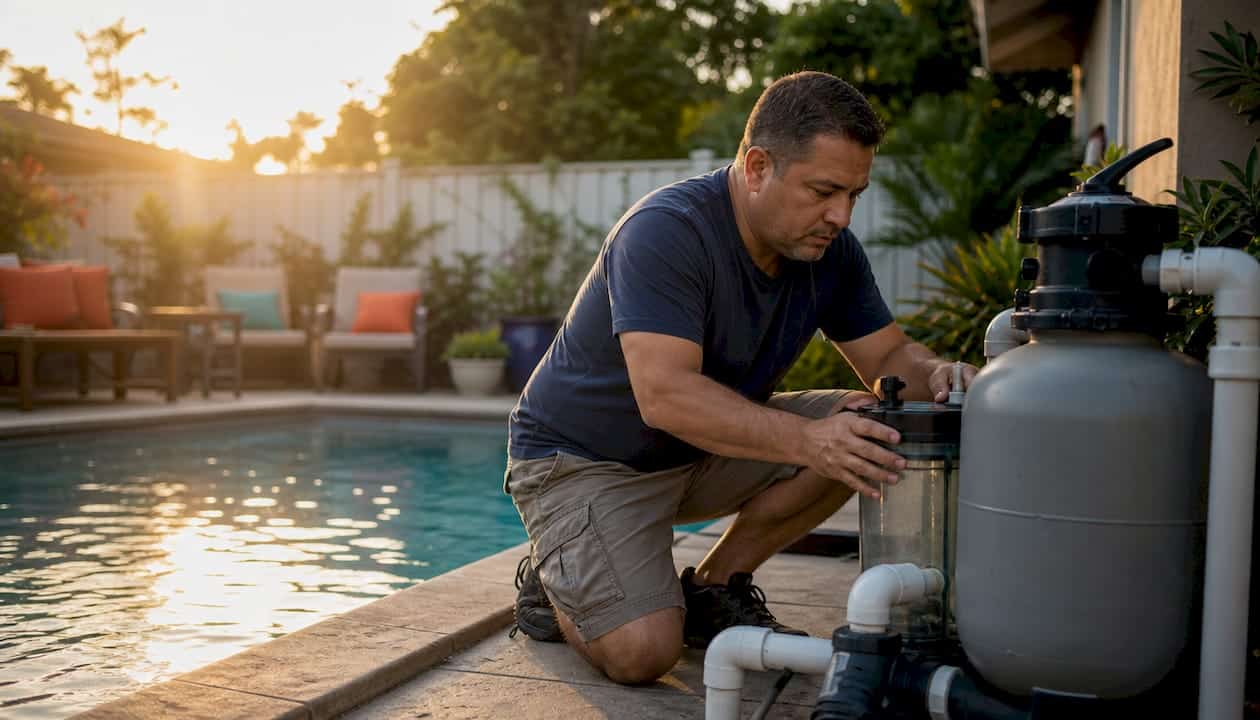
Pool filtration is defined as the mechanical process of removing suspended particles, debris, and contaminants from pool water to maintain clarity and swimmer safety. Explaining pool filtration types means understanding how three distinct systems, sand, cartridge, and diatomaceous earth (DE), each trap particles at different sizes measured in microns. The right filter choice affects water clarity, weekly maintenance time, and long-term operating costs. This guide breaks down how each system works, what it costs you in effort, and which one fits your lifestyle.
What are the main types of pool filtration systems?
The three primary filter types operate at vastly different filtration levels: sand filters capture particles 20–40 microns in size, cartridge filters capture 10–15 microns, and DE filters capture 2–5 microns. A micron is one-millionth of a meter. To put that in perspective, a human hair is roughly 70 microns wide, so even a sand filter catches particles far too small to see with the naked eye.
Each system moves water through a filtering medium and returns clean water to the pool. The medium is what differs. Sand uses silica granules, cartridge uses pleated polyester fabric, and DE uses a fine powder made from fossilized algae. Your choice determines how often you maintain the filter, how much water you use doing it, and how crystal-clear your pool looks on a hot Florida afternoon.
Filtration is also only one part of the water quality equation. Proper circulation and sanitizer levels work alongside your filter to keep water safe. A great filter in a poorly circulated pool still produces cloudy water.
How does a sand pool filter work?
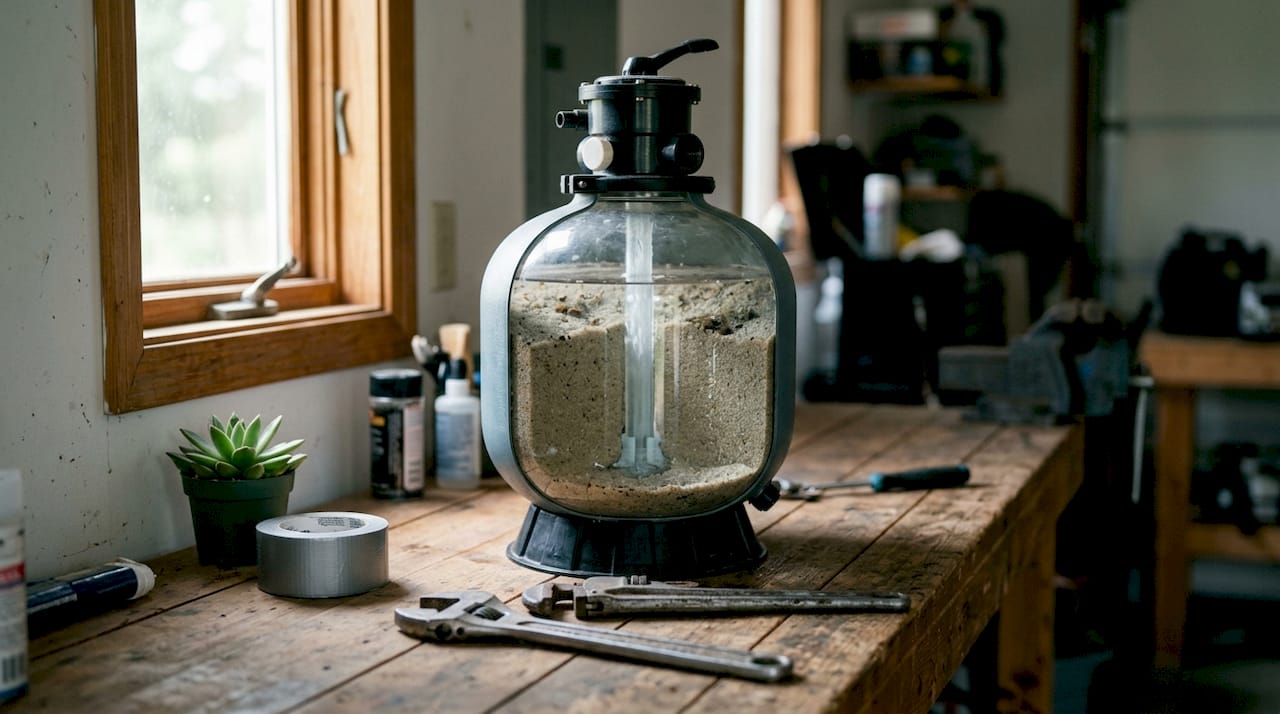
Sand filters push pool water down through a bed of silica sand, which traps debris as water passes through the granules and returns clean water through the bottom of the tank. The filtration range of 20–40 microns makes sand the least precise of the three options. That said, it handles the bulk of visible debris, algae clumps, and dirt effectively for most backyard pools.
Key benefits and limitations of sand filters
Benefits:
- Lowest upfront equipment cost of the three filter types
- Simple operation with minimal technical knowledge required
- Sand media lasts 5–7 years before needing replacement
- Durable tank construction handles years of outdoor use
Limitations:
- Coarser filtration misses fine particles that cloud water
- Backwashing wastes a significant volume of water each cycle
- Backwashing is required every few weeks to flush trapped debris out of the sand bed
- Pressure gauge monitoring is needed to know when backwashing is due
Backwashing reverses water flow through the tank to flush trapped debris out to waste. This process keeps the sand bed clean but uses water every time you do it. In Florida, where water conservation matters, that adds up over a swim season.
Pro Tip: Watch your filter pressure gauge. When pressure rises 8–10 PSI above the clean baseline reading, it’s time to backwash. Waiting too long forces your pump to work harder and shortens its lifespan.
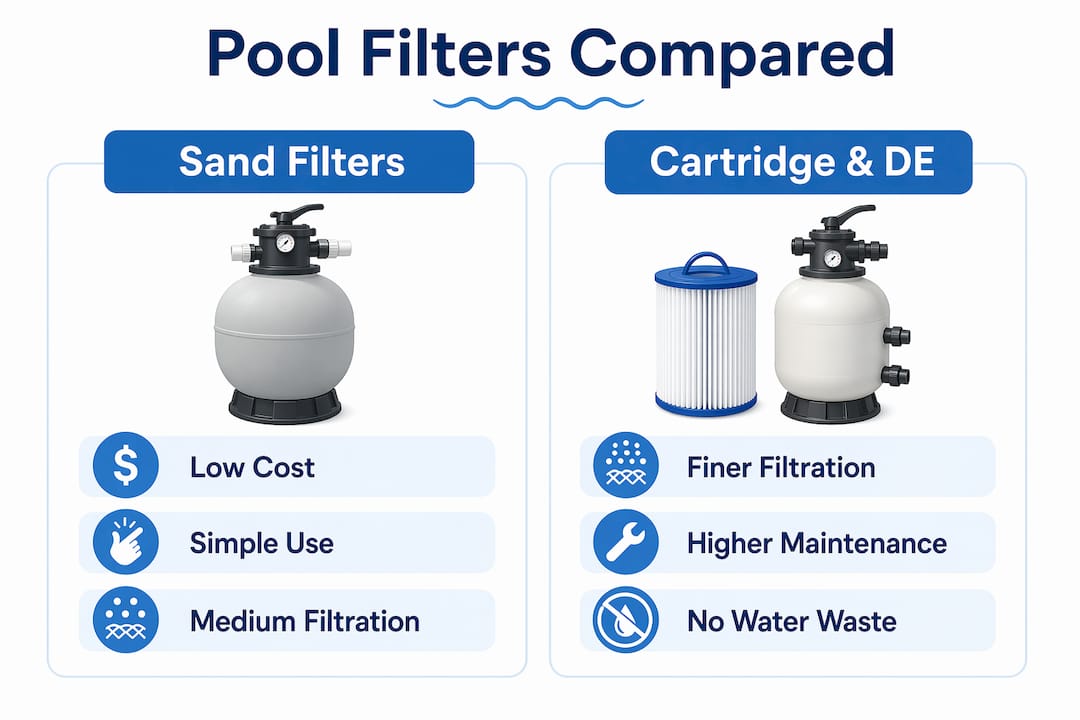
Sand filters suit homeowners who want a low-cost, low-complexity system and can accept slightly less fine filtration. They are a practical choice for larger pools where the cost of cartridge or DE equipment becomes significant.
What makes cartridge filters a balanced choice for pool owners?
Cartridge filters have become the industry standard for residential pools because they balance fine filtration with simple, water-saving maintenance. The pleated polyester fabric element captures particles down to 10–15 microns, which is noticeably finer than sand. That difference shows up as clearer, more polished-looking water.
The maintenance routine is straightforward:
- Remove the cartridge from the housing every 4–8 weeks.
- Rinse the pleats thoroughly with a garden hose, working from top to bottom.
- Inspect the cartridge for tears, collapsed pleats, or worn end caps.
- Every 3–4 months, soak the cartridge overnight in a chemical filter cleaner to dissolve oils, sunscreen residue, and mineral scale.
- Replace the cartridge every 1–3 years depending on pool usage and cleaning frequency.
The chemical soak step is one most homeowners skip, and it is the step that matters most. Regular hose rinsing alone leaves oils and minerals embedded deep in the pleats. Those deposits reduce flow rate and shorten cartridge life significantly.
Pro Tip: Keep a spare cartridge on hand. When you pull the dirty one out for its chemical soak, drop the clean spare in. Your pool keeps running without a gap in filtration.
Cartridge filters require no backwashing, which means no water waste during cleaning. That single advantage makes them a strong choice for homeowners in areas with water restrictions or high utility costs. The filter maintenance routine is also faster than managing a sand or DE system, which appeals to owners who want good results without a steep time commitment.
Cartridge replacement costs vary by filter size and brand, but the overall operating cost remains competitive with sand when you factor in water savings from eliminating backwash cycles.
Why do DE filters provide the finest water clarity?
DE filters deliver the sharpest filtration of any residential pool system, capturing particles as small as 2–5 microns. That level of precision removes particles that sand and cartridge filters pass right through, including fine silt, certain bacteria, and microscopic debris. The result is water that looks genuinely different: brighter, clearer, and more inviting.
The filtering medium is diatomaceous earth powder, which coats a set of internal fabric-covered grids. Water passes through the powder-coated grids, and the DE traps particles at the microscopic level. After backwashing, the spent DE flushes out and you must recharge the filter with fresh powder.
DE filter maintenance at a glance
| Task | Frequency | Key detail |
|---|---|---|
| Backwash the filter | Every few weeks | Flushes spent DE and trapped debris to waste |
| Recharge with DE powder | After every backwash | Add 1 lb per 10 sq ft of filter surface area |
| Full teardown and cleaning | Once or twice per year | Removes scale and debris from grids manually |
| Grid inspection | Annually | Check for tears that allow DE powder into the pool |
Handling DE powder requires care. The National Institute for Occupational Safety and Health (NIOSH) classifies crystalline silica dust as a respiratory hazard. Always wear a dust mask when measuring and adding DE powder to the filter. Work in a well-ventilated area and avoid breathing the powder directly.
Getting the DE powder amount right is not optional. Too little powder leaves grids partially uncoated and reduces filtration quality. Too much raises filter pressure, stresses the pump, and triggers premature backwash cycles. The 1 lb per 10 sq ft rule is the standard starting point.
DE filters cost more upfront than sand or cartridge systems. The ongoing cost of DE powder and the more involved maintenance routine also add up. They are the right choice for high-traffic pools, owners who prioritize water clarity above all else, or anyone running a commercial or semi-commercial pool where water quality standards are strict.
How does filter selection fit into overall pool water quality?
A filter alone does not guarantee clean water. Pool systems require the pump and filter to run 8–12 hours daily to achieve a full water volume turnover every 6–8 hours. That turnover rate is what keeps sanitizer distributed evenly and debris moving toward the filter. Running your pump for only 4–5 hours saves electricity but leaves water sitting untreated for too long.
Circulation patterns matter just as much as runtime. Properly aimed return jets create a circular flow that pushes surface debris toward the skimmer, where the pump draws it into the filter. Jets pointed straight down or at random angles create dead zones where debris settles on the pool floor and sanitizer concentrations drop. Adjusting your return jets to angle slightly downward and in the same rotational direction takes five minutes and measurably improves filtration results.
Cloudy water is the most common complaint pool owners bring to service technicians. Cloudy water issues most often stem from circulation errors and sanitizer imbalances, not filter type or condition. Replacing a perfectly functional filter because the water looks cloudy is a common and expensive mistake.
Pro Tip: Check your pool’s return jet alignment before assuming your filter is the problem. Angle each jet to point slightly downward and in the same circular direction. Give the system 24 hours and check water clarity again before calling a technician.
A practical maintenance schedule covers all three components together:
- Weekly: Check filter pressure, skim debris, test sanitizer and pH levels
- Monthly: Rinse cartridge or check sand/DE pressure trends
- Quarterly: Chemical-soak cartridge or perform full DE recharge
- Annually: Inspect all filter media, pump seals, and return jet fittings
You can find a detailed version of this routine in the pool maintenance checklist Classicmarcite publishes for Florida homeowners.
Key Takeaways
The most effective pool filtration system is the one matched to your maintenance habits, pool size, and water clarity goals, because no single filter type wins on every measure.
| Point | Details |
|---|---|
| Filtration precision varies widely | DE filters capture 2–5 microns; cartridge 10–15; sand 20–40. |
| Cartridge is the residential standard | No backwashing and fine filtration make cartridge filters the most practical choice for most homeowners. |
| DE delivers the clearest water | DE suits high-traffic or clarity-focused pools but requires more maintenance and careful powder handling. |
| Circulation drives filter effectiveness | Run the pump 8–12 hours daily and aim return jets correctly to maximize any filter’s performance. |
| Chemical cleaning extends cartridge life | Hose rinsing alone leaves oils and minerals in the pleats; a quarterly chemical soak is required. |
What I’ve learned from watching homeowners choose the wrong filter
The most common mistake I see is choosing a filter based on upfront cost alone. A sand filter is cheap to buy, but if you live in a neighborhood with strict water restrictions, the backwash waste becomes a real problem every season. The math changes fast when you factor in water bills and the time spent managing pressure cycles.
The second mistake is treating filter selection as a purely technical decision. It is a lifestyle decision. A DE filter gives you genuinely beautiful water, but it demands consistent attention. If you travel frequently or prefer a low-touch maintenance routine, that filter will underperform because the maintenance will slip. A cartridge filter in the hands of an attentive owner beats a DE filter that gets neglected.
Water conservation is also underweighted in most filter discussions. Florida homeowners face real seasonal water restrictions, and backwashing a sand or DE filter multiple times per month adds up to thousands of gallons per year. Cartridge filters eliminate that waste entirely. That is not a minor footnote; it is a meaningful operating difference.
My honest recommendation: start with a cartridge filter unless you have a specific reason to go another direction. It handles most residential pools well, saves water, and rewards consistent but simple maintenance. If you want the absolute best water clarity and you will commit to the upkeep, DE is worth the investment. Sand makes sense for very large pools where cartridge equipment costs become prohibitive.
— Classicmarcite
Pool health starts with the right surface and the right system
A well-chosen filter keeps your water clear, but the pool surface underneath plays an equally important role in long-term water quality. Rough or deteriorating surfaces trap algae, harbor bacteria, and make filtration harder for any system to manage. Classicmarcite has resurfaced over 100,000 pools across Florida since 1988, and the connection between surface condition and filtration performance is one we see on every job.

If your pool surface is pitting, staining, or showing its age, a professional resurfacing assessment is the logical next step alongside any filter upgrade. Classic Marcite serves homeowners across Central Florida, including pool resurfacing in The Villages and the greater Orlando area. Request a free estimate and get a clear picture of what your pool needs to perform at its best.
FAQ
What are the three types of pool filters?
The three residential pool filter types are sand, cartridge, and diatomaceous earth (DE). They differ in filtration precision, maintenance requirements, and upfront cost.
How often should I clean my pool filter?
Sand and DE filters need backwashing every few weeks based on pressure readings. Cartridge filters need rinsing every 4–8 weeks and a chemical soak every 3–4 months.
Which pool filter gives the clearest water?
DE filters provide the finest filtration at 2–5 microns, producing the clearest water of any residential filter type. Cartridge filters at 10–15 microns are a close second for most pools.
Can a good filter fix cloudy pool water on its own?
No. Cloudy water most often results from poor circulation or sanitizer imbalances. The filter must work alongside correct pump runtime and properly aimed return jets to clear the water.
How long does pool filter media last?
Sand media lasts 5–7 years. Cartridge elements last 1–3 years depending on cleaning frequency. DE filter grids can last 5–10 years with proper annual maintenance and inspection.