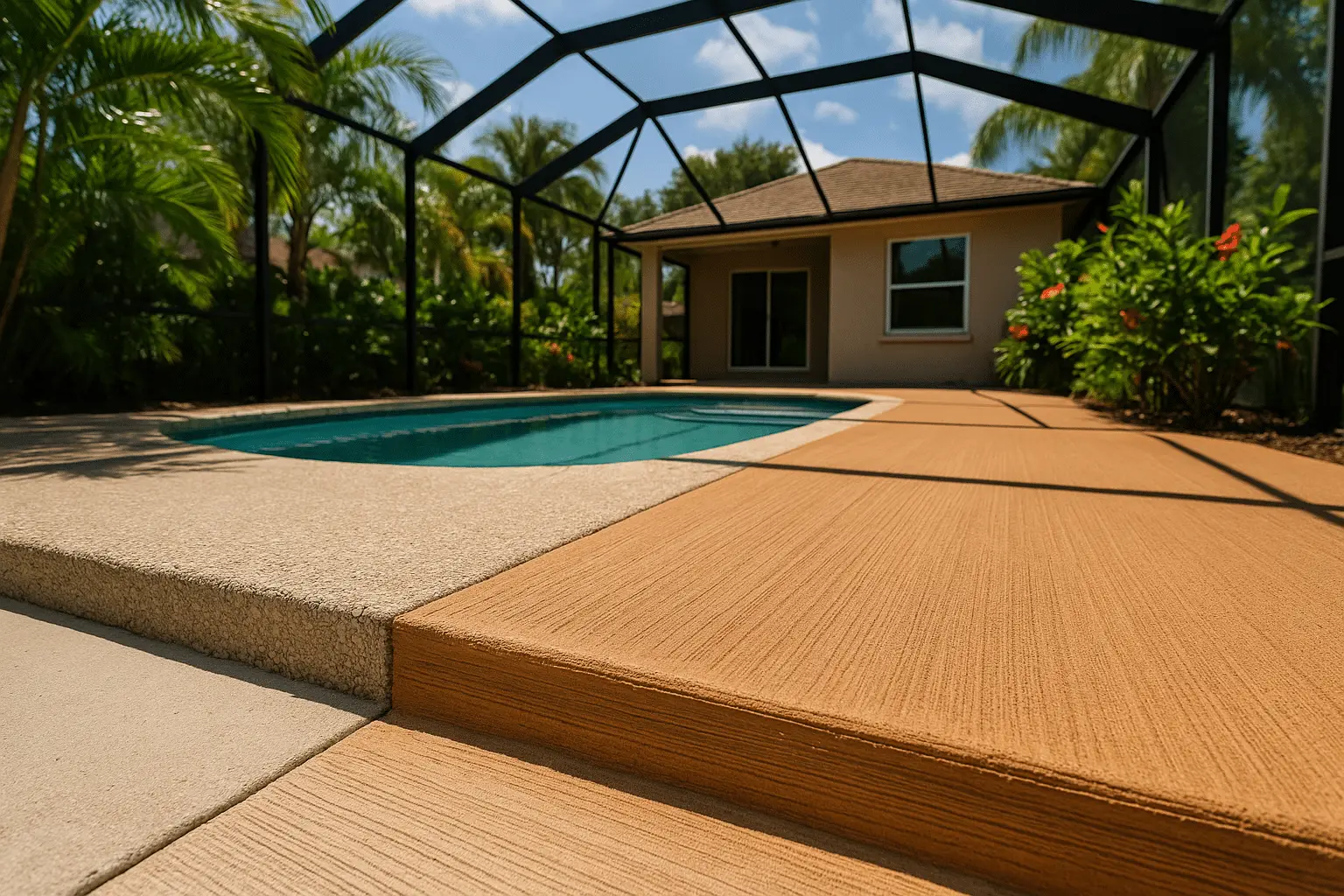
TL;DR: Orlando pool decks take a beating from intense UV, summer thunderstorms, and shifting Central Florida soil, so the right resurfacing material matters as much as the pool finish itself. This guide breaks down the main pool deck resurfacing options — cool deck/knockdown coatings, stamped concrete overlays, pavers, and pebble or exposed-aggregate finishes — with the pros, cons, and code considerations that matter most for homes in Winter Park, College Park, Pine Castle, and Meadow Woods.
If your pool deck is cracked, faded, or scorching hot by 10 a.m., you’re not imagining it. Central Florida’s sun exposure, humidity, and clay-and-sand soil mix are hard on concrete, and an aging deck usually shows wear years before the pool shell itself needs attention. The good news: you don’t have to replace the whole slab. Most Orlando-area decks can be resurfaced with a material better suited to the climate.
Here’s a rundown of the pool deck resurfacing options homeowners and property managers in Orlando, Winter Park, College Park, Pine Castle, and Meadow Woods actually choose between, along with what makes each one work — or fail — in a Florida backyard.
1. Knockdown / Cool Deck Acrylic Coatings
This is the classic Florida pool deck look: a sprayed-on acrylic or cementitious coating troweled to a light texture, usually in pale tones.
It involves applying a cementitious or acrylic base coat followed by a textured splatter coat that is knocked down with a flat trowel.
This profile creates small voids that disrupt heat transfer, and when coated in light pastel tones, it can drop surface temperatures significantly while offering an exceptionally slip-resistant surface for wet bare feet.
It’s typically the most affordable option and works well over decks that are structurally sound but cosmetically tired. The tradeoff is longevity — coatings need periodic recoating as Florida’s UV load wears down pigment and texture over time.
2. Stamped Concrete Overlays
A thin polymer-modified overlay is applied over the existing slab, then stamped with a pattern — flagstone, slate, travertine — while still wet.
Stamped concrete delivers a high-end look for a lower price than pavers or tile, and you can embed nearly any pattern or texture, from slate to brick.
This is a strong middle-ground choice for homeowners who want a upgraded, resort-style appearance without paying paver prices, and it can be applied directly over most sound concrete decks without full demolition.
3. Pavers (Concrete, Travertine, Porcelain)
Pavers sit at the premium end of pool deck resurfacing options.
For a luxurious outdoor retreat, pavers and natural stone are the premium tier of pool deck resurfacing options, offering timeless elegance — pavers (concrete, brick, clay) and natural stone (travertine, flagstone) offer unique character and beauty.
One practical advantage: individual damaged units can be replaced without redoing the whole deck.
Pavers offer easy spot repairs since individual units pop out and replace without affecting surrounding pieces, and they also stay cooler underfoot than poured concrete, especially lighter-colored travertine, which can measure 15 to 20 degrees Fahrenheit cooler than dark gray concrete in direct sun.
The catch is cost and installation complexity, since paver overlays can change deck elevation and drainage slope, which may trigger a permit review depending on the county. If your deck is already showing structural cracking, ask your contractor whether a paver overlay is appropriate or whether the slab needs to be addressed first.
4. Exposed Aggregate & Pebble-Finish Decking
For homeowners upgrading a Pebble Tec®, Pebble Sheen®, or Pebble Fina® pool interior, matching the deck material or finish creates a cohesive, resort-style transition from water to walkway. Exposed aggregate and pebble-style deck finishes add texture and grip, though darker aggregate blends can run hotter underfoot than lighter cool-deck coatings, so color selection matters as much as material choice in a hot climate.
5. Why Slip Resistance and Heat Aren’t Just Comfort Issues in Florida
Slip resistance on pool decks isn’t just a preference — it’s a recognized safety standard.
The CDC’s Model Aquatic Health Code defines “slip resistant” surfaces as those with a minimum dynamic coefficient of friction meeting specified thresholds
, and
the code is meant to prevent injury and illness linked to aquatic venues by addressing how aquatic facilities are designed, built, and operated.
Separately,
the Americans with Disabilities Act Accessibility Guidelines require a wet-condition static coefficient of friction of at least 0.60 for accessible walking surfaces
— a useful benchmark when comparing textured coatings, pavers, and stamped finishes for a residential or commercial deck.
Florida’s own building code adds specific deck requirements.
Textured deck finishes that provide pitting and crevices of more than 3/16 inch deep that accumulate soil are prohibited
, and
the minimum slope for a wet deck is 2 percent, with a minimum of 1 percent allowable for paver-type decks
, to keep water moving off the surface rather than pooling near the pool structure. This matters in Central Florida’s sudden summer downpours — a properly sloped, properly textured deck drains fast and stays safer underfoot.
6. Match the Deck Material to Your Slab’s Condition
Not every resurfacing option is appropriate for every existing deck. A reputable contractor should evaluate slab condition before recommending a finish.
Not all solutions are suitable for all substrates — professionals may perform moisture vapor transmission tests, check for slab movement, or examine the bondability of the current surface before making a recommendation, since these early evaluations ensure your resurfacing investment isn’t wasted on a method incompatible with your conditions.
If your deck already has wide cracks, heaving, or uneven sections — common after years of Central Florida’s sandy, shifting soils and seasonal rain — that’s usually a sign of substrate movement, not just a cosmetic problem. Coatings and thin overlays can mask hairline cracking, but they won’t fix an unstable base. Pavers and thicker overlay systems tolerate more movement, but a full evaluation should come first. Our guide on warning signs your pool needs resurfacing covers many of the same red flags that apply to a failing deck.
7. Coordinate Deck and Pool Interior Timing
Because deck work and interior resurfacing both involve draining or protecting the pool, staging them together often saves time and disruption, especially for HOAs and property managers coordinating amenity closures. If you’re planning a full renovation — new interior finish, tile, waterline, and deck — understanding the project sequence in advance helps set realistic expectations for residents or guests. See our step-by-step pool resurfacing timeline for how these phases typically line up.
Choosing the Right Option for Your Orlando-Area Property
For most single-family homes in Winter Park, College Park, Pine Castle, or Meadow Woods, a knockdown cool-deck coating or stamped overlay covers the budget-to-mid-range tier well. Luxury remodels, hotel and resort properties, and HOA common areas that need to look sharp for years tend to justify pavers or premium pebble-finish decking. Commercial properties and apartment communities should also factor in code-driven slip resistance and drainage requirements, since these are inspected, not optional.
Classic Marcite has resurfaced pool interiors and decks across Central Florida since 1988, working directly — not through subcontractors — on more than 1,000 projects a year. If you’re weighing pool deck resurfacing options alongside an interior refinish, our team can walk the property, check the slab, and lay out transparent options during a free estimate. Browse recent pool resurfacing and deck projects for examples of finished work, or start with our pool resurfacing services page to see the full scope of what we handle in-house.
Recommended Reads
- Pool Resurfacing & Remodeling Company In Orlando, FL
- Pool Resurfacing In Orlando, FL & Beyond | Classic Marcite
- Classic Marcite Gallery – Swimming Pool Resurfacing
