TL;DR:
- Maintaining proper pool alkalinity between 80 and 120 ppm ensures stable pH levels and protects pool surfaces.
- Adjust alkalinity before pH to prevent ongoing pH instability, which wastes chemicals and shortens equipment lifespan.
Pool alkalinity is defined as the total concentration of bicarbonates, carbonates, and hydroxides dissolved in your pool water, and it acts as a chemical buffer that resists sudden pH swings. The industry term for this measurement is total alkalinity, or TA. When TA sits in the ideal range of 80–120 ppm, your pool water stays stable, your chlorine works at full strength, and your surfaces stay protected. When it falls outside that window, you pay for it in damaged equipment, irritated swimmers, and wasted chemicals. Understanding how to explain pool alkalinity is the first step toward spending less time fixing problems and more time enjoying your pool.
How does pool alkalinity affect water balance?
Total alkalinity is the anchor of your pool’s water chemistry. Without adequate TA, pH levels swing wildly in response to rain, bather load, or chemical additions. That instability has real consequences for every system in your pool.
Unstable pH drops chlorine efficiency by 50–70%, meaning you burn through sanitizer without actually disinfecting the water. That is not a minor inconvenience. It means swimmers are exposed to inadequately treated water while you keep adding chemicals that accomplish little.
The consequences of out-of-range alkalinity break down clearly:
- Low alkalinity (below 80 ppm): Low alkalinity causes pH fluctuations, corrosive water, equipment damage, and eye and skin irritation for swimmers. Metal fixtures corrode, plaster surfaces etch, and pH readings bounce unpredictably.
- High alkalinity (above 120 ppm): High alkalinity creates pH lock, making chlorine ineffective and causing scale buildup, cloudy water, and clogged filters.
The bottom line: Pool alkalinity levels that drift out of the 80–120 ppm range do not just affect water clarity. They accelerate surface wear, shorten equipment life, and make every other chemical you add work against you.
Think of TA as the shock absorber in your water chemistry system. A car without shock absorbers still moves, but every bump becomes a problem. A pool without proper alkalinity still holds water, but every chemical addition, rainstorm, or heavy swim session sends your pH into chaos.
What is the difference between alkalinity and pH?
This is the most common point of confusion for pool owners, and getting it wrong costs money. pH measures current water acidity or basicity, while alkalinity measures your water’s resistance to pH changes. They are related but completely separate measurements.
Here is a practical way to think about it. pH is a snapshot. It tells you where your water chemistry stands right now. Alkalinity is the foundation. It determines how stable that snapshot will be over the next 24 hours.
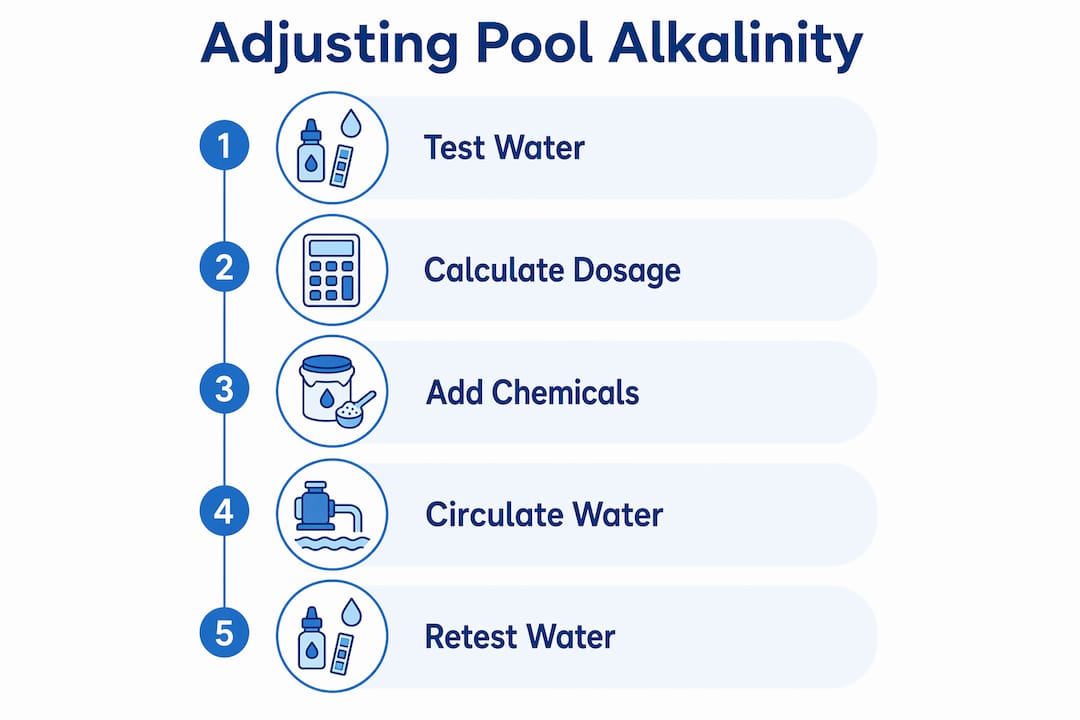
The correct order for adjusting pool water chemistry is:
- Test total alkalinity first. Get TA into the 80–120 ppm range before touching anything else.
- Adjust alkalinity if needed. Use sodium bicarbonate to raise it or muriatic acid to lower it.
- Retest pH after alkalinity stabilizes. Only then make fine pH corrections.
- Test chlorine and other parameters last. Sanitizer effectiveness depends on both alkalinity and pH being in range.
Adjusting alkalinity before pH is not optional. If you try to correct pH first with unbalanced alkalinity, the pH drifts back out of range within hours. You end up chasing a moving target, adding chemicals daily, and never achieving stability. Pool professionals call this pH bounce, and it is almost always caused by neglecting alkalinity first.
Pro Tip: If your pH keeps drifting even after you correct it, check your TA before adding more pH adjuster. The problem is almost always low alkalinity, not a pH problem.
The analogy that works best: alkalinity is the thermostat, pH is the room temperature. You can open windows all day to cool a room, but if the thermostat is broken, the temperature will never stay where you want it.
How to test and adjust pool alkalinity
Testing frequency and best practices
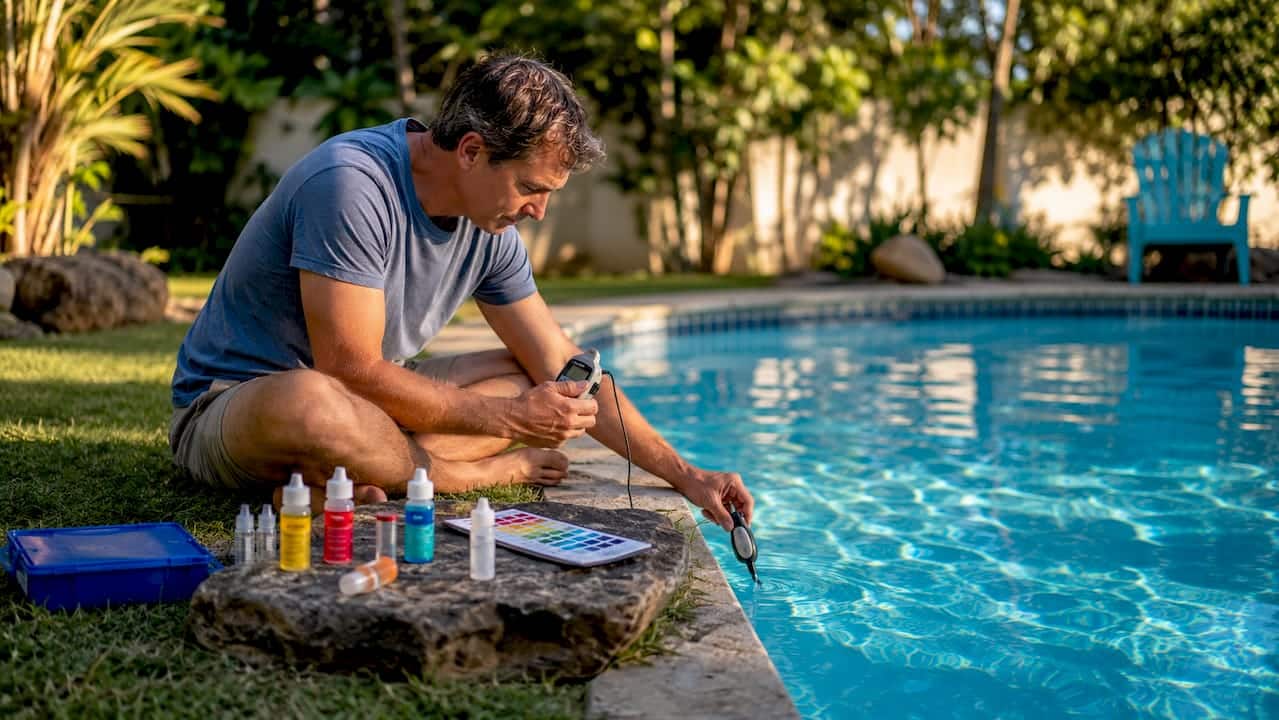
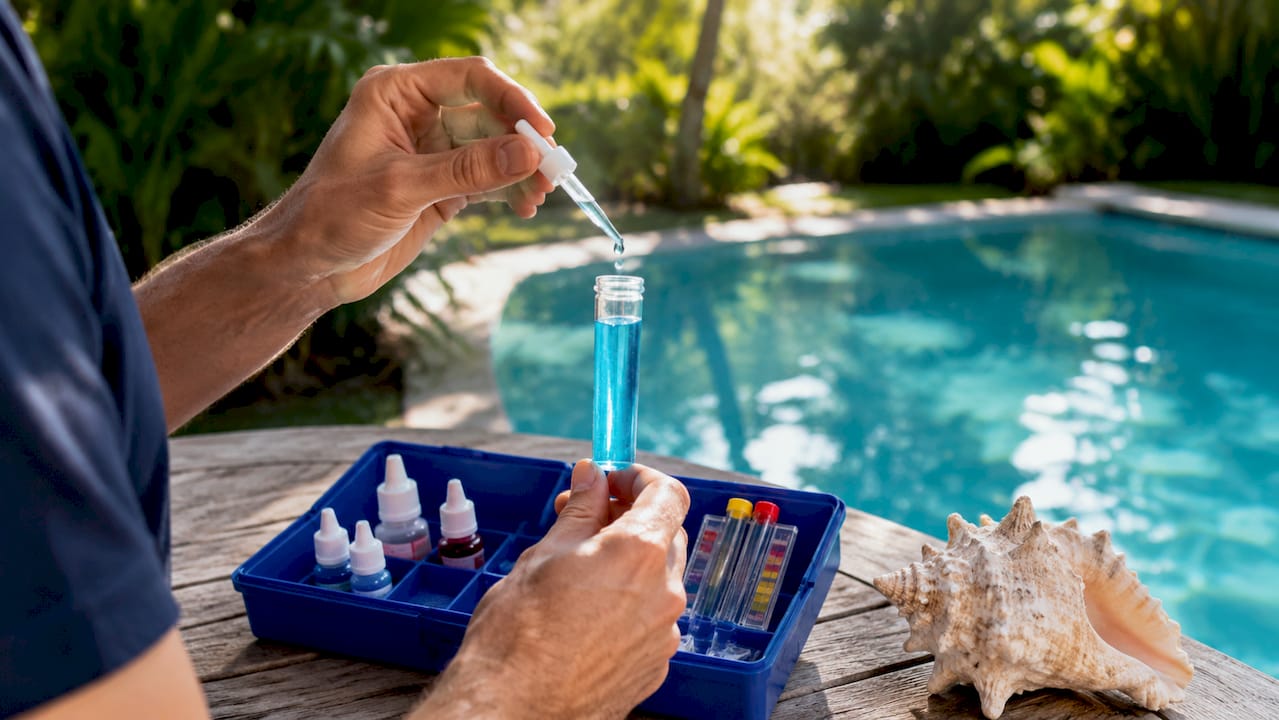
Test alkalinity at least twice weekly during summer and after any storm event. Florida pool owners in particular deal with heavy rain that dilutes and destabilizes water chemistry fast. A standard pool test kit or test strips that measure total alkalinity work for routine checks. For precision, a liquid reagent kit gives more reliable readings than strips.
Raising alkalinity with sodium bicarbonate
Sodium bicarbonate, the same compound as baking soda, is the standard chemical for raising TA. Adding 1.5 lbs per 10,000 gallons raises total alkalinity by approximately 10 ppm. Dissolve it in a bucket of pool water first, then distribute it evenly around the pool with the pump running. Wait at least six hours before retesting.
Lowering alkalinity with muriatic acid
Lowering TA requires more care. Muriatic acid at 31.45% concentration lowers alkalinity by 10 ppm per 10,000 gallons at a dose of approximately 25.6 fl oz. Dry acid (sodium bisulfate) is a safer alternative for homeowners, requiring about 2.1 lbs for the same effect.
| Chemical | Purpose | Dose per 10,000 gallons | Effect on pH |
|---|---|---|---|
| Sodium bicarbonate | Raise TA | 1.5 lbs per 10 ppm increase | Slight increase |
| Muriatic acid (31.45%) | Lower TA | 25.6 fl oz per 10 ppm decrease | Significant decrease |
| Dry acid (sodium bisulfate) | Lower TA | 2.1 lbs per 10 ppm decrease | Moderate decrease |
Key rules for adjusting alkalinity safely:
- Never add more than one dose of acid per day. Lowering alkalinity is a multi-day process, and too much acid at once can crash pH and damage surfaces.
- After adding muriatic acid, run the pump for at least 30 minutes to distribute it evenly.
- Use aeration (fountains, jets, or waterfalls) to raise pH back up after lowering TA without adding more alkalinity.
- Retest after each adjustment and wait 24 hours before adding another dose.
Pro Tip: When lowering alkalinity, pour muriatic acid into the deep end near a return jet with the pump running. Never add it near the skimmer or in a concentrated spot. Uneven distribution etches surfaces.
How does your sanitizer type affect alkalinity targets?
Not every pool needs the same TA level. Your sanitizer choice directly affects the ideal alkalinity range for your specific pool. Getting this wrong means you are constantly fighting your own chemistry.
Here is how sanitizer type changes the target:
- Saltwater and liquid chlorine pools: Target 80–100 ppm. These systems tend to push pH upward naturally, so lower alkalinity reduces the risk of high pH and scale formation.
- Trichlor tablet pools: Target 100–120 ppm. Trichlor is highly acidic (pH around 2.8–3.0), so it pulls pH down aggressively. Higher alkalinity provides the buffering needed to prevent pH from crashing.
- Bromine pools: Target 100–120 ppm for the same reason. Bromine sanitizers are acidic and require stronger buffering capacity to maintain stable pH.
- Biguanide (PHMB) pools: Target 80–120 ppm, but monitor more frequently since biguanide does not interact with chlorine and the chemistry behaves differently.
Seasonal conditions matter too. Florida summers bring frequent afternoon thunderstorms that dump large volumes of fresh water into pools, diluting TA and dropping pH simultaneously. Testing more often during heavy rain and high-use periods prevents the kind of rapid imbalance that takes multiple treatments to correct. A pool that is perfectly balanced on Monday can be significantly off by Thursday after two storms and a weekend pool party.
For pool water quality tips tailored to Florida conditions, the combination of sanitizer type, rainfall frequency, and bather load all factor into how often you need to test and adjust TA.
Key takeaways
Balanced total alkalinity is the single most important foundation of stable pool water chemistry, and every other chemical adjustment depends on getting it right first.
| Point | Details |
|---|---|
| Ideal TA range | Keep total alkalinity between 80–120 ppm to prevent pH swings and protect surfaces. |
| Adjust alkalinity first | Always correct TA before adjusting pH to avoid constant pH drift and chemical waste. |
| Raising vs. lowering TA | Use sodium bicarbonate to raise TA and muriatic acid or dry acid to lower it gradually. |
| Sanitizer type matters | Trichlor and bromine pools need higher TA (100–120 ppm); saltwater pools need lower (80–100 ppm). |
| Test after weather events | Retest alkalinity after rain, storms, or heavy pool use to catch imbalances early. |
What years of pool work taught me about alkalinity
Most pool owners I talk to treat alkalinity as an afterthought. They test pH, add a chemical, and move on. Then they call us wondering why their plaster is etching or their water keeps going cloudy despite adding chlorine every week.
The uncomfortable truth is that pH problems are almost never pH problems. They are alkalinity problems wearing a pH disguise. Once you fix the TA, pH management becomes almost effortless. The pool holds its chemistry for days instead of hours.
The other mistake I see constantly is rushing the process of lowering alkalinity. Pool owners add a large dose of muriatic acid, watch the TA drop, then add another dose the next day because it is still high. By day three, their pH is dangerously low and their plaster is showing the damage. Patience is not optional here. One dose, 24 hours, retest. Repeat.
Stable alkalinity also saves real money. When chlorine works at full efficiency because pH is stable, you use significantly less of it. For a pool maintenance approach that cuts chlorine use without sacrificing water quality, balanced TA is the starting point, not an add-on.
If you are managing a pool in Florida, build alkalinity testing into your weekly routine alongside your pool maintenance checklist. The pools that stay cleanest and cost the least to maintain are the ones where the owner never lets TA drift more than 10 ppm from the target.
— Classicmarcite
Protect your pool surface with professional resurfacing
Balanced alkalinity protects your pool surface. But if your water chemistry has been off for years, the damage may already be done. Etched plaster, stained surfaces, and scaling are all signs that chemical imbalance has taken a toll on your pool’s interior.

Classic Marcite has resurfaced over 100,000 pools across Florida since 1988, restoring surfaces damaged by years of chemical imbalance. Whether your pool needs a full resurfacing in Winter Park or a complete renovation in The Villages, the team at Classicmarcite uses materials like Pebble Tec® that hold up against the chemical demands of Florida pool ownership. Contact Classicmarcite today for a free estimate and find out what your pool’s surface actually needs.
FAQ
What is pool alkalinity in simple terms?
Pool alkalinity, or total alkalinity (TA), is the measure of your water’s ability to resist pH changes. It acts as a chemical buffer that keeps pH stable between adjustments.
What happens if pool alkalinity is too low?
Low alkalinity causes rapid pH swings, corrosive water, equipment damage, and swimmer eye irritation. It also reduces chlorine effectiveness significantly.
How do i raise pool alkalinity quickly?
Add sodium bicarbonate (baking soda) at 1.5 lbs per 10,000 gallons to raise TA by approximately 10 ppm. Distribute it evenly with the pump running and retest after six hours.
Should i adjust alkalinity or pH first?
Always adjust total alkalinity first. Correcting pH before TA is balanced causes constant pH drift, wasting chemicals and never achieving stable water chemistry.
How often should i test pool alkalinity?
Test at least twice per week during summer and after every significant rain event. Florida pools in particular need more frequent testing due to heavy seasonal rainfall that dilutes water chemistry rapidly.