TL;DR:
- Calcium buildup in pools results from hard mineral deposits forming when water chemistry becomes oversaturated with calcium.
- Monitoring pH, calcium hardness, and alkalinity along with regular testing and partial water refills prevents scale formation efficiently.
Calcium buildup in pools is the formation of hard, crusty deposits that occur when dissolved calcium precipitates out of water under specific chemistry conditions. The industry term for this is calcium scale, and it appears in two distinct forms: calcium carbonate and calcium silicate. Both damage pool surfaces, clog equipment, and irritate swimmers. Recommended calcium hardness ranges sit between 175–275 ppm depending on pool type, and pH should stay between 7.4 and 7.6. When either value drifts outside those targets, scale formation accelerates. Understanding why calcium buildup in pools occurs is the first step toward stopping it.
What causes calcium buildup in pools?
Calcium scale forms when water becomes oversaturated with dissolved calcium and can no longer hold it in solution. The calcium then bonds to pool surfaces, tile grout, and equipment as a hard mineral deposit. The trigger is not a single factor but a combination of chemistry variables working together.
The most useful tool for measuring that combined risk is the Langelier Saturation Index, or LSI. Calcium scale forms when the LSI rises above +0.3 due to elevated pH, total alkalinity, and calcium hardness. An LSI reading above zero means your water is scale-forming. An LSI below zero means the water is corrosive and will etch plaster instead.
Several chemistry variables push the LSI upward:
- pH above 7.8 causes calcium carbonate to precipitate rapidly. Scale commonly appears first at the waterline, where carbon dioxide escapes the water and raises pH locally.
- Calcium hardness above 400 ppm creates a large reservoir of dissolved calcium ready to drop out of solution.
- High total alkalinity buffers pH at elevated levels, compounding the scaling risk. Proper pool alkalinity management keeps this variable in check.
- Evaporation concentrates calcium and other minerals in the remaining water, raising hardness without any chemical addition.
Temperature is another major driver. Warm water in spas or heated pools running at 100–104°F accelerates calcium scale formation significantly. Aeration from fountains and water features raises pH and speeds up precipitation as well. If your pool has a heater or a water feature, expect to test chemistry more frequently than a standard pool requires.
What are the two types of calcium scale in pools?
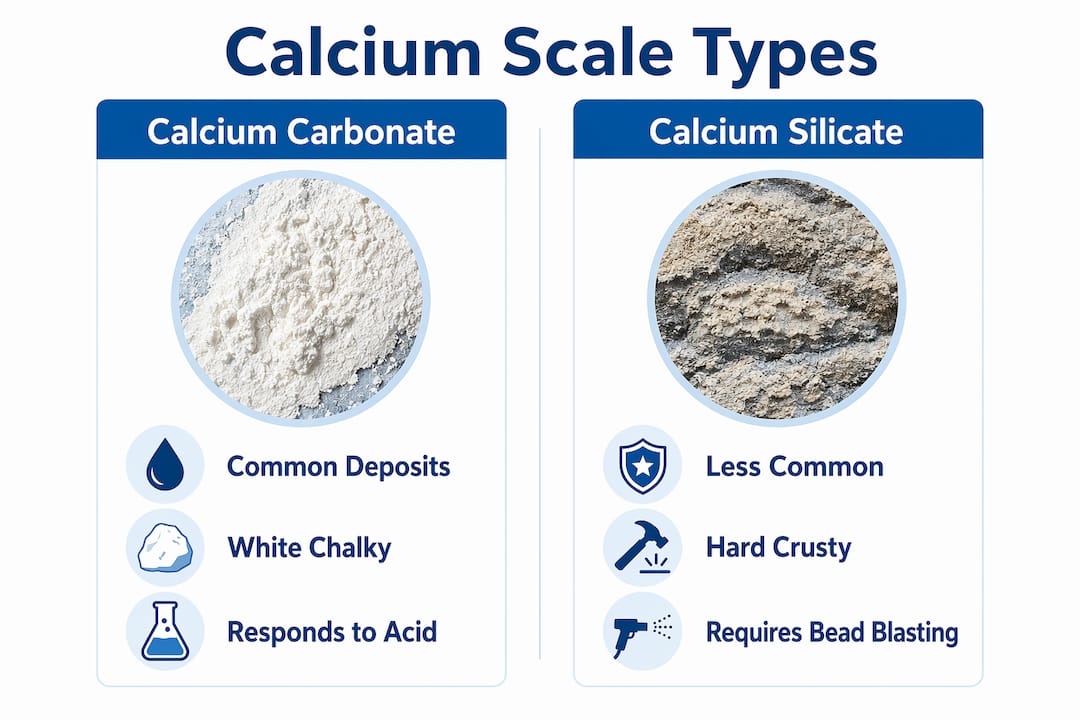
Not all calcium scale behaves the same way, and misidentifying the type leads directly to wasted effort and surface damage. The two types are calcium carbonate and calcium silicate, and they require completely different removal approaches.
Calcium carbonate is the more common of the two. It appears as white or chalky deposits, often at the waterline or on tile. It forms relatively quickly when pH and calcium hardness spike. The defining characteristic is that calcium carbonate scale is acid soluble and fizzes positively when muriatic acid is applied. That reaction tells you the scale will respond to acid-based cleaning.
Calcium silicate is harder, denser, and gray or white in color. It forms more slowly, usually over months or years, when silica in the water combines with calcium under high-pH conditions. Calcium silicate does not fizz with muriatic acid. It is acid resistant and requires mechanical removal.
The fizz test is your fastest diagnostic:
- Apply a few drops of muriatic acid directly to the deposit.
- If it fizzes, you have calcium carbonate. Acid-based cleaners will work.
- If there is no reaction, you have calcium silicate. Plan for mechanical removal.
Pro Tip: Run the fizz test before buying any cleaning product. Spending money on an acid-based cleaner for calcium silicate scale is a common mistake that costs time and money without removing a single gram of deposit.
Misidentification also causes surface damage. Scrubbing calcium silicate with abrasive pads on a plaster finish can scratch the surface. Applying repeated acid treatments to calcium silicate accomplishes nothing except degrading the finish underneath.
How to remove calcium deposits from pool surfaces
The correct removal method depends entirely on which type of scale you are dealing with. Applying the wrong method damages your pool finish without solving the problem.
Removing calcium carbonate scale
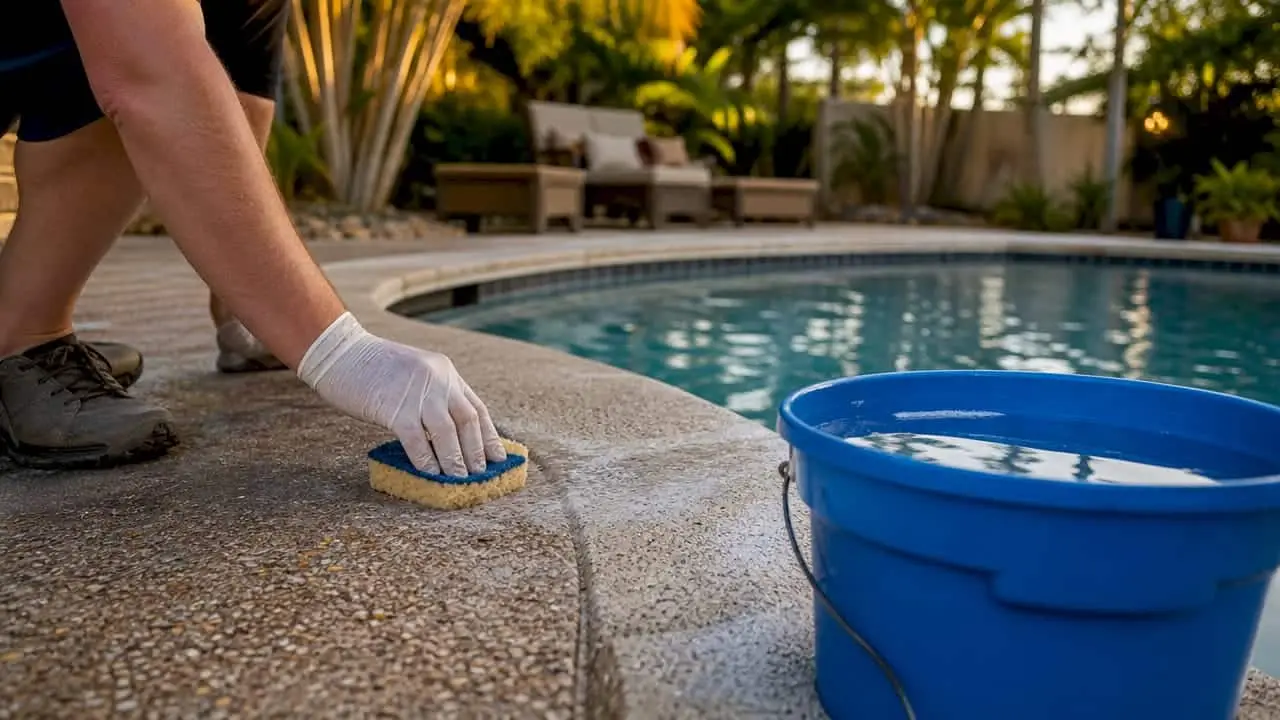
- Apply a diluted muriatic acid solution. Mix muriatic acid at a 1:4 ratio with water (one part acid to four parts water). Apply it directly to the affected area using a brush or sponge. Let it dwell for two to three minutes, then scrub and rinse thoroughly.
- Use a pool-safe acid cleaner for tile. Specialized pool tile cleaners contain buffered acid formulas that are safer to apply near water than straight muriatic acid. They work well for light to moderate calcium carbonate deposits on tile and coping.
- Try a pumice stone for stubborn spots. A wet pumice stone removes calcium carbonate from plaster and concrete without acid. Always keep the stone and surface wet to avoid scratching. Never use a pumice stone on fiberglass or vinyl.
- Rebalance chemistry immediately after cleaning. Removing scale without fixing the underlying chemistry guarantees the deposit returns within weeks.
Pro Tip: Always add acid to water, never water to acid. Wear chemical-resistant gloves and eye protection. Work in sections and rinse each section before moving to the next.
Removing calcium silicate scale
Bead blasting is the recommended method for heavy deposits or calcium silicate scale. This technique uses fine glass beads propelled under pressure to strip scale from tile and plaster without damaging the surface underneath. It is a professional service and not a DIY option.
Acid washing is a last resort for severe calcium carbonate buildup across an entire pool surface. Overuse of acid washing damages pool finishes by removing protective layers and shortening surface lifespan. Repeated acid washing permanently shortens plaster or Pebble Tec® finishes by removing a thin sacrificial layer, causing blotchiness and exposing the underlying aggregate. Reserve it for situations where no other method is viable, and never repeat it more than once every few years. For guidance on restoring scale-damaged tile, professional assessment is the safest starting point.
How to prevent calcium buildup in pools long term
Prevention is far less expensive than removal. The goal is to keep water chemistry within ranges that make scale formation chemically impossible.
Target chemistry ranges by pool type
| Pool type | Calcium hardness target | pH range |
|---|---|---|
| Vinyl or fiberglass | 175–225 ppm | 7.4–7.6 |
| Concrete or plaster | 200–275 ppm | 7.4–7.6 |
Calcium hardness below 200 ppm produces aggressive water that etches plaster and grout. Staying within the target range protects the finish from both scaling and corrosion. The right number is not the lowest possible; it is the balanced one.
Key prevention practices include:
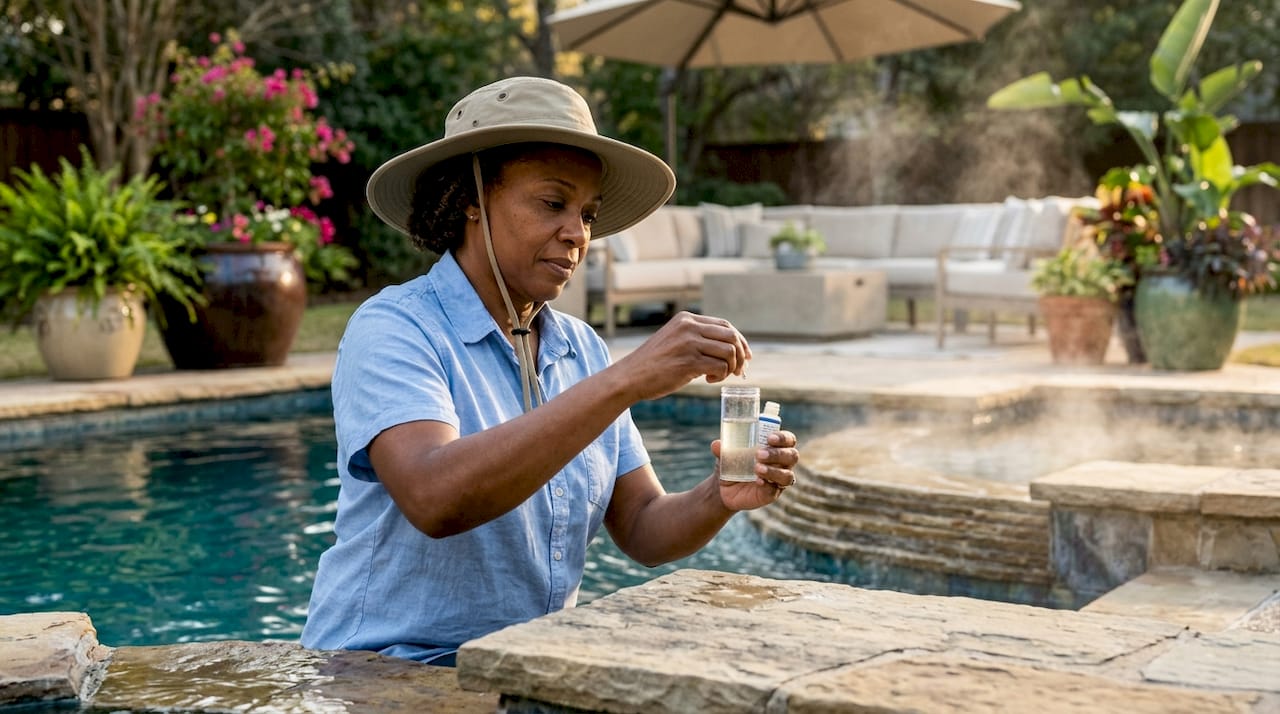
- Test chemistry weekly. Check pH, total alkalinity, and calcium hardness at minimum. Test more often if your pool has a heater, salt chlorinator, or water features.
- Monitor the LSI. A single parameter reading does not tell the full story. Managing pool water chemistry requires balancing calcium hardness, pH, total alkalinity, temperature, and total dissolved solids together.
- Drain and refill when calcium exceeds 400–600 ppm. No chemical removes bonded calcium scale; the most effective method for lowering high calcium hardness is a partial drain and refill of 20–30% of pool water. Check your fill water hardness first, because hard tap water can reintroduce the problem.
- Make gradual adjustments. Incremental, consistent chemical adjustments protect pool finish longevity better than aggressive dosing. Chasing a number with large chemical additions creates a chemistry see-saw that stresses surfaces.
- Account for your environment. Florida pools face intense evaporation rates, which concentrate calcium faster than pools in cooler climates. Adjust your testing schedule and refill frequency accordingly. Practical pool maintenance tips for Florida account for these regional conditions directly.
When adding calcium chloride to raise hardness, never add a large dose at once. The chemical reaction generates heat, and excess heat in pool water stresses the finish and can cause localized scaling.
Key takeaways
Preventing calcium scale requires balancing pH, calcium hardness, and the Langelier Saturation Index together, not chasing any single number in isolation.
| Point | Details |
|---|---|
| Two scale types exist | Calcium carbonate responds to acid; calcium silicate requires mechanical removal like bead blasting. |
| LSI is the key indicator | Scale forms when the Langelier Saturation Index exceeds +0.3; monitor it holistically, not just pH. |
| Partial drain is the reset | Draining and refilling 20–30% of pool water is the only reliable way to lower excessive calcium hardness. |
| Acid washing damages finishes | Reserve acid washing for severe cases only; repeated use shortens plaster and Pebble Tec® surface life. |
| Gradual adjustments win | Incremental chemistry corrections over days protect pool surfaces better than large, rapid dosing. |
What I’ve learned from watching pool owners fight calcium scale
The most common mistake I see is pool owners treating calcium scale as a cleaning problem rather than a chemistry problem. They scrub the tile, the scale returns in two weeks, and they scrub again. The cycle continues until the tile grout is damaged and the plaster is pitted. The deposit is a symptom. The water chemistry is the cause.
The second mistake is panic dosing. A pool owner tests the water, sees calcium hardness at 380 ppm, and dumps in a large dose of pH reducer and sequestering agent the same afternoon. That rapid shift stresses the finish and rarely solves the underlying imbalance. Patience and small corrections over several days produce better results and protect the surface.
Salt chlorinator pools deserve special attention. Salt systems raise pH naturally over time, which pushes the LSI upward and accelerates scale formation. Owners of salt pools need to test pH at least twice a week and keep it firmly at 7.4–7.6. Letting pH drift to 7.8 in a salt pool with moderate calcium hardness is enough to trigger visible scale within days.
For pools with persistent or severe scale that has etched into the plaster or pebble finish, no amount of chemistry correction restores the surface. At that point, resurfacing is the only real fix. Trying to chemically reverse physical surface damage is a losing battle.
— Classicmarcite
When calcium damage calls for professional resurfacing
Calcium scale that has etched, pitted, or stained a pool finish beyond recovery is not a maintenance problem anymore. It is a surface problem, and it requires a surface solution.

Classic Marcite has resurfaced over 100,000 pools across Florida since 1988, including residential pools, commercial facilities, and resort properties. As the largest Pebble Tec® applicator in Central Florida, Classicmarcite replaces calcium-damaged finishes with durable, weather-resistant surfaces built to last. Pool resurfacing in The Villages and across Central Florida restores both the appearance and the structural integrity of surfaces that scale has compromised. Pairing a new finish with proper water chemistry management from day one is the only way to protect that investment long term.
FAQ
What is calcium buildup in a pool?
Calcium buildup is the accumulation of hard mineral deposits, primarily calcium carbonate or calcium silicate, on pool surfaces and equipment. It forms when dissolved calcium precipitates out of water due to elevated pH, high calcium hardness, or rising water temperature.
What causes calcium scale in pools?
Calcium scale forms when the Langelier Saturation Index rises above +0.3, driven by high pH, elevated calcium hardness above 400 ppm, high total alkalinity, or warm water temperatures. Evaporation also concentrates calcium over time, accelerating scale formation.
How do I know which type of calcium scale I have?
Apply a few drops of muriatic acid to the deposit. Calcium carbonate fizzes on contact with acid. Calcium silicate shows no reaction and requires mechanical removal such as bead blasting.
How do I remove calcium deposits from pool tile?
For calcium carbonate, apply a muriatic acid solution diluted at a 1:4 ratio or a pool-safe acid cleaner, then scrub and rinse. For calcium silicate, professional bead blasting is the correct method. Avoid repeated acid washing, which damages the finish.
What calcium hardness level prevents pool scaling?
Maintain calcium hardness between 175–225 ppm for vinyl or fiberglass pools and 200–275 ppm for concrete or plaster pools. Keep pH between 7.4 and 7.6 at all times to prevent both scaling and corrosive water conditions.
