TL;DR:
- Proper winterization of a commercial pool prevents freeze damage, algae growth, and surface deterioration during the off-season. It involves balancing water chemistry, systematically shutting down and protecting plumbing and equipment, and securely covering the pool before temperatures drop. Consistent inspection and maintenance during winter preserve infrastructure and ensure a smooth reopening in spring.
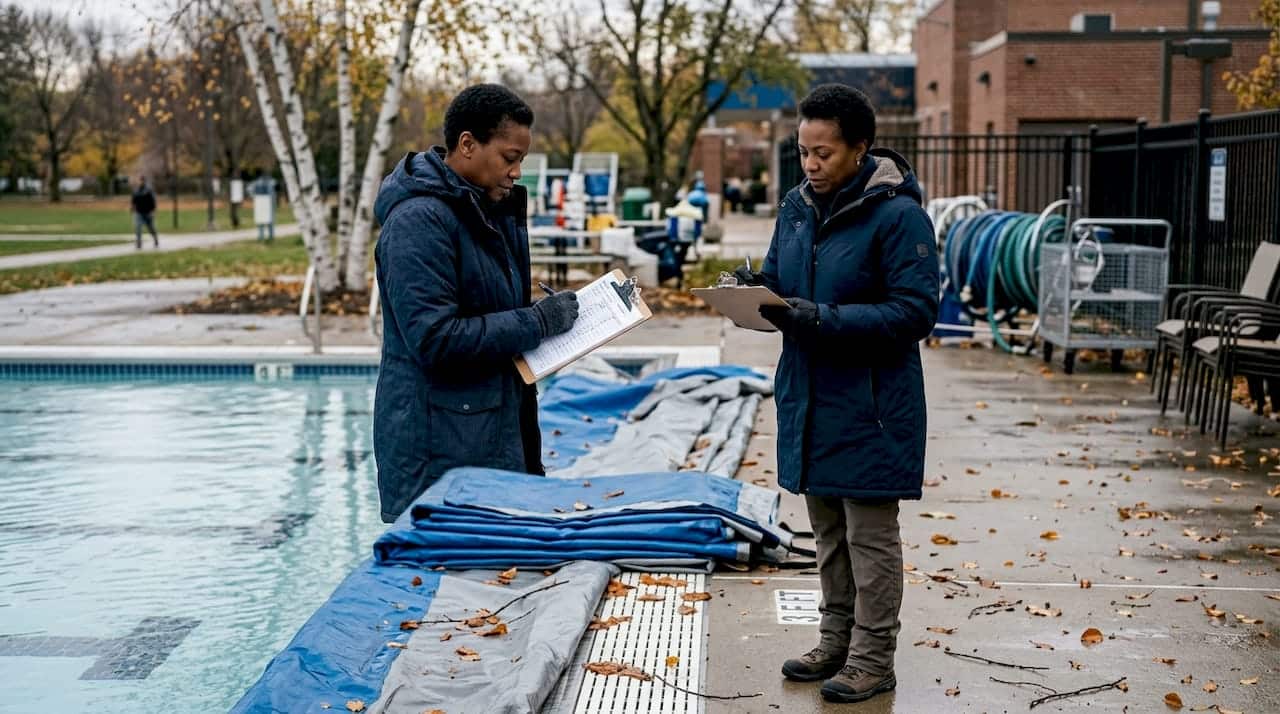
Commercial pool winterization is the process of systematically shutting down, chemically treating, and protecting a pool’s structure and mechanical systems during the off-season. Done correctly, it prevents freeze damage, algae outbreaks, and surface deterioration that cost facilities thousands of dollars to repair. Knowing how to winterize a commercial pool is not optional for property managers. It is a core maintenance responsibility. Industry guidance recommends completing winterization before mid-November to avoid freezing risks and equipment damage. Even in warmer climates like Florida, winterizing prevents corrosion and algae growth that quietly damage surfaces through the closed season.
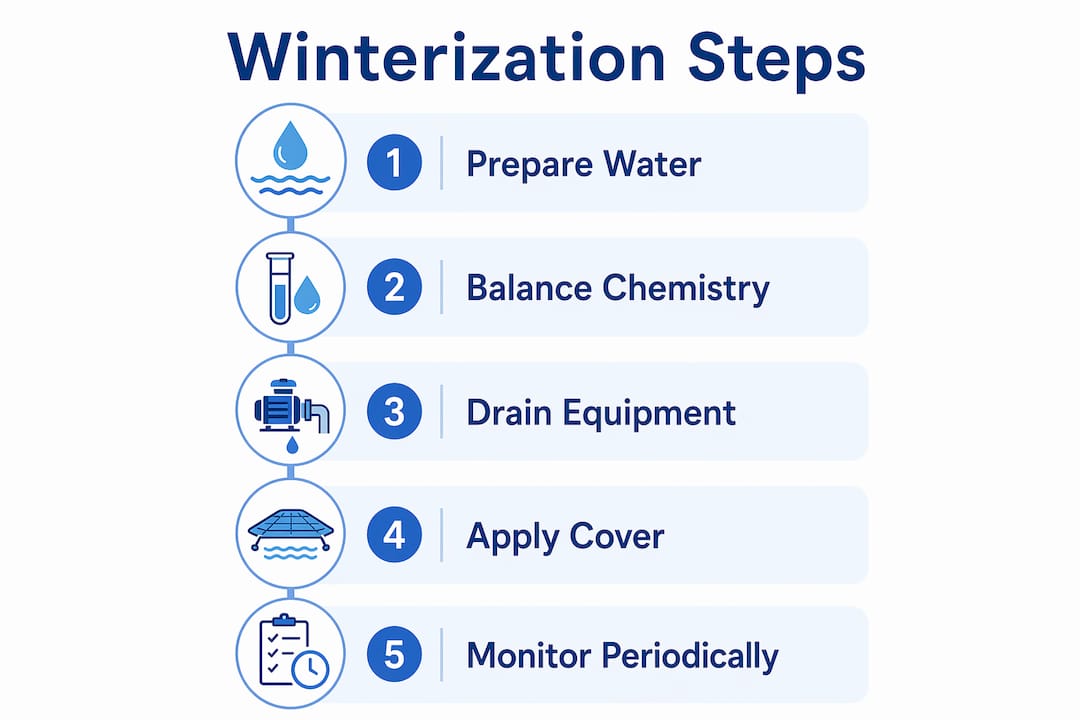
How to winterize a commercial pool: tools and materials checklist
Every successful pool closure starts with having the right equipment on hand before you touch the water. Missing a single item mid-process forces delays that can compromise chemical timing and equipment safety.
Essential tools:
- Pool vacuum and brush set for final cleaning before closure
- Air compressor rated for pool line blowouts
- Chemical testing kit covering pH, alkalinity, calcium hardness, and chlorine
- Submersible pump for lowering water level
- Waterproof camera or phone for documentation
- Maintenance log or digital recordkeeping app
Required chemicals:
- Pool shock (calcium hypochlorite or sodium dichloro)
- Algaecide rated for commercial use
- Metal sequestrant to prevent staining from dissolved metals
- pH increaser (sodium carbonate) and pH decreaser (sodium bisulfate)
- Total alkalinity increaser (sodium bicarbonate)
- Pool-grade antifreeze for hard-to-drain pipe sections
Covers and hardware:
- Commercial-grade solid safety cover with anchor hardware
- Water bags or cover clips for perimeter securing
- Cover pump to remove standing water from the cover surface
Pro Tip: Source commercial-grade chemicals and covers from a licensed pool supply distributor, not a general hardware store. Commercial pools require higher concentrations and larger volumes than residential products are designed to deliver.
For a full seasonal reference, the commercial pool maintenance checklist from Classicmarcite covers Florida-specific considerations that apply to many warm-climate facilities.
How should you balance water chemistry before closing?
Water chemistry is the most critical variable in off-season pool protection. Unbalanced water corrodes surfaces, stains finishes, and creates algae conditions that are expensive to reverse in spring.
Target these parameters before closing:
- pH: 7.2–7.6. Below 7.2 causes corrosion; above 7.6 reduces sanitizer effectiveness.
- Total alkalinity: 80–120 ppm to buffer pH swings during the closed season.
- Calcium hardness: 200–400 ppm to prevent plaster and marcite surface etching.
- Free chlorine: Raise to shock levels 24–48 hours before covering.
Shock the pool and add algaecide 24–48 hours before you install the cover. This timing allows the shock treatment to fully circulate and dissipate to safe levels before the cover traps the chemistry. Adding algaecide after shocking prevents the high chlorine from breaking down the algaecide before it can work.
Avoid floating chlorine dispensers during the final days before closure. They concentrate chlorine in one area, which bleaches liners and degrades cover materials on contact. Remove them before the final shock treatment.
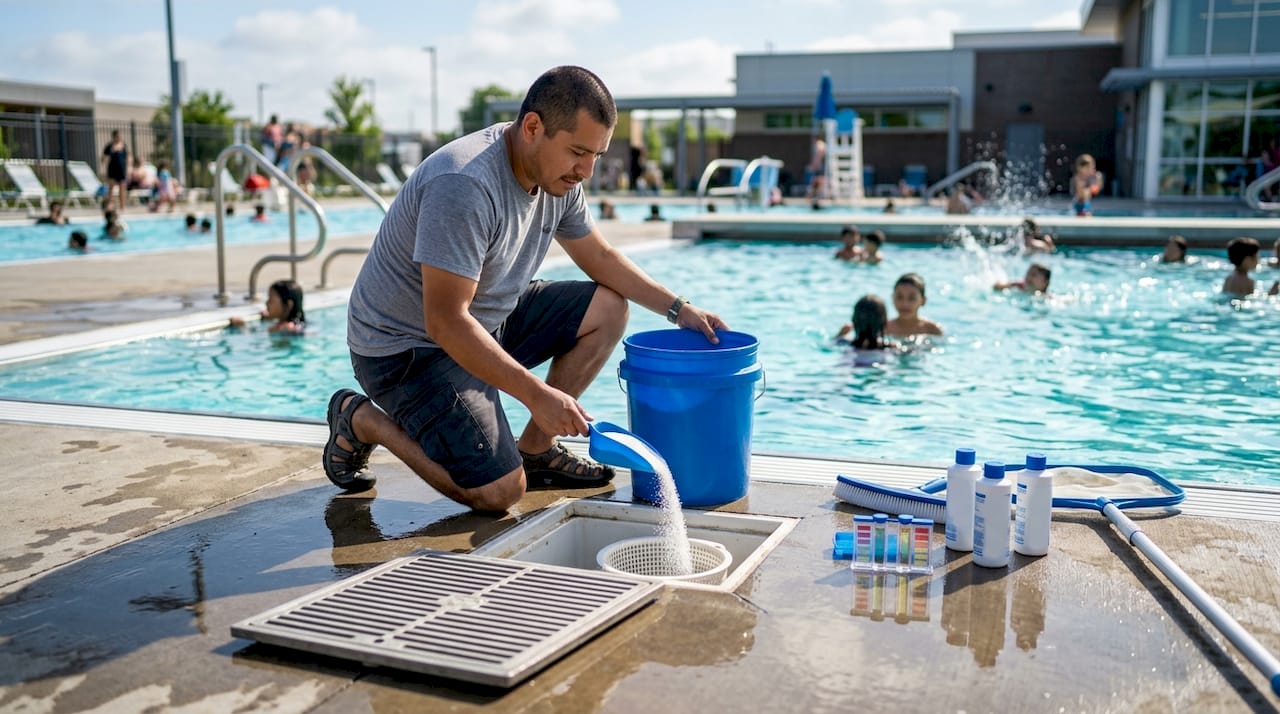
Document your final water chemistry readings with photos and a written log. This record supports regulatory compliance and gives your spring startup team an exact baseline to work from.
Pro Tip: Test water chemistry on two separate days before closing. A single test can miss a pH drift caused by recent heavy bather load or a recent rain event. Two readings give you a reliable average.
For a deeper look at balancing parameters year-round, the pool water quality guide from Classicmarcite covers target ranges and adjustment methods in detail.
What are the steps for winterizing pool plumbing and equipment?
Plumbing and mechanical systems are where most freeze damage occurs. A methodical shutdown sequence protects every component from pumps to heaters to return lines.
Step-by-step equipment shutdown
- Clean the pool thoroughly. Vacuum the floor, brush walls, and skim the surface. Debris left in the water accelerates algae growth and stains surfaces during closure.
- Lower the water level. Drop the water 4–6 inches below the skimmer or tile line. This protects the pool shell and tile from freeze expansion. Do not fully drain the pool.
- Blow out all plumbing lines. Use a commercial air compressor to force all standing water from return lines, skimmer lines, and main drains. Compressed air removes standing water that would otherwise freeze, expand, and crack pipes or fittings.
- Apply pool-grade antifreeze. Add antifreeze to any sections of pipe that cannot be fully blown dry. Use only non-toxic, pool-rated antifreeze, not automotive antifreeze.
- Drain and store pumps and filters. Remove all water from pump housings, filter tanks, and strainer baskets. Leave drain plugs out and store them in a labeled bag attached to the equipment.
- Drain the heater. Follow the manufacturer’s procedure for your specific heater model. Residual water in heat exchangers causes cracking that voids warranties and requires full replacement.
- Remove and store detachable components. Store all removable parts indoors in a climate-stable environment. Moisture and humidity cause corrosion on metal fittings, ladders, handrails, and chemical feeders.
- Label and photograph everything. Tag each removed component with its location and orientation. Photograph the equipment room before and after shutdown.
Common mistakes to avoid:
- Fully draining the pool. Hydrostatic pressure from groundwater can lift or crack an empty shell.
- Skipping valve inspections. Cracked or seized valves discovered in spring create costly delays.
- Leaving chemical feeders connected. Residual chemicals corrode internal components over winter.
Pro Tip: Blow out lines in the correct sequence: start at the skimmers, move to the main drain, then finish with the return lines. Working out of sequence can trap air pockets that leave water in the system.
A home winterization checklist from Xtreme Air Services covers parallel equipment inspection steps that facility teams managing mixed-use properties will find useful alongside pool-specific procedures.
How do you apply and secure commercial pool covers?
The cover is your pool’s primary defense against debris, contamination, and unauthorized access during the off-season. Choosing the wrong type or installing it incorrectly negates most of the chemical and mechanical work you just completed.
Cover types for commercial pools:
- Solid safety covers: The strongest option for commercial facilities. They block all light, which stops algae growth entirely, and support the weight of an adult for safety compliance.
- Mesh safety covers: Allow water to pass through, which reduces standing water on the cover surface. They let in some light, so algae control depends more heavily on your pre-close chemical treatment.
- Automatic covers: Suitable for pools with consistent rectangular geometry. They offer convenience for facilities that partially operate year-round.
Commercial-grade solid safety covers secured with anchors or water bags are the standard for full off-season closure. They prevent wind displacement and meet safety codes that require barriers against unauthorized pool access.
Securing and maintaining the cover:
- Anchor the cover at every designated anchor point around the perimeter. Skipping anchors creates gaps that wind exploits.
- Place water bags along the cover edge for additional weight on exposed sections.
- Install a cover pump to remove standing water automatically. Pooled water on the cover surface adds weight that stresses anchor points and can pull the cover inward.
- Inspect the cover every two to three weeks during the off-season. Proper cover maintenance reduces debris accumulation and limits chemical usage when you reopen.
Pro Tip: Measure your pool’s exact dimensions before ordering a commercial cover, not the nominal size listed in your original construction documents. Pool shells often vary slightly from spec, and a cover that is even six inches short on one side will not anchor correctly.
You can review examples of commercial pool configurations in the commercial pools gallery from Classicmarcite to see how cover choices align with different pool shapes and sizes.
What ongoing maintenance should facility teams do during the off-season?
Closing the pool is not the end of your maintenance responsibility. Off-season neglect is the most common reason spring reopenings run over budget and over schedule.
Monthly inspection tasks:
- Test water chemistry at least once per month. Even a covered, closed pool experiences pH drift and chlorine loss over time. Adjust chemicals through the skimmer or a designated access point.
- Check cover tension and anchor integrity after any significant wind event or storm.
- Remove debris and standing water from the cover surface promptly. Standing water breeds mosquitoes and adds structural stress to the cover.
- Inspect the equipment room for moisture intrusion, pest activity, and condensation on stored components.
- Verify that safety signage and perimeter barriers remain intact and visible.
Maintaining at least one full water turnover every 6–8 hours during partial off-season operation prevents circulation dead zones where algae and bacteria accumulate. For fully closed pools, periodic manual circulation achieves the same protective effect.
Preventive maintenance during winterization including leak detection and valve inspections saves costly emergency repairs and downtime in spring. Schedule a mid-winter walkthrough specifically to check for new cracks, joint separation, or surface changes that developed after closure.
Pro Tip: Keep a dedicated off-season log with dated entries for every inspection, chemical adjustment, and repair. This log becomes your compliance record and your spring startup roadmap in one document.
Key Takeaways
Proper commercial pool winterization protects pool infrastructure, water quality, and mechanical systems, and it directly reduces spring startup costs and delays.
| Point | Details |
|---|---|
| Complete closure before mid-November | Finish all winterization steps before freezing temperatures arrive to protect pipes and equipment. |
| Balance chemistry before covering | Target pH 7.2–7.6 and shock the pool 24–48 hours before installing the cover. |
| Never fully drain the pool | Retain water at 4–6 inches below the skimmer line to prevent hydrostatic shell damage. |
| Store all removable parts indoors | Climate-stable storage prevents corrosion on metal fittings, ladders, and chemical feeders. |
| Inspect monthly through winter | Test water chemistry, check cover integrity, and log every adjustment for spring compliance. |
What facility managers consistently get wrong about winterization
The most expensive winterization mistakes are not dramatic. They are small omissions that compound quietly over three or four months. A valve left uninspected. A cover anchor skipped on the far corner. A pump housing with a tablespoon of water left inside.
The teams that reopen on schedule every spring share one habit: they treat the winterization process as a formal project with documentation, not a checklist they rush through in an afternoon. Photographing the equipment room before and after shutdown takes ten minutes. That ten minutes has saved facilities from weeks of spring troubleshooting more times than I can count.
The other pattern I see consistently is underestimating how much chemistry shifts in a closed pool. Facility teams balance the water perfectly on closing day, then assume it holds. It does not. A single heavy rain event can drop pH by a measurable amount through dilution and atmospheric CO2 absorption. Monthly testing is not excessive. It is the minimum.
If your facility is in a warm climate like Florida, do not assume winterization is less critical. Algae and surface corrosion do not require freezing temperatures. They require only time and unbalanced water. The facilities that skip thorough closure because “it doesn’t freeze here” are the ones calling for emergency resurfacing in march.
— Results
Classicmarcite supports commercial pool facilities year-round

Winter is the right time to assess your pool’s surface condition before spring demand returns. Cracks, staining, and surface erosion that were minor in october become structural concerns after months of unmonitored closure. Classicmarcite has resurfaced over 100,000 pools since 1988, including commercial facilities for resorts, hotels, and property management groups across Central Florida. The team specializes in durable finishes like Pebble Tec® that hold up through seasonal chemical exposure and heavy bather loads. If your commercial pool needs professional resurfacing services or a full renovation assessment before reopening, Classicmarcite offers free estimates for commercial projects. Contact the team to schedule an evaluation while your pool is already closed and accessible.
FAQ
When should a commercial pool be winterized?
Complete winterization before mid-November to avoid freeze damage to pipes, fittings, and mechanical equipment. In warmer climates, close the pool before sustained cool temperatures cause water chemistry to drift unmanaged.
What pH level should pool water be at before closing?
Target a pH of 7.2–7.6 before closing. Water outside this range corrodes pool surfaces or reduces sanitizer effectiveness during the off-season.
Can you fully drain a commercial pool for winter?
Fully draining a commercial pool creates hydrostatic pressure risk that can lift or crack the shell. Retain water at 4–6 inches below the skimmer line to maintain structural integrity.
How often should you check a closed commercial pool during winter?
Inspect the pool and test water chemistry at least once per month. Check cover integrity and remove standing water from the cover surface after any significant storm.
What type of cover works best for commercial pools?
Solid safety covers anchored with hardware or water bags are the standard for commercial off-season closure. They block light to prevent algae, support adult weight for safety compliance, and resist wind displacement.