TL;DR:
- Pool water chemistry balances six key parameters—chlorine, pH, alkalinity, calcium, cyanuric acid, and combined chlorine—that must be maintained within specific ranges for safety and equipment longevity. Proper adjustment order starts with alkalinity, followed by pH, then sanitizer, calcium, and CYA to prevent instability, while accurate testing and patience ensure stable pool conditions. Regular, proactive testing with reliable methods avoids costly damage and keeps the pool surface and water properly balanced.
Pool water chemistry is the balance of six measurable chemical parameters that determine whether your pool water is safe, clear, and gentle on equipment. Those parameters are free chlorine, combined chlorine, pH, total alkalinity, calcium hardness, and cyanuric acid. Get any one of them wrong, and the others fall out of range quickly. Understanding pool water chemistry means knowing what each parameter does, what range it belongs in, and how to adjust it without creating a new problem in the process.
What are the key chemical parameters in pool water chemistry?
The 2026 industry-standard ranges for residential pools give you a clear target for each parameter. Free chlorine should sit between 1–4 ppm. pH belongs in the 7.2–7.8 range. Total alkalinity targets 80–120 ppm. Calcium hardness runs 200–400 ppm for plaster pools. Cyanuric acid stays at 30–50 ppm. Combined chlorine must stay below 0.5 ppm. Each number has a specific job.
Here is what each parameter actually does:
Free Chlorine (FC) is the active sanitizer in your pool. It kills bacteria, viruses, and algae. When FC drops below 1 ppm, pathogens can multiply faster than chlorine can neutralize them.
Combined Chlorine (CC) measures chloramines, the byproduct of chlorine reacting with contaminants like sweat and urine. When CC exceeds 0.5 ppm, shock treatment is the correct response.
pH measures how acidic or basic your water is on a scale of 0–14. The sweet spot of 7.2–7.8 keeps swimmers comfortable and keeps chlorine working at full strength. At pH 8.0, chlorine loses a large portion of its germicidal power.
Total Alkalinity (TA) acts as a chemical buffer that prevents pH from swinging wildly after rain or chemical additions. The 80–120 ppm target keeps pH stable between adjustments.
Calcium Hardness (CH) protects your pool surface. Water that is too soft pulls calcium from plaster and Pebble Tec® finishes, causing pitting. Water that is too hard deposits scale on surfaces and equipment. The 200–400 ppm range keeps both risks in check.
Cyanuric Acid (CYA) shields chlorine from UV degradation. Without it, sunlight destroys free chlorine within hours. The 30–50 ppm range is optimal. CYA above 90 ppm reduces chlorine’s germicidal effectiveness, and levels above 100 ppm are counterproductive regardless of how much chlorine you add.
| Parameter | Ideal Range | Unit | Safety Note |
|---|---|---|---|
| Free Chlorine | 1–4 | ppm | Adjust relative to CYA level |
| Combined Chlorine | Below 0.5 | ppm | Shock pool if exceeded |
| pH | 7.2–7.8 | pH units | High pH cripples chlorine |
| Total Alkalinity | 80–120 | ppm | Adjust before pH |
| Calcium Hardness | 200–400 | ppm | Plaster pools need upper range |
| Cyanuric Acid | 30–50 | ppm | Never exceed 100 ppm |
How do these parameters interact with each other?
Pool chemical levels do not operate in isolation. Each parameter affects at least one other, which is why the order of adjustment matters as much as the adjustments themselves.
Total alkalinity must be corrected first because it buffers pH. If you adjust pH before alkalinity is stable, pH will drift back within hours. This is called “pH bounce,” and it wastes chemicals while giving you a false sense of control. Fix alkalinity first, and pH adjustments hold.
pH directly controls how much of your free chlorine is in its active, germicidal form. At pH 7.2, roughly 65% of free chlorine is active hypochlorous acid. At pH 7.8, that drops significantly. At pH 8.0 and above, chlorine becomes largely ineffective even when FC reads within range. This is why pool owners with high pH often see algae growth despite adequate chlorine readings.
CYA creates a more complex interaction. It protects chlorine from UV, but it also binds a portion of free chlorine, making it temporarily inactive. A practical rule of thumb: minimum free chlorine should equal approximately 7.5% of your CYA concentration. If CYA is at 40 ppm, your FC floor is 3 ppm. When CYA climbs above 90 ppm, the bound chlorine fraction becomes so large that the pool effectively cannot be sanitized. This condition is called “chlorine lock.”
The Langelier Saturation Index (LSI) ties these variables together into a single number. LSI integrates pH, total alkalinity, calcium hardness, water temperature, and total dissolved solids. An LSI between -0.3 and +0.3 indicates balanced water. Below -0.3, water is corrosive and will attack your pool surface. Above +0.3, water is scale-forming and will deposit calcium on surfaces and equipment.
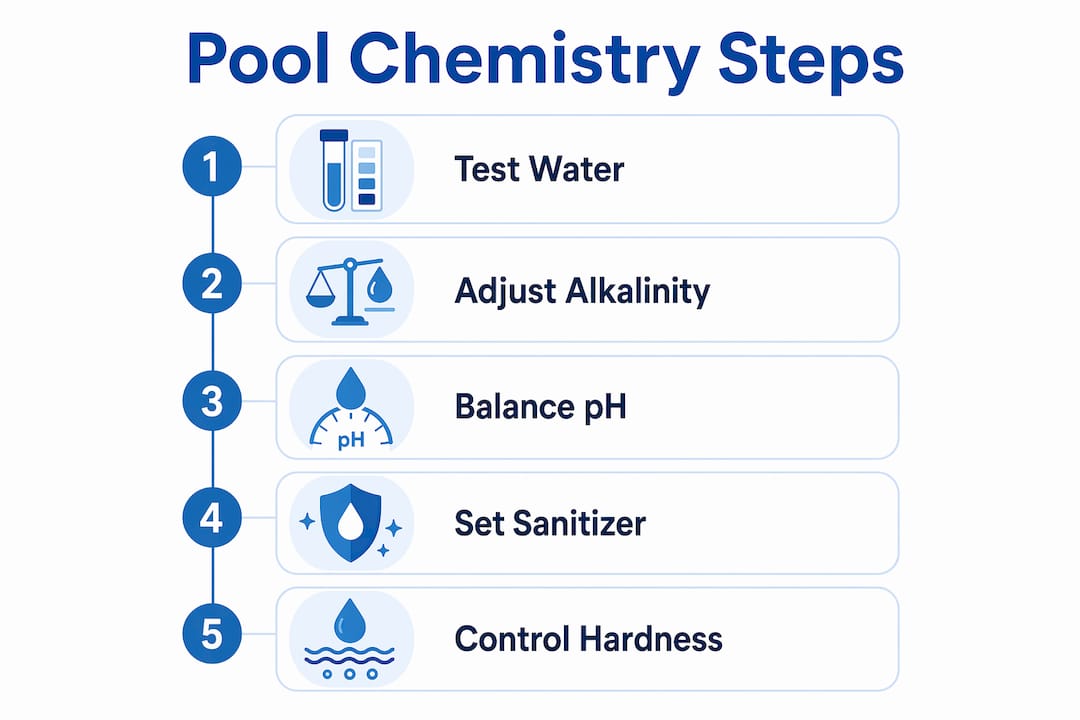
Pro Tip: Follow this adjustment sequence every time: total alkalinity first, then pH, then sanitizer levels, then calcium hardness and CYA. Skipping steps or reversing the order creates chemical instability that can take days to correct.
How to test pool water: frequency and methods
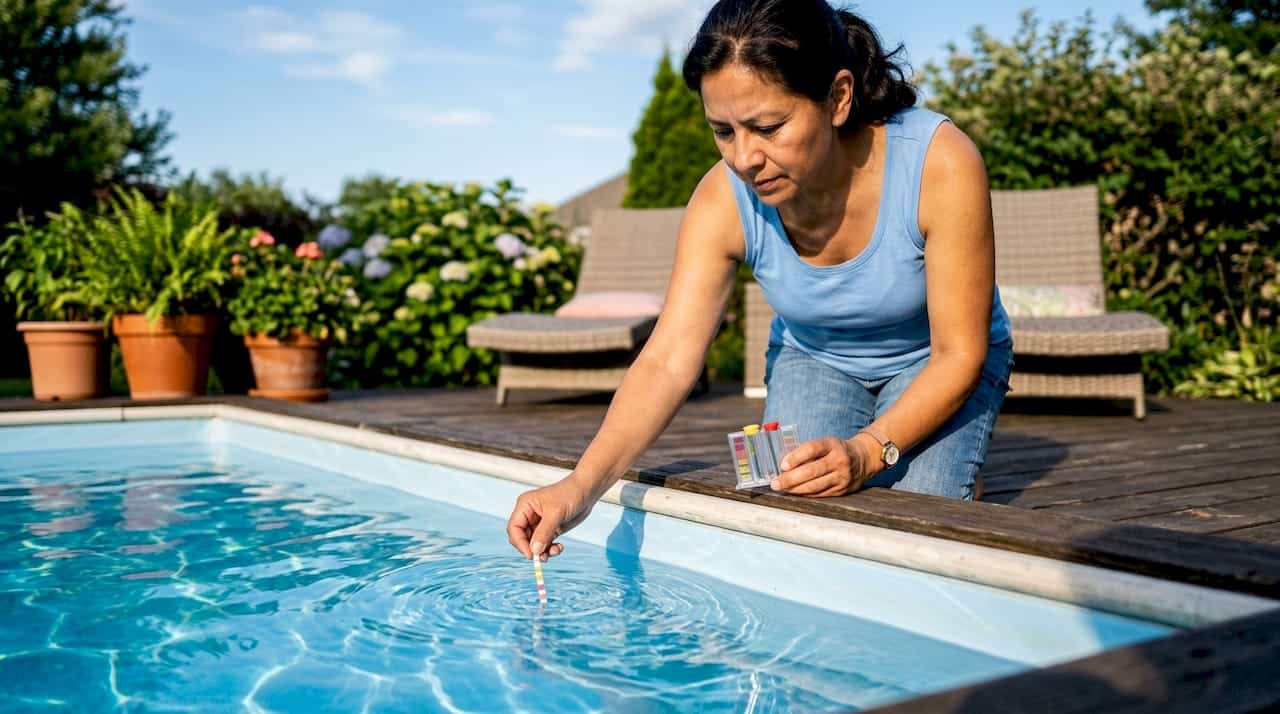
Testing is the only way to know what your pool water actually contains. Guessing based on appearance is unreliable. Clear water can still carry dangerous chemical imbalances.
Free chlorine and pH should be tested 2–3 times per week during swim season. These two parameters shift the fastest and have the most direct impact on swimmer safety. Total alkalinity, calcium hardness, and cyanuric acid are more stable. Test them weekly at the start of the season, then monthly once levels are established.
Test outside these schedules whenever:
- Heavy rain dilutes or alters pool chemistry
- You host a pool party with high bather load
- Water turns cloudy or develops a visible tint
- You notice a strong chlorine smell (which signals chloramines, not excess chlorine)
- You add a large volume of fill water
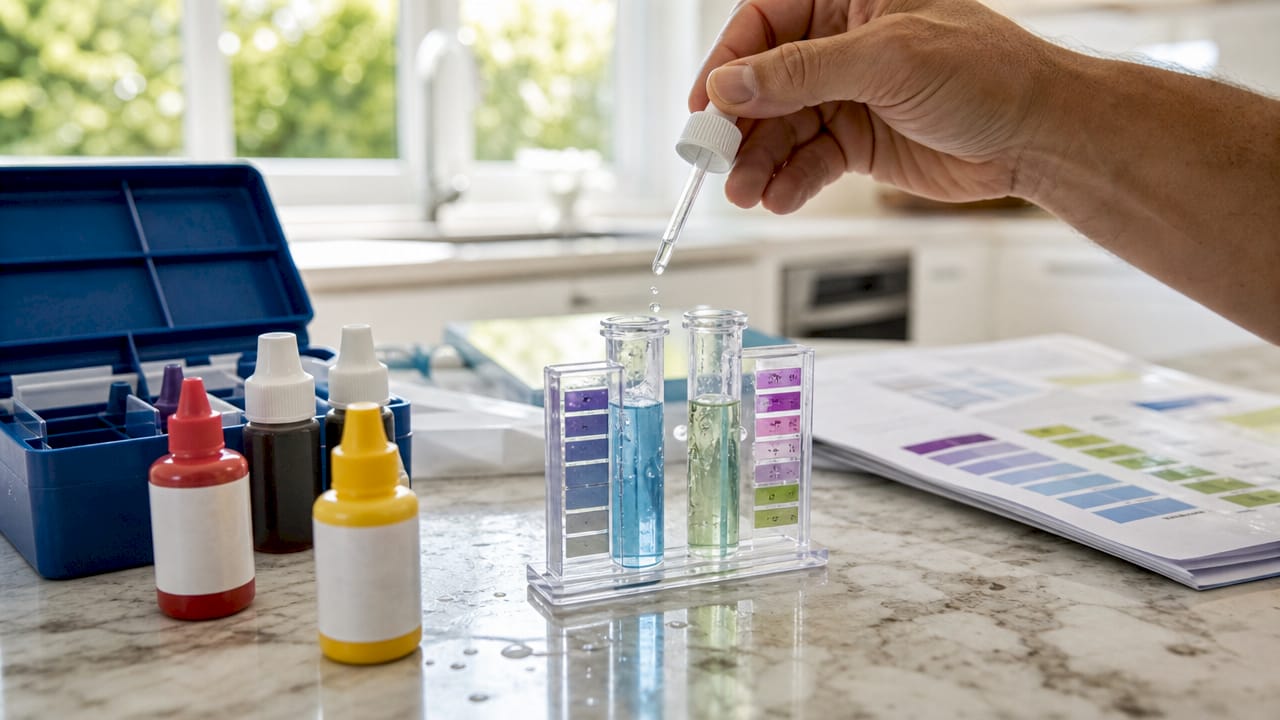
For testing method, liquid reagent kits and digital photometers outperform test strips in accuracy. Test strips degrade in storage and humidity, producing readings that can be off by a meaningful margin. That margin is enough to cause you to add chemicals you do not need or skip ones you do. Liquid kits and digital meters cost more upfront but prevent expensive overcorrections.
Pro Tip: Keep a written or digital log of every test result and every chemical addition. After a few weeks, patterns emerge. You will see whether your pH consistently drifts up or down, which tells you whether your alkalinity is too high or too low.
After adding any chemical, wait at least 30–60 minutes before retesting. The pump needs time to circulate the chemical evenly through the water. Testing too soon gives you a false local reading, not a true whole-pool reading.
Common mistakes homeowners make with pool chemical levels
Most pool problems trace back to a small set of repeated errors. Knowing them in advance saves you money and frustration.
-
Misreading the chlorine smell. A strong chlorine odor does not mean the pool has too much chlorine. That smell signals chloramines, which form when free chlorine reacts with contaminants. The correct fix is shock treatment to burn off combined chlorine, not reducing your chlorine dose.
-
Adding chemicals in the wrong order. Adjusting pH before total alkalinity causes pH bounce. Adding multiple chemicals at once can cause them to react with each other rather than with the water. Add one chemical at a time, circulate, then test before adding the next.
-
Pouring cyanuric acid directly into the skimmer. CYA granules dissolve slowly. Dumping them into the skimmer sends undissolved granules through the filter and plumbing. The correct method is to dissolve CYA slowly in a sock or mesh bag suspended in the pool, allowing it to dissolve gradually without clogging the system.
-
Ignoring CYA accumulation. CYA does not break down or evaporate. It builds up over time, especially when using stabilized chlorine tablets. Pool owners who rely exclusively on trichlor tablets often find their CYA creeping past 80 or 100 ppm by midsummer. At that point, the only fix is a partial drain and refill. Monitoring CYA’s effect on chlorine dosing prevents this entirely.
-
Over-relying on test strips. Strips give a rough estimate, not a precise reading. Using strips as your primary testing method often leads to chronic misdiagnosis of pH and chlorine levels, which compounds over weeks into larger imbalances.
“The biggest mistake pool owners make is rushing chemical adjustments. Adding large doses and retesting an hour later creates a cycle of overcorrection. Small, incremental doses with proper circulation time between them produce stable, lasting results.”
For pool owners who want a deeper look at avoiding these errors, the pool water quality tips resource covers common chemical management mistakes in detail.
Key Takeaways
Proper pool water balance requires adjusting total alkalinity before pH, maintaining free chlorine relative to CYA levels, and testing with accurate equipment at least twice per week during swim season.
| Point | Details |
|---|---|
| Adjust in the right order | Fix total alkalinity first, then pH, then sanitizer, to prevent pH bounce and wasted chemicals. |
| CYA has a ceiling | Keep cyanuric acid at 30–50 ppm; levels above 100 ppm make chlorine ineffective regardless of dose. |
| Chlorine smell means chloramines | A strong pool odor signals combined chlorine buildup, not excess free chlorine. Shock the pool. |
| Use accurate test equipment | Liquid reagent kits and digital photometers outperform test strips for reliable pH and chlorine readings. |
| Log every test and adjustment | Written records reveal drift patterns and prevent the chronic overcorrections that damage surfaces and equipment. |
What 35 years of pool work actually teaches you about water chemistry
Most homeowners treat pool chemistry as a problem to solve once and forget. That mindset is the root cause of most pool damage I have seen. Water chemistry is an ongoing process, not a one-time fix.
The detail that surprises pool owners most is how slow proper balancing actually is. Stabilizing chemical levels after a significant imbalance takes 3–7 days of incremental adjustments and retesting. Owners who try to correct everything in one afternoon almost always overshoot, creating a new imbalance in the opposite direction. Patience is not optional here. It is the method.
Investing in a quality liquid test kit or digital photometer pays for itself within one season. The cost of a single unnecessary chemical treatment, or a single algae outbreak caused by misread chlorine levels, exceeds the price of a good test kit by a wide margin. Accurate data is the foundation of every correct decision you make about your pool.
The other habit that separates well-maintained pools from problem pools is proactive testing rather than reactive testing. Pool owners who test only when something looks wrong are always behind the problem. Pool owners who test on a fixed schedule catch drift before it becomes damage. That discipline also protects the pool surface itself. Chronically low pH and calcium hardness are the leading causes of plaster and finish deterioration, which is a far more expensive repair than a bag of sodium bicarbonate. For a full breakdown of how chemistry affects surface longevity, the 2026 pool water quality guide is worth reading before swim season starts.
— Results
Classicmarcite: where water chemistry meets surface quality
Balanced water chemistry protects your pool surface from the inside out. Corrosive water attacks plaster and finish materials over time, and no resurfacing job lasts as long as it should in a pool with chronic chemical imbalances.

Classicmarcite has resurfaced over 100,000 pools across Florida since 1988, and the team sees the same pattern repeatedly: pools with neglected water chemistry need resurfacing years ahead of schedule. If your pool surface shows staining, pitting, or roughness, those are signs that chemistry and surface condition need attention together. Classicmarcite specializes in pool resurfacing in The Villages, FL and across Central Florida using materials like Pebble Tec® that are built to last when paired with proper water maintenance. Request a free estimate and get a surface that holds up season after season.
FAQ
What is the correct pH range for a swimming pool?
The ideal pool pH range is 7.2–7.8. Below 7.2, water becomes corrosive and irritates swimmers’ eyes and skin. Above 7.8, chlorine loses much of its sanitizing effectiveness.
Why does my pool smell strongly of chlorine?
A strong chlorine smell indicates chloramines, which are combined chlorine compounds formed when free chlorine reacts with contaminants. The fix is shock treatment to eliminate combined chlorine, not reducing your chlorine dose.
How often should I test my pool water?
Test free chlorine and pH 2–3 times per week during swim season. Test total alkalinity, calcium hardness, and cyanuric acid weekly at the start of the season, then monthly once levels are stable.
What happens if cyanuric acid gets too high?
CYA above 90 ppm reduces chlorine’s germicidal effectiveness. Above 100 ppm, chlorine cannot sanitize the pool adequately regardless of how much you add. The only correction is a partial drain and refill to dilute CYA levels.
What is the Langelier Saturation Index?
The LSI is a calculated value that integrates pH, total alkalinity, calcium hardness, temperature, and total dissolved solids to determine whether pool water is balanced, corrosive, or scale-forming. An LSI between -0.3 and +0.3 indicates properly balanced water.