TL;DR:
- Florida classifies pools by access, with commercial pools subject to stricter regulations and inspections.
- Proper classification affects permitting, contractor licensing, and ongoing operational requirements.
- Misclassification can lead to costly legal issues, forced renovations, and liability risks.
Florida’s pool market moves fast, and many buyers assume the rules are the same whether you’re putting in a backyard pool or upgrading a resort facility. That assumption can cost you tens of thousands of dollars, trigger forced renovations, or land you in serious legal trouble. Florida draws a sharp legal line between commercial and residential pools, and that line affects everything from who can build your pool to how often it gets inspected. If you own property in Orlando or Jacksonville and you’re planning a pool project, this guide cuts through the confusion and gives you exactly what you need to move forward with confidence.
Table of Contents
- Defining pool types: What makes a pool residential or commercial?
- Regulations and compliance: How rules differ for commercial and residential pools
- Permitting, contractors, and the construction process
- Operational differences: Maintenance, inspections, and risk
- Common mistakes: Misclassification risks and best practices
- What most pool buyers miss: Legal nuance over aesthetics
- Next steps: Getting help with your Florida pool project
- Frequently asked questions
Key Takeaways
| Point | Details |
|---|---|
| Classification matters | Pool type affects the laws, costs, and who can build or operate your pool in Florida. |
| Regulation differences | Commercial pools face strict inspections, chemical standards, and accessibility rules; residential pools do not. |
| Cost and complexity | Commercial pools are more expensive to build and maintain due to regulation and licensing requirements. |
| Avoid misclassification | Accurately identifying your pool type prevents costly errors and legal trouble for homeowners and property managers. |
Defining pool types: What makes a pool residential or commercial?
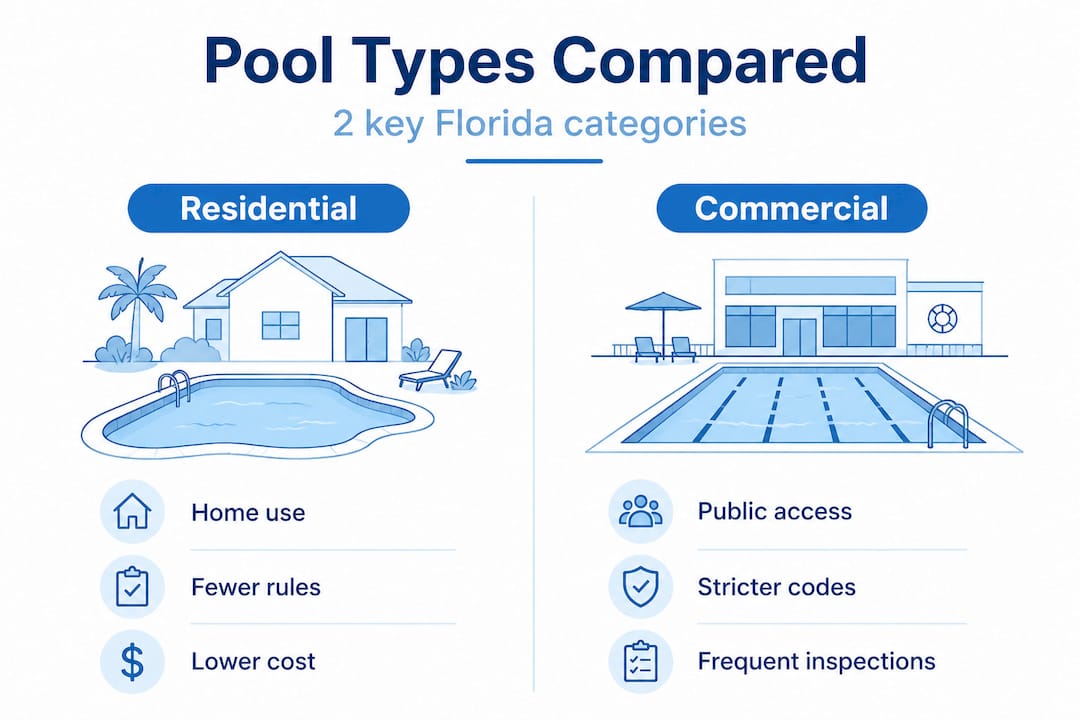
Florida doesn’t classify pools by size or price. The state classifies them by who has access. That’s the core rule, and it catches a lot of property owners off guard.
Under Florida law, commercial pools require stricter regulations including Florida Statute Chapter 514 (which governs public pools), FDOH inspections, and ADA compliance. Residential pools fall under Chapter 515 and local codes only. The practical difference is enormous.
A residential pool is one used exclusively by a single-family household and their invited guests. The moment access extends beyond that household, Florida considers the pool commercial, or “public” in legal terms. This covers:
- HOA community pools used by multiple households
- Apartment and condo pools open to residents
- Hotel and resort pools open to guests
- Short-term rental pools where paying guests have access
- Club or gym pools open to members
The short-term rental situation is a major gray area in Orlando and Jacksonville right now. If you list your home on a platform like Airbnb and guests can use the pool, that pool may be reclassified as public under Florida Administrative Code 64E-9. Many homeowners don’t find out until they’re already in violation.
| Feature | Residential pool | Commercial pool |
|---|---|---|
| Governing statute | Chapter 515 | Chapter 514 |
| Typical users | Single household | Multiple households or guests |
| FDOH permit required | No | Yes |
| ADA compliance | No | Yes |
| Routine inspections | No | Yes (2+ per year) |
| Examples | Backyard pool | HOA, hotel, rental property |
Pro Tip: Before you purchase a property with a pool in Orlando or Jacksonville, check with your local health department to confirm the pool’s current legal classification. A pool that looks residential may already be operating under commercial rules.
You can browse commercial pool examples and compare them with the residential pool gallery to get a visual sense of how different these projects look in practice.
Regulations and compliance: How rules differ for commercial and residential pools
Once you understand how pools are classified, the next crucial step is grasping how these categories impact day-to-day operation and legal requirements.
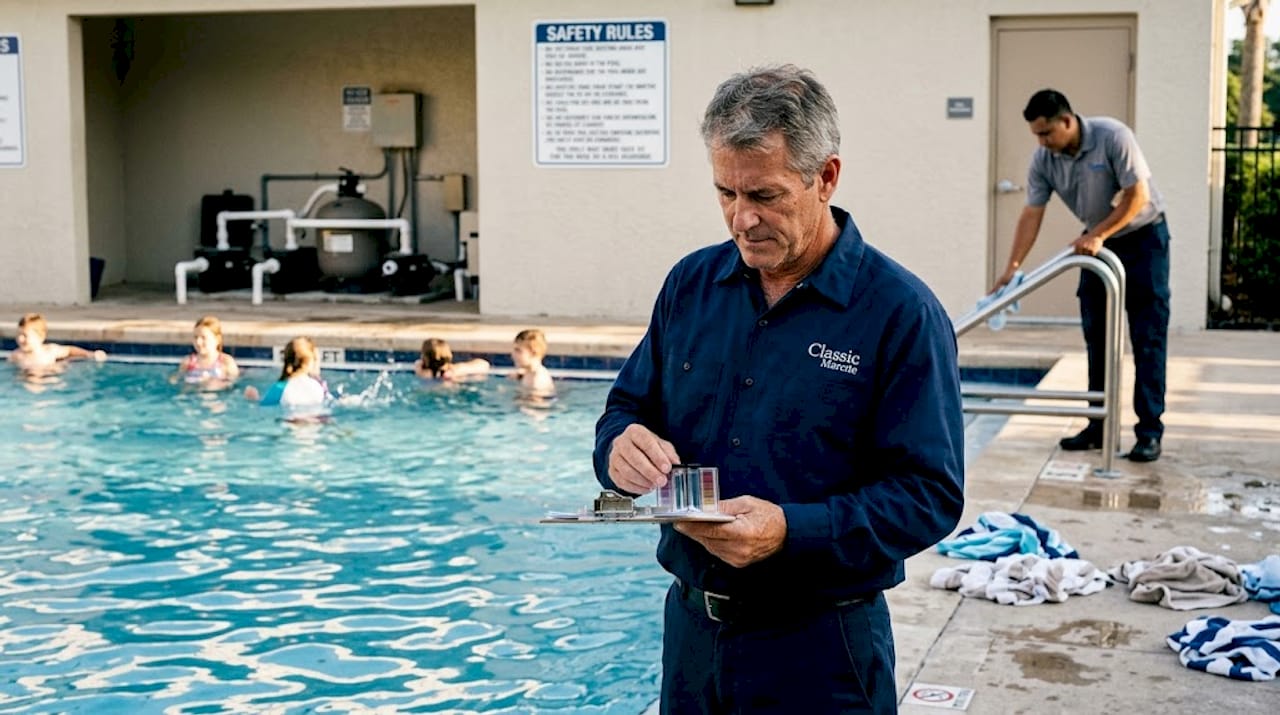
The regulatory gap between the two pool types is wide. Commercial pools require routine FDOH inspections, higher chlorine levels of 2 to 3 ppm, and must meet ADA and lifeguard rules. Residential pools face none of these operational requirements.
Here’s a detailed comparison of the major regulatory differences:
| Regulation | Residential | Commercial |
|---|---|---|
| Fencing/barrier | Required (local code) | Required (stricter standards) |
| FDOH permit | Not required | Required before construction |
| Routine inspections | None | 2+ per year minimum |
| Chlorine levels | 1.0 to 3.0 ppm (general guidance) | 2.0 to 3.0 ppm (enforced minimum) |
| ADA accessibility | Not required | Required (ramps, rails, lifts) |
| Lifeguard requirement | Not required | Situational (depends on size/type) |
| Chemical logs | Not required | Required and subject to inspection |
| Drain safety standards | Virginia Graeme Baker Act applies | Strictly enforced |
The liability implications are significant. A commercial pool operator who fails an FDOH inspection can face fines, forced closure, or legal action if a guest is injured. Property managers at Orlando resorts or Jacksonville apartment complexes carry real financial risk if they let compliance slide.
“The difference between a compliant commercial pool and a non-compliant one isn’t just paperwork. It’s the difference between a functioning amenity and a liability that can shut down your entire property.”
Residential pool owners aren’t completely off the hook. Local codes in Orange County and Duval County both require proper fencing, drain covers, and safety barriers. But they don’t face the same ongoing inspection burden or chemical recordkeeping that commercial operators do.
For a detailed breakdown of what commercial pool operators need to track, the commercial pool maintenance checklist for Florida resorts is a solid reference. You can also review commercial pool durability considerations when planning a renovation that needs to hold up under heavy use.
Permitting, contractors, and the construction process
With regulations in mind, let’s look at the actual process of building or renovating a pool and who is allowed to do the work.
Florida is strict about contractor licensing for pool work, and the rules differ based on pool type. A Certified Pool/Spa Contractor (CPC) is required for commercial work statewide. A Registered Pool/Spa Contractor (RPC) can handle residential projects but is limited to specific counties and cannot legally take on commercial jobs.
This matters because hiring the wrong contractor type can void your permits, trigger fines, and force you to redo completed work. Always verify your contractor’s license before signing anything.
Here’s how the construction and renovation process differs step by step:
- Classification check. Before any design work, confirm whether your pool is legally residential or commercial. This determines every step that follows.
- Permit application. Residential pools go through local building departments. Commercial pools require an FDOH permit in addition to local building permits, which adds weeks to the timeline.
- Plan review. Commercial pool plans must meet ADA standards, drain safety requirements, and FDOH specifications. Residential plans go through standard local review.
- Contractor assignment. Commercial projects require a licensed CPC. Residential projects can use an RPC, though many homeowners choose a CPC for added assurance.
- Construction and inspection. Commercial pools face multiple inspections during construction. Residential pools are inspected at key milestones by local building officials.
- Final approval. Commercial pools require FDOH sign-off before opening. Residential pools get a certificate of occupancy from the local building department.
The cost difference is real. Orlando averages $77,000 per new pool across 207 permits filed in January 2026, while Jacksonville averages $91,000 across 139 permits in the same period. Commercial projects in both cities run significantly higher once you factor in ADA features, FDOH compliance, and extended permit timelines.
Pro Tip: Ask your contractor to show you their pool contractor certifications before work begins. A CPC license number is publicly verifiable through the Florida Department of Business and Professional Regulation website.
If you’re working on a project in northeast Florida, the Jacksonville pool renovation process has its own local nuances worth understanding before you commit to a timeline. You can also learn more about hiring licensed contractors to avoid the most common and costly mistakes.
Operational differences: Maintenance, inspections, and risk
Beyond construction, what does daily upkeep look like for each type of pool, and how does this influence ongoing cost and risk?
The operational gap between commercial and residential pools is just as wide as the construction gap. Commercial pools require FDOH inspections at least twice per year, a minimum chlorine level of 2.0 ppm, and must maintain ADA and lifeguard compliance. Residential pools have no mandatory operational inspections at all.
For commercial pool operators, the ongoing requirements include:
- Daily chemical testing and logging with records available for inspector review
- Monthly equipment checks on pumps, filters, drains, and safety devices
- FDOH inspection readiness at all times, not just during scheduled visits
- ADA equipment maintenance including lift inspections and ramp condition checks
- Lifeguard staffing documentation where required by pool size or local ordinance
- Incident reporting for any injury or chemical exposure event
For residential pools, the routine is simpler:
- Weekly chemical testing (chlorine, pH, alkalinity)
- Monthly filter cleaning
- Annual equipment inspection (recommended, not required)
- Barrier and fence checks per local code
The financial gap adds up fast. A commercial pool operator in Orlando or Jacksonville can spend $15,000 to $40,000 per year on maintenance, compliance, and staffing. A residential homeowner typically spends $1,500 to $3,500 annually for the same pool size.
Pro Tip: Property managers should build a compliance calendar at the start of each year. Schedule your FDOH inspections, chemical log reviews, and ADA equipment checks in advance. Missing a commercial inspection isn’t just a fine risk, it can trigger a temporary closure order that affects your entire property’s reputation.
The maintenance checklist for Florida resort pools gives you a practical framework for building that calendar and staying ahead of compliance requirements.
Common mistakes: Misclassification risks and best practices
To finish the deep dive, let’s explore where homeowners and managers often go wrong, and how to avoid expensive, stressful mistakes.
Misclassification is more common than most people expect. Property managers should verify pool type before purchase or renovation, because multi-family or short-term guest use triggers commercial rules and significantly higher costs. Discovering this after construction begins is a painful and expensive lesson.
Common mistakes include:
- Assuming a small HOA pool is residential. Even a four-unit condo with a tiny pool is commercial under Florida law if residents share access.
- Not updating permits when converting to short-term rental. Converting a home to an Airbnb without reclassifying the pool is a violation that FDOH can and does enforce.
- Hiring an RPC for commercial work. This invalidates permits and can require full demolition and reconstruction of completed work.
- Skipping chemical logs. Commercial operators who don’t maintain logs face automatic violations during FDOH inspections, even if the water chemistry is actually fine.
- Ignoring ADA requirements during renovation. Resurfacing a commercial pool without addressing ADA access features can trigger a full compliance review.
Best practices to protect yourself:
- Contact your county health department before any pool purchase or renovation to confirm the pool’s legal classification.
- Request a copy of the current FDOH permit for any commercial pool you’re buying or managing.
- Always check contractor certification before signing a contract.
- Document every chemical test, inspection, and maintenance task for commercial pools.
- If you’re converting a property to short-term rental, consult a pool compliance specialist before listing it.
Pro Tip: If you’re unsure whether your pool triggers commercial rules, err on the side of caution. The cost of getting a professional compliance review upfront is a fraction of what you’ll pay if FDOH flags a violation after the fact.
What most pool buyers miss: Legal nuance over aesthetics
Here’s the reality that most guides never tell you: the majority of pool buyers in Orlando and Jacksonville spend the bulk of their research time on tile colors, surface finishes, and water features. Those choices matter. But they pale in comparison to the long-term impact of getting the legal classification right from day one.
We’ve worked on thousands of pools across Central Florida since 1988, and the projects that turn into nightmares almost never start with a bad design choice. They start with a misunderstood permit, a misclassified pool, or a contractor who wasn’t licensed for the scope of work. The aesthetic problems are fixable. The legal problems compound.
Property managers face the sharpest version of this risk. A resort or apartment complex with a non-compliant pool isn’t just facing a fine. It’s facing potential closure of the pool, liability exposure for any guest injury during the non-compliant period, and the reputational cost of a failed FDOH inspection that becomes part of the public record.
The counterintuitive advice here is to spend more time on compliance research before you spend a dollar on design. Confirm your pool’s legal status. Verify your contractor’s license. Review your local health department’s requirements. Then, once that foundation is solid, invest in the surface finishes, the Pebble Tec® texture, and the visual upgrades that will make the pool genuinely beautiful.
Getting pool certification advice from a qualified professional early in the process is one of the highest-value steps you can take, and it costs far less than correcting a compliance failure after the fact.
Next steps: Getting help with your Florida pool project
If you’re planning your own pool project or uncertain about compliance, here’s where to turn.

Classic Marcite has resurfaced more than 100,000 pools across Orlando, Jacksonville, and beyond since 1988. Whether you’re managing a resort pool that needs to meet FDOH standards or renovating a residential backyard pool with Pebble Tec®, we bring the licensing, experience, and materials knowledge to get it done right. Start with the resurfacing basics to understand your surface options, explore what a Jacksonville renovation project looks like from start to finish, or get a free estimate for your Orlando pool remodeling project. Our team handles both commercial and residential work, so you get accurate guidance no matter where your pool falls on the classification spectrum.
Frequently asked questions
What is the main legal difference between a commercial and residential pool in Florida?
A commercial pool is any pool accessible beyond a single household, subject to stricter regulations and FDOH inspections, while residential pools are for single-family use and face fewer rules. Florida Statute Chapter 514 governs commercial pools, while Chapter 515 and local codes apply to residential ones.
Do HOA or condo pools count as commercial or residential?
Even if small or private, HOA and condo pools count as commercial if used by more than one household, triggering commercial regulations. Florida classifies these as public pools under Chapter 514 regardless of their size.
How often are commercial pools inspected in Florida?
Commercial pools are typically inspected by the Florida Department of Health at least twice yearly, and operators must maintain chemical logs and compliance records between FDOH inspections.
Who can build or renovate a commercial vs. residential pool?
Only Certified Pool/Spa Contractors (CPCs) can do commercial projects statewide, while Registered Pool/Spa Contractors (RPCs) are limited to residential work in specific counties. Hiring the wrong license type invalidates permits and can require costly rework.
Do backyard pools for short-term rentals count as commercial?
Yes, if guests have access to your home’s pool, it may be classified and regulated as a public/commercial pool in Florida. Short-term rental pools may trigger Florida Administrative Code 64E-9, requiring commercial-level permits and inspections.