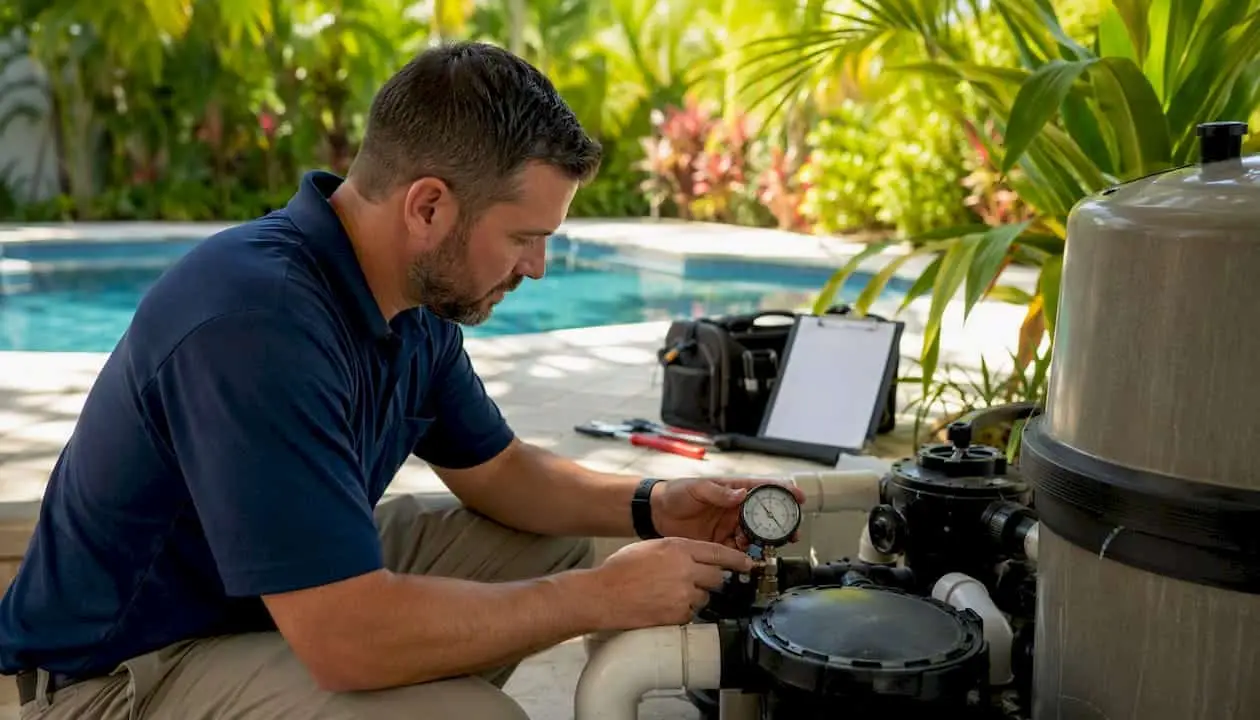
Pool equipment lifecycle management is the practice of tracking, maintaining, inspecting, and replacing pool assets on a planned schedule to maximize uptime, minimize total cost of ownership, and stay compliant with health and safety codes. According to equipment lifecycle frameworks, the most effective approach moves operators from reactive repairs to proactive, data-driven oversight across six stages: acquisition, commissioning, operation and maintenance, performance optimization, end-of-life evaluation, and retirement. The single most important first action is building a complete equipment inventory with install dates and serial numbers before anything else.
Your 6-step lifecycle action plan:
- Inventory every asset — record make, model, serial number, install date, and warranty expiry for each piece of equipment on the pad.
- Build a preventive maintenance schedule — assign daily, weekly, monthly, and seasonal tasks with named owners.
- Establish a phased inspection cadence — visual safety check, mechanical assessment, chemistry cross-check, and documentation review.
- Set up documentation and logs — chemistry readings, maintenance actions, photos, and corrective steps logged every session.
- Define repair-vs-replace rules — apply the 50% rule and age-relative-to-lifespan criteria before authorizing any major repair.
- Select tools or a service partner — choose software or a professional service that supports asset profiles, alerts, and exportable compliance reports.
Start this week (next 24–72 hours):
- Create a spreadsheet with one row per equipment item and columns for serial, install date, warranty expiry, and last service date.
- Record the clean baseline differential pressure (ΔP) on your filter gauge right after a backwash or cartridge rinse.
- Confirm your pH and disinfectant test cadence in writing, especially if you operate a commercial facility.
Key Takeaways
Consistent preventive maintenance and accurate documentation are the two factors that most reliably extend pool equipment life beyond manufacturer averages and keep commercial facilities compliant.
| Point | Details |
|---|---|
| Inventory first | Record every asset’s serial number, install date, and warranty expiry before building any maintenance schedule. |
| Log ΔP and amp draw | Weekly pressure and monthly amp-draw readings catch gradual degradation before it becomes a failure. |
| Apply the 50% rule | If a repair costs more than half the installed replacement price, replacement is typically the better investment. |
| Commercial testing cadence | The CDC recommends testing pH and disinfectants at least twice daily in commercial settings; manual tests are required even with automated controllers. |
| Classicmarcite as lifecycle partner | Coordinated resurfacing and equipment upgrades reset the lifecycle baseline and reduce long-term maintenance costs across the pad. |
Table of Contents
- How pool equipment lifecycle management affects what you spend and when
- What does a preventive maintenance program actually look like?
- How should you run a pool equipment inspection?
- When should you repair pool equipment versus replace it?
- What records do you need to keep, and for how long?
- What features should you require from lifecycle management software?
- How resurfacing and renovation reduce equipment failures
- What the most preventable failures actually have in common
- Classicmarcite supports your pool’s long-term performance
- Authoritative references and primary sources to consult
- Sources
How pool equipment lifecycle management affects what you spend and when
Most pool equipment failures are not sudden. Industry data consistently shows that neglected preventive maintenance and out-of-range water chemistry are the primary causes of premature failure, and that consistent scheduled tasks are the strongest predictor of equipment life exceeding manufacturer averages. Knowing what each component is rated for, and what early failure looks like, is the foundation of any lifecycle plan.
Expected lifespans and early failure signs by component
Most major pool components fall in the 5–15 year range, though actual service life varies significantly with water chemistry, usage intensity, and maintenance quality.
| Equipment | Typical Lifespan | Early Failure Signs |
|---|---|---|
| Single-speed pump | 8–12 years | Increased amp draw, loud bearing noise, shaft seal leak |
| Variable-speed pump | 10–15 years | Error codes, reduced flow at programmed RPM, bearing noise |
| Sand filter | 10–15 years (media 5–7 yrs) | ΔP stays elevated after backwash, cloudy return water |
| Cartridge filter | 3–5 years (cartridge) | ΔP > 10 psi above clean baseline, torn pleats |
| DE filter | 5–10 years (grids) | DE passing to pool, persistent high ΔP |
| Gas heater | 7–12 years | Heat exchanger corrosion, incomplete combustion, slow heat rise |
| Heat pump | 10–15 years | Reduced BTU output, refrigerant issues, compressor noise |
| Salt chlorinator cell | 3–7 years | Calcium scaling, low chlorine output despite correct salt level |
| Automation/control panel | 10–15 years | Relay failures, communication errors, display faults |
| LED pool lights | 10–15 years | Flickering, water intrusion, color shift |
| Robotic cleaner | 3–6 years | Reduced suction, motor noise, erratic navigation |
| Valves/actuators | 7–12 years | Actuator stall, valve body cracking, slow response |
| Drain covers (VGB) | 5–10 years | Cracking, discoloration, loose fasteners |
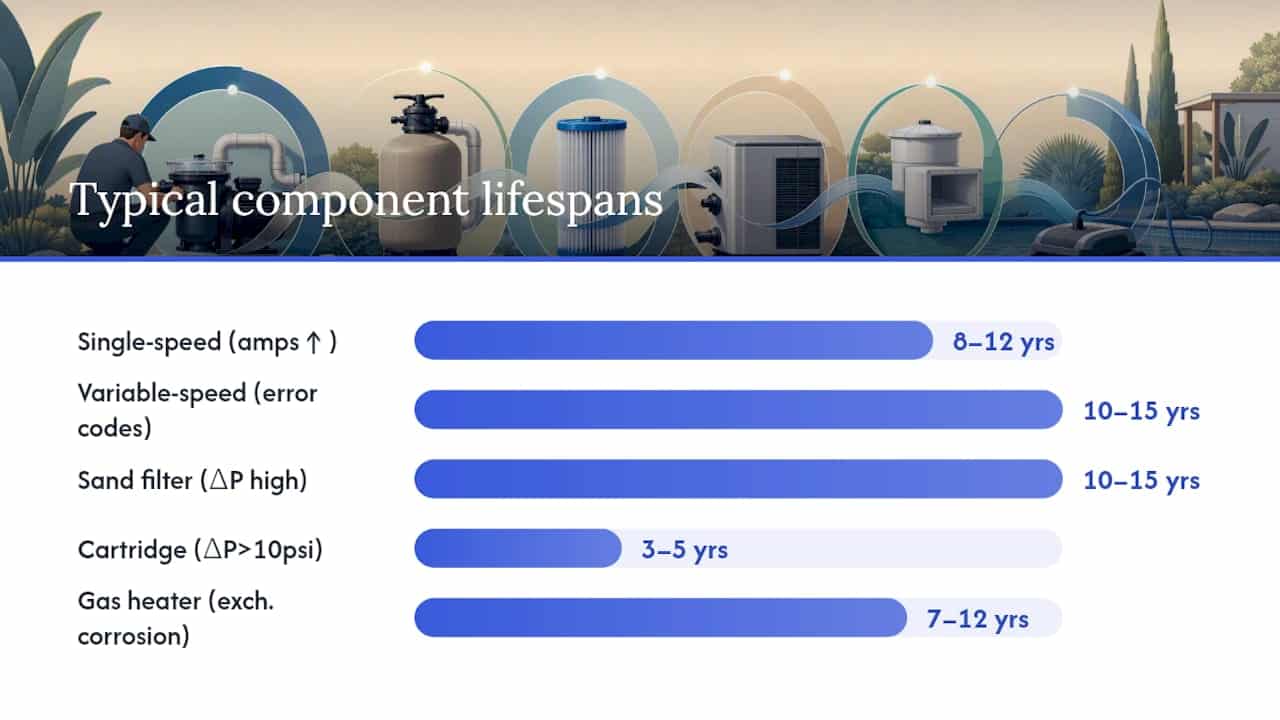
A ΔP reading more than roughly 10 psi above the filter’s clean baseline is a widely used field threshold for immediate service. For pumps, measuring amp draw against the nameplate rating at startup and under load catches impeller wear and motor degradation before a full failure occurs.
Reserve budgeting: Many homeowners are advised to set aside $500–$1,500 annually to cover predictable replacements across a typical residential pad. Commercial operators should calculate reserves per asset based on replacement cost divided by expected remaining life.
What does a preventive maintenance program actually look like?
A well-designed preventive maintenance program assigns specific tasks to specific cadences and names who owns each one. Ownership matters as much as the task list itself.
Daily tasks
For commercial facilities, the CDC recommends testing pH and disinfectant levels at least twice daily when the pool is open, and many state codes require more frequent checks during peak bather loads. Automated chemical controllers improve consistency but do not replace the obligation for manual verification tests. Residential pools benefit from a daily visual walk-around: check for obvious leaks, unusual pump sounds, and debris accumulation at skimmers.
Weekly tasks
- Log filter pressure (ΔP) at the same time each week to build a trend baseline.
- Clear skimmer and pump baskets.
- Backwash sand or DE filters when ΔP rises 8–10 psi above baseline; rinse cartridge filters on schedule.
- Verify chemical feeder output and calibrate dosing pumps if readings drift.
- Inspect visible plumbing fittings and equipment pad for moisture or staining.
Monthly tasks
- Deep clean cartridge filter elements or inspect sand/DE media condition.
- Inspect salt chlorinator cell for calcium scaling; clean with diluted acid solution if needed.
- Test and exercise all valves and actuators through their full range of motion to prevent seizing.
- Back up automation controller settings and verify time-clock programs.
- Check pump motor amp draw against nameplate and log the reading.
Seasonal tasks
Pre-season startup is the highest-leverage maintenance window of the year. Inspect the heater heat exchanger and burner assembly before the first firing. Verify all bonding connections are intact. Confirm drain covers meet current VGB standards and replace any that show cracking or discoloration. For pools in freeze-risk climates, winterization must include draining equipment, blowing out lines, and adding antifreeze to trap legs.
Ownership and escalation: Homeowners and trained technicians can handle chemistry, basket cleaning, filter service, and basic calibration. Electrical bonding checks, gas heater combustion work, and structural plumbing modifications require a licensed electrician or plumber. Knowing that boundary protects everyone.
Spare parts to keep on hand: pump shaft seals, O-rings for filter lids and unions, a spare cartridge element (if applicable), chemical feeder tubing, and pressure gauge replacements. Rotate stock by install date and log expiry on each item.
Pro Tip: Record the install date, serial number, and warranty expiry date on every spare part the moment it arrives on-site. When a part fails in the field, you will know immediately whether it is still under warranty before you order a replacement.
For a ready-made residential task list, the pool maintenance checklist for homeowners from Classicmarcite covers the full annual cycle.
How should you run a pool equipment inspection?
Structured inspection protocols separate safety-critical checks from performance items and use phased sequences so nothing gets missed. The four-phase approach below is audit-ready and works for both residential service calls and commercial compliance inspections.
Phase 1: Visual safety pre-check
Walk the entire pool perimeter and equipment pad before touching anything mechanical.
- Confirm all drain covers are present, secured, and undamaged. Mark any cracked or loose cover as safety-critical and do not allow pool use until replaced.
- Check pool barriers, gates, and latches for compliance with local code.
- Look for obvious electrical hazards: exposed conduit, water near junction boxes, corrosion on bonding lugs.
- Note any visible leaks, standing water under equipment, or unusual odors near the heater.
Phase 2: Mechanical systems assessment
- Measure pump amp draw at startup and compare to the nameplate rating. A reading significantly above nameplate indicates motor stress.
- Listen for bearing noise, cavitation, or air entrainment in the pump.
- Record filter inlet and outlet pressure; calculate ΔP and compare to the clean baseline.
- Check heater for proper ignition sequence, heat rise across the heat exchanger, and combustion-air clearance.
- Cycle automation controller through all circuits and verify actuator response times.
Phase 3: Water chemistry cross-check
- Test pH, free chlorine (or bromine), total alkalinity, calcium hardness, and cyanuric acid. Log all readings with timestamp.
- Cross-reference chemistry with equipment condition: heavy scaling on the SCG cell or heat exchanger often points to high calcium hardness or pH drift. Plaster etching suggests chronically low pH or alkalinity. These are equipment diagnostics, not just water quality notes.
- Verify that automated controller setpoints match current manual test results. If they diverge by more than a defined tolerance, recalibrate the sensor.
Phase 4: Documentation and work-order generation
A compliant service checklist organizes checks into pre-service, in-service, and post-service phases and reduces liability exposure. Capture the following fields on every inspection record:
| Field | Example Value |
|---|---|
| Date and time | 2026-15, 9 AM |
| Technician name and credential | J. Rivera, CPO |
| Equipment make/model/serial | Pentair SuperFlo VS, SN XXXX |
| Reading type and value | Filter ΔP: 18 psi (baseline 8 psi) |
| Photo reference | filter gauge image |
| Corrective action taken | Backwashed filter; ΔP returned to 9 psi |
| Parts used | None |
| Escalation flag | None / Escalate to licensed electrician |
Compliance triggers that require escalation: Any modification to suction outlets or drain covers (VGB compliance), electrical bonding or grounding work governed by NEC Article 680, gas line or combustion-air modifications, and structural plumbing changes that may require a permit. Field inspection checklists recommend marking these items as Pass/Fail/Monitor with a clear escalation note to protect both the contractor and the owner.
When should you repair pool equipment versus replace it?
The repair-vs-replace decision is where lifecycle management pays off most directly. Making it consistently requires a repeatable framework, not a gut call on each service visit.
The three-factor decision rule
- Age relative to lifespan: If the component has used more than 70–80% of its expected service life, replacement is almost always the better investment even for a moderate repair.
- The 50% rule: If repair costs exceed roughly 50% of the replacement cost, replacement is typically recommended. This threshold accounts for the fact that a repaired aging component often fails again within 12–18 months.
- Systemic degradation signals: A single failed bearing is a repair. A pump that has had three seal failures in two years, draws high amps, and runs hot is showing systemic degradation. Replace it.
Decision flow for a service call
- Identify the failure mode and estimate repair cost (parts + labor).
- Look up the component’s install date and calculate age as a percentage of expected lifespan.
- Apply the 50% rule: if repair cost exceeds half of installed replacement cost, flag for replacement.
- Check for systemic degradation signals (repeat failures, corrosion, multiple worn components on the same unit).
- If replacement is indicated, evaluate whether an upgrade (variable-speed pump, heat pump, automation) changes the ROI calculation.
Upgrade ROI worth knowing
Variable-speed pumps typically use significantly less energy than single-speed models at equivalent flow rates, and many utilities offer rebates on qualifying models. A heat pump heater costs more upfront than a gas unit but operates at a fraction of the running cost in Florida’s climate. Automation upgrades reduce manual errors and often extend equipment life by preventing dry-run events and chemistry swings. For a detailed upgrade workflow, the pool equipment upgrade steps guide from Classicmarcite covers the full process.
Pro Tip: When quoting a repair to a customer, always present the installed replacement cost alongside the repair estimate. Labor typically adds 30–60% on top of equipment cost for most pad components. Seeing both numbers side by side makes the 50% rule easy to apply and builds trust with the customer.
For homeowners navigating this decision, the guide to replacing pool equipment the right way walks through installation considerations and common mistakes.
What records do you need to keep, and for how long?
For commercial operators, documentation is not administrative overhead. Well-kept logs prevent closure orders and speed incident response. Missing records during a health inspection can result in the same outcome as a failed test.
Minimum log fields
Every chemistry log entry needs: date and time, technician name, pH reading, free disinfectant level, combined chlorine (if applicable), corrective action taken, and initials. Every equipment maintenance log entry needs: date, technician, equipment ID, task performed, readings before and after, parts replaced with serial numbers, and a photo reference.
Commercial retention guidance
Most state health codes require commercial aquatic facilities to retain chemical testing logs and maintenance records for 2–5 years and to make them available on-site for inspector review. The CDC’s guidance for operating public pools and the Model Aquatic Health Code (MAHC) set the expectation that records are current, complete, and accessible during any inspection. Automated chemical controllers must be supplemented with manual verification tests to satisfy most state inspectors, even when the controller logs data continuously.
Sample log schema
How documentation protects you
A complete log with make, model, serial number, and install date is your first line of defense in a warranty claim. Manufacturers routinely deny warranty coverage when there is no service history showing the equipment was maintained according to their specifications. The same log that satisfies a health inspector also satisfies a warranty adjuster.
What features should you require from lifecycle management software?
The right software turns a spreadsheet-based lifecycle plan into a system that alerts you before failures happen rather than after. Evaluate tools against these criteria before committing.
Core features to require
- Asset registry with fields for make, model, serial number, install date, warranty expiry, and location on the pad.
- Maintenance schedule engine that generates tasks automatically based on cadence (daily, weekly, monthly, seasonal) and sends alerts when tasks are overdue.
- Inspection checklist support with photo attachment capability so field techs can document readings and conditions in the app.
- Trend charts for ΔP, pump amp draw, and chemical readings over time, so gradual degradation is visible before it becomes a failure.
- Warranty tracking with expiry alerts tied to each asset record.
- Parts inventory module that tracks stock levels and reorder points for critical spares.
Automation and integrations worth prioritizing
Chemical controller telemetry ingestion (pulling readings directly from an automated controller into the log) eliminates manual transcription errors. Smart sensor integration for flow rate and pressure gives real-time ΔP without a technician on-site. Route optimization for field service companies reduces drive time and increases the number of pools a tech can service per day. Exportable compliance reports in PDF or CSV format are non-negotiable for commercial operators who need to hand logs to a health inspector on short notice.
Evaluation criteria
Score candidate tools on: data completeness (can every required log field be captured?), offline field capability (does it work without cell service?), ease of exporting raw readings for regulators, and API availability for integration with chemical controllers or billing systems. Security matters too: logs that contain facility operational data should be stored with access controls, regular backups, and a defined SLA for uptime and data export.
Pro Tip: Before signing any software contract, ask the vendor to demonstrate a configurable inspection template and a CSV export of raw chemical readings. If they cannot show both in under five minutes, the product is not built for regulatory use.
How resurfacing and renovation reduce equipment failures
Pool surface condition directly affects equipment stress. A rough, porous, or degraded interior surface increases chemical demand, promotes algae attachment, and accelerates calcium saturation, all of which shorten equipment life. Commercial renovation workflows that combine resurfacing with equipment inspection and staged upgrades produce measurable improvements in system performance.
The mechanism
A smooth, properly bonded surface like Pebble Tec® reduces the surface area available for biofilm and calcium carbonate attachment. That means lower sanitizer demand, more stable pH, and less scaling on salt cells and heat exchangers. Restored hydraulic geometry after a full resurface also normalizes flow rates, which reduces pump run-time and energy stress.
Workflow: coordinated resurface and equipment refresh
- Pre-renovation inspection: Full phased inspection (visual, mechanical, chemistry, documentation) to identify all equipment at or near end-of-life before the pool is drained.
- Surface preparation and repair: Address structural cracks, tile failures, and plumbing penetrations while the pool is empty.
- Equipment replacement or upgrade: With the pool drained and the pad accessible, replace aging pumps, valves, or automation components. Labor costs are significantly lower when the pool is already down.
- New surface application: Apply the chosen finish (marcite plaster, Pebble Tec®, or aggregate blend) and allow proper cure time.
- Startup and commissioning: Fill, balance chemistry to the finish manufacturer’s startup protocol, set baseline ΔP and amp-draw readings, and document everything.
- Post-startup documentation: Log all baseline readings as the new reference point for the lifecycle plan going forward.
A pool that enters this workflow with a pump drawing 20% above nameplate amperage, a filter showing persistent high ΔP, and a salt cell coated in calcium scale will exit it with normalized readings across the board, because the root causes (surface roughness, chemistry instability, and aging components) have all been addressed together.
Pro Tip: Bundle equipment upgrades with a resurfacing project whenever possible. Replacing a pump or replumbing a valve while the pool is already drained for resurfacing costs a fraction of what the same work costs as a standalone service call. Plan the equipment inspection before the resurface date so the parts are on order before the pool goes down.
What the most preventable failures actually have in common
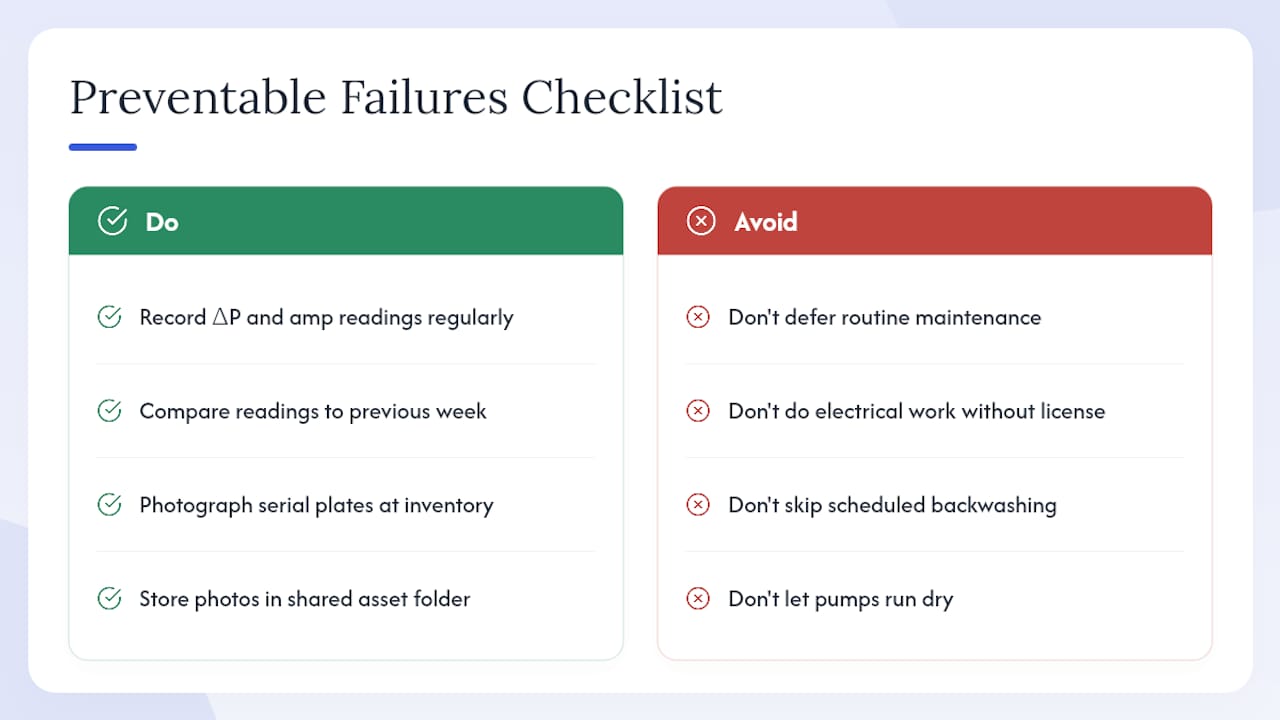
The pattern that shows up repeatedly across residential and commercial pools is not dramatic. It is a filter that was never backwashed on schedule, a salt cell that was never descaled, or a pump that ran dry for three days because a skimmer basket was never checked. The most expensive repairs in this industry are almost always the result of deferred maintenance, not bad luck.
The single habit that extends equipment life more than any other is logging. Not because paperwork matters for its own sake, but because the act of recording a ΔP reading or a pump amp draw forces a technician to actually look at the number and compare it to last week’s. That comparison is where problems get caught at the $50 stage instead of the $2,000 stage.
Credentials matter here too. Technicians trained under PHTA, CPO, or NSPF frameworks are better at recognizing the boundary where a task requires a licensed electrician or plumber, which reduces both regulatory exposure and the risk of a repair that creates a new hazard. For commercial operators, that boundary is not optional. NEC Article 680 governs electrical bonding for pools, and work in that scope requires a licensed electrician regardless of who noticed the problem first.
One practice worth adopting immediately: photograph every serial number plate on every piece of equipment during the initial inventory. Store the photos in a shared folder tied to the asset record. When a component fails at 7 PM on a Friday, you will have the model number and serial in your phone before you call the supplier.
Classicmarcite supports your pool’s long-term performance
A professional resurfacing and renovation partner is not just a contractor you call when the surface looks bad. Coordinated resurfacing and equipment replacement reduces long-term maintenance costs by addressing the root causes of chemistry instability and equipment stress at the same time, rather than treating symptoms one service call at a time.
Classic Marcite has resurfaced more than 100,000 pools across residential, commercial, and resort properties since 1988, and holds the position of the largest Pebble Tec® applicator in Central Florida. Services include pool resurfacing in Orlando, full pool remodeling, interior finish upgrades, tile and deck repair, and equipment pad coordination during renovation projects. When a resurfacing project is planned correctly, it becomes the most cost-effective window to replace aging equipment, normalize hydraulics, and reset the lifecycle clock on the entire system. Request a free on-site evaluation to find out which components on your pad are approaching end-of-life and what a coordinated renovation would cost. For repair needs outside a full resurface, the pool repair service page covers the full scope of what Classicmarcite handles.
Authoritative references and primary sources to consult
Save these sources for compliance audits, inspector requests, and staff training. Each one covers a distinct layer of pool equipment lifecycle management.
- CDC Healthy Swimming: Operating Public Pools, Hot Tubs and Splash Pads — The primary federal guidance document for commercial aquatic facility operations, testing frequency, and recordkeeping requirements under the Model Aquatic Health Code.
- Xylem: Understanding the Lifecycle of Your Pool’s Equipment — Industry-level analysis of how maintenance practices and documentation affect equipment lifespan relative to manufacturer averages.
- Pool Tech Association: Pool Equipment Inspection Protocols — Phased inspection framework with threshold-based escalation triggers for ΔP, amp draw, and safety-critical items.
- National Pool Safety Association: Pool Service Safety Inspection Checklist — Structured pre/in/post-service checklist format with NEC Article 680 electrical bonding compliance requirements.
- Pool Founder: Pool Equipment Lifespan Guide — Lifespan ranges for major components and the 50% repair-vs-replace rule explained with practical examples.
- Pool User Guide: Pool Equipment Costs and Lifespan — Installed cost anchors and annual reserve guidance for residential pool owners.
- Gomocha: What Is Equipment Lifecycle Management? — Framework for the full asset lifecycle from acquisition through end-of-life, with emphasis on data-driven scheduling.
- Pool Trade Network: Equipment Inspection Checklists for Pool Service Calls — Field-ready checklist structure with Pass/Fail/Monitor flags and escalation notes for licensed-trade boundaries.
Sources
- Operating and Managing Public Pools, Hot Tubs and Splash Pads | Healthy Swimming | CDC
- Understanding the lifecycle of your pool’s equipment
- Pool Equipment Inspection Protocols
- Pool service safety inspection checklist
- Pool Equipment Lifespan Guide: When to Repair vs Replace Everything on the Pad
- Pool equipment costs and lifespan – Pool User Guide
- What Is Equipment Lifecycle Management? – Field Service Management Software & Platform | Gomocha
- Equipment inspection checklists for pool service calls
