TL;DR:
- A commercial pool safety workflow is a structured, ongoing system that monitors hazards, maintains compliance, and reduces liability through integrated chemical testing, inspections, and digital recordkeeping. Proper implementation involves using certified personnel, compliant infrastructure, and advanced software tools to ensure continuous safety and legal defensibility. Recognizing common mistakes and leveraging emerging technology enhances compliance, streamlines documentation, and supports a proactive approach to pool safety management.
A commercial pool safety workflow is a structured, repeating process for monitoring, documenting, and correcting pool hazards and compliance requirements across every operational cycle. Facilities managers and safety officers who treat this process as a unified system, rather than a checklist of isolated tasks, consistently reduce liability exposure and protect guests. The core components are chemical testing, physical inspections, personnel credentialing, and digital recordkeeping. Each component feeds the next, creating an audit trail that satisfies health department scrutiny and holds up in court. This guide covers the tools, step-by-step procedures, and common failure points you need to manage the full workflow.
What does an effective commercial pool safety workflow require?
The foundation of any reliable pool safety management system is the right combination of equipment, software, credentials, and physical safety infrastructure. Without these in place before operations begin, every inspection cycle starts with gaps.
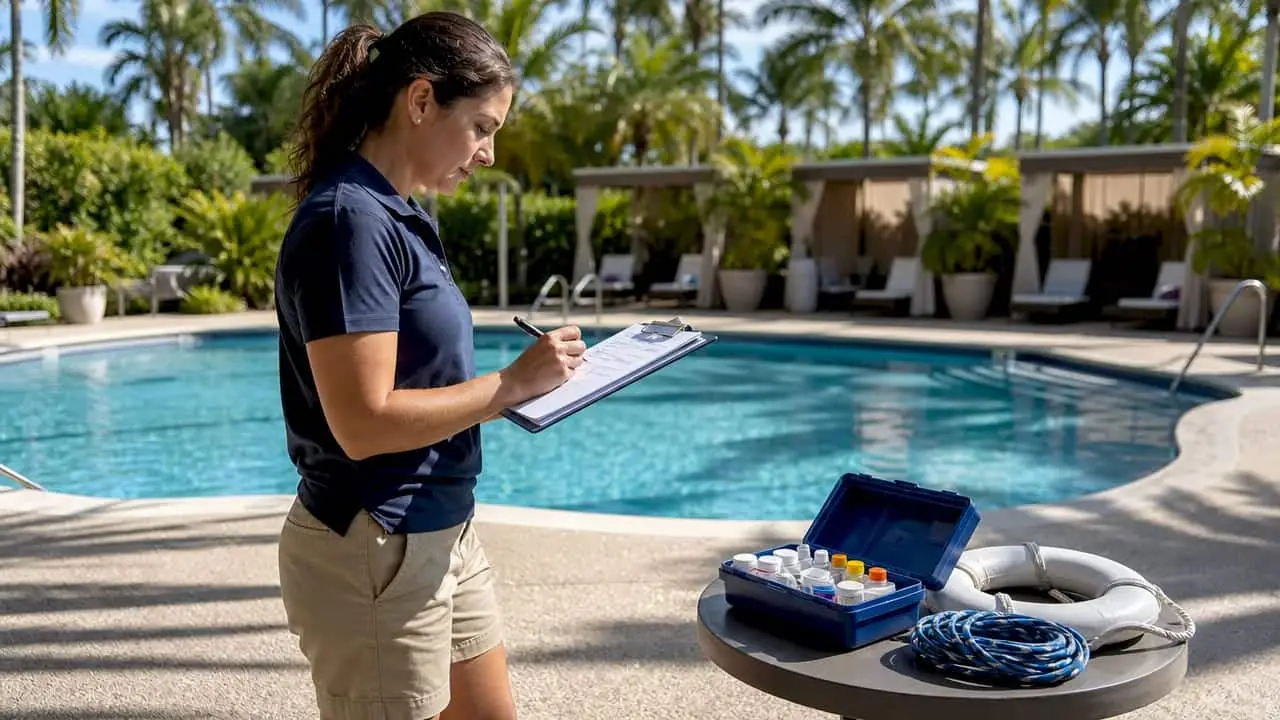
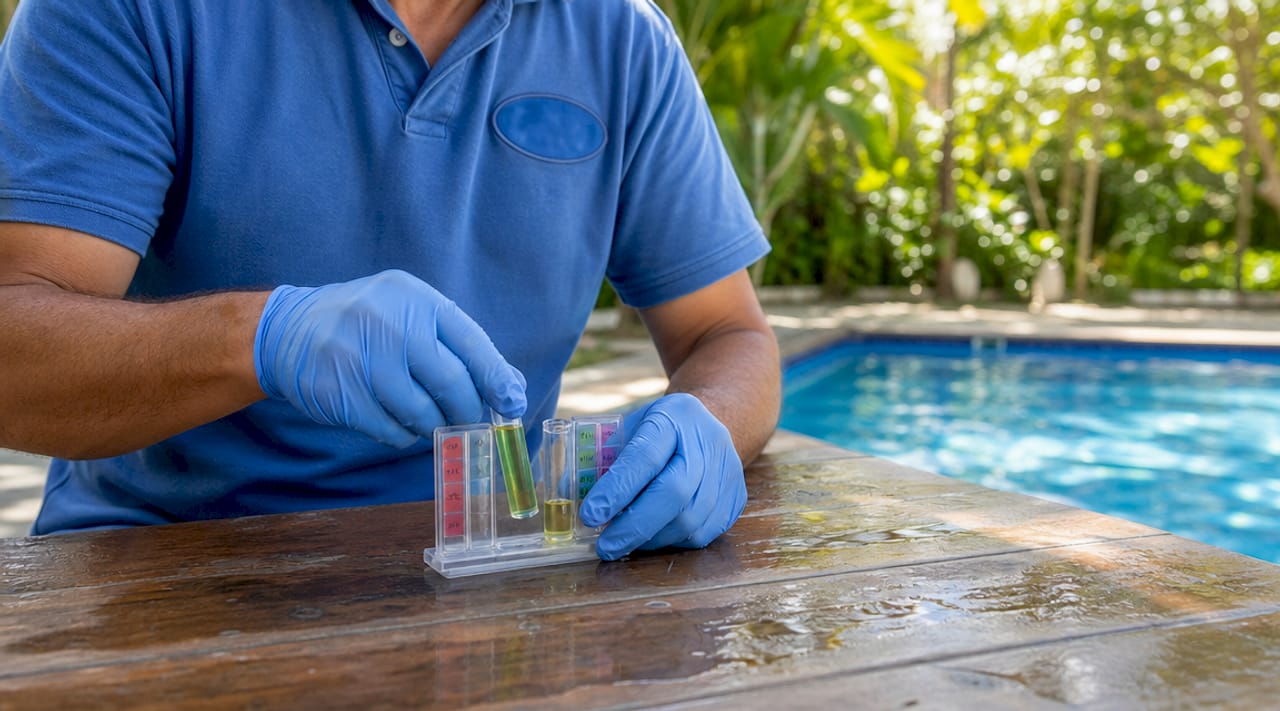
Chemical testing tools must meet the frequency standards set by your local health code. Testing requirements vary by facility type: HOAs with 25 or more units typically test twice daily, while smaller facilities may test twice weekly. Digital logging of those results, rather than paper logs, simplifies compliance reviews and reduces transcription errors.
Certified Pool Operator (CPO) credentials are non-negotiable for commercial facilities. The CPO role is fundamentally a risk management position, not just a chemical testing function. Operators must proactively defend decisions with audit trails, meaning their training must cover documentation practices as thoroughly as water chemistry.
Physical safety infrastructure includes Virginia Graeme Baker Act-compliant drain covers, compliant barriers and fencing, visible depth markers, and posted emergency contact signage. These are not optional upgrades. They are baseline requirements under most state codes, including Florida’s commercial swimming pool guidelines.
Digital inspection and compliance software rounds out the toolkit. Platforms like PoolVerify support pre-built regulatory templates, photo integration, digital signatures, and searchable storage that meets BPC §7195 standards. This matters because manual recordkeeping leaves facilities exposed when auditors or attorneys request documentation.
Pro Tip: Before selecting compliance software, confirm it supports ESIGN Act-compliant digital signatures. A signature that does not meet this standard may be inadmissible as evidence in a liability proceeding.
| Tool or Credential | Why it matters |
|---|---|
| CPO certification | Establishes legal accountability and risk management authority |
| Chemical testing kit | Meets daily or twice-weekly frequency standards by health code |
| Drain cover compliance | Prevents entrapment incidents under Virginia Graeme Baker Act |
| Digital compliance software | Creates searchable, exportable audit trails for inspections |
| AI vision integration | Detects physical hazards in real time and triggers automated work orders |
How to implement a step-by-step pool safety inspection workflow
A repeatable inspection sequence is the operational core of best practices for pool safety. The sequence below moves from daily tasks through seasonal preparation, with documentation built into each phase.
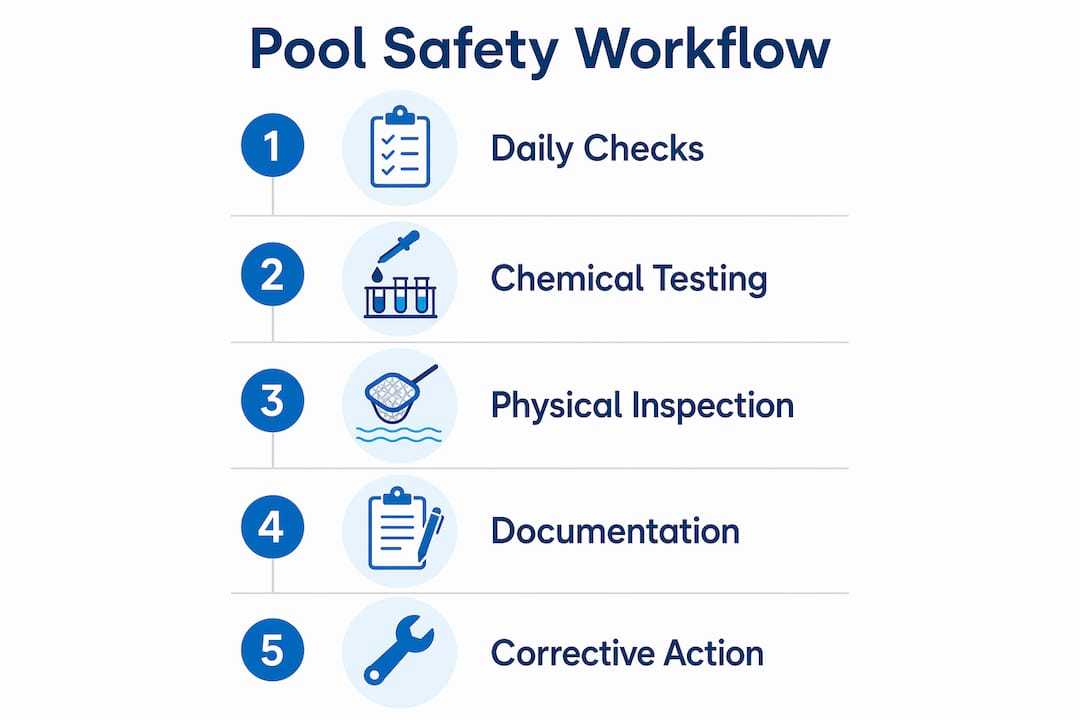
- Daily chemical inspection. Test chlorine, pH, alkalinity, and cyanuric acid at opening and again at peak usage. Standard chlorine levels are 1 to 3 ppm for pools and 3 to 5 ppm for spas, with a six-hour turnover time for pools and 30 minutes for spas. Log every reading digitally at the time of testing, not retroactively.
- Daily physical walkthrough. Inspect drain covers for cracks or displacement, check barrier integrity, verify signage is posted and legible, and confirm rescue equipment is in place. Flag any deficiency immediately and open a work order before the facility opens to guests.
- Weekly equipment checks. Inspect pump operation, filter pressure, and heater function. Review the previous week’s chemical logs for trends that signal equipment drift. A pump running at reduced flow will show up in turnover time before it shows up as a visible failure.
- Monthly documentation review. Audit your digital log for missing entries, unsigned inspection forms, or overdue corrective actions. Effective pool management demands coordination between chemical safety, equipment maintenance, staff training, and documented compliance. Treating these as a unified system reduces liability risks.
- Seasonal preparation and health department readiness. Before opening season, conduct a full swimming pool compliance checklist review covering permits, equipment certifications, staff credentials, and emergency action plans. Archive all documents with timestamps. Proper archival of emergency action plans with timestamps is a recognized best practice for legal defense before and after incidents.
Pro Tip: Link your digital inspection findings directly to automated work orders. When an inspector flags a cracked drain cover at 7 a.m., the maintenance team should receive a work order automatically, not after a manual handoff that may be delayed by hours.
| Inspection frequency | Key tasks | Documentation output |
|---|---|---|
| Daily | Chemical testing, physical walkthrough | Digital log entry, signed inspection form |
| Weekly | Equipment checks, log trend review | Equipment status report, corrective action record |
| Monthly | Full documentation audit | Compliance summary, overdue action report |
| Seasonal | Permit review, staff credentialing, emergency plan update | Pre-opening compliance package |
What common mistakes disrupt pool safety management?
Even well-resourced facilities make predictable errors that compromise their compliance posture. Recognizing these patterns is the first step toward eliminating them from your workflow.
- Ignoring regulatory updates. Florida’s commercial swimming pool guidelines are not static. Local health departments issue amendments, and ANSI/APSP standards, while technically voluntary, become binding when referenced in contracts or state law. Facilities that do not assign someone to monitor code changes routinely discover non-compliance during inspections rather than before them.
- Retroactive or incomplete recordkeeping. Filling in chemical logs at the end of a shift rather than at the time of testing is one of the most common compliance failures auditors find. A log entry without a timestamp is legally worthless and signals negligence to a plaintiff’s attorney.
- Underestimating the CPO’s risk management role. Many facilities treat the CPO as a maintenance technician. The CPO’s actual function is to document decisions, maintain audit trails, and defend the facility’s practices. Operators who lack documentation training leave the facility exposed even when the water chemistry is perfect.
- Neglecting drain cover condition. Premises liability claims frequently stem from drain cover failures and inspection lapses. Failing to fix identified hazards promptly has resulted in multimillion-dollar settlements. Drain cover inspections belong on the daily walkthrough, not the monthly checklist.
- Relying solely on maintenance vendors. Equipment maintenance is only a subset of full pool management, which also includes compliance, training, incident response, and defensible documentation. Delegating everything to a vendor without retaining internal oversight leaves the facility legally exposed when something goes wrong.
How can technology improve compliance and safety workflow?
Emerging technology does not replace human judgment in a commercial pool safety workflow. It fills the gaps that human inspection cycles inevitably leave open.
AI vision systems integrated with Computerized Maintenance Management Systems (CMMS) convert passive security cameras into active safety monitoring tools. These systems detect physical hazards, including cracks, displaced drain covers, and unauthorized access, and generate work orders instantly. AI vision complements but does not replace water chemistry monitoring. Combined sensor integration provides full compliance coverage across both physical and chemical dimensions.
Automated inspection report generation addresses one of the most time-consuming parts of the workflow. Automating report generation reduces manual preparation time by 30 to 60 minutes per inspection, integrating photos and ESIGN Act-compliant digital signatures into a single deliverable. Software like PoolVerify expedites report delivery and keeps facilities audit-ready at all times.
Cloud-based compliance platforms provide searchable storage, export capabilities, and real-time alerts for critical safety issues. When a chemical reading falls outside acceptable range, the system notifies the CPO immediately rather than waiting for the next manual review cycle.
“Risk assessments are legally required under general duty of care. Following recognized industry practices helps establish a legal defense in liability claims.” — UK Health and Safety Executive
The legal dimension of technology adoption is significant. Digital signatures that meet ESIGN Act standards, timestamped photos, and automated audit trails all contribute to a defensible record. Facilities that rely on paper logs and manual handoffs cannot produce the same quality of evidence when a claim is filed. For Florida commercial properties operating under state health department oversight, this distinction is material.
Key takeaways
A commercial pool safety workflow succeeds when chemical testing, physical inspections, CPO-led documentation, and digital compliance tools operate as one integrated system rather than separate tasks.
| Point | Details |
|---|---|
| CPO as risk manager | The CPO role centers on documentation and audit trails, not just chemical testing. |
| Daily documentation discipline | Log chemical readings and physical findings at the time of inspection, never retroactively. |
| Technology fills inspection gaps | AI vision and automated reporting reduce manual errors and create legally defensible records. |
| Regulatory monitoring is ongoing | ANSI/APSP standards and local health codes change; assign someone to track updates continuously. |
| Drain covers are a daily priority | Cracked or displaced drain covers are a leading source of premises liability claims and require daily inspection. |
Why most facilities underestimate the documentation burden
After working with commercial pool operators across Florida, the pattern I see most often is not a failure of intent. It is a failure of system design. Facilities invest in the right chemicals, hire credentialed staff, and install compliant equipment. Then they document everything on paper, in a binder that no one can search when an attorney sends a records request.
The facilities that handle audits and liability claims most effectively are the ones that treat documentation as a product of the workflow, not an afterthought. Every inspection generates a timestamped digital record. Every corrective action links back to the finding that triggered it. Every staff credential is stored in the same system as the inspection logs. When a health department inspector walks in, the facility manager pulls up a dashboard rather than a binder.
The technology to do this exists and is not expensive relative to the cost of a single liability settlement. The gap is not budget. It is the organizational decision to treat pool safety management as a continuous, integrated operation rather than a series of tasks assigned to different people with no shared system. That decision is the most important one a facilities manager can make.
— Classicmarcite
Upgrade your pool’s safety foundation with Classicmarcite

A compliant safety workflow depends on a pool surface that holds up under daily chemical exposure and heavy use. Cracked, degraded, or porous surfaces trap bacteria, accelerate chemical imbalance, and create physical hazards that no inspection checklist can fully offset. Classic Marcite has resurfaced more than 100,000 pools across Florida since 1988, including commercial properties at resorts, hotels, and theme parks. As the largest Pebble Tec® applicator in Central Florida, the company delivers surfaces built for durability, compliance, and long-term performance. If your facility is due for a surface upgrade, explore commercial pool resurfacing options or request a free estimate for Florida pool renovation services tailored to commercial properties.
FAQ
What is a commercial pool safety workflow?
A commercial pool safety workflow is a structured, repeating process covering chemical testing, physical inspections, equipment maintenance, staff credentialing, and compliance documentation. It operates as a unified system to reduce liability and meet health department standards continuously.
How often should commercial pools be chemically tested?
Testing frequency depends on local health codes. HOAs with 25 or more units typically test twice daily, while smaller facilities may test twice weekly. Digital logging at the time of testing is required for compliance.
What does a Certified Pool Operator actually do?
The CPO role is primarily a risk management function that includes maintaining audit trails, documenting decisions, and overseeing unified system compliance. Chemical testing is one component, not the full scope of the position.
How does AI vision technology improve pool safety compliance?
AI vision systems integrated with CMMS platforms detect physical hazards in real time and generate automated work orders. They complement water chemistry monitoring rather than replacing it, providing full compliance coverage across both physical and chemical dimensions.
What records should a commercial pool facility keep for legal protection?
Facilities should maintain timestamped chemical logs, signed inspection forms, corrective action records, staff credentials, and emergency action plans. Archiving emergency action plans with timestamps is a recognized best practice for establishing legal defense before and after incidents.
