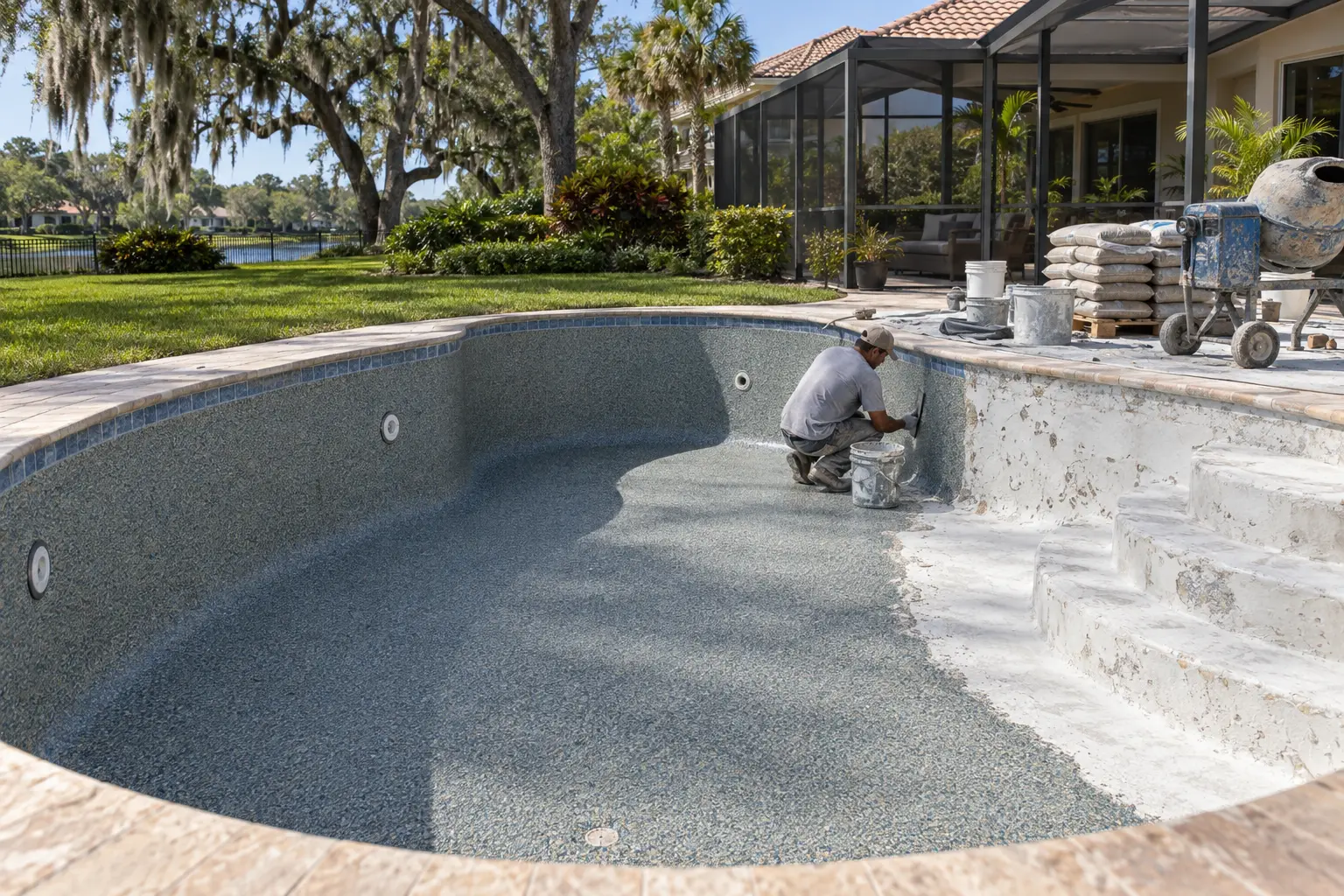
TL;DR: Industry figures put white plaster (marcite) at about 7 to 10 years, quartz and polished aggregate at about 15 to 20, and pebble finishes at 20 years or more. Orlando’s sun, heat and year-round swimming push many pools toward the low end of each range. To plan your next resurfacing, start with your finish type and its age, then check its condition.
How often should a pool be resurfaced in Florida? Plan on about every 7 to 10 years for white plaster (marcite), about 15 to 20 years for quartz or polished aggregate, and 20 years or more for a pebble finish. In Orlando, strong sun, heat and year-round swimming push most pools toward the low end of each range.
You may have seen these numbers before. This guide shows how to use them: what each finish really gives you in Central Florida, how to tell where an inherited pool is in its cycle, and how to plan the next resurfacing so it doesn’t surprise you.
How often should a pool be resurfaced in Florida, by finish type?
Mostly it depends on the finish, because each material wears at a different rate. The ranges below come from finish makers. They assume a good install and steady water care. SGM, a pool finish manufacturer, puts traditional plaster at 7 to 10 years, quartz at 15 to 20 years and exposed aggregate at 20 years or more.
| Finish | Typical industry lifespan | Resurfacings in 20 years (approx.) | Feel and look |
|---|---|---|---|
| Marcite (white plaster) | 7 to 10 years | About 2 | Smooth, classic white, shows stains easily |
| Quartz | 15 to 20 years | About 1 | Smooth, comes in colors |
| Polished marble aggregate | 15 to 20 years | About 1 | Smooth, polished, speckled look |
| Pebble (Pebble Tec, Pebble Sheen, Pebble Fina) | 20+ years | Often 0 to 1 | Natural stone look; Pebble Tec has more texture, Sheen and Fina feel smoother |
Plaster can last longer than its reputation suggests. Universal White Cement says well-applied white cement plaster should give 15 to 20 years. It adds that a pool that only gets 7 years usually had aggressive water, a poor start-up, a bad mix or rushed prep. In other words, the install and the first month matter as much as the material.
Why do Orlando pools often land at the low end?
A Florida pool gets used all year, so its finish ages faster than a pool that sits closed half the year. Most Orlando-area pools are concrete (gunite) shells with a plaster or pebble interior, and many sit inside screen enclosures. The screen keeps leaves out, but the water still runs warm for months and families swim most of the year.
Heat and sun are the first factor. Warm water speeds up chemical reactions, so water that is a little off balance etches plaster faster here. Our article on how Florida heat and humidity wear on pool surfaces goes deeper on this.
Start-up is the second. The National Plasterers Council says a new finish is most likely to stain, scale or discolor in its first 28 days. Mistakes in that window can take years off a finish that should have lasted.
Fill water is the third. The pool is drained for resurfacing and refilled from the tap. OUC reports that its water averages 129 ppm hardness, about 7 grains per gallon. The NPC notes that start-up steps sometimes need adjusting for the fill water. That’s one more reason careful start-up chemistry matters after a refill.
Inherited a pool? How to tell where it is in its cycle
Start with the finish type and any records you can find, then check the surface yourself. Buyers in older neighborhoods like College Park and Pine Castle, and in newer Meadow Woods subdivisions, often close on a home without knowing when the pool was last resurfaced. Here’s how to estimate it:
- Ask the seller, or check your closing papers, for the last resurfacing date and finish.
- Identify the finish. Smooth and white is usually marcite. Smooth with colored flecks is often quartz or polished aggregate. Small stones you can feel underfoot mean a pebble finish.
- If you know the age, compare it to the table above.
- Check the steps, benches and shallow end. These high-traffic spots wear first, so trouble shows up there early.
- Run your hand along the walls. A chalky residue, rough patches or a sandpaper feel point to worn plaster.
- Get an inspection before you set a budget. A resurfacing pro can tell you whether you have years left or months.
What signs mean resurfacing can’t wait?
Call a pro once damage goes deeper than the surface, no matter how old the finish is. Watch for:
- A rough surface that snags swimsuits or scrapes feet
- Plaster that flakes, peels or sounds hollow when tapped
- Gray or dark patches where the finish has worn thin
- Stains that come back after treatment
- Cracks in the finish, especially if the water level keeps dropping
- Loose or missing pebbles in a pebble finish
- Waterline tile that cracks or falls off
Should you resurface on a schedule or wait for problems?
Plan on a schedule, then let the pool’s condition decide the exact year. If you know your plaster is about eight years old, start budgeting now, even if it still looks fine.
How long you’ll stay in the home changes the math. If you plan to stay in your Winter Park or Orlando home for a long time, a finish rated for 20-plus years can mean one drain-and-refill instead of two. SGM notes that plaster often needs two resurfacings in 20 years. If you plan to sell soon, read our guide on whether to resurface before listing your home.
Do the extra work in the same project. The pool is already drained, so it’s a good time to replace waterline tile and coping, upgrade lights or resurface the deck. One Classic Marcite customer, Steve, wrote in a Google review: “I have used Classic for my last two pool resurfacings.” That’s what a long ownership cycle looks like.
If you upgrade to pebble, the installer matters. PebbleTec says its finishes can last well over 20 years with proper care. It backs them with a product warranty plus a workmanship warranty from its authorized applicators. An uncertified installer can void a pebble finish’s manufacturer warranty, so ask who will apply it before you sign.
Why Orlando homeowners call Classic Marcite
Classic Marcite is a family-owned company founded in Orlando in 1988.
The company reports resurfacing more than 100,000 pools.
It is the largest Pebble Tec applicator in Florida.
Crews install marcite, quartz, Pebble Tec, Pebble Sheen, Pebble Fina, Beadcrete and polished aggregate finishes.
Every crew member is a company employee, not a subcontractor.
A supervisor handles the start-up after the new finish goes in.
The company holds a 4.1-star Google rating from 120 reviews as of October 2026.
Still comparing companies? Our checklist for choosing a licensed pool renovation contractor covers what to ask.
Want to know how many years your finish has left? Call (407) 521-6260 or book a free resurfacing estimate.
Frequently Asked Questions
Can I patch my plaster instead of resurfacing the whole pool?
A small patch can buy time on an isolated chip or hollow spot. Patches rarely match the old finish, though, and they don’t fix wear across the whole pool. Once problems spread, full resurfacing is the real fix.
Is it worth switching from plaster to pebble when I resurface?
If you plan to stay in the home for many years, a pebble finish rated for 20-plus years can mean fewer drain-and-refill cycles than plaster. It costs more up front, so weigh how long you’ll stay against the price difference.
Why does the pool have to be drained for resurfacing?
The old surface has to be prepped and the new finish applied to a dry shell. Afterward the pool is refilled, and the new finish needs careful water chemistry during start-up.
Does resurfacing include new waterline tile?
Not automatically, but many owners replace waterline tile and coping in the same project because the pool is already drained. Ask for tile and coping to be priced as part of your estimate.
Recommended Reads
- How Often Should You Resurface a Pool in Florida?
- Should You Resurface Your Pool Before Selling Your Home in Florida?
- Does Pool Resurfacing Increase Your Home’s Value? What Florida Homeowners Should Know
