TL;DR:
- Pool filter systems mechanically remove debris, reducing the organic load that sanitizers must handle.
- Proper maintenance, correct sizing, and monitoring pressure are essential to keep filters effective and extend their lifespan.
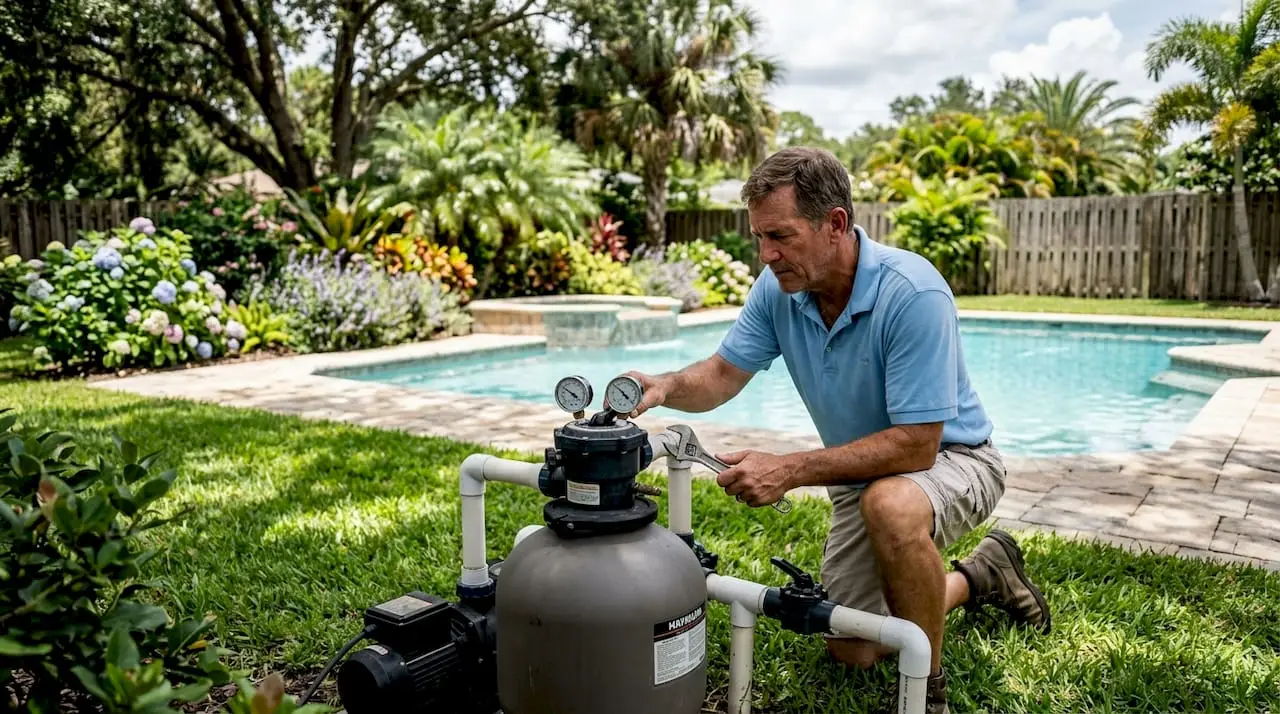
Pool filter systems are defined as the mechanical backbone of water circulation, removing suspended debris and particles before returning clean water to swimmers. Hayward describes the filter and pump as the “heart and lungs” of any pool, and that analogy holds up under scrutiny. Without active filtration, suspended dirt, oils, algae spores, and organic waste accumulate faster than any chemical treatment can handle. The role of filter systems in pools extends beyond clarity. They reduce the chemical load on sanitizers, protect equipment from clogging, and form the first line of defense in a two-layer water safety system. Sand, cartridge, and diatomaceous earth (DE) filters each accomplish this through mechanical separation, capturing particles at different size thresholds depending on the media used.
How do different types of pool filters work?
Mechanical filtration works by forcing pool water through a porous medium that physically traps suspended particles. The three main filter types differ primarily in how fine a particle they can capture, which directly affects water clarity and pathogen management.
Sand filters

Sand filters are the most common type in residential pools. Water passes down through a bed of filter sand, and particles get trapped between the grains. The practical capture limit for sand filters is approximately 20–40 microns. That range handles visible debris well but misses finer contaminants entirely.
Cartridge filters
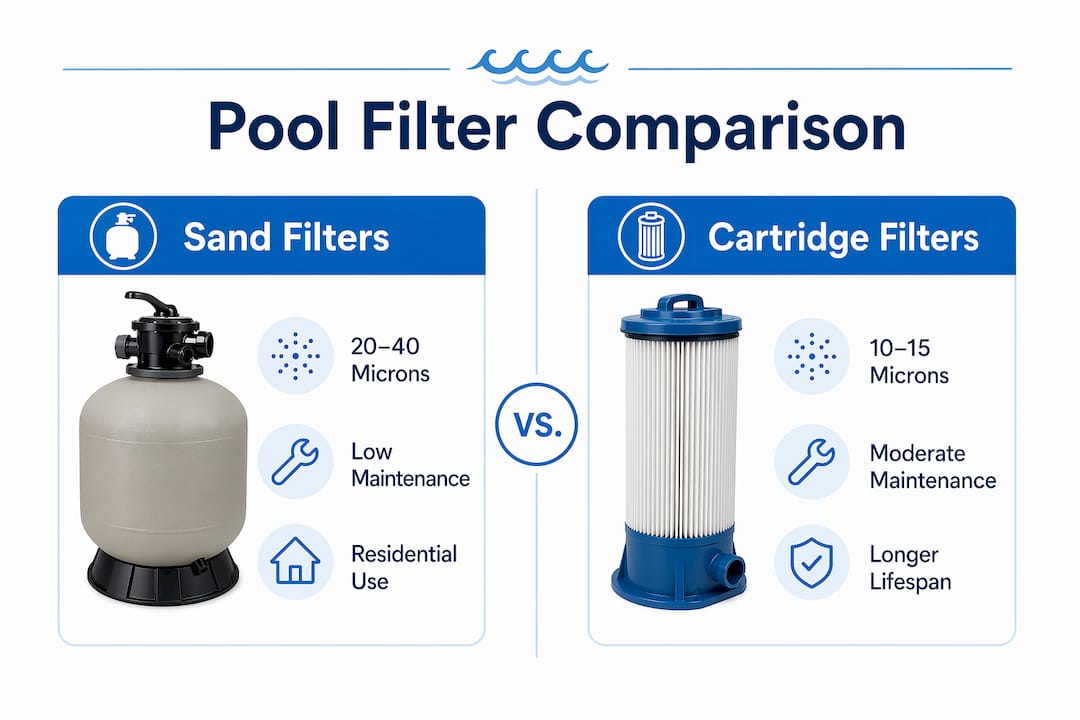
Cartridge filters use a pleated polyester element to trap particles. The increased surface area of the pleated design allows finer filtration than sand, with a practical capture range of roughly 8–15 microns. Cartridge filters require no backwashing, which saves water. They are a strong choice for most residential pools because they balance filtration quality with low maintenance complexity.
DE filters
Diatomaceous earth filters deliver the finest filtration available for residential use. Water passes through a coating of fossilized diatom skeletons, capturing particles as small as 2–5 microns. That level of filtration approaches what some commercial systems require. The tradeoff is more labor-intensive maintenance and careful handling of DE powder during recharging.
Filter type comparison
| Filter type | Particle capture range | Maintenance style | Best suited for |
|---|---|---|---|
| Sand | 20–40 microns | Backwash every few weeks | High-traffic pools, easy upkeep |
| Cartridge | 8–15 microns | Rinse every 4–8 weeks | Residential pools, water conservation |
| DE | 2–5 microns | Recharge after backwash | Maximum clarity, commercial use |
One critical limitation applies to all three types. Cryptosporidium oocysts measure approximately 4 microns. Sand filters cannot capture them at all. Even DE filters at the lower end of their range may not reliably remove every oocyst. This is why filtration alone never constitutes a complete safety system.
What operational factors affect filter performance?
Filter performance depends on more than the media type. Flow rate, system sizing, and turnover time all determine whether a filter actually cleans the water or just moves it around.
Turnover time is the number of hours required to cycle the entire pool volume through the filter once. Public pools must achieve complete water turnover in 6 hours for main pools and 1 hour for wading pools under Model Aquatic Health Code (MAHC) standards. Residential pools typically target a similar 6-to-8-hour turnover. Faster turnover means more filtration cycles per day and cleaner water overall.
Pump sizing matters more than most pool owners realize. Undersized pumps or restricted plumbing reduce actual flow rates well below the pump’s rated capacity. A properly sized filter underperforms when the pump cannot push enough water through it. The filter media, the pump, and the plumbing must all be sized together as a system.
Pressure gauges provide the most reliable real-time signal of filter condition. The standard cleaning trigger is a pressure rise of 8–10 psi above the clean baseline. That baseline matters. A pool owner who records the pressure immediately after a fresh backwash or cartridge rinse has a reliable reference point. One who uses a fixed psi number without knowing their system’s baseline may clean too early or too late.
The following factors all reduce effective filtration performance:
- Pump undersized for pool volume
- Plumbing with sharp bends or undersized pipe diameter
- Clogged skimmer baskets restricting inlet flow
- Filter media past its service life
- Running the pump fewer hours than needed for full turnover
Pro Tip: Record your filter’s clean baseline pressure after every service. Post it on a label near the equipment pad. That number is your most reliable maintenance trigger, not a generic psi target from a manual.
Why is filtration alone not enough for pool water safety?
Filtration removes particles. It does not kill pathogens. That distinction defines the two-layer defense every safe pool relies on: mechanical removal plus chemical disinfection.
Chlorine and other sanitizers kill bacteria and viruses that pass through filter media. Viruses measure well below 1 micron, far smaller than any residential filter can capture. Without a maintained sanitizer residual, filtered water can still transmit illness. The filter reduces the organic load in the water, which in turn allows chlorine to work more efficiently. A dirty, overloaded filter forces sanitizers to work harder against a higher concentration of organic material.
Special situations demand additional steps beyond standard filtration and chlorination:
- Fecal incidents: Standard filters do not reliably remove Cryptosporidium. Adding coagulants and replacing or chemically soaking filter media is required after a confirmed fecal incident.
- Algae blooms: Algae cells can pass through sand filters. Shock treatment combined with filtration is necessary to clear an active bloom.
- High bather loads: Heavy use increases organic load rapidly. Both filtration run time and sanitizer dosing need to increase proportionally.
Pool owners who rely on water quality tips focused only on chemistry often overlook the filter’s role in making that chemistry effective. The two systems are interdependent. Neglecting either one compromises both.
How do maintenance practices extend filter system lifespan?
Consistent maintenance keeps filters performing at their rated capacity and prevents premature equipment failure. The right maintenance schedule depends on the filter type, bather load, and local conditions.
Maintenance intervals differ by filter type. Cartridge filters need rinsing every 4–8 weeks under normal use. Sand filters require backwashing every few weeks and complete sand replacement every 5–7 years. DE filters need recharging with fresh DE powder after each backwash, and the grids require periodic deep cleaning to remove oil and scale buildup.
Pressure-based cleaning is more reliable than calendar-based cleaning. Establishing a clean baseline pressure after each service gives you a precise trigger for the next cleaning. Waiting for visible water cloudiness as a cleaning signal means the filter has already been underperforming for days.
Proper maintenance also reduces pump strain. A clogged filter forces the pump to work against higher resistance, increasing energy consumption and accelerating wear on the motor. Keeping the filter clean is one of the most direct ways to extend the life of the entire circulation system.
A practical maintenance checklist for pool owners includes:
- Check filter pressure weekly and log the reading
- Rinse cartridge filters every 4–8 weeks or when pressure rises 8–10 psi above baseline
- Backwash sand and DE filters when pressure triggers are met, not on a fixed calendar
- Inspect O-rings and seals during every service to prevent air leaks
- Replace sand media every 5–7 years regardless of appearance
- Review your full pool maintenance checklist at least once per season
Pro Tip: After replacing sand or recharging DE media, run the pump for 30 minutes before recording your new baseline pressure. The media needs to settle before the reading stabilizes.
Key Takeaways
Pool filtration works only when mechanical removal, proper sizing, and chemical sanitation operate together as a single integrated system.
| Point | Details |
|---|---|
| Filter type determines particle capture | Sand handles 20–40 microns; cartridge handles 8–15 microns; DE handles 2–5 microns. |
| Turnover rate drives water quality | Main pools require full water turnover within 6 hours to meet MAHC standards. |
| Pressure rise signals cleaning time | Clean the filter when pressure rises 8–10 psi above the recorded clean baseline. |
| Filtration and sanitation are interdependent | Filters reduce organic load; sanitizers kill pathogens that filters cannot capture. |
| Maintenance intervals vary by filter type | Cartridge filters need rinsing every 4–8 weeks; sand media requires replacement every 5–7 years. |
Filtration as part of a larger system, not a standalone fix
Pool owners consistently underestimate how much the filter’s performance depends on everything around it. I have seen pools with top-tier DE filters running cloudy water because the pump was undersized by 30% for the pool volume. The filter was doing its job. The system was not.
The most common mistake is treating filtration as a set-and-forget component. Pressure gauges get ignored. Baselines go unrecorded. Cartridges run for six months without a rinse. By the time water clarity degrades visibly, the filter has been working at reduced capacity for weeks. That reduced capacity means sanitizers have been fighting a higher organic load the entire time, which drives up chemical costs and shortens equipment life.
Cartridge filters offer the best balance for most residential pools in Florida. They conserve water compared to backwashing systems, filter finer than sand, and require straightforward maintenance. For pool owners who want better clarity without the complexity of DE systems, a properly sized cartridge filter with a logged baseline pressure is the most practical choice.
The technical parameters covered here, turnover rate, micron capture limits, pressure differentials, are not just numbers for professionals. Understanding them gives every pool owner the ability to diagnose problems before they become expensive. A pool that runs a pool safety improvement program without addressing filtration fundamentals is leaving the most controllable variable unmanaged.
— Classicmarcite
Pool resurfacing and filtration work together
A well-maintained filter system and a sound pool surface reinforce each other. Rough, deteriorating plaster releases calcium and debris into the water continuously, increasing the particle load on your filter and forcing more frequent cleaning cycles. A smooth, properly resurfaced pool reduces that burden and lets your filter operate closer to its rated efficiency.

Classic Marcite has resurfaced over 100,000 pools across Orlando, Jacksonville, and Central Florida since 1988. Whether your pool needs a full resurfacing in The Villages or a surface assessment before a filter upgrade, the team at Classicmarcite can evaluate your pool’s condition and recommend the right path forward. Contact Classicmarcite for a free estimate and find out how a renewed surface can make your entire pool system perform better.
FAQ
What is the main role of a filter system in a pool?
A pool filter system mechanically removes suspended debris and particles from water by passing it through sand, cartridge, or DE media. This reduces the organic load on sanitizers and maintains water clarity.
Which pool filter type provides the finest filtration?
DE filters provide the finest filtration, capturing particles as small as 2–5 microns. Sand filters capture only down to 20–40 microns, making DE the best choice for maximum water clarity.
How often should I clean or backwash my pool filter?
Clean or backwash your filter when pressure rises 8–10 psi above its clean baseline. Cartridge filters typically need rinsing every 4–8 weeks; sand filters require backwashing every few weeks.
Can a pool filter remove all pathogens from the water?
No. Filters remove particles but cannot kill pathogens, and viruses are far smaller than any filter can capture. Maintaining a sanitizer residual alongside filtration is required for safe pool water.
Why does pool turnover rate matter for filtration?
Turnover rate determines how many times the full pool volume passes through the filter each day. Public pools must achieve full turnover within 6 hours under MAHC standards, and faster turnover means more filtration cycles and cleaner water.
